
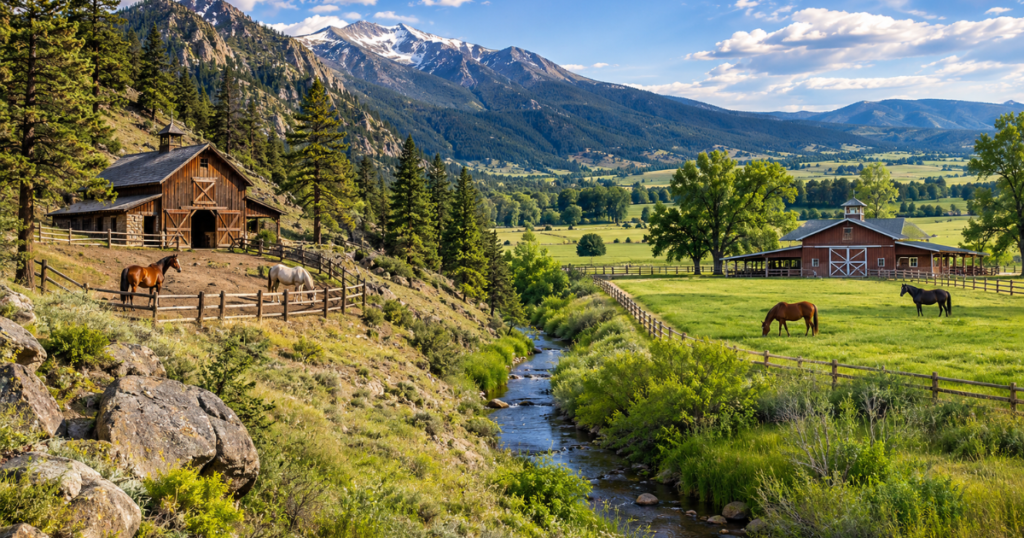
Picture two Colorado horse properties. One has a ponderosa ridge behind the barn and a national forest trailhead a short ride from the gate. The other has flat, irrigated pasture, an arena that drains after a storm, and an equine vet twenty minutes away.
Buyers fall for both. Most don’t learn what each one costs in hay, snow removal, and drive time until their first winter.
The short answer: For most buyers comparing mountain vs. valley horse property in Colorado, the valley is the more practical choice. It has longer growing seasons, more usable flat acreage, easier water and trailer access, and faster vet care. Mountain property makes more sense for trail riders with a few easy keepers who value privacy and public-land access over convenience.
Below, we compare the two settings on climate, forage, water law, riding access, hazards, and resale value, using published figures from Colorado State University Extension, the Colorado Division of Water Resources, and the Colorado State Forest Service.
Colorado Horse Property: Mountain vs. Valley - Which is Better?
Quick Summary: Mountain vs. Valley at a Glance
- Valley ground grows more feed: CSU Extension puts Denver (5,280 feet) at about 155 frost-free days a year and Leadville (10,177 feet) at about 25, so most high-country owners feed hay for the bulk of the year.
- Mountain ground offers better trail riding: Parcels near national forest give direct access to public-land trails, plus privacy and summer shade. The trade is heavier snow, longer drives, and more self-reliance.
- Water law limits herd size in both settings: Most Colorado wells drilled on or after May 8, 1972 on parcels under 35 acres are permitted for household use only, which rules out watering livestock.
- Your riding should decide it: Arena riders, breeders, and boarding operations usually do better in the valley. Trail riders and owners of two to four easy keepers often do well in the mountains.
Mountain vs. Valley Horse Property: Side-by-Side Comparison
The valley is cheaper and easier to run day to day. The mountains offer better trail access, privacy, and cooler summers.
| Factor | Mountain Horse Property | Valley Horse Property |
|---|---|---|
| Typical elevation | Usually above 7,500 feet | Roughly 4,500 to 6,500 feet |
| Growing season | Often under 90 frost-free days | About 150 frost-free days near Denver |
| Usable acreage | Limited by slope, rock, and timber | Mostly flat and easy to fence |
| Hay needs | Hay for most of the year | Irrigated pasture can carry horses through the growing season |
| Water | Wells in fractured rock; household-use-only permits common on small lots | More likely to include ditch shares or decreed irrigation rights |
| Trail riding | Excellent near national forest | Mostly trailer-out |
| Arena and show access | Expensive to grade and build; long hauls | Easier to build; close to major venues |
| Vet and farrier response | Slower, often with trip fees | Faster, with more providers |
| Winter workload | Heavy snow, ice, and plowing | Lighter, shorter storms |
| Wildfire exposure | Often high in forested areas | Lower, though grass fires move fast |
| Best for | Trail riders, packers, retirees with a few easy keepers | Show riders, breeders, boarding barns, larger herds |
1. What Counts as Mountain vs. Valley Horse Property in Colorado?
In Colorado, mountain horse property usually means land above about 7,500 feet in the foothills and high country. Valley property means the flatter river valleys and plains, mostly below about 6,500 feet. High mountain valleys such as the Wet Mountain Valley sit in between and mix traits of both.
Mountain Horse Property
CSU Extension uses 7,500 feet as its working line for "high elevation" in Colorado. Horse properties above that line are common in Park, Teller, Custer, Clear Creek, Gilpin, Grand, and Gunnison counties, and along the western edges of Jefferson, Boulder, and Larimer counties.
These parcels tend to have slopes, timber, rock outcrops, and seasonal creeks. On many of them, only a small share of the acreage is flat enough for paddocks or an arena.
Valley and Plains Horse Property
Valley properties include the river valleys and high plains of Weld, Elbert, Douglas, Arapahoe, and Adams counties, plus eastern Larimer and Boulder counties. On the Western Slope, they include the farm valleys around Grand Junction, Delta, Montrose, and the North Fork of the Gunnison.
The ground is flatter and more open, so fencing, irrigating, and building cost less per usable acre.
The Hybrid: High Mountain Valleys
The Wet Mountain Valley around Westcliffe, the Upper Arkansas Valley near Salida and Buena Vista, the San Luis Valley, and South Park all have flat meadow ground with public land nearby. They still have mountain winters. CSU Extension lists Alamosa, at 7,536 feet, at about 95 frost-free days a year.
2. How Does Elevation Affect Horses and Daily Care?
Elevation mostly changes how long winter lasts and how much work it takes. Healthy horses adapt to Colorado altitudes, but mountain owners spend more time breaking ice, plowing, and feeding hay than owners on the plains.
Winter Length
Front Range properties between 5,000 and 6,000 feet get cold snaps and big storms, but sun and chinook winds often melt the snow within days. Above 8,000 feet, snowpack can last for months.
That means more plowing, more frozen water lines, and more days of horses standing on packed ice. Barns and loafing sheds in the high country also have to be engineered for heavier snow loads, which raises construction costs.
Altitude Adaptation
Most healthy horses do fine at Colorado elevations, especially horses raised here. A horse moved from near sea level may need a few weeks before hard work at altitude.
Ask your veterinarian before moving an older horse, a hard keeper, or a horse with a respiratory condition to a high-elevation property. Thin air, strong UV, and very dry winter air all add stress.
Summer Comfort
The mountains do better in July and August. Cooler days, fewer biting insects, and shade from timber make high-country summers easier on horses. On the eastern plains and the Western Slope, summers run hot and buggy, so budget for shade structures, fly control, and dependable water.
3. How Much Pasture and Hay Will You Need?
A valley property with irrigation can feed your horses from the land for several months a year. Most mountain properties can't, so plan to buy hay for the majority of the year if you buy in the high country.
Growing Season
CSU Extension reports that Leadville, at 10,177 feet, averages about 25 frost-free days, compared with more than 150 in many plains areas. An earlier CSU elevation table lists Denver at about 155 days and Bailey, at 7,733 feet, at about 82.
Mountain meadows can look lush in June, but they green up late and go dormant early.
Carrying Capacity
According to CSU Extension, dryland pasture in most Colorado counties produces 300 to 2,000 pounds of usable dry matter per acre a year, while irrigated pasture produces 2,000 to 6,000 pounds. In one published answer to a Douglas County owner, an Extension expert suggested about one horse per 25 acres of dryland pasture to keep the grass healthy.
That gap is why ten irrigated valley acres can carry more horses than forty steep, timbered mountain acres, where much of the ground can't be grazed at all.
Hay Hauling and Storage
CSU Extension notes that horses on pasture typically need 3 to 4 percent of their body weight in forage a day, more than cattle, because they waste and trample more. Mountain owners buy more of that feed as hay and usually pay more to get it delivered, since big trucks struggle on steep, narrow, or snow-packed roads.
You'll also need covered storage big enough for a full winter's supply, because deliveries get unreliable once the snow arrives.
Toxic Plants
Mountain pastures often hold native plants that are dangerous to horses, including locoweed, larkspur, water hemlock, and chokecherry. Walk unfamiliar high-country pasture with your county CSU Extension office or a knowledgeable neighbor before you turn horses out.
4. Which Setting Has Better Water for Horses?
Valley properties are more likely to come with irrigation water and livestock-approved wells. In either setting, the well permit and any water rights on file decide how many horses you can legally keep, so verify them before you fall for the view.
Well Permits and the 35-Acre Rule
CSU Extension's guide to Colorado well permits explains that most private wells drilled on or after May 8, 1972 on parcels under 35 acres are permitted for household use only. That water can be used only inside the home, not for lawns, gardens, or livestock.
On parcels of 35 acres or more, owners can usually get a domestic and livestock well. These exempt wells are limited to 15 gallons per minute. Older permits, and some areas whose streams are not over-appropriated, can differ, so always read the actual permit.
Mountain Wells
Many mountain homes draw from wells drilled into fractured granite, and yields can be low and unpredictable. A well that keeps up with a household may not keep up with a barn full of horses in August.
Creeks and Springs
A creek through a mountain property does not give you the right to divert its water. Under Colorado's prior appropriation system, surface water use depends on decreed rights, which are separate from land ownership.
Valley Irrigation and Ditch Shares
Valley parcels more often include ditch company shares or decreed surface rights, which can turn dry ground into productive pasture. They come with obligations: ditch schedules, headgate operation, annual assessments, and in some basins an augmentation plan for well use.
What to Verify Before You Buy
- Pull the well permit from the Colorado Division of Water Resources and confirm it allows livestock watering.
- Order a well flow test and a water quality test during your inspection period.
- Confirm in the contract that any ditch shares or decreed water rights convey with the property and are in good standing.
- Ask the ditch company about assessments and delivery schedules before closing.
5. Which Is Better for Trail Riding or Arena Work?
Mountain property is better for trail riding, especially near national forest. Valley property is better for arena work, showing, and breeding, because flat ground is cheaper to build on and the major show venues are close by.
Trail Riding in the Mountains
Riding straight out your gate into the Pike, San Isabel, Roosevelt, or Gunnison National Forest is the main reason many buyers choose the mountains. Climbing and descending varied terrain also builds strong, sure-footed horses.
Rules on public land vary. Some areas restrict stock use, require certified weed-free hay, or limit group size, so confirm that the access you're paying for is legal and practical before you buy.
Arena Work and Competition in the Valley
For dressage, jumping, reining, cutting, barrel racing, or roping, the valley usually wins. Building a regulation-size arena on flat ground costs far less than cutting and grading a mountain slope. Our guide on searching for horse property by arena footing type covers what to look for once you're there.
Valley locations also keep you closer to the Colorado Horse Park in Parker, The Ranch Events Complex in Loveland, and the National Western Complex in Denver. Shorter hauls save wear on your horses and your truck.
Matching Terrain to the Rider
- Trail riders and packers: mountain or high mountain valley property near public land.
- Arena and show riders: valley or plains property with a flat building site and easy highway access.
- Breeders and boarding operations: valley property with irrigated pasture, several paddocks, and easy client access.
- Retirees with a few easy keepers: either setting can work; the mountains suit owners who rank privacy above convenience.
6. How Do Access, Vet Care, and Wildfire Risk Compare?
Valley properties are easier to reach with a trailer, closer to equine vets, and usually lower in wildfire risk. Mountain properties trade those conveniences for privacy, and they call for a written evacuation plan for every horse.
Trailer Access
A long gooseneck or living-quarters trailer needs room to turn and a road it can climb safely in snow. Many mountain parcels sit on steep, winding, or privately maintained roads.
Drive the access road with your own rig if you can, and find out who plows it, who maintains it, and whether a road maintenance agreement or HOA fee applies.
Veterinary and Farrier Access
With colic, response time matters. Front Range valley properties are usually within a reasonable drive of equine practices and referral hospitals, including the Colorado State University Veterinary Teaching Hospital in Fort Collins.
Mountain owners may wait much longer for a farm call, and some farriers charge trip fees or skip remote locations. Line up high-country providers before you close.
Wildfire and Insurance
The Colorado State Forest Service estimates that about 2.5 million Coloradans live in the wildland-urban interface, and more than 1 million of them live where wildfire risk is moderate to very high. Many mountain horse properties fall in that zone, and insurance there has become harder and more expensive to buy.
Get insurance quotes during your inspection period. Plan defensible space around barns and hay storage, and work out where your horses would go and how many trailer trips an evacuation would take.
Valley ground has its own fire risk. The Marshall Fire started as a grass fire on December 30, 2021, and Boulder County's assessment found 1,084 homes destroyed. Plains properties also face hail, high wind, and flooding near rivers and creeks.
Predators and Wildlife
Mountain owners share the land with mountain lions, black bears, and elk that damage fences and eat forage. Strong fencing, secure feed storage, and lighting around the barn matter more in the high country.
7. Which Holds Value Better?
Valley horse property usually resells faster because more kinds of buyers want it, and land near Front Range growth corridors can gain value from development pressure. Mountain horse property can command strong prices when it has flat meadow, good water, and year-round access, but its buyer pool is smaller and more sensitive to the economy.
Mountain Value: Scarcity and Lifestyle Demand
Mountain horse properties attract lifestyle buyers, remote workers, and second-home owners who pay for views and privacy. Truly usable mountain horse land is rare, and that scarcity supports price.
The same narrow appeal works against you in a slow market. When interest rates rise or the economy cools, discretionary mountain purchases tend to slow first, and listings can sit.
Valley Value: Function and Growth Pressure
Valley and plains horse properties appeal to working equestrians, small-scale agricultural buyers, and families who want acreage within reach of the city.
Parcels along growth corridors in Douglas, Elbert, Weld, and Larimer counties can also gain from suburban encroachment, when expanding development turns pasture into higher-value land. We cover this in Do Horse Properties Appreciate Like Regular Homes? For the operating side, see How to Calculate ROI on a Working Ranch.
What Protects Value in Both Settings
Legal, adequate water supports value more than almost any improvement. Barns and arenas built with county permits can be counted by appraisers, while unpermitted structures often can't. Standard stall sizes and multipurpose arenas appeal to more buyers than highly specialized setups, and maintained year-round road access widens your future buyer pool, especially in the mountains.
8. So, Which Is Better for You?
Choose the setting that fits how you ride and how many horses you keep. If you're unsure, the valley is the lower-risk choice: it costs less to run, resells to more buyers, and puts help closer when a horse gets hurt.
Choose the Mountains If...
You ride mostly on trails, keep two to four easy keepers, and are comfortable handling long winters on your own. Privacy and public-land access matter more to you than a short drive to the vet or feed store.
Choose the Valley If...
You train or compete, keep more than a few horses, want your land to grow feed, run or plan to run an equine business, or need fast access to veterinary care.
Consider a High Mountain Valley If...
You want flat, workable ground and mountain scenery, can handle a high-elevation winter, and want public-land riding a short trailer ride away.
We Know Colorado Horse Country, Peak to Plains
Comparing a mountain and a valley horse property means checking things a standard home search skips: well permits, usable acreage, road access, insurability, and how each parcel fits your riding and herd size.
When Mark Eibner's team represents you, we pull the well permit and water rights records, walk the usable ground and outbuildings, check access and insurance, and match each property to how you ride.
Whether you want a trailhead past your back gate or a fenced arena property close to town, we'll help you find land that works for your horses and holds its value.
Contact us today at coloradohorseproperty.com to find premium horse properties Colorado buyers trust.
Browse active Colorado horse ranches for sale or search by location with our Search by County and Search by City tools.
About the Author
Mark Eibner is broker/owner of Realty Oasis and leads Team Eibner with MB Metro Brokers. His team represents buyers and sellers of horse and acreage property across the Denver metro and Colorado Front Range.
Frequently Asked Questions (FAQ) About Mountain vs. Valley Horse Property
Can horses live year-round at high elevation in Colorado?
Yes. Many horses live comfortably year-round at 8,000 feet and above with good shelter, reliable unfrozen water, and plenty of quality hay. Horses coming from low elevations may need time to acclimate, and older horses or those with respiratory issues should be evaluated by a veterinarian before the move.
How many acres do I need for a horse in the mountains versus the valley?
It depends far more on usable ground and water than on total acreage. A small irrigated valley parcel can support more horses than a much larger steep, timbered mountain parcel. Also check county zoning, which often sets animal-density limits based on lot size.
Is it more expensive to keep horses on a mountain property?
Usually, yes. Mountain owners typically buy more hay, pay higher delivery fees, spend more on snow removal and winter water systems, and may pay more for insurance. Construction costs for barns and arenas are also higher because of slope, access, and snow-load requirements.
Can I build an arena on a mountain property?
Often, but it can be costly. Steep sites may require significant excavation, retaining walls, and drainage work to create a level, safe riding surface. Before buying, have a contractor evaluate the building site and confirm county permit requirements.
Does a creek on the property mean my horses have water rights?
Not necessarily. Colorado water law separates water rights from land ownership, so a stream crossing your property does not automatically give you the right to use or divert it. Verify any decreed rights or permits in writing before you rely on surface water for livestock.