
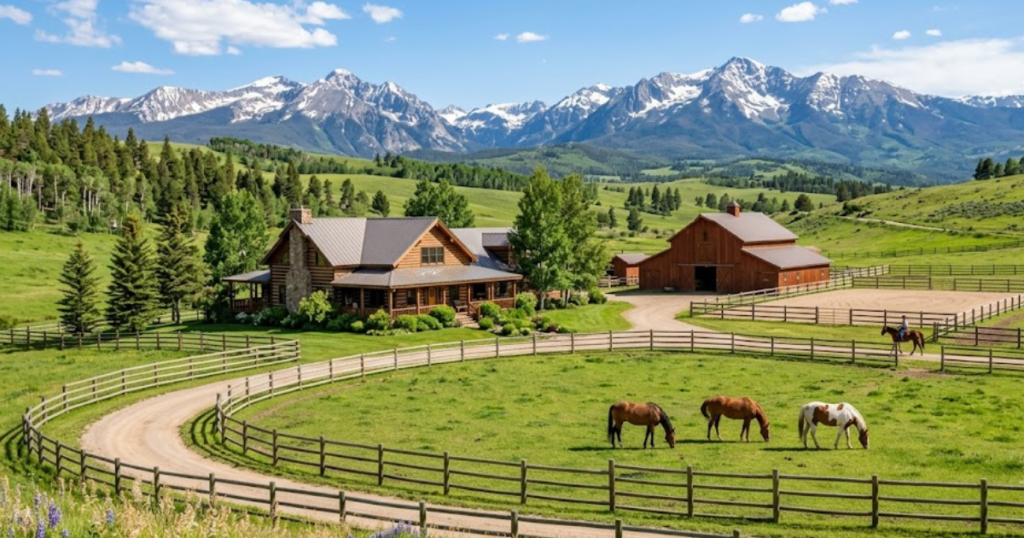
You find a breathtaking 10-acre property nestled in the foothills. The house is completely remodeled, there is a picturesque red barn, and the rolling terrain looks like a postcard. You buy the property and move your three horses in, thrilled with your new equestrian lifestyle.
Within the first month, reality hits. First, you discover that 7 of your 10 acres are situated on a steep, rocky incline, leaving your three horses confined to a tiny, muddy 1-acre patch of flat dirt. Second, you receive a violation letter from the local Homeowners Association informing you that their covenants only allow one horse per 5 acres, meaning you are legally required to re-home two of your animals. Finally, when your first load of winter hay arrives, the semi-truck gets stuck in your narrow, winding driveway, forcing you to unload 100 bales by hand in the snow.
When buyers search for horse properties colorado, they often lead with their emotions, focusing on the views, the house, or the aesthetic of the fencing. But a horse property is a specialized agricultural facility.
Here is the ultimate blueprint of what you must look for to ensure a property is legally sound, structurally safe, and logistically functional.
What to Look For in a Colorado Horse Property
Quick Summary: The Equestrian Blueprint
- Zoning Over Aesthetics: A beautiful barn is entirely worthless if the local HOA or county zoning legally prohibits livestock. You must verify Animal Unit allowances before you even look at the house.
- Usable vs. Total Acreage: Ten acres on a map does not mean ten acres of pasture. You must subtract steep cliffs, deep ravines, dense timber, and floodplains to calculate the actual land your horses can safely use.
- The Water Lifeline: Colorado water law is incredibly strict. You must verify that the property's well permit legally allows for livestock watering and that the physical hydrants are frost-free for sub-zero winters.
- The Tractor Turning Radius: A farm requires heavy machinery and massive deliveries. If a 60-foot hay semi or a dually truck pulling a 4-horse gooseneck trailer cannot easily turn around in the driveway, the property will be an operational nightmare.
Evaluate the property as an agricultural operation first. The house, views, and decorative finishes should come after legal horse use, water, usable land, drainage, and farm access have been confirmed.
1. The Legal Foundation: Zoning and HOAs
Never trust a real estate listing that cheerfully says “Bring your horses!” without verifying the legal reality yourself.
- County Animal Units (AUs): Every county dictates how many animals you can have based on acreage. Usually, it is a sliding scale, such as 2.5 acres for the first horse and 1 additional acre for every horse thereafter. You must calculate your current herd and your future growth against these strict county limits.
- The HOA Override: If the property is in a subdivision, the Homeowners Association covenants are the ultimate law. Even if the county allows five horses, an HOA can legally ban them completely, dictate what color your barn must be, or prohibit you from parking your horse trailer in your own driveway.
- Commercial Restrictions: If you plan to board other people's horses, give riding lessons, or breed commercially, you need specific commercial agricultural zoning. A standard residential zoning permit will not cover a business operation and can lead to immediate shutdown by the county.
Obtain the parcel's zoning designation, animal-unit rules, subdivision documents, HOA covenants, architectural guidelines, and any restrictions governing barns, arenas, trailers, manure storage, lessons, boarding, breeding, or other commercial activity.
2. Evaluating “Usable” Acreage
Horses are flight animals with fragile legs. They need safe, flat, and clear ground.
- The Topography Trap: Look past the property lines and examine the terrain. Heavy timber, rocky outcroppings, steep drop-offs, and boggy wetlands are unusable acres. A 35-acre property with only 2 flat acres is functionally worse than a perfectly flat 5-acre property.
- Future Expansion: Is there a flat, well-draining location to build an outdoor riding arena in the future? Excavating and leveling the side of a mountain to build an arena can cost tens of thousands of dollars in earth-moving alone.
- The Perimeter Safety: Walk the fence lines. Are you bordering a busy 55-mph highway or quiet public open space? Are there deep washouts under the fences where a horse could trap a hoof or a predator could easily slip through?
Subtract the house site, driveway, septic field, steep slopes, wetlands, waterways, floodplains, dense timber, easements, roads, rock outcroppings, and other areas that cannot safely function as turnout or grazing land.
3. The Water and Winter Infrastructure
In Colorado, surviving the winter and managing water rights dictate your daily quality of life.
- The Well Permit Check: A Household Use Only well permit means you cannot legally run a hose to a horse trough. You must explicitly verify that the property has a Domestic and Livestock well permit.
- Frost-Free Hydrants: Carrying 50-pound buckets of sloshing water through knee-deep snow in January will break your spirit. Every pasture, paddock, and barn aisle must have a professionally installed, deeply buried frost-free water hydrant.
- Southern Exposure: Look at how the barn and the primary paddocks are situated. Shelters and barn doors should open to the South or East to catch the warming winter sun and block the brutal prevailing winter winds sweeping in from the North and West.
Review the well permit, well log, pumping rate, recovery rate, static water level, pump depth, water quality, pressure tank, buried water lines, hydrants, automatic waterers, and backup power plan.
4. The Flow of the Farm: Logistics
A beautiful property is useless if it takes you three hours just to feed and muck out.
- The Heavy-Haul Driveway: You will have massive trucks delivering hay, gravel, and propane, plus your own truck and trailer. The driveway must have a wide, heavy-duty compacted gravel base with a massive circular turnaround at the barn. If you have to blind-back a gooseneck trailer down a quarter-mile curved driveway, you will hate leaving the farm.
- The Mud Management: Where does the water go when the snow melts? If the barn is situated at the bottom of a hill, spring runoff will turn your paddocks and barn aisles into a knee-deep, stagnant mud pit, causing severe hoof rot and thrush in your horses.
- Tractor Access: You cannot maintain a farm with a wheelbarrow. Can you easily drive a tractor into every single pasture and stall to drag the dirt, dump fresh sand, and remove massive manure piles?
Walk the path from hay storage to stalls, from manure collection to the compost area, from the trailer pad to the barn, and from every turnout to its water source. Small inefficiencies become major daily burdens.
We Evaluate the Entire Ecosystem Before You Buy
We do not just show you houses; we inspect agricultural operations.
When Mark Eibner and Belinda Seville represent you in buying a rural estate, we look at the property through the eyes of seasoned equestrians. We pull the well permits, read the fine print of the HOA covenants, measure the turning radius of the driveway, and evaluate the drainage of the paddocks. We ensure you are buying a sustainable, functional farm that makes horse ownership a joy, not a daily struggle.
Contact Us Today to find premium horse properties colorado buyers trust for exceptional zoning, smart logistics, and beautiful layouts.
Browse Active Colorado Horse Properties: Browse active colorado horse ranches for sale or ask our team about finding a functional horse property for rent colorado while you search for your perfect ride-out estate
Frequently Asked Questions (FAQ) About Buying Horse Property
Can I just build a barn and fences if I buy a cheaper piece of vacant raw land?
Yes, but it is rarely cheaper. Buying raw dirt means you have to pay for installing the power lines, drilling a deep water well, installing a septic system, excavating the driveway, and building the barn and fences from scratch. Buying an existing, functional horse property is almost always more cost-effective than developing raw land.
Does a good horse property have to have a massive barn?
No. Many Colorado horses actually thrive living outside year-round with access to large, deep three-sided run-in sheds that block the wind and snow. While a barn is wonderful for human comfort, tack storage, and medical emergencies, high-quality outdoor shelters and safe fencing are far more critical to the horse's daily health.
What is the best type of fencing to look for on a horse property?
The gold standard is woven wire, V-mesh or no-climb, with a sturdy top rail, or continuous steel pipe fencing. You should actively avoid any property where the primary horse containment is barbed wire or high-tensile smooth wire, as these cause horrific, career-ending injuries if a horse becomes tangled in them.