
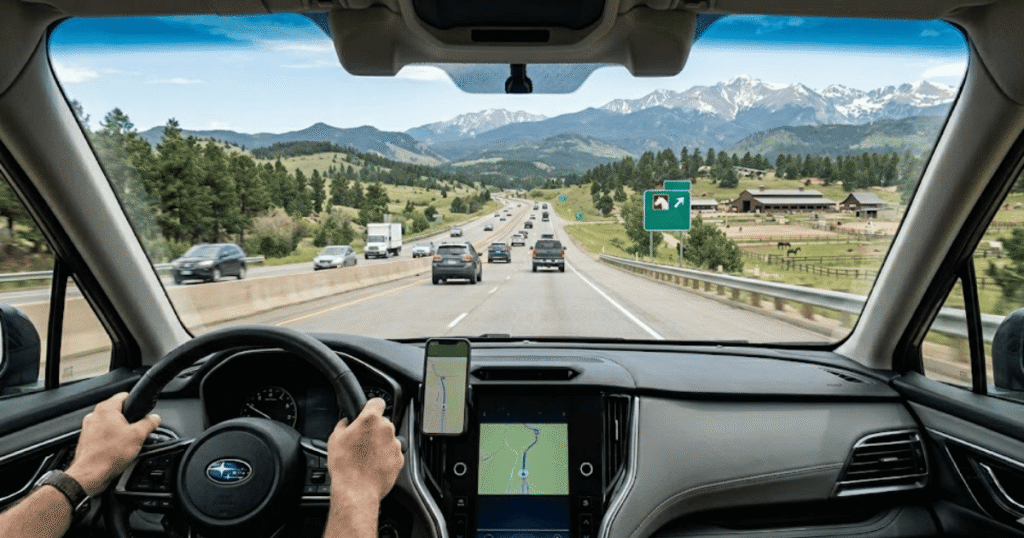
You find a massive, beautiful equestrian property in the rolling plains of Elbert County. The price is incredible, and the listing agent assures you that it is a “quick drive” to the Colorado Horse Park. You buy the farm, load up your horses for the first day of the summer show series, and pull out of your driveway at 6:00 AM.
An hour and fifteen minutes later, after navigating two-lane country roads behind a slow-moving tractor and sitting in bumper-to-bumper traffic on Highway 83, you finally pull through the gates of the horse park. Your horses have been standing in a hot trailer for over an hour, you missed your warm-up time, and you are already exhausted before the competition even begins.
If you are an active competitor—whether in hunter/jumpers, dressage, or eventing—your drive time to the Colorado Horse Park is one of the most critical logistical factors of your real estate purchase.
Here is how to calculate the true hauling distance and evaluate the surrounding equestrian corridors before you buy.
What is the "Drive Time" to the Colorado Horse Park?
Quick Summary: The Commuter's Reality
- The Show Ring Hub: Located just south of Parker, the Colorado Horse Park is the premier equestrian competition venue in the Rocky Mountain region. Your proximity to it heavily dictates the value of your property and your quality of life during show season.
- The 20-Mile Radius: Serious competitors typically draw a hard 20-mile circle around the park. Anything outside of that radius requires exhausting, pre-dawn wake-up calls to haul horses in for early morning classes.
- The Parker Road Bottleneck: You cannot rely on standard Google Maps times. The main artery to the park, Highway 83 and Parker Road, is a notorious traffic bottleneck during morning rush hour and summer construction.
- The Trailer Haul Variable: Pulling a 4-horse gooseneck trailer takes significantly longer than driving a standard SUV. You must factor in slower acceleration, wider turns, and cautious braking when calculating your true barn-to-ring drive time.
For active competitors, drive time is not a minor convenience. It affects horse stress, class timing, fuel cost, early wake-ups, and how sustainable your show routine will be over time.
1. The Parker-Franktown Advantage
If your primary goal is minimizing your show commute, you need to look at the immediate surrounding communities.
- Parker: The horse park technically holds a Parker address. Properties in southern Parker and the Pinery area offer the ultimate luxury: a commute under 15 minutes. However, because you are competing with suburban development for land, equestrian acreage here is scarce and comes with a massive premium price tag.
- Franktown: Located just a few miles south of the park, Franktown is the golden ticket for serious competitors. It offers larger 5-to-10-acre parcels with a true rural feel, yet you can often reach the showgrounds in 10 to 20 minutes without ever having to touch a major interstate.
2. The Elbert County Compromise
Many buyers looking for larger, 35-acre working farms look east to Elbert County, but you must measure the drive time carefully.
- Elizabeth: Elizabeth offers sprawling acreage and a fantastic equestrian community. In a standard passenger car, the drive to the park is about 20 to 25 minutes. However, pulling a heavy trailer along Highway 86 and turning north onto Parker Road can easily push your drive time to 35 or 40 minutes during morning traffic.
- Kiowa: Further east lies Kiowa. The land is cheaper and more expansive, but you are now looking at a 45-to-60-minute haul to the park. If you are showing multiple horses over a five-day series, that daily round-trip commute will become grueling.
Larger acreage and lower price often come at the cost of show-day convenience. For competitors, that commute tradeoff can affect the property’s long-term fit as much as the barn itself.
3. The Highway 83 (Parker Road) Bottleneck
You must evaluate the route, not just the mileage.
- The Commuter Artery: State Highway 83, Parker Road, is the primary north-south artery connecting Denver, Parker, and Castle Rock to the horse park. During the morning commute, when you are usually hauling in for classes, this two-lane highway frequently backs up with standard commuter traffic.
- The Construction Delay: Summer is peak show season, but it is also peak road construction season in Colorado. You must build a 20-minute buffer into your schedule just to account for sudden lane closures and heavy equipment near the park entrances.
4. The "Trailer Time" Multiplier
When an appraiser or a real estate agent tells you the drive time, they are usually quoting a passenger car going the speed limit.
- The Acceleration Deficit: A heavily loaded commercial semi-truck or a one-ton pickup pulling a four-horse gooseneck trailer cannot safely accelerate or brake like a small SUV.
- The Real-World Math: As a general rule of thumb, whatever a standard GPS app tells you the drive time is, you must add 20% to 30% when hauling a loaded horse trailer. If the GPS says 30 minutes, plan for 40 minutes.
We Calculate the Commute Before You Buy
We do not just look at the acreage; we calculate the logistics of your show schedule.
When Mark Eibner and Belinda Seville help you purchase an equestrian property, we bring practical hauling experience to the table. We evaluate the specific county roads you will be driving, map the turnarounds, and give you realistic, trailer-adjusted drive times to the Colorado Horse Park so you can focus on your competition, not your commute.
Contact Us Today to find a property perfectly situated for your competitive equestrian lifestyle.
Browse Active Colorado Horse Properties: Browse Active Colorado Horse Properties within an easy hauling distance of the showgrounds
Frequently Asked Questions (FAQ) About Horse Park Commutes
Can I just rent an RV space at the Colorado Horse Park instead of commuting daily?
Yes, the park offers extensive RV hookup sites on a first-come, first-served basis, and reservations are highly recommended. Many competitors who live more than an hour away choose to park a living-quarters trailer or an RV on the grounds for the duration of the show series to eliminate the daily haul entirely.
Are the roads leading to the park safe for massive commercial semi-truck horse vans?
Yes. The primary access roads, Parker Road or Highway 83 and Bayou Gulch Road, are engineered to support heavy commercial freight and large 18-wheeler transport vans. However, navigating the tight turns of the secondary neighborhood roads surrounding the park requires extreme caution.
If I live far away, can I board my horse closer to the park during the summer?
Yes, but it is highly competitive. Many premium boarding facilities in Parker and Franktown have massive waiting lists that fill up months before the summer show series begins. You will also pay top dollar for a dry stall simply due to the proximity of the venue.