
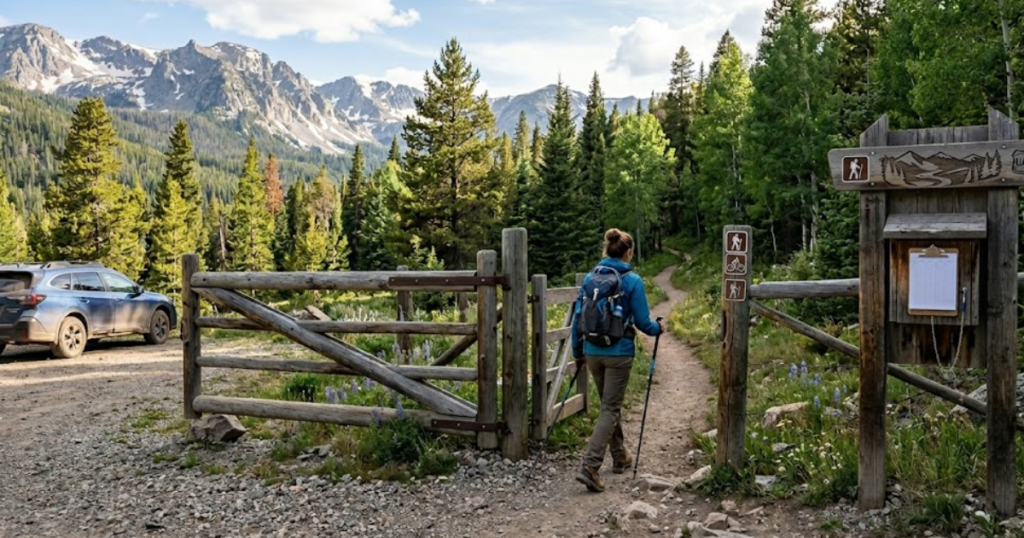
You buy a sprawling 10-acre property on the edge of the foothills. You check the county maps and see that your neighborhood is just two miles down the road from thousands of acres of public open space. On your first Saturday, you load the horses into the trailer and drive the five minutes to the trailhead.
When you arrive, the parking lot is completely packed with small commuter cars belonging to hikers. There is nowhere for a 50-foot rig to turn around, let alone park. You are forced to awkwardly back your loaded trailer out onto the busy county road and drive all the way back home.
Proximity to a trail does not automatically equal access. When buying a horse property, how close you are to public land is only half the equation; how you actually access that land is what dictates your weekend quality of life.
Here is how to evaluate true public land access and trailhead logistics before you buy the farm.
What Are the "Public Land" Trailheads Closest to the Gate?
Quick Summary: The Access Reality
- The Drive-Out Dream: Finding a property where you can saddle up and ride directly out your back gate onto pristine public trails is the ultimate equestrian goal, but these properties command a massive premium and are incredibly rare.
- The "Short Haul" Standard: For most rural buyers, a good property is one located within a 15-to-20-minute trailer haul of a dedicated equestrian trailhead with oversized parking.
- The Conflict of Multi-Use: Not all public lands are horse-friendly. You must evaluate if a nearby trailhead is dominated by high-speed mountain bikers or off-leash dogs, which can make weekend riding incredibly dangerous.
- The Trailer Parking Test: Having a beautiful county open space two miles from your farm is entirely useless if the parking lot cannot physically accommodate a truck pulling a four-horse gooseneck trailer.
Public land value is not just about distance on a map. True access depends on hauling time, trailer parking, route safety, and the way the trail system is actually used on weekends.
1. Direct Gate Access vs. The "Short Haul"
The real estate market puts a heavy price tag on convenience.
- The Boundary Premium: Properties that share a direct, fenceline boundary with federal land like the Pike National Forest are the unicorns of the market. Because they offer the ability to ride out without ever starting your truck, these properties often command a 20% to 30% price premium over identical acreage located just one mile away.
- The HOA Trail Network: A common compromise is buying into a master-planned equestrian community that features private, maintained neighborhood bridle paths. These paths weave behind the houses and often connect directly to a regional county trailhead, allowing you to ride from your barn to the public land without stepping foot on asphalt.
- The 15-Minute Haul: If direct access is out of budget, the short haul is the gold standard. Being located within a 15-to-20-minute drive of a massive equestrian-friendly open space allows you to easily squeeze in an afternoon trail ride after work without turning it into an exhausting, all-day logistical mission.
2. Evaluating the Trailer Parking Test
A trailhead is only viable if you can legally and safely park your rig.
- The Designated Equestrian Lot: Premium county open spaces are engineered with separate, dedicated equestrian parking lots. These lots feature massive, pull-through pull-out lanes, so you never have to back the trailer up, and are usually separated from the main hiker lots by heavy wooden fencing.
- The Overflow Reality: If a trailhead only has parallel dirt parking along a narrow county road, you must assume it will be unusable on weekends. Hikers will unknowingly block you in, and unloading horses on the shoulder of a road with speeding traffic is a recipe for disaster.
- The Turnaround Radius: Before assuming a nearby trailhead is your new weekend hub, you must scout it without the horses first. Drive your truck and trailer through the lot to verify you can actually make the tight turnaround corners without dropping your trailer tires into a drainage ditch.
A trailhead can be close, scenic, and still unusable if your rig cannot enter, turn, unload, or exit safely during peak hours.
3. The "Multi-Use" Conflict
Just because horses are allowed does not mean the trail is enjoyable.
- The Speed Discrepancy: Mountain bikers and equestrians do not mix well on blind corners. While bikers are legally required to yield to horses, many do not. If a trailhead is heavily advertised as a premium mountain biking destination, you will likely spend your entire ride tense, dealing with spooked horses.
- The Directional Trails: The best public lands mitigate this conflict by creating dedicated, directional trails. For example, some trail networks require bikers to travel clockwise and equestrians to travel counter-clockwise, ensuring you can see approaching traffic from a distance rather than having someone suddenly speed up behind your horse's tail.
- The Equestrian-Only Exception: True equestrian-only or hike-and-horse-only public lands are rare but incredibly valuable. If a property is located near one of these restricted-use gems, it drastically increases the lifestyle value of the farm.
4. Prime Examples of Colorado Equestrian Access
When exploring the market, buyers often target specific, well-engineered public lands in Douglas and Elbert counties.
- The Wooded Escape: The Dawson Butte Ranch Open Space Trail south of Castle Rock is a prime example of premium access. It features a massive, dedicated pull-through trailer parking lot and a heavily wooded 5-mile loop where mountain bikers are rare and the trail footing is exceptional.
- The Wide-Open Vistas: Further south, the Spruce Mountain Open Space Trail in Larkspur offers a fantastic mix of sprawling meadows and rocky climbs, complete with specialized trailer parking and designated horse trails that separate riders from heavy pedestrian traffic.
We Map the Access Before You Buy
We do not just look at the property lines; we map your weekend escape routes.
When Mark Eibner and Belinda Seville represent you in buying a rural estate, we analyze the surrounding public infrastructure. We map out the closest equestrian trailheads, evaluate the trailer parking logistics, and ensure the local trail culture aligns with a safe, relaxing ride.
Contact Us Today to find premium horse properties Colorado buyers trust for incredible public land access.
Browse Active Colorado Horse Properties: Browse active Colorado horse ranches for sale or ask our team about finding a horse property for rent Colorado while you plan your permanent move to the perfect trail-adjacent location
Frequently Asked Questions (FAQ) About Trail Access
Do I have to pay to park at these county open space trailheads?
Most county-owned open spaces in Colorado, like those in Douglas or Elbert County, are completely free to access and park. However, Colorado State Parks, like Castlewood Canyon or Chatfield, require a daily vehicle pass or a yearly State Parks pass, and they frequently charge an additional premium if you are pulling a horse trailer.
Are dogs allowed on equestrian trails?
Generally, yes. Most multi-use public lands allow dogs, but county laws strictly require them to be leashed at all times. Unfortunately, off-leash dogs are the most common hazard equestrians face on public trails, making visibility and wide trails critical for safety.
Can I camp overnight with my horses at these trailheads?
No. Standard county and city open space trailheads strictly prohibit overnight parking and camping. If you want to camp with your horses, you must haul to designated equestrian campgrounds located within the National Forest or specific State Parks that offer corrals and overnight permitting.