
A mare motel can create an additional income opportunity on a Colorado horse property, but its business potential depends on more than the number of stalls. When evaluating a property with a mare motel for sale in Colorado, consider zoning and permitted uses, water and septic capacity, horse facilities, grazeable acreage, and documented lodging performance.
It’s easy to focus on the existing setup and picture guests arriving with their horses. Start by understanding what the land and improvements can legally support, how they function day to day, and whether the income records support your plans.
This guide covers how to assess zoning and permits, evaluate barns and related facilities, consider pasture needs, and review potential motel income. Use it to weigh the property as both a horse-focused operation and a real estate investment.
Key Takeaways
- Assess zoning and permitted uses alongside well and septic capacity; existing improvements alone don’t establish what the property can support.
- Look beyond barns to the full horse setup, including safe access, usable outdoor space, and the condition and function of the facilities.
- Use the typical range of 2 to 5 acres per horse as a starting point, then consider forage availability and pasture management.
- Evaluate motel income using at least three years of monthly results, and weigh the property’s location against your intended guests and operating plans.
Well permits, septic systems, zoning, and historic designation
For a mare motel, begin with three connected records: the well permit, septic documentation, and the property’s approved uses. Compare the water source and septic system with the existing buildings and planned guest activity. A system serving a private residence may not be suited to additional visitors, horse facilities, or lodging. Treat these records as part of the property’s operating capacity, not just a closing file.
Next, compare the proposed use with local zoning. A motel, equestrian facility, event space, and RV parking can each raise different land-use questions. Identify which activities are already established and which are future plans. The zoning designation alone does not describe every allowed use; the jurisdiction and required approvals determine what can proceed.
White Horse Property in El Paso County has CR zoning and comprises 7.52 acres. Its potential uses may include RV parking, campers, and tiny homes, subject to zoning and approvals. That example shows why buyers should distinguish a possible use from an established, approved use. For a mare motel, apply the same distinction to guest stays, horse access, and any proposed lodging expansion.
Ranch zoning also requires a property-specific review. The label does not mean every ranch activity or commercial use is permitted. Match your intended operation to the parcel’s land-use designation, existing improvements, and any approval conditions. For example, determine whether the plan involves both horse accommodation and overnight guest lodging, rather than treating them as a single use.
Review any historic designation separately. Find out whether the building or site has that status, then consider how it affects planned alterations. If you’re evaluating a motel conversion or facility upgrade, account for the designation before developing renovation plans.
Keep a concise review file with the well permit and water records, septic documents, zoning designation, documented uses, and historic status. Together, these records help you assess whether the property’s current setup fits your intended operation.
Equestrian properties and horse facilities
Assess the horse setup as a working system, not a collection of buildings. For a property with a mare motel for sale in Colorado, start with the stalls, then trace safe movement between them, turnout areas, and riding or recreation spaces. Check whether gates, fencing, and paths suit the planned horse use. Distinguish guest amenities from facilities needed for daily horse care.
Next, inspect the main improvements and how they function. Look for a sound barn structure, usable doors, secure stall partitions, and practical trailer access. Where there is an arena, review its footing and drainage. Walk the paddocks and fence lines, noting damage, terrain, and horse movement. A well-planned layout supports both animal handling and visitor circulation.
- Inventory barns, stalls, turnout areas, arenas, and storage.
- Assess fencing, gates, trailer access, and internal paths.
- Inspect drainage, footing, building condition, and horse-safe layouts.
- Match each facility to the planned guest and horse capacity.
Financing may involve residential, agricultural or ranch, or commercial lending. The appropriate route depends on the property’s configuration, intended use, income records, and lender criteria. Recommended inspections include the structure, roofs, electrical systems, drainage, fencing, and horse facilities. For lodging use, include guest areas and the systems that support them.
Colorado examples show how varied equestrian real estate can be. The Grand Valley Equestrian Estate near Grand Junction covers approximately 74 acres and includes professional-grade horse facilities. For buyers considering a property with a mare motel for sale in Colorado, compare acreage and improvements with the intended operation. Investors focused on recreation should also assess how trails, arenas, and open space fit their plans.
Use Colorado horse property listings to explore equestrian features and compare facilities with your priorities.
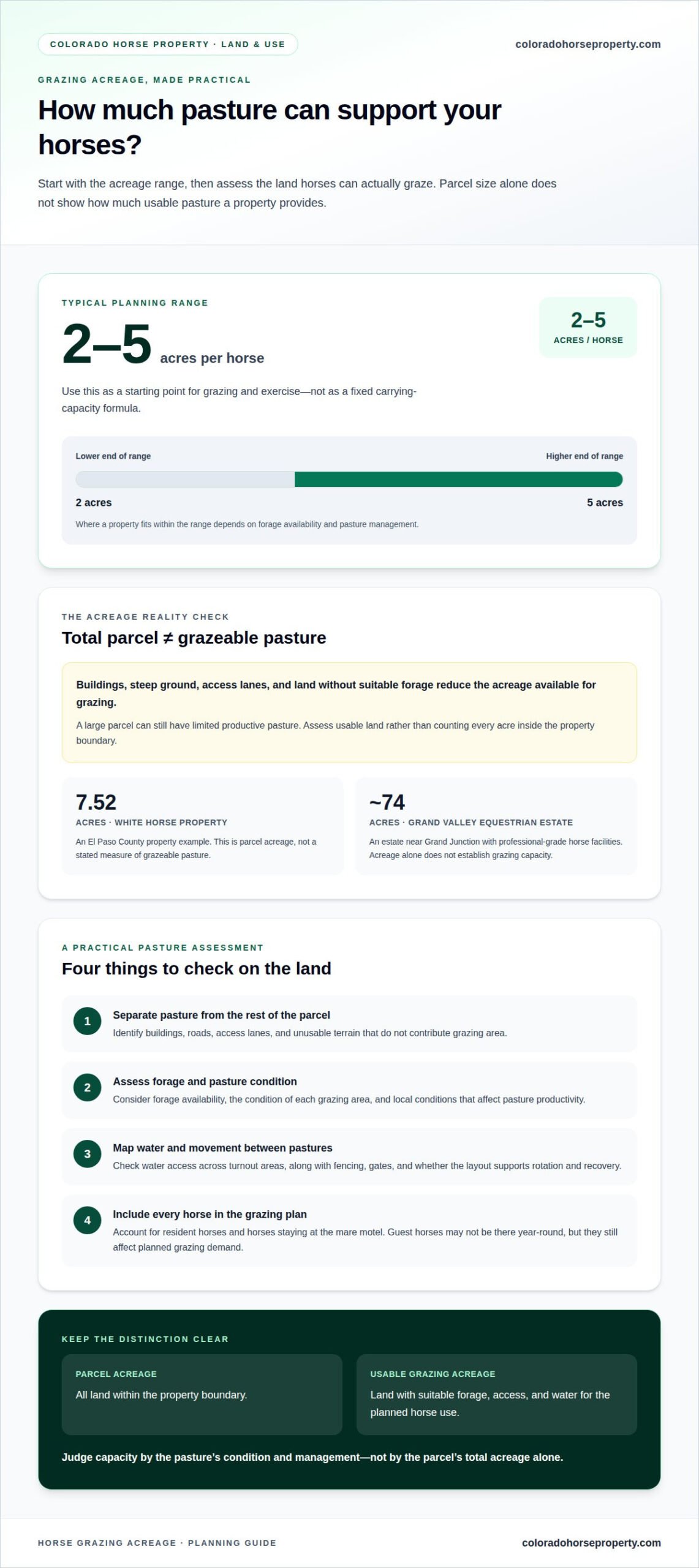
Horse grazing acreage
Use 2 to 5 acres per horse as a typical grazing and exercise range, depending on forage availability and pasture management. Treat it as a planning guide, not a fixed carrying-capacity formula. The usable acreage matters more than the parcel’s total: buildings, steep ground, access lanes, and areas without suitable forage reduce land available for grazing. A property with extensive acreage may still have limited productive pasture.
Assess the land in practical steps. First, distinguish grazeable pasture from the total parcel. Then consider forage quality, pasture condition, and whether the layout allows for rotation and recovery. Check for reliable water access across turnout areas, including whether springs or other sources serve the land. County conditions and local pasture management affect how much forage the acreage can provide.
- Separate pasture from buildings, roads, and unusable terrain.
- Assess forage availability and the condition of each grazing area.
- Map water access, fencing, gates, and movement between pastures.
- Account for resident horses as well as horses staying at the mare motel.
Guest horses change the acreage calculation. A mare motel may host horses that are not on the property year-round, while resident horses use pasture regularly. Estimate grazing demand based on the planned operation, then assess whether turnout areas and pasture management can meet it. Do not count every acre as usable grazing just because it falls within the parcel boundary.
Compare the land’s horse use with its other functions. A former restaurant or guest building can occupy acreage without adding pasture. Trails and open ground may support recreation, but they still need suitable forage and water to serve as grazing land. This distinction helps you judge whether the property has space for both lodging and horse use.
Finally, connect the acreage assessment to the operating plan. If the property is intended for a specific number of resident and visiting horses, evaluate pasture availability, water distribution, and management needs together. The 2 to 5 acres per horse range provides a starting point; forage and pasture conditions determine how well the land supports the intended use.
Where in Colorado are these properties located, and how far are they from major cities?
Colorado’s equestrian and lodging properties range from city-edge parcels to mountain communities and western ranch country. Compare each location with your priorities for guest access, horse transport, nearby services, and landscape. A town name alone does not establish travel time: the route, road conditions, and destination within a city all affect the trip.
Two examples illustrate the geographic range. White Horse Property is at 14275 S State Highway 115 in Colorado Springs, in El Paso County. The Silver Cliff motel listing is at 700 Ohio Street, ZIP code 81252. These addresses give buyers a concrete starting point for assessing access to local roads and services, rather than relying only on a broad regional label.
For a mountain-town comparison, Leadville is located at 10,119 feet and is described as the highest incorporated city in the United States. A property there presents a different setting from Colorado Springs or Silver Cliff. Consider how elevation, the approach route, and seasonal travel conditions fit guest arrivals, horse hauling, and regular operations. Don’t assume two Colorado listings offer comparable access because both are within the same state.
Use a consistent location review for each candidate:
- Record the property’s street address and county.
- Map the route to the nearest town and the cities relevant to your guests.
- Consider horse-trailer access, road type, and the property entrance.
- Compare nearby services and the setting against your operating plan.
For buyers comparing Colorado Springs-area properties with rural listings, this process clarifies the tradeoff between access and space. It also helps investors assess whether a location fits a lodging audience, a horse-focused use, or both. Explore Colorado horse properties by location to find listings that align with your preferred region and access needs.
Colorado Horse Property
Colorado Horse Property helps buyers match their priorities with suitable equestrian real estate. If you’re weighing zoning, horse facilities, grazing acreage, location, and possible motel income, its AI-Powered Horse Property Search can help you find listings with relevant features. Buyer Representation supports the purchase process, and Transaction Management helps coordinate the transaction.
Turn to Colorado Horse Property when you’re ready to move from evaluating requirements to finding or purchasing a property. Real Estate Listing Services can also support owners preparing an equestrian property for sale. Your next step depends on whether you’re buying, selling, or refining your property criteria.
Contact Colorado Horse Property to discuss your Colorado horse property goals.
Turn Your Property Search Into a Clear Plan
Define the operation you want before settling on a parcel. A property with a mare motel for sale in Colorado may serve different goals, from accommodating visiting horses to supporting a broader lodging operation. Set priorities for land, facilities, guest use, and income, then use them to decide which opportunities merit a closer look.
The next step is turning those priorities into a focused search and a purchase strategy. Colorado Horse Property offers specialized search, listing, and buyer representation services for equestrian real estate. Whether you’re beginning to explore or ready to pursue a specific property, contact Colorado Horse Property to discuss your next move.
Frequently Asked Questions
What Colorado properties with a mare motel are currently for sale?
Listings are added, updated, and sold over time. Use Colorado Horse Property’s search to view active horse-related real estate across Colorado, then identify properties whose descriptions fit your intended use. Listing details can help you assess acreage, barns, arenas, pasture, and water features. Compare each property’s stated features with your priorities before narrowing your search by location or layout.
What are the property’s barn, stall, pasture, fencing, water, and arena features?
Features vary by listing, so assess each property on its own rather than assuming every mare motel has the same setup. Review details about barns and arenas, pasture and acreage, and any stated fencing or water features. Then compare them with your operating plan: an arena may suit regular riding, while pasture and water access are important for turnout.
What water rights, well permits, septic requirements, and wildfire risks should buyers check?
Review water-right documentation and the well permit in light of the intended use, then compare septic records with the planned lodging and horse activity. Keep parcel-specific documents together so you can assess the water source, permitted uses, and system details as a whole. To evaluate wildfire exposure, consider surrounding vegetation, access routes, and how the property’s layout affects plans for buildings and animal areas.
What is the asking price and acreage of each property?
What does a mare motel include, and how many horses can it accommodate?
A mare motel includes horse stalls and related facilities such as turnout areas, fencing, gates, and safe access. Match its capacity to the available facilities and usable pasture.
Are there Colorado listings for equestrian properties with horse boarding or caretaker income?
Alpen Way Chalet Mountain Lodge has on-site quarters suitable for a manager or operator, and Grand Valley Equestrian Estate has professional-grade horse facilities.