
A lower asking price does not necessarily buy the acreage or setup you want. Parker vs. Elizabeth, CO, for horse properties comes down to the land and facilities as much as the town. The examples span different property sizes, so they are not a like-for-like market comparison.
It makes sense to weigh both your purchase budget and practical access when choosing where to keep horses. This comparison considers listing examples, acreage, equestrian facilities, and what nearby Franktown adds to the search.
See how Parker and Elizabeth differ, why property features affect value, and how to assess access alongside land and infrastructure. The goal is to build a shortlist around how you plan to use a property, not just its town name.
Key Takeaways
- Compare Parker listings by acreage, land layout, and equestrian facilities, not asking price alone.
- Assess access alongside your routine, including the routes connecting Parker, Franktown, and the Denver area.
- Evaluate wells, septic systems, fencing, and barns as part of how a property will function for your horses.
- Broaden your search to Elizabeth and Franktown, where property size and features can shift the value equation; specialized search and buyer representation can help narrow the options.
Parker horse-property listings and market snapshot
Parker listings include both smaller horse properties and larger acreage parcels. Elizabeth-area examples also vary widely in price and land size. The Parker-versus-Elizabeth, CO, comparison is most useful when you consider each property’s land and improvements together.
Prices and Property Sizes
Horse properties sold in Parker in the last year had a median lot size of 5.0 acres. These figures offer context, but individual listings vary substantially.
Comparing horse properties in Parker and Elizabeth, CO, means weighing differences in acreage and property type.
Compare acreage with usable pasture, existing facilities, and the land’s layout. A larger parcel may meet different needs than a smaller property with established horse infrastructure.
Taxes and Cost of Living
Listing prices alone do not show which community costs less. Compare each property’s tax bill, utilities, access, and ongoing land and facility upkeep. These expenses can vary from one property to another, even within the same community.
For a meaningful comparison, assess the total cost of owning each property rather than treating Parker or Elizabeth as a single price point. Property size, condition, services, and maintenance needs all affect your budget.
Assess wildfire, drought, and flood exposure for each parcel. Review vegetation and access for wildfire planning, water reliability during dry conditions, and drainage or flood exposure at the site.
Horse-keeping rules in Parker depend on the parcel’s zoning and applicable property restrictions. The same is true in Elizabeth: requirements depend on the specific parcel, not just the town name. There is no single horse-per-acre figure that applies across both communities. Permitted uses and animal numbers depend on the requirements and conditions governing the property.
Nearby Parker, Franktown, and Denver-area access
For horse properties, access affects everyday trips as well as travel with a trailer. At 42593 London Drive, Parker and Southlands are described as about 10 minutes away. Treat that as a listing-specific detail, not a travel-time estimate for every Parker property. Franktown and Denver-area access also depend on the parcel’s location and route.
Neither Parker nor nearby communities are universally better for equestrian trails, arenas, or boarding facilities based on location alone. Compare the route from each property to the places you plan to use. A nearby facility may matter more than the town name, especially if you expect frequent trips to ride or board.
- Map regular trips: Compare routes from each address to your usual destinations, including Parker, Franktown, and Southlands.
- Consider horse transport: Review the roads and turns you would use with a trailer, not only the route shown for a passenger car.
- Separate on-site from off-site needs: A property with suitable riding space may reduce reliance on outside arenas, while boarding access matters if you need it.
- Test the routine: Consider how often you’ll travel for riding, supplies, veterinary care, or other horse-related needs.
The London Drive listing offers a Parker-area access reference, but the property’s own setup still matters. An on-site arena, usable riding areas, or adequate horse facilities can reduce how often you need to travel. Nearby services and destinations matter differently to each owner, so prioritize the trips that shape your routine.
Use a simple comparison for each candidate: note its address, the destinations that matter, and the routes you expect to take. Then weigh travel convenience against the property’s land and facilities. Reviewing horse-property listings can help keep those location and property details together as you narrow your search.
Wells, septic systems, fencing, and barns
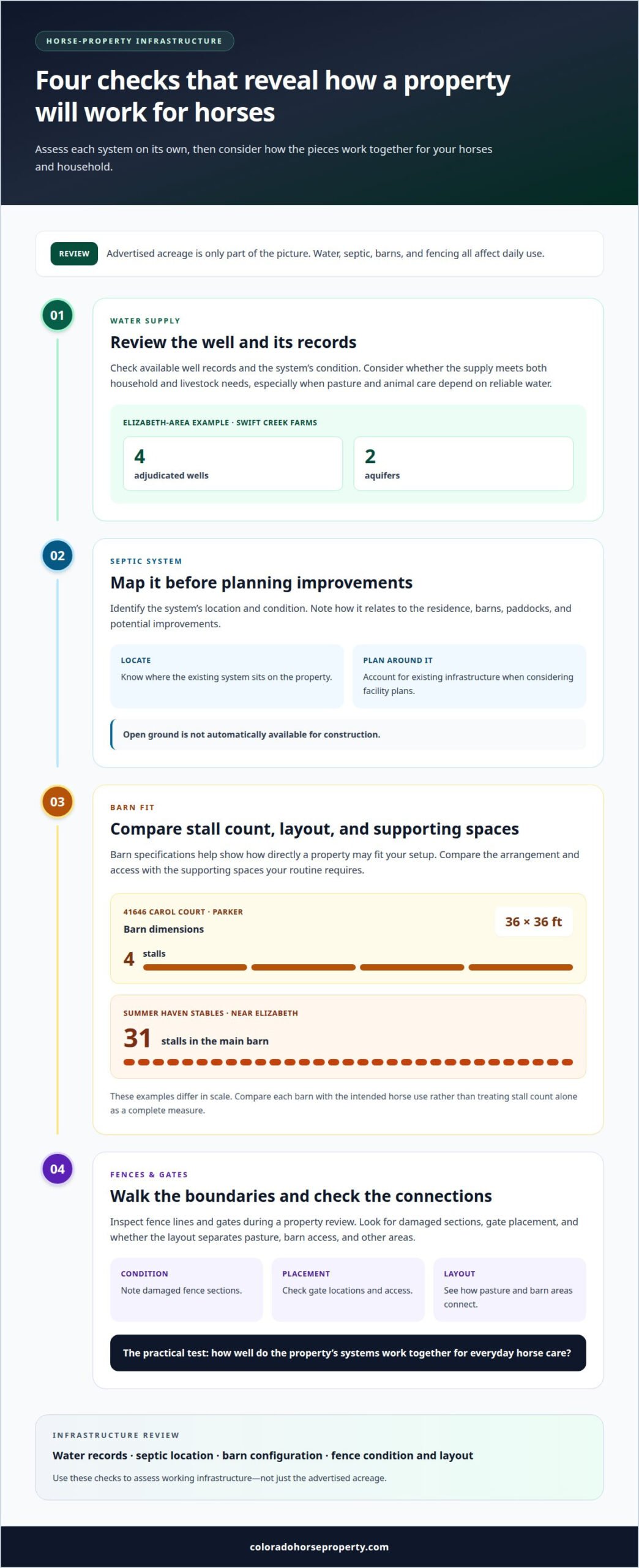
Horse-property infrastructure affects daily use as much as acreage does. Parker examples range from the four-stall barn at 41646 Carol Court to the substantial equestrian facilities at Summer Haven Stables near Elizabeth. Evaluate each system separately, then consider how the components work together for your horses and household.
Water deserves close attention on rural parcels. Swift Creek Farms near Elizabeth has four adjudicated wells drawing from two aquifers. For any property with a well, review the available records and the system’s condition, then consider whether the supply meets household and livestock needs. Water access can shape how a property functions, especially when pasture and animal care depend on a reliable source.
Septic systems also affect how you can use a residence and its land. Identify the system’s location and condition, and note how it relates to barns, paddocks, and potential improvements. Account for existing infrastructure in any facility plan rather than assuming open ground is automatically available for construction.
Barn specifications reveal how directly a property may fit your setup. The listing at 41646 Carol Court describes a 36-by-36-foot, four-stall barn. Summer Haven Stables has 31 stalls in its main barn. Those examples differ in scale, so compare stall arrangement, access, and the supporting spaces your routine requires.
Walk the fence lines and check the gates during a property review. Note damaged sections, gate placement, and whether the layout separates pasture, barn access, and other areas. Fence condition and configuration affect everyday movement, not just the parcel’s appearance.
- Water: Review well records and assess the system’s role in household and livestock use.
- Septic: Locate the system and account for it in facility planning.
- Barns: Compare stall count and layout with your intended horse use.
- Fencing: Inspect boundaries, gates, and connections between pasture and barn areas.
Use these checks to assess working infrastructure, not just advertised acreage. Stall count, a well’s documented setup, and the fencing layout each tell part of the story.
Nearby horse-property markets, including Elizabeth and Franktown
Elizabeth and Franktown broaden the comparison beyond Parker’s established listings. Their examples show why location alone does not define value: acreage, improvements, and intended use vary from property to property. Treat asking prices as individual examples, not townwide averages.
Swift Creek Farms provides another large-scale example near Elizabeth. Its equestrian complex includes 17 stalls, and approximately one mile of Swift Creek runs through the property. These features describe a distinct kind of operation from a smaller acreage home, so compare them against your intended use.
Franktown offers another point of comparison. These examples help frame nearby options, but listing prices and a single sale do not establish a marketwide ranking.
- For larger acreage: Compare the Elizabeth-area 60-acre and Swift Creek Farms listings.
- For substantial facilities: Review Discovery Farm and Summer Haven Stables by their buildings, acreage, and parcel options.
- For a mid-sized example: Include Franktown’s 13.53-acre listing in the comparison.
Build a shortlist across all three communities, then weigh usable land and facilities against price. Searching Parker, Elizabeth, and Franktown together can surface options a town-by-town search may miss.
Colorado Horse Property
Colorado Horse Property helps buyers compare equestrian properties in Parker, Elizabeth, and nearby markets. Its AI-Powered Horse Property Search can narrow options by features such as barns, arenas, water rights, and pasture size, keeping your priorities at the center as you build a shortlist.
When you’re ready to assess specific properties and move toward a purchase, Colorado Horse Property provides Buyer Representation. Real Estate Listing Services help owners prepare a horse property for the market, while Transaction Management helps coordinate the steps in a real estate transaction.
Share the location, acreage, facilities, and access that matter to your plans. Contact Colorado Horse Property to discuss your horse-property search or listing.
Choose the Property That Fits Your Next Chapter
Choosing between Parker and Elizabeth, Colorado, for horse properties comes down to how you want your land to work for you. Look beyond the town name and picture an ordinary day: where horses move, how you reach the places you ride, and what you want the property to support over time. That practical vision can guide a more confident decision.
As you move from comparing communities to considering individual properties, keep your priorities in view. A clear sense of your intended use can focus conversations on the features that matter most, whether you’re buying or preparing a property for sale.
Colorado Horse Property can help you take that next step. Contact Colorado Horse Property to discuss your plans and move toward a property that supports the horse-centered life you envision.
Frequently Asked Questions
How do horse-property prices compare in Parker and Elizabeth, Colorado?
Parker and Elizabeth listings vary in acreage and equestrian improvements, so individual examples are more useful than assuming one town is always cheaper. Compare land, facilities, and intended use alongside asking price; these listings are not identical property types.
What is the typical acreage of horse properties in Parker versus Elizabeth?
Parker’s sold horse properties had a median lot size of 5.0 acres in the last year. Elizabeth-area properties span a broader range in the examples available, including a 9.7-acre property sold in October 2026 and a 144-acre ranch listing. For a practical comparison, separate home-and-horse parcels from larger ranch operations rather than treating every acreage figure as comparable.
What are commute times from Parker and Elizabeth to Denver and nearby employment centers?
Commute times depend on the property address, destination, route, and travel conditions, so town names alone can’t provide a reliable estimate. One Parker listing, 42593 London Drive, is described as about 10 minutes from Parker and Southlands. For Denver or another employment center, compare the actual route from each candidate property with your regular travel schedule.
How do water rights, wells, and septic systems affect horse properties in Parker and Elizabeth?
Water rights, well infrastructure, and septic systems are separate parts of a property’s utility. For example, an Elizabeth-area ranch listing states that it includes 198 acre-feet of Denver Basin water rights. Review how documented water access relates to household and horse needs, and account for the septic system’s condition and location when considering barns, paddocks, or future site plans.
How do wildfire, drought, and flood risks compare for horse properties in Parker and Elizabeth?
Assess risks parcel by parcel. Review vegetation and access for wildfire planning, water reliability during dry conditions, and drainage or flood exposure.