
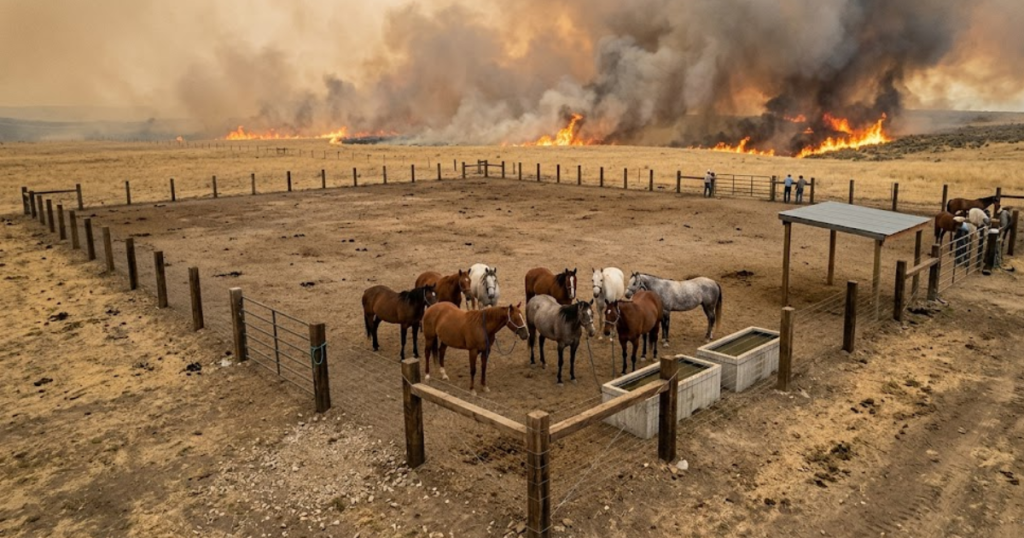
The sky turns an eerie shade of orange, and the smell of smoke hits you instantly. A fast-moving wildfire, fueled by dry mountain winds and thick prairie grass, is racing toward your neighborhood. You sprint to the barn to hook up your truck and trailer, but your horses are panicked by the smoke. They refuse to load, rearing and pulling back. The emergency sirens begin to wail in the distance, and the local sheriff drives down your lane, shouting over a loudspeaker that you must evacuate immediately.
You are forced to make the heartbreaking choice to leave your horses behind.
In the West, wildfire is an absolute reality, not a distant hypothetical. When shopping for horse properties colorado buyers heavily evaluate the structural footprint of the barns and arenas, but they rarely look at the property’s defensive fire infrastructure. If a wildfire cuts off your evacuation route, having a designated, completely cleared fire turnout zone can mean the difference between life and death for your herd.
Here is how to evaluate a property’s wildfire defensible space and emergency holding zones before you buy.
Is There a Functional, Cleared "Turnout Zone" Devoid of Vegetation to Hold Horses Safely if a Fast-Moving Grass Fire Approaches?
Quick Summary: The Equestrian Defensive Space
- The Fire Safety Zone: A true emergency turnout zone, often called a sacrifice lot or fire pad, must be completely devoid of dry grass, weeds, and brush. It serves as a bare-dirt or gravel sanctuary where horses can be corralled safely if evacuation is impossible.
- The Embers and Radiant Heat Threat: Fast-moving Colorado grass fires travel at terrifying speeds driven by high winds. The primary danger to horses is not just the main flame wall, but flying embers and intense radiant heat that can ignite standard wood fencing or shelters.
- The Materials Matter: A fire-safe turnout zone must utilize heavy-duty steel pipe, paneling, or oilfield drill-stem fencing. If your emergency paddock is built with standard cedar post-and-rail or vinyl fencing, it will melt or burn, releasing the horses directly into the path of the fire.
- The Evacuation vs. Shelter-in-Place Dilemma: Loading multiple horses into a trailer while a smoke column looms is incredibly chaotic and dangerous. Having a designated, cleared defensible space gives you a critical, life-saving shelter-in-place option when time runs out.
In wildfire country, emergency horse safety depends not only on evacuation plans but also on whether the property has a realistic place to shelter horses if the road out is no longer an option.
1. The Anatomy of a Wildfire Sacrifice Lot
An emergency turnout zone cannot just be a spare paddock; it must be engineered as a fire break.
- Zero Fuel Load: The zone must be entirely clean dirt, crushed road-base, or heavily compacted gravel. There can be no native pasture grass, dry weeds, tumbleweeds, or overhanging tree branches within or immediately surrounding the perimeter.
- The Distance Formula: To protect horses from the lethal radiant heat of burning structures or surrounding brush, this cleared zone should be situated at least 50 to 100 feet away from the main barn, hay storage sheds, and heavy timber lines.
- The Mud-Management Bonus: The beauty of this infrastructure is its dual-purpose utility. In the winter and wet spring months, this completely cleared, gravel-based zone functions perfectly as your daily sacrifice lot, keeping your horses out of the mud and protecting your main grazing pastures from overgrazing.
2. Eliminating Combustible Fencing
If the fire paddock is surrounded by flammable materials, it becomes a trap, not a sanctuary.
- The Vinyl Meltdown: While white PVC or vinyl fencing looks pristine, it is catastrophic in a wildfire. The intense radiant heat from a nearby grass fire will cause vinyl fencing to melt, sag, and release toxic fumes, allowing panicked horses to escape directly into the path of the smoke and flames.
- The Wood Fuel Source: Traditional pressure-treated wood, split-rail, or cedar post-and-board fencing acts as a continuous fuse. If a grass fire ignites one section of the fence, the flame will travel along the perimeter right to your barn or into the emergency paddock.
- The Steel Drill-Stem Standard: The gold standard for emergency turnout zones is heavy-walled steel pipe or oilfield drill-stem fencing welded directly to steel posts set in deep concrete. Steel will not burn, melt, or structurally fail during a fast-moving grass fire, ensuring your horses remain securely contained in the safest part of the property.
A turnout zone is only as safe as its weakest material. In a fire event, the difference between steel and combustible fencing can determine whether the containment area still functions when it matters most.
3. The Power of On-Site Water Utilities
A high-functioning fire safety zone relies heavily on nearby, independent utility access.
- Hydrant Proximity: A true emergency lot should feature a dedicated, frost-free yard hydrant located right at the gate. This allows you to rapidly fill heavy rubber stock tanks before you evacuate, giving the horses a critical water supply to combat dehydration from heavy smoke inhalation.
- The Plastic Tank Danger: Avoid automatic waterers or stock tanks made of cheap plastic in your fire zone. If the fire passes close by, plastic tanks will melt and drain your water supply instantly. Opt for heavy-gauge galvanized steel tanks that can withstand extreme heat.
4. Evaluating the Local Fire District and Access
When exploring Colorado horse ranches for sale, you must look beyond the property lines to understand how emergency services interact with the location.
- The Turnaround Test: If a fire crew drives down your lane to defend your property, they need room to operate. A dead-end driveway with a tight gate will prevent a massive Type 3 wildland fire engine from entering. They look for wide, open spaces and circular drives where they can safely position equipment and escape if the fire shifts.
- The ISO Rating: Check the local fire department’s Insurance Services Office, ISO, rating for the property. A lower number indicates better response times, closer proximity to a station, and more reliable access to rural water tenders, which directly impacts both your safety and your annual property insurance premiums.
We Evaluate Emergency Readiness Before You Buy
We do not just look at the aesthetics of the barn; we analyze the survival mechanics of the land.
When our team represents you in your search for the perfect equestrian estate, we bring practical, Western risk-management to the tour. We evaluate property layout for wildfire defensibility, look for non-combustible fence lines, and help you identify if a property is truly equipped to shelter-in-place safely when a crisis hits.
Contact Us Today to find premium horse properties Colorado buyers trust for safety, longevity, and professional infrastructure.
Browse Active Colorado Horse Properties: Browse active Colorado horse ranches for sale or ask our team about finding a horse property for rent Colorado featuring exceptional defensible space and secure emergency layouts
Frequently Asked Questions (FAQ) About Fire Turnout Zones
Should I leave halters on my horses if I have to abandon them in a fire paddock?
No, absolutely not. Standard nylon halters will melt directly onto a horse's face under extreme radiant heat, causing catastrophic burns. Leather halters are safer but can still shrink and burn. If you must leave your horses in a cleared fire zone, strip them of all halters, blankets, and fly masks to prevent synthetic materials from catching fire or melting onto their skin.
How large does a wildfire sacrifice lot need to be for three horses?
For emergency holding, the lot does not need to be massive, but it must give the horses room to move away from the edge where heat might be most intense. A minimum footprint of 50x50 feet is functional for a few horses, though a 100x100 foot cleared space is highly preferred to maximize their distance from any peripheral heat sources.
Can I use a dirt arena as my emergency wildfire turnout zone?
Yes, a large outdoor riding arena with a sand or dirt footing is an exceptional emergency turnout zone, provided it is fully fenced with steel panels or pipe and sits a safe distance away from combustible structures, wood fence lines, or heavy brush.