
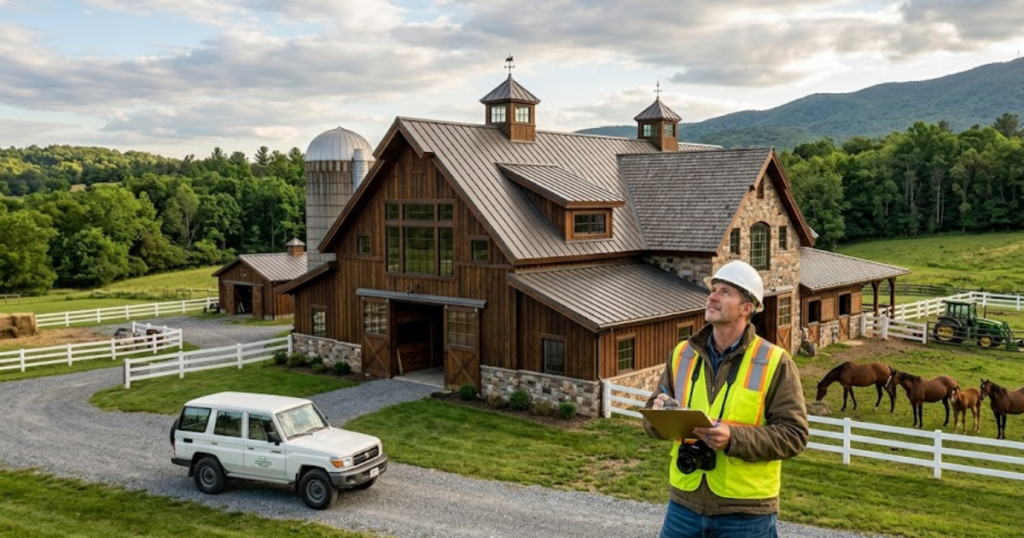
You finally close on a stunning equestrian estate featuring a fully insulated, $350,000 custom Morton barn with a heated tack room and wash racks. A year later, a severe Colorado microburst or a fast-moving wildfire tears through the property, destroying the barn completely.
You call your insurance agent, expecting a check to rebuild. Instead, the agent informs you that your standard homeowner’s policy only covers outbuildings up to $50,000. You are left with a massive pile of debris and a $300,000 out-of-pocket bill to replace your equestrian infrastructure.
Assuming your beautiful barn is fully protected by your standard residential mortgage insurance is a catastrophic financial mistake. High-value agricultural buildings require highly specific coverage.
Here is how to evaluate the true cost and structure of hazard insurance for a working horse property before you buy.
How Much Is the "Hazard Insurance" for a High-Value Barn?
Quick Summary: The Coverage Gap
- The 10% Standard Limit: A standard homeowner's insurance policy typically caps coverage for other structures at just 10% of the primary dwelling's value. This will barely cover the foundation of a high-value custom barn.
- Replacement Cost vs. Actual Cash Value: If a 20-year-old barn is destroyed, an Actual Cash Value policy only pays out its depreciated worth. You need Replacement Cost coverage to actually afford the lumber and labor to rebuild it today.
- The Wildfire and Hydrant Premium: In rural Colorado, your insurance premium is heavily dictated by your property's distance to the nearest fire station and whether there is an accessible fire hydrant or drafted water source nearby.
- The Commercial Void: If you charge someone to board their horse in your barn, or teach a paid riding lesson, standard personal hazard insurance is immediately voided. You must transition to a commercial farm and ranch policy.
On a horse property, barn insurance is not automatically solved by a normal homeowner policy. High-value equestrian structures often need specific coverage design and higher limits to avoid a catastrophic shortfall after a loss.
1. The "Other Structures" Trap
Standard residential insurance policies are designed for suburban homes with small garden sheds, not sprawling equestrian estates.
- The 10% Rule: Most homeowner's policies default to Coverage B, Other Structures, which is typically capped at 10% of the coverage on the main house. If your house is insured for $800,000, you only have $80,000 in total coverage for your barn, your arena, your run-in sheds, and your miles of fencing combined.
- Scheduling the Barn: To properly insure a high-value barn, you must have your insurance agent officially schedule the building. This means listing the barn as a specific, independent asset on the policy with its own dedicated coverage amount based on a formal agricultural appraisal.
2. Actual Cash Value (ACV) vs. Replacement Cost
How your policy values the barn makes a massive difference in your monthly premium and your payout after a disaster.
- The Depreciation Penalty: If you opt for an Actual Cash Value policy to save money on your monthly premium, you are taking a massive risk. If a 30-year-old barn burns down, the insurance company will aggressively calculate 30 years of depreciation. They will hand you a check for what the old wood was worth, which will not come close to covering the cost of new construction.
- Rebuilding in Today's Market: You must insist on Replacement Cost coverage. While the annual premium is significantly higher, this guarantees the insurance company will pay current market prices for lumber, steel, and labor to rebuild the barn to its original condition, regardless of how old the structure was when it fell.
The cheapest premium can create the most expensive outcome if the payout is based on depreciation instead of real-world rebuilding cost.
3. Fire Ratings and Rural Infrastructure
In the rural West, fire is the ultimate hazard, and insurance companies underwrite that risk aggressively.
- ISO Fire Scores: Insurance companies rely on ISO fire ratings, which evaluate the local fire department's capabilities. If the property is located more than five miles from a fire station, or if it is served by a volunteer-only department, your hazard insurance premium will skyrocket.
- The Hydrant Deficit: Most rural horse properties do not have fire hydrants. If the fire department has to truck in their own water, water tenders, because your property lacks a high-volume drafting pond or a commercial cistern, the insurance company views the barn as a total loss in the event of a fire, pricing the premium accordingly.
- The Hay Storage Hazard: If you store 10 tons of highly combustible baled hay inside the exact same building where the horses live, underwriters consider that an extreme fire hazard. Storing hay in a separate, detached shed can actually lower the insurance premium on your primary high-value barn.
4. The Business Use Exclusion
Insurance companies draw a very hard, absolute line between a personal hobby and a commercial enterprise.
- The Boarding Trigger: The moment you accept $1 in rent from a friend to keep their horse in your spare stall, your property becomes a commercial boarding facility in the eyes of the underwriter.
- Voided Coverage: If a fire starts or the barn roof collapses, and the insurance adjuster discovers you were running an undeclared commercial boarding or training operation, they can legally deny the entire hazard claim. If you plan to generate any income from the property, you must purchase a dedicated Commercial Equine or Farm and Ranch policy.
We Evaluate the Risk Before You Buy
We do not just look at the quality of the stalls; we look at the cost to protect them.
When Mark and Alison Eibner at Realty Oasis help you purchase a horse property, we ensure you see the complete financial picture. We advise you to bring your insurance agent into the conversation early during the escrow period so you can get accurate quotes on scheduling high-value barns, mitigating fire risks, and securing the exact farm policies you need to protect your equestrian investment.
Contact Us Today to find a property where your equestrian lifestyle and your financial assets are secure.
Browse Active Colorado Horse Properties: Browse Active Colorado Horse Properties equipped with premium, insurable infrastructure
Frequently Asked Questions (FAQ) About Barn Insurance
Does my hazard insurance cover my fencing and riding arena?
Fencing and arenas are technically considered other structures, but they are usually the first things excluded or heavily depreciated in a standard policy. You typically need to add a specific Farm and Ranch endorsement to get true replacement coverage for miles of expensive steel pipe fencing or specialized arena footing.
Can I lower my barn insurance premium by installing fire safety equipment?
Yes. Installing hardwired commercial heat and smoke detectors, monitored security systems, lightning rods, and strategically placed fire extinguishers can often earn you premium discounts from agricultural insurance carriers.
If the barn roof collapses from heavy snow, will hazard insurance cover it?
Usually, yes, if you have a comprehensive policy. Weight of ice and snow is a standard covered peril. However, if the insurance adjuster determines the roof collapsed because the structural beams were already rotting due to long-term neglect or deferred maintenance, they may deny the claim.