
The right acreage for horses depends on pasture quality, turnout plans, the number of horses, and the space needed for riding and facilities. Homes with a barn and a covered arena for sale vary widely: one property example combines 12.53 acres with a fully enclosed 60-by-180-foot riding arena. That example shows why land size and arena dimensions are best considered together, not as separate checkboxes.
Acreage matters, but so do practical details such as stall count, pasture layout, arena type, and how the buildings support your daily plans. A large parcel may offer room to ride and graze, while a more compact property may suit a different setup.
This guide explains the factors that shape land needs and compares property prices, acreage, barn stalls, arena sizes, and features across the United States. You’ll get a clearer way to assess listings against your horses, riding priorities, and budget, so you can focus on properties that fit the life you want to build.
Key Takeaways
- Match acreage to pasture, turnout, and riding plans rather than relying on parcel size alone.
- Compare stall counts and barn features with the way you intend to use the property.
- Assess arena type, dimensions, and supporting features to understand how well a facility fits your riding needs.
- Use listing prices and property details as a comparison point, while considering zoning and permitted building use in your evaluation.
Barns and horse stalls
Stall count helps show whether a barn suits your horses, but layout and supporting facilities matter too. Iron Hide Ranch in Greenback, Tennessee, has a 20-stall barn, while a Dandridge horse farm has four stalls with electricity and water. In Colorado, the property at 901 Tierra Del Oro in Pagosa Springs has an 11-stall heated barn. These examples range from compact setups to facilities suited to more horses.
Horse properties near Billings, Montana, offer another regional comparison: an equestrian-property search displayed 27 listings on November 19, 2026. Michigan horse farms and equestrian properties span different scales, from a 10.18-acre Pinckney property with four stalls and four pastures to a 62.5-acre Chelsea property with 25 stalls and an indoor arena. Compare the primary use, horse capacity, and riding facilities rather than relying on the label alone.
A hobby farm may combine a home, a smaller barn, and pasture, while a ranch may prioritize more acreage and agricultural use. A dedicated horse property may center on stalls, turnout, and riding facilities. Existing barns and arenas provide established infrastructure, while building new requires planning for site conditions, intended use, and local rules. Buyers should consider zoning, legal livestock use, and whether buildings have the required permits.
What zoning and land-use rules apply? Zoning and permitted livestock use depend on the property’s jurisdiction, so confirm that the intended uses of its barns, arenas, and acreage are allowed. What permits or building-code requirements apply? Buildings may require permits where applicable. The U.S. Department of Justice says newly constructed covered facilities must be readily accessible to and usable by individuals with disabilities.
Financing decisions may depend on the home, agricultural use, acreage, and condition of the facilities. Insurance needs may also vary with the covered structures and how you use the property. Compare these factors when evaluating homes with barns and covered arenas: lifestyle appeal is only one part of a property’s practical fit.
Property prices and acreage
There’s no single average price for an equestrian estate. Location, acreage, the home, barn, and arena features all influence asking prices. When navigating high-value rural and acreage properties, consulting independent luxury property specialists such as Nikki Homes can provide valuable perspective on balancing residential quality with practical acreage. Listings range from modest acreage to large ranch properties, so compare the land and facilities as well as the price.
Featured Property Prices
Featured listings show how widely asking prices can vary. These examples are snapshots, not a national average.
Acreage and Pasture Suitability
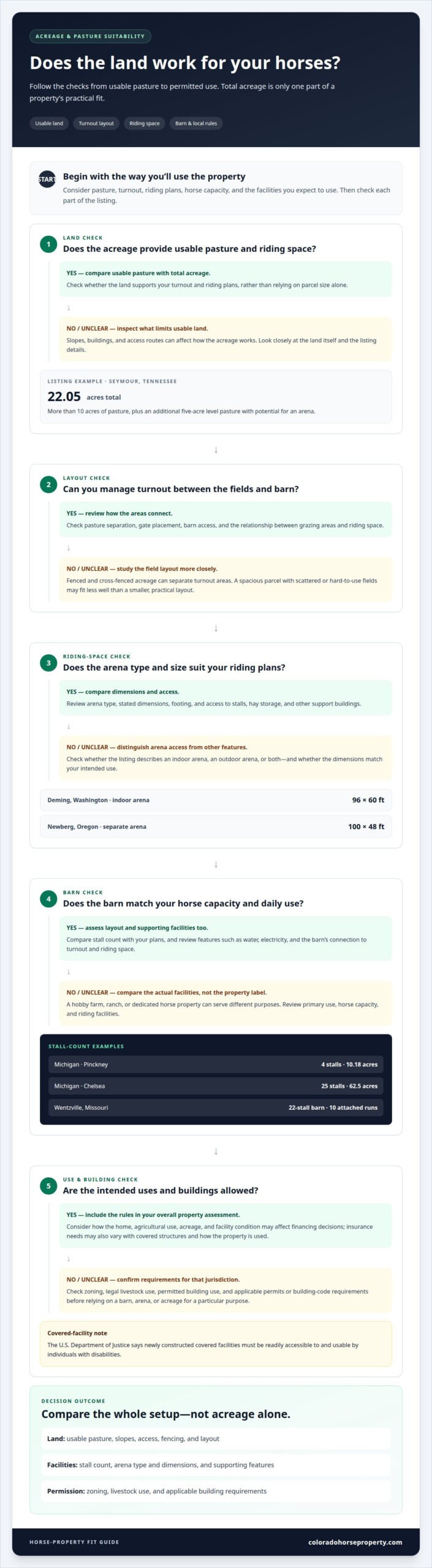
Parcel size alone doesn’t show how much land supports turnout or riding. A 22.05-acre Seymour, Tennessee, estate has more than 10 acres of pasture and an additional five-acre level pasture with potential for an arena. Compare usable pasture with total acreage, and consider whether slopes, buildings, and access routes limit how the land works for your horses.
Fenced and cross-fenced acreage can separate turnout areas and make moving horses between pastures more manageable. Study the layout, including gate placement, barn access, and the relationship between grazing areas and riding space. A spacious parcel with scattered or hard-to-use fields may suit your plans less well than a smaller property with a practical layout.
Listings also vary in barn and arena scale. For example, the property at 31100 N.E. A tack room, stall barn, pasture arrangement, and arena dimensions each affect how a property fits your intended use. Colorado equestrian property listings can help narrow the search by location and facilities.
Barn stalls and indoor or outdoor arenas
Stall capacity and arena access show how a property may support daily horse care and riding. Review the listing details to see whether its facilities fit your plans.
For instance, in Deming, Washington, a property features a 96-by-60-foot indoor riding arena. These listings illustrate different combinations of home, barn, and riding space available through Colorado Horse Property.
A real estate professional can search listings by location and equestrian features, then compare descriptions, photos, and property details. For buyers exploring acreage and lifestyle homes in regional markets, consulting dedicated agencies like Ollie James Real Estate can help pinpoint properties that balance land and living requirements. Terms such as “indoor arena,” “horse barn,” and “stalls” can help narrow the search. Review each listing carefully to distinguish arena access from other barn features.
Private Indoor Riding Arenas
A private indoor arena can support riding on the property without relying on an outdoor ring. Compare the arena’s dimensions with your intended riding use, then review its connection to the barn and home. The South Lyon listing pairs an indoor arena with a 2,149-square-foot home, while St. Clair’s listing combines an indoor arena with 39 stalls.
Indoor and Outdoor Arena Options
Indoor and outdoor facilities serve different roles in a horse property’s layout. The St. Clair listing pairs an indoor arena with a 46.74-acre parcel, while a Wentzville, Missouri, property combines a regulation-size outdoor arena with a 22-stall barn and 10 attached runs. Compare arena type, dimensions, footing, and access to stalls, hay storage, and the garage or other support buildings.
Stall counts also vary substantially: the St. Clair example has 39, while a Merrill, Michigan, listing includes a 60-by-90-foot indoor arena. Consider whether the barn arrangement, riding space, and surrounding ground work together for your horses and intended use.
Madisonville, Tennessee, adds an example with a 9-stall horse barn and indoor and outdoor riding arenas, bringing both arena types together on one ranch. The property at 901 Tierra Del Oro in Pagosa Springs, Colorado, has a 12,000-square-foot heated and insulated indoor riding arena. These details let buyers compare stall capacity and indoor comfort alongside outdoor access.
Arena sizes and features
Arena dimensions shape how a facility supports riding, and listings can describe more than one arena type. A Newberg, Oregon, property has an indoor arena and a separate 100-by-48-foot arena.
Compare stated dimensions with your riding plans, then assess the surface, drainage, roof, lighting, and access. For example, 6407 Mount Baker Highway in Deming, Washington, has a 96-by-60-foot indoor arena. The measurement gives a clearer comparison than a listing photo alone, while facility condition and layout help show how usable the space may be.
What should buyers inspect? Review the arena’s dimensions, footing, drainage, roof structure, lighting, and route between the arena and barn. Consider stall access and acreage, too, and whether the available space suits your intended riding use.
Features vary across properties for sale. The Newberg property also includes a round pen, while 3955 Hoffman Road in Wentzville, Missouri, has a regulation-size outdoor arena. These details distinguish a single-purpose ring from a broader riding setup. A covered arena can extend riding opportunities, while outdoor space adds another option when conditions allow.
Evaluate the whole estate, not just the arena. In Golden, Colorado, the property at 1154 South Grapevine Road combines a 19,000-square-foot indoor riding arena with 327 acres. Home features such as bedrooms, a kitchen, and garage space matter alongside equestrian amenities. County location and acreage also shape access and how the property fits your real estate priorities.
Use a consistent comparison: record each arena’s type and dimensions, then note footing, shelter, access, and nearby facilities. This makes differences between properties easier to assess without relying on terms such as “beautiful” or “luxury” alone. Explore equestrian real estate listings to narrow options by arena features and acreage.
Colorado Horse Property
Colorado Horse Property helps buyers connect their priorities with equestrian real estate options. Its AI-powered search and buyer representation can help you focus on acreage, barn capacity, and arena features that fit your plans. Real estate listing services and transaction management support the process from finding suitable properties through purchase.
Identify the features that matter most, such as indoor riding space, stall layout, pasture, or location. A focused search can help bring those priorities together as you compare listings and decide which properties merit a closer look.
Contact Colorado Horse Property to discuss your equestrian property search.
Turn Your Priorities Into a Property Search
First, decide which features are essential and where you can stay flexible. For homes with a barn and covered arena for sale, that distinction keeps your search focused on properties that fit your plans, rather than features that simply look appealing in a listing. Consider how you expect to use the barn, arena, and surrounding land, then compare properties against those priorities.
Colorado Horse Property can help turn your preferences into a focused equestrian real estate search. Its services include AI-Powered Horse Property Search, Real Estate Listing Services, and Buyer Representation. Share the property features and location that matter to you to start a conversation about your next move.
Contact Colorado Horse Property to discuss your search, and take the next step toward finding a property that fits your equestrian plans.
Frequently Asked Questions
How Much Land Do You Need for Horses?
There’s no single acreage requirement for every horse property. The land needed depends on pasture productivity, climate, planned turnout, and whether you’ll supplement grazing with stored feed. For a practical estimate, separate usable grazing ground from the parcel’s total acreage, then account for the home, arena, barn, access, and other amenities. Let your intended horse-care routine guide the search.
Which states and regions have the most properties with barns and covered arenas for sale?
The Billings-area search displayed 27 equestrian properties. The article also discusses listings in Michigan, Tennessee, Colorado, Washington, Oregon, and Missouri, but provides no comparison showing which region has the most.