
In the Colorado real estate market of 2026, deciding between a hobby farm vs horse ranch Colorado comes down to more than just how many stalls you have. It’s a legal and financial divide that often begins at the 35-acre mark. You’ve likely spent hours scrolling through listings in Douglas or Boulder County, feeling the weight of rising land prices and the complexity of senior water rights. It’s exhausting to determine if a property can actually support your horses without becoming a maintenance burden that drains your time and bank account.
This guide will clarify the critical differences between these property types by breaking down the specific zoning laws, tax implications, and water requirements you’ll face this year. You’ll discover why the 35-acre rule is the most important factor in your search and how new regulations like HB 1340 impact your long-term investment. We’ll provide a clear framework to help you choose between a lifestyle-focused property and a commercial operation, while showing you how to use AI-powered tools to filter listings with confidence.
Key Takeaways
- Identify why the 35-acre threshold is the critical regulatory cliff for Colorado well permits and tax status.
- Evaluate senior water rights to understand why they often hold more value than the land itself.
- Use our tactical framework to decide the hobby farm vs horse ranch Colorado debate based on your maintenance capacity and lifestyle goals.
- Discover how AI-powered tools pinpoint equestrian features that traditional search filters miss.
- Learn to weigh the ROI of on-site hay production against the high feed costs expected in 2026.
Hobby Farm vs. Horse Ranch: Defining the Colorado Standard
Choosing between a hobby farm vs horse ranch Colorado requires looking far beyond the fence line. In 2026, the distinction isn’t just about how many stalls you have in the barn. It’s about your primary intent and the legal framework of the land. A hobby farm is typically a lifestyle asset where the owner maintains a primary income outside of agriculture. To establish a baseline, it helps to understand What is a Hobby Farm? in a broader sense. Essentially, these are small-scale operations managed for personal enjoyment rather than a primary source of profit. In the Colorado Front Range market, these are treated as distinct asset classes because the management intensity and legal requirements differ significantly.
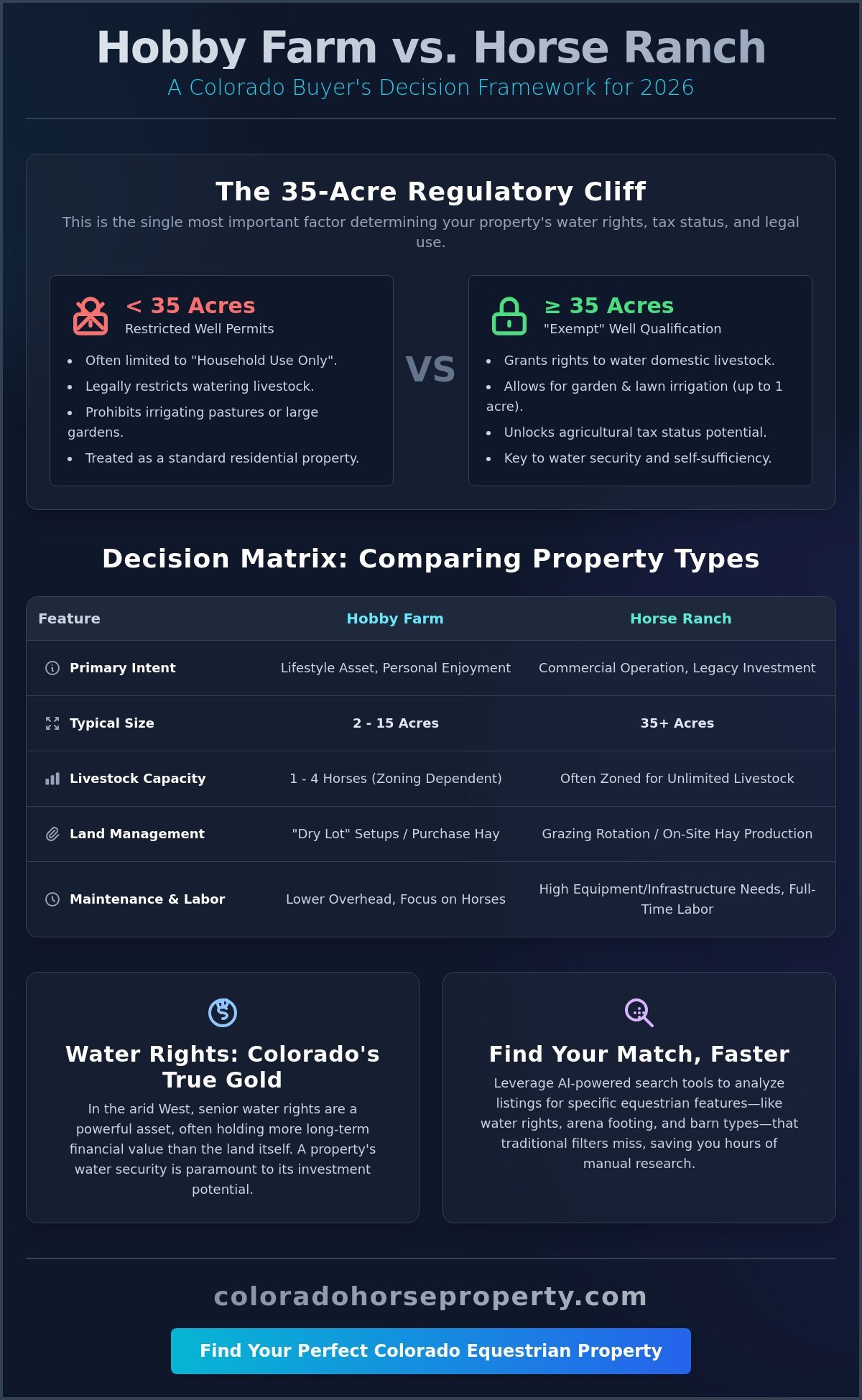
The most significant divider in the Centennial State is the 35-acre rule. This is a regulatory cliff that dictates your future. If your property is under 35 acres, your well permit options are often restricted. You might be limited to “household use only,” which doesn’t legally allow for watering livestock or irrigating pastures. Once you cross that 35-acre threshold, you typically qualify for an “exempt well.” This permit is vital because it grants you the right to water domestic livestock and maintain larger acreage without the same municipal restrictions found on smaller parcels.
To better understand this concept, watch this helpful video:
What Constitutes a Hobby Farm in Colorado?
Hobby farms, often called “ranchettes,” generally range from 2 to 15 acres. These properties are the tactical choice for dual-career families who need to stay close to Denver or Colorado Springs. The focal point of these listings is the equestrian house and its immediate convenience. On a hobby farm, you’re likely managing “dry lot” setups rather than expansive pastures. You’ll probably purchase your hay rather than producing it on-site. It’s a curated space designed for the joy of ownership without the full-time labor of a working agricultural operation.
The Anatomy of a Colorado Horse Ranch
A true horse ranch usually starts at 35 acres to maximize legal land use and water security. These larger parcels allow for superior well rights and are often zoned for unlimited livestock. The infrastructure is built for professional scale. It’s common to find multiple horse barns for sale on these estates, alongside professional-grade arenas. On a ranch, the focus shifts toward land production and long-term legacy. You’re not just buying a home; you’re acquiring a play for the West’s most valuable resource: water. Management here requires a deep understanding of grazing rotation and infrastructure maintenance.
The Hobby Farm Lifestyle: Convenience and Curated Spaces
Active professionals often gravitate toward the “ranchette” model for its tactical advantages. While a full ranch requires constant equipment maintenance, a hobby farm allows you to focus on the horses rather than the hay production. This lower overhead makes it a sustainable choice for those balancing a career in the city with a passion for the trail. These properties often blend high-end residential luxury with immediate horse-ready facilities, providing a seamless transition between a professional life and an equestrian one.
Zoning in suburban-rural buffers like those in Douglas or El Paso County often falls into A-1 or A-2 categories. These designations determine exactly how many animals you can keep per acre. Navigating these restrictions is the first step in deciding the hobby farm vs horse ranch Colorado trade-off. On smaller parcels, you’ll likely rely on dry lot setups. This means keeping horses in smaller, non-vegetated areas to prevent them from destroying the limited pasture you have. It’s a management style that prioritizes health and safety over natural grazing.
Is a Hobby Farm Right for You?
A hobby farm is ideal if you own between one and four horses. At this scale, proximity to trail systems often outweighs the need for vast grazing land. You’ll spend more time in the saddle and less time on a tractor. From an investment perspective, there is a high resale value for horse property for sale in colorado located near metro hubs. These assets remain in high demand because they offer the equestrian lifestyle without the isolation of deep rural living.
Common Pitfalls of Small-Acreage Ownership
Small-acreage ownership comes with specific challenges. Overgrazing is the most common pitfall. According to the Colorado Agricultural Statistics, the state’s semi-arid climate means grass grows slowly. On five acres, horses can quickly turn a green field into a dust bowl. You must also account for manure management. In closer proximity to neighbors, you can’t just pile waste; you need a plan for removal or composting. Finally, be aware of zoning “creep.” As suburban developments expand, your once-quiet buffer may face new noise ordinances or traffic concerns. You can explore curated property listings to see how different parcels handle these spatial constraints.
The Horse Ranch Advantage: Water, Wealth, and Wilderness
While a hobby farm offers curated convenience, a horse ranch represents a strategic play for Colorado’s most valuable resources. The distinction between a hobby farm vs horse ranch Colorado becomes starkly clear when you look at the 35-acre rule. In counties like Weld and El Paso, this acreage is often the minimum required to secure an “exempt” well permit. This permit is a legal game changer. It allows you to water domestic livestock and irrigate up to one acre of land, providing a level of self-sufficiency that smaller parcels simply cannot match.
Ownership at this scale also unlocks the potential for agricultural tax status. For the 2026 tax year, agricultural property in Colorado is assessed at 25% of its value. While this rate appears higher than the residential assessment of roughly 7%, the underlying valuation method is different. Agricultural land is valued based on its productive capacity rather than its market sales price. This distinction can lead to a significantly lower property tax burden, making large-scale colorado ranches for sale a more viable long-term investment for those building a legacy.
Water Rights: The Ultimate Differentiator
In a prior appropriation state, water is often more valuable than the dirt it sits on. Senior water rights mean you have a higher priority during drought years. This security is essential for the valuation of horse real estate for sale. You must understand the difference between adjudicated rights and ditch company shares. New legislation, specifically HB 1340, adds another layer of complexity. Starting in 2027, changing the use of irrigation water will require strict revegetation efforts. You cannot simply lease your way to this level of security; deeded water rights are the only way to protect your ranch’s future.
Operational Realities of Large-Scale Land
Managing hundreds of acres of colorado land requires a shift in mindset and machinery. You’ll move from riding mowers to skid steers and potentially irrigation pivots. Scalability is the primary advantage here. A ranch provides the footprint needed for professional breeding programs, commercial boarding, or public training facilities. Remember that Colorado is an “open range” state. This means the responsibility falls on you to fence livestock out if you don’t want them on your property. Many ranch owners use conservation easements to protect this wilderness while securing additional tax benefits for their heirs.
Decision Matrix: Comparing Costs, Maintenance, and ROI
The choice between a hobby farm vs horse ranch Colorado often rests on whether you view your property as a sanctuary or a second job. Initial investment strategies differ significantly between these two asset classes. On a hobby farm, you are typically paying a higher price-per-acre for residential amenities and proximity to urban centers. In contrast, a ranch involves a lower price-per-acre but requires a much larger total capital outlay to secure the land and its accompanying water rights. You must decide if you are investing in a high-end home with horse facilities or a productive land legacy.
Ongoing expenses in 2026 are heavily influenced by hay and feed costs. Drought conditions and low snowpack have pushed hay prices to between $220 and $260 per ton, with small square bales costing $15 or more. A ranch owner with irrigation rights can mitigate these costs by producing hay on-site, potentially saving thousands of dollars annually. A hobby farm owner, however, must import every flake of hay. While the rancher saves on feed, they must invest in tractors, balers, and the labor required to manage the harvest. It is a trade-off between cash flow and equipment equity.
Financial Comparison Over 5 Years
Projected appreciation for ranches for sale colorado often outpaces suburban farms because of the finite supply of large, water-secure parcels. Maintenance costs on a ranch include road grading and extensive fencing repairs across hundreds of acres. On a hobby farm, your costs are more predictable, focusing on facility upkeep and manure removal. However, the “cost of water” remains the ultimate wild card. In a drought year, the lack of senior water rights can force a hobby farm owner to pay premium prices for hauled water, whereas a rancher with adjudicated rights maintains their utility.
Maintenance and Labor Audit
Land management is a 40-hour weekly commitment on a full-scale ranch. You need the skills to maintain irrigation pivots and manage grazing rotation to prevent soil depletion. A hobby farm fits a “weekend warrior” lifestyle, requiring about 10 hours of weekly labor. Privacy is another key differentiator. A ranch offers total seclusion and wilderness, while a hobby farm is “neighbor-aware,” requiring careful management of noise and dust. If you want a property that works for you, start your AI-powered horse property search to find a listing that matches your specific labor capacity and ROI goals.
Finding Your Perfect Match with AI-Powered Property Search
Traditional real estate platforms often fail to distinguish between a property with a few sheds and a professional equestrian estate. They rely on broad filters that ignore the technical nuances of the hobby farm vs horse ranch Colorado debate. When you’re looking for specific infrastructure like GGT footing or a clear-span indoor arena, standard search tools fall short. Our AI-Powered Horse Property Search bridges this gap by analyzing listing data to identify specific equestrian features that matter most to owners. This technology allows you to skip the manual sorting process and focus on properties that actually meet your operational needs.
Mark and Alison Eibner bring 40 years of specialized experience to this process. This professional longevity is a key signature of our service because data alone cannot evaluate the quality of a barn’s ventilation or the structural integrity of a perimeter fence. We combine cutting-edge technology with decades of “horse sense” to provide a level of buyer representation that generalists cannot offer. This partnership ensures you find high-value land for sale in colorado that aligns with your financial and lifestyle goals.
Technology Meets Horse Sense
Our proprietary system automatically filters for critical factors like agricultural zoning (A-1) and adjudicated water rights. Instead of guessing if a property allows for domestic livestock, the AI identifies these permissions instantly. You can also map proximity to Colorado’s premier horse parks and public trail systems. This capability is vital for those who need to distinguish between “horse-ready” properties and “raw land” projects that might require years of permitting and development. By identifying these variables early, you save months of wasted site visits and focus on parcels that are ready for your herd.
Strategy and Next Steps
Securing a Colorado ranch or hobby farm requires a specialized strategy. You need custom alerts for niche equestrian estates that often move quickly in a competitive market. A specialized broker is essential when it comes to negotiating complex water and mineral rights, which are often the most valuable parts of the transaction. We manage the entire process, from initial search to transaction management and title services, ensuring your investment is protected. Start your AI-powered horse property search today to find the property that fits your legacy.
Securing Your Colorado Equestrian Legacy
Mark and Alison Eibner provide 40 years of specialized Colorado equestrian real estate expertise to help you navigate these waters. We utilize proprietary AI search technology to pinpoint niche horse features and provide expert guidance on Colorado water rights and zoning laws. Our team manages every aspect of the transaction, from buyer representation to title and escrow services. Find Your Dream Colorado Horse Property with AI-Powered Search and gain the confidence of working with a seasoned expert. Your future in the Colorado high country starts with the right partner by your side.
Frequently Asked Questions
How many acres do I need for a hobby farm in Colorado?
A hobby farm in Colorado typically ranges from 2 to 15 acres. This size is ideal for managing one to four horses while maintaining a primary career outside of agriculture. In popular areas like Douglas or Boulder County, these smaller parcels provide a manageable balance between equestrian lifestyle and proximity to urban centers. This acreage allows for essential outbuildings without the heavy equipment requirements of a larger operation.
What is the 35-acre rule in Colorado real estate?
The 35-acre rule is a regulatory threshold that dictates your land use and water rights. Properties with at least 35 acres generally qualify for an “exempt” well permit from the Colorado Division of Water Resources. This permit is vital because it legally allows for watering domestic livestock and limited irrigation. Parcels smaller than this are often restricted to “household-use-only” permits, which can forbid watering horses or outdoor gardens.
Do hobby farms qualify for agricultural tax status in Colorado?
Most hobby farms do not qualify for agricultural tax status because their primary purpose is personal enjoyment rather than monetary profit. To receive the agricultural assessment, you must prove the land is used for a commercial agricultural venture, such as breeding or hay production. For the 2026 tax year, residential properties are assessed at a much lower percentage of actual value than the 25% rate for agricultural land, though the valuation methods differ significantly.
Is it better to buy a hobby farm or a ranch for investment ROI?
Ranches often provide superior long-term ROI due to the scarcity of large parcels and senior water rights. When evaluating a hobby farm vs horse ranch Colorado, consider that ranches act as a play for the West’s most valuable resources. However, hobby farms near metro hubs like Denver often see faster residential appreciation. Your choice depends on whether you value land legacy and water security or the liquidity of a high-end residential asset.
What zoning should I look for when buying horse property in Colorado?
Look for A-1 (Agricultural One) or specific rural-residential zoning that explicitly allows for livestock. In counties like Weld or El Paso, A-35 or A-5 districts provide clear frameworks for the number of animals allowed per acre. Always verify the “animal unit” limits and required setbacks for barns and manure storage. Some suburban-rural buffers have strict “zoning creep” that could impact your ability to build professional-grade arenas in the future.
How do water rights differ between a hobby farm and a ranch?
Water rights on a ranch are typically deeded, senior adjudicated rights or ditch company shares that provide security during drought. A hobby farm usually relies on a domestic well or municipal supply. Under 2026 regulations, the distinction is critical; a rancher can often irrigate pastures, while a hobby farm owner may be forced to purchase hauled water if their well permit is restrictive. Water rights often hold more value than the land itself.
Can I run a commercial boarding business on a hobby farm?
Running a commercial boarding business on a hobby farm is difficult due to zoning and well permit restrictions. Most domestic well permits for small acreage specifically prohibit commercial use, including boarding horses for profit. You would likely need to apply for a commercial well permit and a Special Use Permit from the county. A ranch with an exempt well and proper agricultural zoning is much better suited for commercial boarding or training operations.
What are the hidden costs of owning a Colorado horse ranch?
Hidden costs include specialized equipment like skid steers and the ongoing maintenance of private roads and miles of fencing. In 2026, hay prices are a major factor, with costs between $220 and $260 per ton due to drought conditions. You must also budget for wildfire mitigation, which includes creating defensible space around outbuildings. These operational expenses can quickly surpass the initial mortgage payment if you don’t have a dedicated land management plan.