
Most buyers think a five-acre lot automatically makes a property horse-friendly, but in Douglas County, the difference between a “large lot” and a legal equestrian estate is often a complex web of zoning and water rights. You’ve likely spent hours scrolling through listings that promise space, only to find that the local metro district or HOA restrictions actually prohibit the barn or arena you need. It’s a common frustration for riders who refuse to compromise on the quality of their home or the functional needs of their horses.
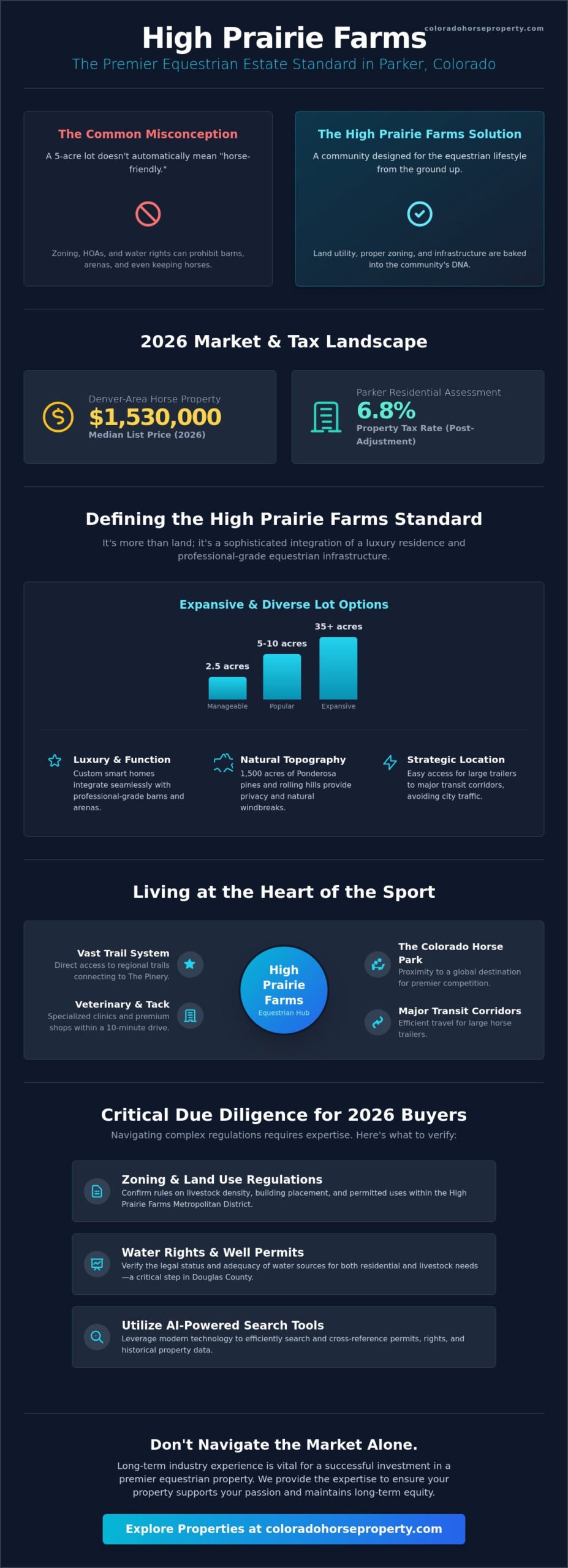
Discover why High Prairie Farms equestrian estates remain the gold standard for those who want a custom luxury lifestyle paired with professional-grade infrastructure. With the 2026 median list price for Denver-area horse properties reaching $1,530,000, understanding the specific value of this community is essential for a smart investment. This guide explores the 2026 property tax landscape in Parker, where residential assessments sit at 6.8% for most local governments after a 10% legislative adjustment. You’ll also learn about the local impact of the Colorado Horse Park’s latest upgrades and how to identify a property that truly supports your equestrian passion while maintaining long-term equity in a shifting market.
Key Takeaways
- Learn how High Prairie Farms blends luxury residential architecture with the specialized infrastructure required for a functional horse property.
- Explore the diverse lot options for High Prairie Farms equestrian estates, ranging from manageable 2.5-acre parcels to expansive 35-acre tracts.
- Understand the strategic investment value of living near the Colorado Horse Park, a global destination for premier equestrian competition.
- Identify the critical technical steps for 2026 buyers, including how to verify water rights and well permits using AI-powered search tools.
- See why long-term industry experience is vital when navigating complex zoning and land-use regulations in Douglas County.
The Allure of High Prairie Farms: Parker’s Premier Equestrian Enclave
High Prairie Farms represents a unique 1,500-acre landscape where the rugged beauty of the Palmer Divide meets sophisticated residential design. This enclave is defined by its dense stands of Ponderosa pines and rolling hills, offering a topography that naturally accommodates High Prairie Farms equestrian estates. While many developments in Douglas County have densified over time, this community has preserved the expansive feel of the original High Plains. It ensures that land utility remains at the forefront of every property, providing the necessary windbreaks and privacy that only mature timber can offer.
The area’s history is rooted in “The Pinery,” a name that once described the vast timber resources used by early settlers. Today, that legacy is reflected in the deliberate layout of the estates. By prioritizing large lot sizes from the start, developers ensured that the transition from pioneer homesteads to luxury custom homes didn’t sacrifice the space required for professional-grade barns and arenas. Douglas County has long been the epicenter of Colorado’s horse culture, boasting one of the highest horse populations in the state. Parker, Colorado serves as the anchor for this lifestyle, balancing rural seclusion with high-end amenities.
To better understand the scale and quality of world-class horse properties, watch this overview of a premier equestrian estate:
A Legacy of Luxury and Land
The original vision for this community focused on animal husbandry as a core lifestyle component. Early planners avoided the cookie-cutter layouts found in suburban Denver. They opted instead for varied lot sizes that respect the natural contours of the land. This evolution from rugged homesteads to custom estates hasn’t diminished the “High Plains” aesthetic. Buyers in 2026 still seek that specific intersection of architectural excellence and functional acreage. It’s a place where a modern smart home sits comfortably alongside a four-stall barn without feeling crowded or out of place.
Location and Accessibility for the Modern Equestrian
Efficiency is critical for owners who frequently travel for competition. High Prairie Farms offers direct access to major transit corridors. This makes it easy to navigate large horse trailers without the stress of narrow city streets or heavy residential traffic. The community is also integrated into a vast regional trail system that connects directly to the Pinery. This allows for hours of riding through scenic terrain without ever needing to load a trailer. Beyond the trails, the proximity to specialized veterinary clinics and premium tack shops ensures that every logistical need is met within a ten-minute drive.
Defining the High Prairie Farms Equestrian Estate Standard
A true equestrian estate in this enclave isn’t defined by acreage alone. It’s a sophisticated integration of a luxury primary residence and professional-grade horse infrastructure. While many local listings claim to be “horse properties,” High Prairie Farms equestrian estates adhere to a higher baseline of utility and design. Lot sizes here typically range from 2.5 acres to expansive tracts exceeding 35 acres. This variety allows owners to choose a scale that matches their specific discipline, whether they need a simple turnout or a full-scale training facility.
Zoning regulations within the High Prairie Farms Metropolitan District are specific about livestock density and building placements. These rules protect property values while ensuring the land remains viable for animals. It’s vital to work with custom builders who understand the unique requirements of these properties. They must account for structural loads in hay lofts, proper stall ventilation, and the turning radius required for large trailers. Organizations like the Colorado Horse Council provide excellent resources on state-wide standards, but local expertise remains the deciding factor in a successful build.
Essential Infrastructure: Barns, Arenas, and Pastures
A functional barn in the Colorado climate requires more than just four walls. High Prairie standards often include rubber-matted stalls, integrated wash bays with hot water, and climate-controlled tack rooms. Drainage is a primary concern for outdoor arenas. Professional footing must handle the rapid freeze-thaw cycles common in Parker. Community guidelines also dictate fencing types, usually favoring high-quality wood or non-climb materials that maintain a cohesive aesthetic across the 1,500-acre landscape. If you’re ready to see how these elements come together, you can explore current luxury listings that meet these rigorous standards.
Luxury Living: The “Main House” Requirements
The residential side of these estates matches the quality of the equestrian facilities. Prevailing architectural styles include European Manor, Traditional, and the increasingly popular Mountain Modern. For estates priced over $2 million, buyers expect high-end finishes like reclaimed hardwood flooring, chef’s kitchens with commercial-grade appliances, and expansive windows. Outdoor living spaces are a priority. Decks and patios are strategically positioned to provide clear sightlines of the pastures and the Front Range mountains. This visual connection between the home and the livestock is a hallmark of the High Prairie lifestyle.
The Colorado Horse Park Synergy: Living at the Heart of the Sport
The Colorado Horse Park isn’t just a local facility; it’s a world-class destination that anchors the regional equestrian economy. For owners of High Prairie Farms equestrian estates, the park represents a significant lifestyle and financial asset. Originally established as the High Prairie Farms Equestrian Center, the facility has evolved into a global hub for hunter/jumper and dressage disciplines. As of May 2026, the park has completed a full schedule of “Colorado Summer” events, bolstered by newly installed footing designed for peak performance. This proximity transforms a property from a simple residence into a strategic base for competitive athletes.
Living within a few miles of the park eliminates the logistical hurdles of frequent competition. You aren’t just buying land; you’re buying access to an ecosystem of elite sport. The facility’s presence creates a consistent demand for properties that can accommodate high-performance horses. Because High Prairie Farms was designed with these specific needs in mind, it remains the first choice for professionals and serious amateurs who compete in the “Summer in the Rockies” series. The 2026 ownership has committed to maintaining the park’s status as a premier venue, ensuring it remains a centerpiece of the Parker landscape for years to come.
Training and Competition Convenience
One of the most practical advantages is the ability to hack to the show grounds directly from your property. This saves hours of trailer loading and logistics during busy show weeks. The area attracts world-class clinicians and trainers who frequent the park, providing residents with unparalleled access to top-tier instruction. Community life here revolves around the show calendar. You’ll find that your neighbors understand the demands of a high-level training schedule, creating a community of peers who share your dedication to the sport.
Economic Impact on Property Values
The “halo effect” of the Colorado Horse Park is a measurable driver of land prices in the immediate vicinity. While the 2026 housing market in Parker has become more balanced, High Prairie Farms equestrian estates continue to act as a hedge against general market volatility. The rarity of custom luxury homes paired with functional acreage near a world-class venue keeps inventory low and demand high. Consider these economic factors:
- Steady appreciation driven by the limited supply of horse-zoned acreage near the park.
- High demand for short-term stabling needs during the peak summer competition months.
- Increased property desirability due to the park’s ongoing infrastructure investments, such as the 2026 footing upgrades.
Investing in this enclave isn’t just about the current lifestyle. It’s about securing a piece of specialized real estate that maintains its value because the infrastructure around it, the park itself, is irreplaceable. This synergy between private luxury and public sporting excellence is what keeps High Prairie Farms at the top of the Douglas County market.
Navigating the 2026 Market: AI Search and Due Diligence
Finding High Prairie Farms equestrian estates requires more than a basic zip code search. Standard real estate portals often misclassify rural land, failing to distinguish between a large backyard and a property with legal horse zoning. In 2026, there has been a 12% increase in buyers seeking rural acreage, yet technical due diligence remains the most overlooked step. You need to verify that a property supports your specific livestock needs before you fall in love with the kitchen finishes.
Evaluating the Land and Legalities
Zoning determines how many horses you can keep per acre. These rules are strictly enforced within the High Prairie Farms Metropolitan District. This district manages open space and snow removal, funded by property taxes that are assessed at 6.8% for residential properties in 2026. Because temporary tax relief measures expired in 2025, Douglas County homeowners are seeing property tax increases of 20% to over 40%. You must also verify water rights and well permits. In Parker, the ability to irrigate pastures or provide water for livestock depends on the specific legal status of your well. Beyond the legalities, inspect existing outbuildings for structural integrity. Soil health is another factor; poor drainage leads to mud management nightmares, while high-quality soil supports the productive pastures essential for land value.
Leveraging AI for Your Search
Standard MLS tools are notoriously poor at filtering for equestrian-specific assets like wash racks, hay lofts, or heated barns. Our AI-powered horse property search solves this by analyzing listing data to identify hidden High Prairie Farms equestrian estates that generalist agents don’t tag correctly. This technology allows you to filter for specific infrastructure needs, ensuring you only spend time touring estates that meet your functional requirements. It also uses data-driven valuation tools to compare comparable sales in Douglas County. This helps you avoid overpaying in a market where the median list price for horse properties reached $1,530,000 in May 2026. Specialized buyer representation is essential for these high-value transactions, as a generalist broker may overlook critical issues like well production rates or fencing easements.
Access our AI-powered property search to find your next equestrian estate.
The Colorado Horse Property Advantage: Why We Lead the Market
Achieving a successful acquisition in the Parker market requires more than a standard real estate license. It demands a broker who understands the dirt, the water, and the specific demands of livestock. Realty Oasis brings a 40-year legacy to the Front Range, positioning Mark and Alison Eibner as the premier authorities on High Prairie Farms equestrian estates. This tenure isn’t just a number. It represents four decades of navigating the evolving zoning laws, water rights disputes, and market shifts that define Douglas County land ownership. We specialize in the intersection of luxury living and agricultural utility, ensuring your investment is sound from the ground up.
Our approach is built on direct, functional expertise. We provide comprehensive transaction management that covers every detail from the initial search to title and escrow services. Buying a horse property involves layers of due diligence that residential-only agents often overlook. We verify the integrity of existing barns, evaluate pasture health, and confirm that well permits match your intended use. By maintaining a leadership-forward approach, we act as your seasoned partner, protecting your interests in high-value transactions where the stakes involve both your capital and your animals’ well-being.
Expert Representation for Discerning Buyers
Our team provides a specialized perspective on equestrian real estate Colorado. We don’t just facilitate a sale; we negotiate complex contracts that often involve specific land-use contingencies. For example, we recently secured a premier estate in a low-inventory market by identifying a property before it reached the public MLS. This proactive strategy is essential in a competitive enclave like High Prairie. Beyond the contract, we connect our clients with a vetted ecosystem of equestrian service providers, including land surveyors and agricultural specialists, to ensure your new estate is fully operational from day one.
Ready to Find Your High Prairie Farms Legacy?
The 2026 market offers unique opportunities for buyers who have access to the right data and expert representation. Whether you’re searching for a primary residence with easy access to the Colorado Horse Park or a sprawling 35-acre tract for a private breeding operation, our tools are designed to filter for your exact needs. You can explore current horse property for sale in Colorado through our AI-powered portal or schedule a private tour of available High Prairie Farms equestrian estates. Contact Mark and Alison Eibner today for a confidential consultation. We’ll help you secure a property that isn’t just a home, but a functional legacy for your equestrian passion.
Secure Your Legacy in Parker’s Premier Equestrian Enclave
High Prairie Farms remains the pinnacle for riders who require both architectural excellence and professional-grade land utility. You’ve seen how the proximity to the Colorado Horse Park and the specialized zoning of this enclave create a rare investment opportunity. Success in this market depends on looking beyond the surface to verify water rights, soil quality, and infrastructure integrity before committing to a purchase.
Identifying the best High Prairie Farms equestrian estates requires a data-driven approach that standard search tools simply can’t provide. Led by Mark and Alison Eibner, Realty Oasis leverages 40 years of experience and proprietary AI technology to find properties that meet your specific livestock and luxury requirements. We provide a full suite of services, including expert buyer representation, transaction management, and strategic partnerships for title, escrow, and land management. Explore High Prairie Farms Estates with Our AI Search Tool to find a property that supports your passion and your lifestyle. Your ideal legacy home is waiting in the heart of Colorado’s horse country.
Frequently Asked Questions
How many horses can I have on a property in High Prairie Farms?
Livestock density depends on the specific acreage and zoning of your lot. Generally, High Prairie Farms equestrian estates allow for horses based on a ratio of animals per acre, though you must verify specific limits with the Douglas County zoning department. These rules ensure that pastures aren’t overgrazed and that the community maintains its high-end rural character. It’s essential to check your specific filing’s plat map for any additional restrictions.
Does High Prairie Farms have a homeowners association (HOA)?
Yes, there are multiple homeowners’ associations within the community. Separate HOAs exist for High Prairie Farms, High Prairie Farms At The Lake, and The Timbers at the Pinery. These organizations collect their own assessments for community-specific services. As of May 2026, dues for some phases are reported between $300 and $350 per year, though you should confirm current rates for specific filings before closing on a property.
Are there public riding trails within the High Prairie Farms community?
Residents have access to an extensive network of regional trails that connect to the Pinery and surrounding open spaces. These paths are designed specifically for equestrian use, allowing you to ride for miles without navigating major roads. This trail system is a primary reason why High Prairie Farms equestrian estates remain in high demand among competitive and recreational riders alike. The trails are maintained to ensure year-round accessibility for the neighborhood.
What school district serves the High Prairie Farms neighborhood?
The neighborhood is served by the Douglas County School District (DCSD). This district is highly regarded for its academic performance and diverse extracurricular programs, including options for students involved in competitive sports. Families moving to the area often prioritize the proximity to local schools while enjoying the expansive rural lifestyle that Parker offers. The district’s reputation contributes significantly to the long-term property values of the surrounding estates.
Is the Colorado Horse Park open to the public for riding?
The Colorado Horse Park is primarily a competition and event venue rather than a public riding stable. While it hosts a full schedule of world-class shows like the “Summer in the Rockies” series, it isn’t typically open for general public hacking. Riders usually access the facility through event entries or specific training clinics. You should contact the park office directly to inquire about any 2026 schooling passes or membership options for local residents.
What are the typical property taxes for an equestrian estate in Parker?
Property taxes in Douglas County are seeing significant changes in 2026. Residential property is assessed at 6.8% for most local governments after a 10% legislative adjustment on the first $700,000 of value. Because temporary tax relief measures expired in 2025, many homeowners are experiencing increases between 20% and 40%. Specialized estates with agricultural-use status may qualify for lower rates if they meet specific documentation requirements regarding active agricultural production on the land.
Can I build a new barn or arena on an existing High Prairie Farms lot?
You can build new structures, but they must comply with both county and community standards. Any new barn or arena requires a permit from Douglas County and approval from the High Prairie Farms Metropolitan District or your specific HOA. These entities review building materials, placement, and size to ensure the new infrastructure doesn’t negatively impact drainage or the neighborhood’s aesthetic. Always consult the architectural control committee before finalizing your construction plans.
How does the metro district differ from a traditional HOA in this area?
The Metropolitan District is a governmental entity, while the HOA is a private organization. The High Prairie Farms Metropolitan District uses property taxes to fund the maintenance of parks, open spaces, and snow removal for the subdivision. In contrast, the HOAs focus on enforcing architectural guidelines and managing smaller community-specific assets. Both play a role in maintaining the high standards of the local real estate market and the overall utility of the land.