
Did you know that in 2026, a “household-use-only” well permit in Colorado can legally prevent you from watering your horses, even on a 35-acre tract? It’s a frustrating reality for many buyers who assume land ownership automatically includes full water access. You’ve likely spent years dreaming of a Front Range estate where the trails start at your back gate and the infrastructure is already top-tier. You want the freedom of the Colorado landscape, but the technical hurdles of zoning and resource management often stand in the way.
Finding the right horse ranches for sale Douglas County CO requires more than a drive through the countryside. This guide provides the expert clarity you need to move forward with confidence. We’ll show you how to leverage AI-powered property searches to find turn-key facilities, explain the impact of the 2026 tax assessment changes, and help you secure a legacy asset with ironclad water rights. From understanding the 49-day well permit processing window to identifying properties with superior trail access, we’ve mapped out exactly how to master this specialized market.
Key Takeaways
- Master the “horses per acre” rule and zoning designations to ensure your ranch meets local livestock capacity and legal water requirements.
- Discover the best regions for trail access, including properties near Sandstone Ranch and Spruce Mountain, for immediate connection to the Front Range system.
- Efficiently filter horse ranches for sale Douglas County CO using AI-powered search technology that identifies specific features like water seniority and existing arenas.
- Learn to evaluate equestrian infrastructure for the Colorado climate, focusing on the “Equestrian House” concept that integrates living spaces with high-quality barns.
- Compare the distinct lifestyles of Parker and Castle Rock to determine which community offers the right balance of luxury and equestrian tradition for your legacy asset.
Why Douglas County is Colorado’s Premier Equestrian Hub in 2026
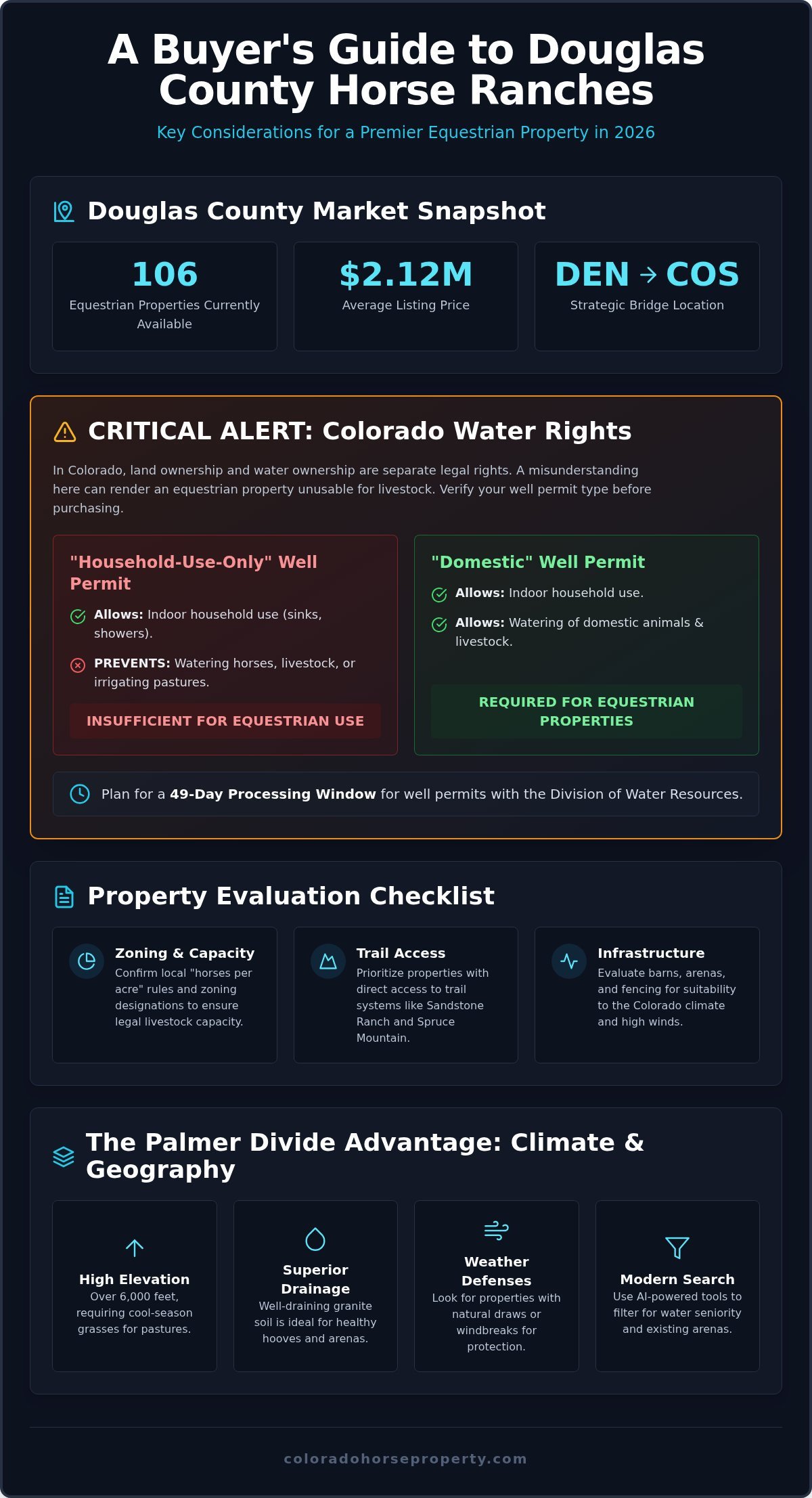
Douglas County occupies a unique position for the equestrian professional. It provides a tactical bridge between the corporate centers of Denver and the aerospace hubs of Colorado Springs. For those searching for horse ranches for sale Douglas County CO, the 2026 market is robust. There are currently 106 equestrian properties available, with an average listing price of $2,122,542. This region isn’t just about high-end real estate. It’s about a preserved rural identity. The county’s “Open Space” tax initiatives have successfully protected thousands of acres from urban sprawl. This ensures that your view of the Rampart Range remains unobstructed for decades.
Access to world-class trail systems like Sandstone Ranch and Spruce Mountain makes this the premier choice for serious riders. You can find general information on Douglas County that details its diverse geography, but for a horse owner, the reality is even more practical. The county maintains a commitment to multi-use trails that connect private estates to vast public lands. This connectivity is a major driver of property value in 2026. Buyers prioritize direct trail access over almost any other amenity.
To see the scale and beauty of local equestrian facilities, watch this feature on a prominent local ranch:
The Front Range Lifestyle: Balancing Luxury and Land
Living here means you don’t have to choose between a rustic lifestyle and modern convenience. High-net-worth buyers often select this area because they can reach luxury dining in Lone Tree or boutiques in Castle Rock within twenty minutes of leaving their barn. The culture is deeply rooted in equine excellence. It’s anchored by the Colorado Horse Park in Parker and supported by robust local 4-H chapters. This community infrastructure supports the long-term value of legacy horse ranches for sale Douglas County CO, making them stable, appreciating assets for families who value both privacy and professional proximity.
Geography and Climate Considerations for Horse Owners
The Palmer Divide creates a specific microclimate that ranch owners must master. This microclimate offers a distinct advantage over the flatter plains of Weld County or the drier southern exposure of El Paso County. Soil types here vary, but many areas offer the well-draining decomposed granite necessary for healthy hooves and arena longevity. At elevations often exceeding 6,000 feet, pasture management requires a focus on specific cool-season grasses. Winters bring heavy snow and high winds. Because of this, properties with natural draws or strategically placed windbreaks are highly prized. Effective drainage patterns are essential. They prevent spring mud issues in high-traffic paddock areas, which is a common pain point for livestock owners in lower-lying regions.
Navigating Douglas County Zoning and Water Rights
The legal framework of a ranch is as important as the quality of its soil. When browsing horse ranches for sale Douglas County CO, you must look beyond the fence lines to the underlying property rights. In Colorado, land ownership and water ownership are separate legal entities. This separation often surprises out-of-state buyers. Securing a property without the correct water decree can render a high-end equestrian facility unusable for livestock.
Decoding Colorado Water Law for Ranchers
Water rights are the primary driver of long-term property valuation. An adjudicated water right has been through a court process to confirm its priority and amount, providing much higher security than a non-adjudicated claim. Most rural properties in this area rely on the Dawson Aquifer for their supply. However, the type of well permit matters. A “household-use-only” permit is strictly for indoor use and does not legally allow for watering horses or irrigating pastures. You need a domestic well permit to provide for your animals. Understanding Water Rights in Colorado is essential because mistakes here are expensive to fix. Current data shows that the Division of Water Resources takes up to 49 days to process new permits, and water-related fees increased by 14 percent at the end of 2025. If you need help verifying these complex documents, you can consult with our transaction management team to ensure your investment is protected.
Zoning and Land Use Regulations
Agricultural One (A1) zoning in Douglas County requires a minimum of 35 acres and is designed to support full-scale ranching and farming operations. While Rural Residential (RR) zoning allows for homes on 5-acre lots, the livestock capacity is strictly regulated. The “Horses Per Acre” rule varies based on your specific designation and whether you are in a Planned Development (PD). Always review Douglas County’s Animal Regulations to confirm the current density limits for your specific parcel. As of April 2026, a new zoning amendment allows for up to 14 training sessions per week for non-owned animals, which is a significant win for owners looking to run small-scale professional operations. Protecting your rideable acreage also means checking for utility easements or public right-of-ways that could interfere with your privacy or facility placement.
Comparing Douglas County Equestrian Communities
Every corner of Douglas County offers a different utility for the horse owner. While the entire region is horse-friendly, the “vibe” and infrastructure vary significantly between the eastern plains and the western foothills. Selecting the right location for horse ranches for sale Douglas County CO involves weighing your need for professional equine services against your desire for total isolation. In 2026, buyers are increasingly looking at specific micro-markets to find the best balance of amenities and acreage. For readers who are also considering high-end investments in other regions, County Properties offers specialized real estate guidance for the Southern California market.
Parker is the traditional heart of the local equestrian scene. It centers around the Colorado Horse Park, a venue that anchors the local economy and draws international competitors. Living here puts you within minutes of specialized equine hospitals, major tack shops, and a dense network of professional trainers. Franktown acts as Parker’s quieter neighbor. It is the go-to destination for those seeking “ranchettes” or mid-sized agricultural parcels that still feel rural but remain close to suburban conveniences. Many buyers start their search for Horse Property for Sale in Colorado within this corridor because of the established community trail systems and the high concentration of boarding facilities that keep property values stable.
Larkspur and Castle Rock: Space and Sophistication
If you prefer dramatic topography over rolling plains, Castle Rock and Larkspur provide a more rugged landscape. Castle Rock features luxury estates often characterized by massive rock outcroppings and scrub oak. As you move south into Larkspur and Sedalia, the parcels grow in size. This area is where you find true 35-acre legacy ranches tucked into the ponderosa pines. Because these communities sit higher on the Palmer Divide, they experience more intense weather patterns. You’ll need to account for higher snow totals and wind protection when designing your facilities.
These larger holdings often require a deeper understanding of Colorado’s Prior Appropriation System for water rights, especially if you intend to maintain significant livestock numbers or irrigate hay fields. Fortunately, the A1 zoning common in Larkspur is often more flexible regarding multi-generational housing. This makes it easier to build secondary ranch hand quarters or a guest house for extended family. For those targeting Colorado Ranches for Sale with significant acreage, these southern communities offer the best opportunities for privacy and long-term land preservation. Sedalia, in particular, remains a prized location for those who want the ultimate “end of the road” seclusion while staying within a 45-minute drive of downtown Denver.
Evaluating Equestrian Infrastructure: Barns, Arenas, and Fencing
High-quality infrastructure distinguishes a functional ranch from a simple acreage. In 2026, the “Equestrian House” concept has become a standard for luxury horse ranches for sale Douglas County CO. This design philosophy treats the residence and the stable as a single, integrated living environment. It prioritizes ease of movement between the home and the barn while ensuring that architectural styles remain cohesive across the entire estate. When you evaluate a property, you aren’t just looking at the house. You’re assessing the utility and longevity of the specialized structures that support your livestock. For those seeking inspiration on how this concept is executed by premier custom home builders in other luxury markets, you can learn more about Galloway Realty.
A professional stable in the Colorado Front Range must handle extreme temperature swings. Proper insulation is essential to prevent condensation in the winter, while strategic ventilation prevents respiratory issues during the dry summer months. Stall sizes should be at least 12×12 feet to accommodate larger breeds comfortably. Wash racks with radiant heat and hot water are no longer optional for year-round training. Climate-controlled tack rooms are also vital for protecting expensive leather equipment from the arid Colorado air. Fire safety remains a top priority for large facilities. Always look for properties that store hay in a separate structure to minimize risk. Deciding whether to renovate an existing barn or start fresh is a common dilemma. You can explore the pros and cons in our guide to Horse Barns for Sale.
Arenas and Training Facilities
An indoor arena is a luxury that becomes a necessity during a Front Range blizzard. However, outdoor arenas are excellent for summer training if they have proper wind protection. The natural soil in the Palmer Divide often contains heavy clay or rock. You’ll likely need to amend your footing with washed sand or synthetic fibers to ensure horse joint health. A solid 6-8 inch sub-base of compacted road base is non-negotiable for proper drainage. Turnout paddocks and round pens should be positioned near the main barn for daily efficiency.
Safety should drive your fencing choices. While traditional wood looks iconic, high-tensile polymer or no-climb wire with a top rail requires significantly less maintenance. These options also withstand the heavy snow loads common in Larkspur and Sedalia without sagging. If you’re ready to see these facilities in person, start your AI-powered property search today to filter listings by specific barn and arena features.
Finding Your Legacy Ranch with AI-Powered Search
Legacy ranches aren’t found by scrolling through generic listing aggregators. Most traditional real estate sites fail the equestrian buyer because their search algorithms treat land like standard residential lots. A keyword search for “horse” on a national portal often returns suburban homes with horse-themed decor or properties that are merely near a street named “Horse Creek.” When you are looking for horse ranches for sale Douglas County CO, you need data that reflects the actual utility of the land. You need to know if a property is truly “horse-ready” with existing infrastructure or simply “horse-possible” land that requires significant capital investment to become functional.
The AI Difference in Equestrian Real Estate
Our proprietary technology changes how buyers interact with the market. Instead of manual filtering, our system identifies specific high-value features such as cross-fencing, water seniority, and the presence of loafing sheds. You can filter results by barn type, arena dimensions, and specific pasture acreage to ensure every listing you view meets your operational requirements. AI-Powered Horse Property Search reduces search time for buyers by identifying specific infrastructure like indoor arenas and specialized drainage systems before you ever schedule a showing. This precision prevents the frustration of visiting properties that lack the necessary zoning or physical space for your herd. By focusing on data points like soil quality and trail connectivity, we help you identify the best horse ranches for sale Douglas County CO that others might miss.
Expert Representation for Buyers and Sellers
Finding the right property is only the first step. Closing a ranch transaction requires a broker who understands the nuances of Horse Real Estate for Sale, from evaluating existing outbuildings to navigating complex water rights transfers. Mark and Alison Eibner bring 40 years of experience serving the Colorado Front Range through Realty Oasis. This deep local history is essential when dealing with Douglas County’s specific title and escrow hurdles. We provide full-cycle transaction management to ensure that legal certainties regarding zoning and water are resolved before you sign.
A successful purchase involves more than just a price agreement. It requires a partner who understands the Palmer Divide’s unique challenges and the long-term value of agricultural land. Our team manages the technical details of the sale so you can focus on the lifestyle you are building. If you are ready to stop sorting through irrelevant listings and start seeing properties that match your vision, you can Find CO Horse Property Faster with Our AI Search Tool. We combine high-tech search precision with old-school brokerage expertise to secure your perfect Colorado ranch.
Securing Your Colorado Equestrian Future
Douglas County remains the gold standard for Colorado ranching, but securing a property requires a blend of local knowledge and modern search tools. You now understand the critical importance of domestic well permits and the impact of 2026 tax assessments on your bottom line. Whether you choose the active community of Parker or the seclusion of Larkspur, your success depends on identifying truly functional infrastructure. Distinguishing between “horse-ready” land and “horse-possible” parcels is the key to protecting your investment and your livestock.
Navigating the market for horse ranches for sale Douglas County CO is simpler when you have 40 years of Front Range experience on your side. Led by Mark and Alison Eibner, our team at Realty Oasis combines deep industry tenure with specialized AI technology to pinpoint estates that generic search engines miss. We manage the complex transaction details, from water rights verification to title and escrow services, so you can focus on your horses. Our tools allow you to filter by barn type, arena size, and pasture acreage with total precision.
Search Douglas County Horse Ranches with Our AI Tool and take the first step toward your legacy ranch. The perfect Colorado landscape is waiting for you.
Frequently Asked Questions
How many horses can I have on 5 acres in Douglas County?
In Douglas County, Rural Residential (RR) zoning typically allows for horses on a minimum of 5 acres. The exact number of animals depends on specific livestock capacity calculations and any Homeowners Association (HOA) or Planned Development (PD) covenants. While the county provides general guidelines, you must verify the specific parcel’s limits. Our team helps buyers confirm these density requirements to ensure your property remains compliant with local agricultural standards.
What are the common water rights issues in Douglas County?
The most frequent issue is discovering a property has a household-use-only permit, which legally prohibits watering livestock. Because water rights are separate from land ownership in Colorado, buyers often face challenges with well permit limitations and the 49-day processing window for new applications. We verify the status of any well permits to ensure your ranch has the legal right to support horses before you close the transaction.
Is an indoor arena necessary for a horse ranch in Colorado?
While not legally required, an indoor arena is highly recommended due to the extreme weather patterns of the Palmer Divide. Winter blizzards and high winds can halt training for weeks at a time. Properties featuring indoor facilities tend to hold higher resale value and offer year-round utility. If you plan to train professionally or ride through the winter, an indoor space is a critical infrastructure component for any serious equestrian estate.
What is the average price per acre for horse property in Douglas County?
As of September 2026, the average cost per acre for horse ranches for sale Douglas County CO is $59,161. With a total of 106 equestrian properties currently on the market, the average listing price sits at $2,122,542. These values vary based on infrastructure quality, water seniority, and proximity to major hubs like Parker or Castle Rock. We use AI-driven data to help you identify properties that offer the best value for your specific budget.
Can I build a second home for a ranch hand on my property?
Building a secondary residence or ranch hand quarters is possible but depends heavily on your zoning designation and lot size. Agricultural One (A1) zoning, which requires a minimum of 35 acres, generally offers more flexibility for accessory dwellings than smaller Rural Residential plots. You will need to obtain specific building permits and pass zoning reviews. Our brokers assist in reviewing these land-use regulations to determine if your property can support additional housing.
What are the best horse trails in Douglas County, CO?
Douglas County is home to some of the finest trails on the Front Range, including the expansive systems at Sandstone Ranch and Spruce Mountain. These areas offer dedicated equestrian access and connect to thousands of acres of preserved open space. Many riders also frequent the trails near the Colorado Horse Park in Parker. Choosing a property with direct trail connectivity is one of the most effective ways to preserve the long-term value of your ranch.
How does the AI search tool find specific equestrian features?
Our proprietary AI search technology scans property data to identify specific equestrian infrastructure that traditional real estate sites often miss. It filters for features like cross-fencing, water seniority, indoor arena dimensions, and barn specifications. By analyzing listing descriptions and technical data, the tool distinguishes between generic horse-possible land and turn-key equestrian estates. This technology saves you time by ensuring you only visit properties that meet your exact animal husbandry and training needs.
Do I need a special inspection for a ranch well and septic system?
Yes, a specialized inspection is vital for any rural property. You should perform a well-flow test to ensure the system produces enough gallons per minute for your livestock and a water quality test to check for contaminants. Septic systems on ranches are often larger and more complex, requiring a separate certification. Our transaction management team coordinates these inspections with local experts to ensure your infrastructure is sound and your investment is legally protected.