
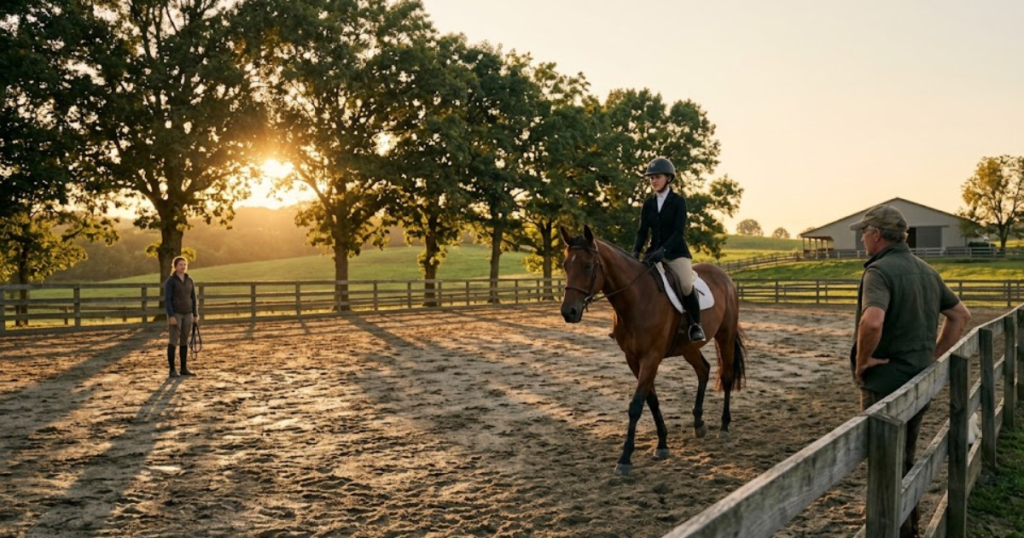
You rush home from work, tack up your horse, and head out to your brand-new outdoor arena for a relaxing 6:00 PM ride. As you turn onto the long side of the rail to ask for a canter, the Colorado sun drops just above the mountains and blasts you straight in the face.
You pull your visor down, but the glare is so intense your eyes are watering. You cannot see the jump set up at the far end of the ring. Your horse hesitates, confused by the massive, distorted shadows stretching across the sand. Instead of a productive training session, you spend the entire ride squinting, stressed, and fighting the light.
When buyers look at colorado horse ranches for sale, they usually focus on the depth of the sand and the quality of the fencing. But the physical compass orientation of the arena dictates whether that sand is actually usable when you have the free time to ride.
Here is how to evaluate the geometry of sunlight before you buy the farm.
Does the Outdoor Riding Arena Get Completely Blinded by Afternoon Sun Glare, or Is It Oriented to Offer Comfortable Evening Lighting?
Quick Summary: The Directional Dilemma
- The North-South Rule: The industry gold standard for an outdoor arena is a North-South orientation. This ensures the sun passes over the short sides of the arena, keeping it out of the rider's eyes during prime morning and evening training hours.
- The Glare Hazard: If an arena is built on an East-West axis, riding down the long rail during a Colorado sunset means staring directly into a blinding, low-angle sun. You cannot see your distances to jumps, and your horse cannot see the footing ahead.
- The Spooking Shadows: Poor orientation does not just blind you. It creates long, aggressive, high-contrast shadows across the sand in the late afternoon. To a sensitive horse, a sudden 40-foot shadow cast by a jumping standard looks like a bottomless trench, triggering sudden refusals and spooking.
- The Wind Deflection: In addition to the sun, a properly oriented arena takes the prevailing local winds into account, ensuring that afternoon gusts blow across the short side rather than sweeping blinding dust directly down the entire length of the track.
Arena footing and fencing matter, but the ring also has to work at the exact hours when you are actually able to ride. Orientation directly affects comfort, visibility, and training quality.
1. The East-West Blind Spot
An East-West arena is the most common mistake made by inexperienced property developers.
- The Commuter's Trap: Most amateur equestrians can only ride early in the morning before work or late in the evening after clocking out. During these exact times, the sun is sitting low on the Eastern or Western horizon.
- The Long-Rail Liability: If your arena's long sides, the 200-foot stretches where you do the majority of your galloping and extending, run East-West, you will spend half of every single lap staring directly into the sun.
- The Safety Risk: Riding into blinding glare is incredibly dangerous. It ruins your depth perception, making it impossible to accurately spot a distance to a fence or notice if a deer is standing just outside the arena gate.
2. The North-South Gold Standard
Professional equestrian facilities are plotted with a compass before a single tractor touches the dirt.
- The Cross-Sun Advantage: A proper arena is laid out on a North-South axis. As the sun rises in the East and sets in the West, it travels across the short width of the arena.
- The Peripheral Light: This means that when you are riding down the long rail during an evening sunset, the sun is positioned safely off your shoulder or entirely behind you. The entire arena is bathed in warm, comfortable, indirect light, allowing you to focus entirely on your horse's movement rather than fighting the glare.
A good arena is not just properly built; it is properly aligned. Compass orientation can be the difference between a ring that invites evening rides and one that constantly fights you.
3. The Shadow Spook Factor
Horses process light and contrast much differently than humans do.
- The Slow Adjustment: It takes a horse's eyes up to 20 or 30 minutes to fully adjust from bright light to dark shadows.
- The High-Contrast Contrast: When a poorly oriented arena casts long, sharp shadows across the footing from nearby trees, barn roofs, or jump standards, a horse does not see a lack of light. They perceive a physical, dark hole in the ground.
- The Refusal Zone: Forcing a horse to canter from a blindingly bright patch of sand directly into a pitch-black shadow line will naturally trigger their flight-or-fight response, causing them to slam on the brakes, drop their shoulder, or spook violently. Proper orientation minimizes these creeping, high-contrast evening shadows.
4. Wind Sheer and Dust Control
While the sun is the primary factor, you must also look at how the arena catches the wind.
- The Prevailing Gusts: In Colorado, prevailing storm winds often blast in from the North or Northwest.
- The Dust Tunnel: If an arena is oriented poorly against the wind, a 30 mph gust will catch the sand and funnel it down the entire length of the arena, creating a blinding dust storm that chokes both you and your horse. A strategically placed arena uses natural hills, mature timber lines, or nearby barn structures to break the prevailing wind before it ever hits the riding surface.
We Evaluate the Geometry Before You Buy
We do not just look at the dirt; we track the sun.
When Mark Eibner and Belinda Seville represent you in buying a rural equestrian estate, we pull the compass out. We analyze the exact orientation of the existing arenas, map the afternoon shadow lines from surrounding trees, and ensure that your new training facility is designed for maximum safety, comfort, and visibility during the hours you actually plan to ride.
Contact Us Today to find premium horse properties Colorado buyers trust for professional-grade arena engineering.
Browse Active Colorado Horse Properties: Browse active Colorado horse ranches for sale or ask our team about finding a premium horse property for rent Colorado while you search for an estate with perfect training infrastructure
Frequently Asked Questions (FAQ) About Arena Orientation
If I buy a property with an East-West arena, can I fix it with stadium lighting?
Stadium lighting only helps after the sun has completely set. During the critical golden hour right before sunset, high-powered LED lights cannot overpower the blinding, direct glare of the sun hitting you right in the eyes. Your only defense is to plant a thick row of fast-growing evergreen trees on the Western edge of the arena to artificially block the horizon.
Do indoor arenas need to be oriented North-South as well?
Yes, absolutely. While an indoor arena has a roof, it usually features massive open sliding doors or translucent polycarbonate wall panels to let in natural light. If an indoor arena is oriented East-West, the setting sun will blast through the Western doors, creating a blinding spotlight effect that is incredibly dangerous in an enclosed space.
Does arena orientation affect how fast the footing melts after a snowstorm?
Yes. A North-South arena generally receives more even, balanced sun exposure across the entire surface throughout the day. In an East-West arena that is built too close to a tall barn or a tree line on its Southern edge, the Southern half of the arena will remain trapped in freezing shade all winter, turning half your footing into a solid block of ice while the other half turns to mud.