
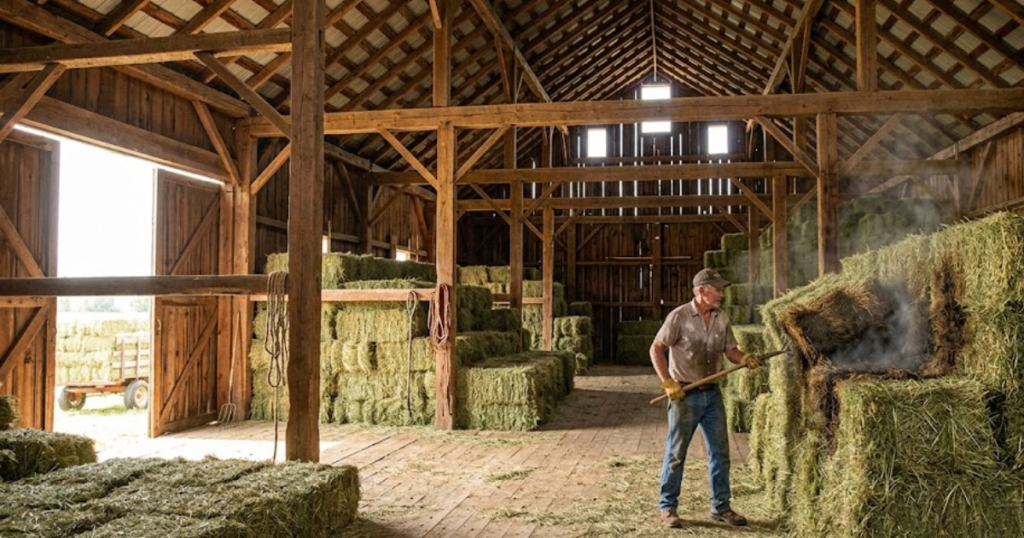
You buy a picturesque equestrian property with a classic wooden barn and a cozy hayloft. In early August, you secure a fantastic deal on 400 bales of premium, second-cutting orchard grass directly out of a neighbor’s irrigated field.
To make it all fit before winter, you pack the fresh, heavy bales tightly into every square inch of the loft, stacking them flush against the walls and right up to the ceiling joists. Three weeks later, you walk into the barn and notice a sweet, caramel-like tobacco smell. You climb up to the loft and find the air is incredibly humid and hot. You place your hand between two bales in the center of the stack, and it is burning hot to the touch.
You haven’t just stored horse feed; you have accidentally built a massive, ticking biological bomb directly over your horses’ heads.
When buyers evaluate colorado horse ranches for sale, they often look at a hay room and simply ask, “Will my yearly supply fit?” The real question an equestrian buyer must ask is, “Will it fit with enough room to breathe?”
Here is how to evaluate a property’s hay storage infrastructure for crucial fire safety.
Does the Barn Have Adequate Space to Cure Fresh, Tightly Bound Summer Bales Safely Without Risking Heat Buildup?
Quick Summary: The Spontaneous Combustion Threat
- The Biological Oven: Freshly baled hay is not entirely dead; it continues to cure for several weeks. During this process, microscopic bacteria and fungi consume residual moisture, generating intense internal heat.
- The Moisture Trap: If a farmer bales a field too quickly before the grass has fully dried, retaining more than 20% moisture, that heat will rapidly escalate.
- The Airflow Mandate: To prevent a catastrophe, fresh bales cannot be stacked like a solid brick wall. They require high ceilings, floor pallets, and strategic vertical air gaps, the chimney effect, to allow the extreme heat to escape.
- The Ultimate Risk: If a barn's hay storage area is too small, owners are forced to cram bales tightly up to the rafters. The trapped heat will eventually reach the flashpoint of 190°F, causing the hay to spontaneously combust and burn the entire barn to the ground.
Hay storage is not just about capacity. It is about whether the barn allows fresh forage to finish curing safely without turning the loft into a fire hazard over your horses' heads.
1. The Biology of a Hay Fire
To understand the infrastructure needed, you have to understand the science of curing hay.
- The Respiration Phase: For the first two to six weeks after baling, the plant stems continue to release moisture, and naturally occurring microbes begin to break down complex carbohydrates. This generates heat.
- The Moisture Tipping Point: If the hay was baled at the optimal 15% moisture, the heat peaks around 120°F and harmlessly dissipates. If it was baled at 20% to 25% moisture, the microbial activity explodes.
- The Ignition Threshold: As the temperature crosses 150°F, heat-resistant bacteria take over, driving the temperature even higher. Once the internal core of the stack reaches 175°F to 190°F, a chemical reaction occurs that no longer requires oxygen. The hay will spontaneously ignite, burning from the inside out.
2. The Spacing Calculus: The "Chimney" Method
A safe hay barn must be physically large enough to allow for strategic, open stacking.
- The Pallet Foundation: Fresh hay should never be stacked directly on a concrete or dirt floor, as it will wick moisture up from the ground. A properly sized storage area will allow you to lay down a grid of wooden pallets to create an air gap underneath the bottom tier.
- The Breathing Room: You cannot pack bales tight to the walls. You must leave at least an 18-inch gap between the outer bales and the barn walls. Furthermore, when stacking, you should alternate directions and leave small vertical gaps between columns, chimneys, so the heat can vent upward.
- The Space Deficit: If the property’s hay room is tiny, you will be forced to violate these safety rules just to fit your winter supply, dramatically increasing your risk of a catastrophic fire.
The question is not only whether the barn can hold your annual bale count. It is whether it can hold that hay with enough clearance and airflow to cure safely.
3. Passive Ventilation Infrastructure
The heat escaping from the bales has to go somewhere. If the building is sealed, the ambient temperature in the room will skyrocket.
- The Ridge Vents and Cupolas: A dedicated hay barn must have continuous ridge vents along the peak of the roof or open, louvered cupolas. This allows the rising thermal heat from the curing hay to exhaust naturally into the atmosphere.
- The Conex Death Trap: Many buyers assume they can just buy a metal shipping container, a Conex box, to store extra hay. This is highly dangerous for fresh hay. A metal box sitting in the August sun with zero ventilation will bake the fresh bales, trapping the moisture and accelerating the microbial heat cycle to dangerous levels.
4. The Detached Storage Advantage
The gold standard for equestrian property layout is separating the combustible fuel from the livestock.
- The Main Barn Liability: Storing 10 tons of highly combustible, heat-generating fuel directly inside the same structure where your horses sleep, where you park tractors, and where electrical wiring runs is an inherent, massive risk.
- The Outbuilding Ideal: When evaluating estates, look for a dedicated, pole-barn style hay shed located at least 50 to 100 feet away from the main stabling barn. If a spontaneous combustion event does occur, you will lose your winter feed supply, but you will not lose your horses or your primary facility.
We Evaluate the Infrastructure Before You Buy
We do not just measure the square footage; we evaluate the safety and logistics of your supply chain.
When Mark Eibner and Belinda Seville represent you in your rural property search, we analyze the operational footprint of the farm. We evaluate hay storage capacity, look for proper ventilation, and ensure you have the safe, detached infrastructure required to manage bulk feed deliveries without putting your herd at risk.
Contact Us Today to find premium horse properties Colorado buyers trust for safe, professional-grade agricultural layouts.
Browse Active Colorado Horse Properties: Browse active Colorado horse ranches for sale or ask our team about finding a functional horse property for rent Colorado featuring expertly designed hay and equipment storage
Frequently Asked Questions (FAQ) About Storing Fresh Hay
How can I monitor the temperature of my hay if it is tightly stacked?
Every farm owner should invest in a digital hay temperature probe, a long metal thermometer on a rod. For the first six weeks after a fresh summer delivery, you should drive the probe deep into the center of the stack daily. If the temperature hits 150°F, you need to start unstacking the bales to let them cool. If it hits 175°F, call the fire department immediately, as exposing that hot core to fresh oxygen can cause an instant explosion of flames.
How long does it take for fresh hay to finish sweating or curing?
Generally, hay goes through its most volatile sweat phase for the first two to three weeks after baling, but it can take up to six weeks for the moisture to completely stabilize. Once the bales feel cool to the touch deep inside the stack and the moisture content drops below 15%, the fire risk is virtually eliminated.
Should I put a fan in the hay loft to blow air on the bales?
No. While ventilation above the stack to exhaust heat is critical, blowing high-velocity air directly into a heating stack of hay can actually be dangerous. If the hay is already smoldering internally, forcing fresh oxygen into the pile can act like a bellows, rapidly accelerating a smolder into an active fire.