
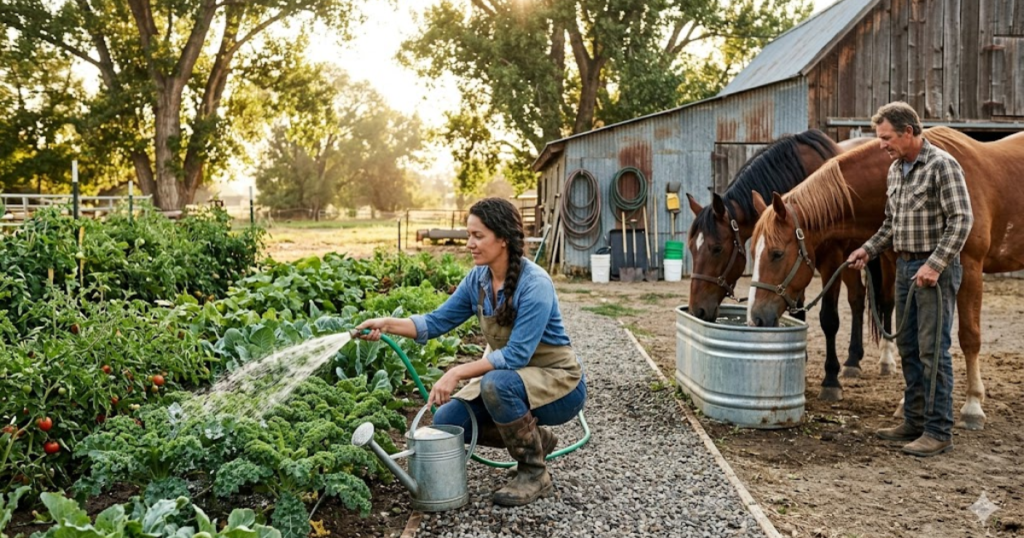
You find a gorgeous 5-acre property in a highly desirable county. It has a beautiful home, an empty three-stall barn, and a massive fenced area that looks perfect for a summer vegetable garden. You ask the seller if the well allows you to water your horses and your tomatoes. They hand you a massive, 40-page legal document called an “Augmentation Plan” and say, “It is all in here.”
Colorado water law is governed by the doctrine of “Prior Appropriation” meaning those who claimed the water first get to use it first. Because almost every river basin in the state is over-appropriated, getting permission to pull water out of the ground for outside use on smaller acreages is incredibly difficult.
An Augmentation Plan is the golden ticket that allows you to operate a small ranch, but it comes with strict mathematical boundaries. Here is how to understand what your plan actually allows before you buy the farm.
Does the "Augmentation Plan" Allow for Watering a Vegetable Garden + Horses?
Quick Summary: The Decreed Water Rights
- The Court's Ruling: An Augmentation Plan is a highly specific, legally binding document decreed by a Colorado Water Court. It dictates exactly what you can and cannot do with your well water.
- The Household Only Trap: Many smaller parcels under 35 acres are restricted to household use only wells, which strictly forbid watering horses or growing a vegetable garden. An Augmentation Plan is the legal workaround to lift that restriction.
- The Allotted Math: If a property has an Augmentation Plan, it will explicitly state the allowances. It usually grants a specific square footage of outside irrigation, like a 2,000-square-foot garden, and a specific number of large domestic animals, like 4 horses.
- The Replacement Requirement: In exchange for allowing you to water your garden and your herd, the plan requires you to replace the water you consume. This is typically done through the return flows of your engineered septic system or by legally purchasing replacement water credits.
An augmentation plan can make a small horse property workable, but only if your actual intended use fits the exact math and limits written into the decree.
1. The Limitation of the "Exempt" Well
To understand an Augmentation Plan, you must first understand why you need one.
- The 35-Acre Rule: In Colorado, if you buy a parcel that is 35 acres or larger, you are generally entitled to a domestic and livestock exempt well permit. This automatically allows you to supply three homes, water your herd, and irrigate up to one acre of gardens and lawns.
- The Subdivision Restriction: If you buy a parcel smaller than 35 acres, like a 5-acre or 10-acre lot, that was subdivided after 1972, the state will generally only issue a household use only well permit.
- The Legal Ban: A household use only permit is ruthless. It means the water cannot legally leave the inside of the house. You cannot fill a horse trough, you cannot wash your horse trailer, and you cannot irrigate a single tomato plant.
2. What is an Augmentation Plan?
An Augmentation Plan is a customized legal agreement designed to bypass the household use only restriction.
- The Out-of-Priority Pumping: The plan allows you to pump water out of priority, meaning you are taking water even though senior water rights holders need it downstream, by proving that you are replacing the water you consume.
- The Septic Return Flow: The most common way rural properties augment or replace their water is through their septic system. When you wash dishes or take a shower, that water goes into your septic leach field and slowly filters back down into the groundwater table, eventually returning to the stream system to satisfy the senior water rights holders.
The plan is not a casual permission slip. It is a structured legal mechanism that allows extra uses only because the water court has approved a specific replacement method.
3. Reading the Decree: The Horse and Garden Math
Does the plan allow for a vegetable garden and horses? Usually, yes, but you must read the exact numbers written by the judge.
- The Animal Unit Limit: The court decree will state a maximum allowance for watering livestock. It is incredibly specific. It might state: watering of up to four large domestic animals, horses or cattle. If the decree says four, you cannot legally bring a fifth horse onto the property.
- The Irrigation Cap: The decree will also limit your outside watering by square footage, not by the acre. It will commonly state something like: irrigation of up to 3,000 square feet of lawns, gardens, and greenhouse operations. You must measure your planned vegetable garden and any irrigated grass to ensure you do not exceed this exact square footage.
- The Annual Pumping Limit: Ultimately, the plan caps the total amount of water you can pump from the well in a single year, often expressed in acre-feet, for example 0.5 acre-feet per year. You must actively monitor your well meter to ensure your combined household, garden, and horse usage does not exceed this hard limit.
4. The Cost of Compliance
Operating under an Augmentation Plan requires active, ongoing management by the property owner.
- Metering and Reporting: Almost all Augmentation Plans require you to install a highly accurate, state-approved totalizing flow meter on your well pipe. You are legally required to read this meter and submit your water usage data to the state or your local water district every single year.
- HOA and District Fees: If your property is part of a larger subdivision's blanket Augmentation Plan, the HOA or local water district is responsible for buying the replacement water credits on the open market. They will pass this cost onto you through hefty annual water assessments or HOA dues.
We Read the Decree Before You Buy
We do not just trust the listing description; we read the water court decree.
When Mark Eibner and Belinda Seville represent you in buying a rural property, we bring specialized knowledge of Western water law to the table. We pull the well permits, locate the Augmentation Plan documents, and help you verify the exact mathematical allowances for livestock and irrigation so you know your herd and your garden are legally protected.
Contact Us Today to find premium horse properties Colorado buyers trust for secure, legally sound water rights.
Browse Active Colorado Horse Properties: Browse active Colorado horse ranches for sale or ask our team about finding a horse property for rent Colorado while you search for your permanent equestrian estate
Frequently Asked Questions (FAQ) About Augmentation Plans
Can I change an existing Augmentation Plan to allow for more horses?
It is technically possible but incredibly expensive and time-consuming. You would have to hire a water rights attorney and a hydrologist to file a formal amendment in Water Court, proving you have acquired additional replacement water to offset the new horses. The legal fees alone can cost tens of thousands of dollars.
What happens if I use more water for my garden than the plan allows?
If you exceed your annual pumping limit or your allotted irrigation square footage, the Colorado Division of Water Resources can issue cease-and-desist orders, levy massive financial fines, or physically lock your well to prevent further pumping.
Does collecting rainwater count against my Augmentation Plan?
In Colorado, standard residential rainwater collection, up to two 55-gallon rain barrels, is generally legally permitted for outdoor garden use and is completely separate from your well's Augmentation Plan limits. However, you cannot build massive, unpermitted catchment cisterns without specific legal authorization.