
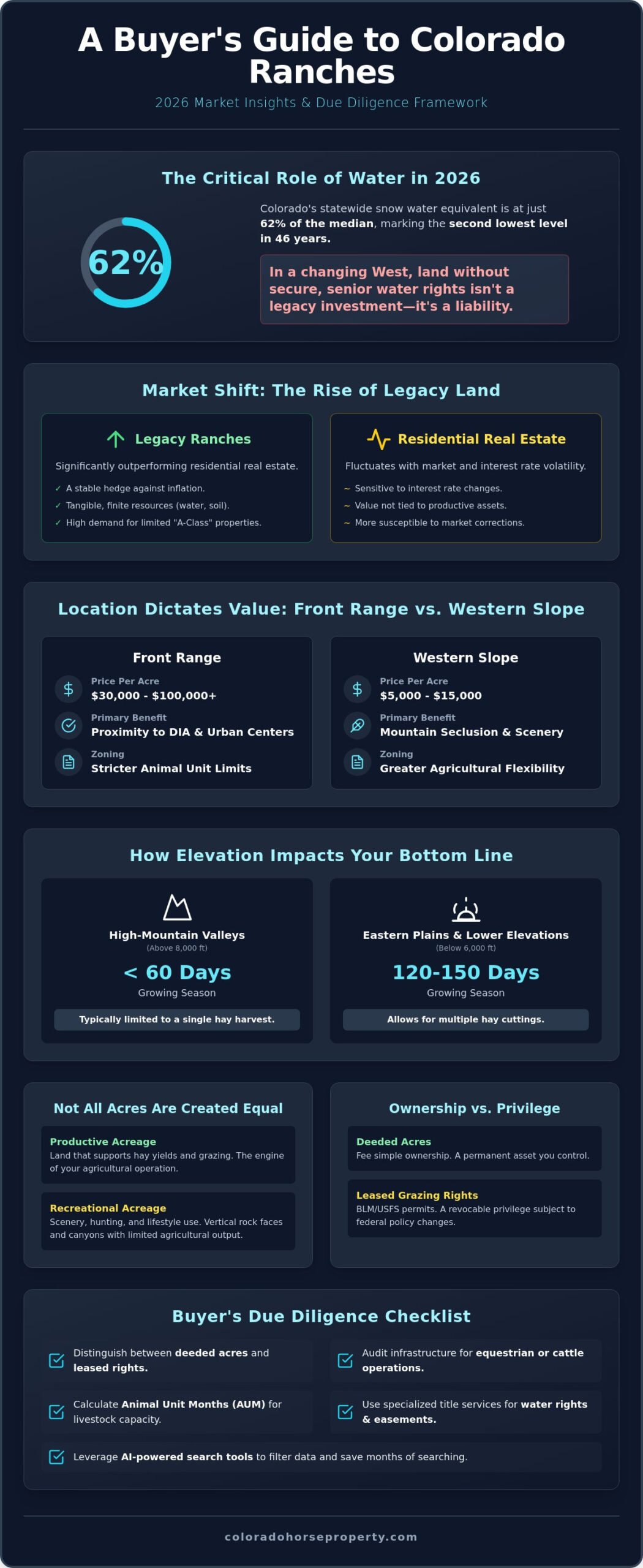
In 2026, Colorado’s statewide snow water equivalent sits at just 62% of the median, marking the second lowest level in 46 years. If you’re looking for Colorado ranches with acreage, you already know that land without secure water isn’t a legacy investment; it’s a liability. You need more than a scenic view. You need a property that can withstand the legal and environmental pressures of a changing West.
It’s frustrating to spend hours sorting through listings that fail to specify well permits or equestrian infrastructure. You want a property that supports your livestock and your financial future, but the fear of hidden easements or “buy and dry” lawsuits makes every decision feel high-stakes. We understand that specialized land requires a specialized approach, backed by decades of experience in the field.
This guide provides the technical roadmap you need to buy with confidence. We’ll break down the 2026 grazing rates, the ROI of senior water rights, and how to use AI-powered search tools to filter for turnkey equestrian setups. By the end, you’ll have the expertise to secure a ranch that truly lasts for generations.
Key Takeaways
- Discover why Colorado ranches with acreage are currently outperforming residential real estate as a stable, long-term legacy investment.
- Learn to distinguish between deeded acres and leased grazing rights to ensure your land supports your specific livestock or agricultural goals.
- Master essential metrics for success, including calculating AUM for cattle operations and auditing infrastructure for professional-grade equestrian estates.
- Understand why specialized title and escrow services are critical for navigating the legal complexities of water rights and land easements.
- See how AI-powered search tools can cut months off your property hunt by filtering for specific infrastructure and water data before you visit the site.
Navigating the 2026 Colorado Ranch Market
The 2026 market shows a distinct separation between standard residential plots and legacy land. Buyers are prioritizing tangible assets over volatile urban markets. To understand the foundation of these properties, one should first ask: What is a Ranch? In Colorado, it’s increasingly defined by its ability to offer self-sufficiency and long-term value. This shift has led to “legacy land” significantly outperforming residential real estate. While the housing market fluctuates with interest rates, high-quality Colorado ranches with acreage remain a stable hedge against inflation because they offer finite resources like senior water rights and productive soil.
Demand for these properties remains high, even as inventory for “A-Class” ranches stays limited. Mark and Alison Eibner, with their 40 years of experience, have observed a clear shift toward “lifestyle ranches.” These aren’t just agricultural operations; they’re multifunctional estates where recreation and utility overlap. Conservation easements also play a larger role now. These legal agreements help preserve the state’s agricultural heritage while providing landowners with substantial tax benefits, though they require careful due diligence to ensure they don’t block your future plans.
To better understand this concept, watch this helpful video:
Front Range vs. Western Slope: Where to Buy?
Location dictates price. In the Front Range, specifically around areas like Douglas County and Englewood, prices often exceed $30,000 per acre and can climb past $100,000 for prime parcels. These properties offer unmatched accessibility to Denver International Airport and urban amenities. In contrast, the Western Slope offers more mountain seclusion with prices typically ranging between $5,000 and $15,000 per acre. Zoning also varies by region. Front Range counties often have stricter limits on animal units per acre, while rural Western Slope counties generally provide more flexibility for large-scale equestrian or livestock use.
The Impact of Seasonality on Acreage Value
Altitude is the primary driver of operational costs for Colorado ranches with acreage. High-country ranches require significant budgets for snow removal and year-round access management. This elevation also impacts your bottom line through livestock capacity and hay production windows. Lower elevation properties might allow for multiple hay cuttings, whereas high-mountain land is often limited to a single harvest. In Colorado, the growing season for hay varies significantly by altitude, typically lasting 120 to 150 days on the Eastern Plains but shrinking to fewer than 60 days in high-mountain valleys above 8,000 feet.
Evaluating Acreage: Beyond the Surface of Colorado Land
When you evaluate Colorado ranches with acreage, don’t let the total number of acres distract you from the land’s actual utility. A 500-acre property might look impressive on a map, but if 400 of those acres are vertical rock faces or deep canyons, your productive capacity is limited. You must distinguish between “Productive Acreage,” which supports hay yields and grazing, and “Recreational Acreage,” which offers scenery and hunting but lacks agricultural output. Soil quality is another silent factor; poor soil won’t just lower your hay tonnage, it will compromise the health of your horse pastures and increase your reliance on expensive supplemental feed.
You also need to understand the difference between deeded acres and leased grazing rights. Many large Colorado ranches rely on permits from the Bureau of Land Management (BLM) or the U.S. Forest Service. While these leases allow you to run more head of cattle, they aren’t permanent assets. They are privileges that can be reduced or revoked based on federal policy. You only truly control the land you own in fee simple. If you’re unsure how to navigate these technical property details, you can find expert guidance at Colorado Horse Property.
Water Rights: The Lifeblood of the West
Water is the most litigated resource in the state. Under the Prior Appropriation Doctrine, “senior” rights have priority over “junior” rights during dry years. This means a neighbor with an older decree can legally shut off your irrigation if the stream flow is low. You can learn the specifics of this system through the official guidelines on Colorado Water Rights. For horse owners, the type of well permit is equally critical. A “Domestic” well usually allows for watering livestock and limited irrigation, while a “Household-Use Only” permit strictly forbids outside watering. For a deeper dive into these legalities, read our guide on Water Rights in Colorado: What Every Buyer Must Know.
Topography and Infrastructure Requirements
The layout of the land dictates your building costs. Arena placement requires flat, well-drained ground to avoid the massive expense of hauling in fill dirt or installing complex drainage systems. You should also consider the cost of utilities. Bringing power or high-speed internet to remote acreage can cost tens of thousands of dollars per mile. Existing infrastructure adds immediate value to Colorado ranches with acreage. High-quality perimeter fencing, established road maintenance agreements, and well-placed loafing sheds aren’t just conveniences; they are significant capital assets that protect your investment from day one.
Defining Your Ranch Type: Cattle, Equestrian, or Recreational?
Choosing between Colorado ranches with acreage requires a clear understanding of your operational goals. Your choice dictates everything from your daily chores to your long-term return on investment. A working cattle ranch is a production-based asset where success is measured in Animal Unit Months (AUM) and hay tonnage. If you’re entering the industry for the first time, the Colorado new farmer and rancher resources provided by the state can help you navigate the transition into agricultural management. These properties require high-functioning soil and reliable water distribution systems to remain profitable.
Equestrian estates prioritize the safety and training of horses over raw agricultural output. These properties often feature smaller acreage counts but higher infrastructure density, such as indoor arenas and specialized medical stalls. For those seeking a balance between work and play, recreational ranches focus on “amenity value,” such as private trout stream access or borders with National Forest land for hunting. If you aren’t ready for a large-scale operation, the “ranchette” model offers 10 to 35 acres. This size is ideal for hobbyists who want the rural lifestyle without the overhead of a full-scale commercial ranch.
Equestrian Infrastructure Essentials
A professional-grade riding arena is more than just a flat piece of dirt. It requires a multi-layered base and specific footing material that won’t pack down or blow away in the wind. When evaluating Colorado ranches with acreage, look for barns designed for the state’s semi-arid climate. Proper ventilation is critical; you need a system that allows for constant airflow to prevent respiratory issues while providing enough insulation to handle sub-zero winter nights. For a deeper look at these requirements, consult our Equestrian Real Estate Colorado: A Complete Buyer’s Guide.
Cattle and Agricultural Viability
Efficiency on a cattle ranch depends on your fencing and water distribution. You’ll need high-quality perimeter fencing to secure your boundaries and strategic cross-fencing to implement rotational grazing. This practice prevents overgrazing and keeps your pastures productive throughout the season. Water tanks should be distributed so livestock never have to travel more than a half-mile for a drink, which helps maintain animal weight. Maintaining an agricultural status in Colorado significantly reduces your carrying costs, as agricultural property is assessed at just 25% of its actual value for the 2026 tax year.
The Due Diligence Framework for Large Acreage
Standard due diligence for a suburban home won’t protect you when buying Colorado ranches with acreage. A simple title search might miss the fact that a neighbor has a prescriptive easement to drive cattle across your north pasture. You need a specialized framework that addresses land-specific risks. We partner with Meridian Title & Escrow because they understand the nuances of ranch closings, from complex legal descriptions to severed mineral rights. In Colorado, mineral rights are often “split,” meaning a third party could own the subsurface rights. If you don’t own the minerals, you may have limited control over surface access for resource extraction.
Environmental assessments are equally vital. You must check for historical land use, such as old sheep dips, abandoned pesticide storage, or buried fuel tanks from previous agricultural operations. These “hidden” liabilities can become expensive cleanup projects if they aren’t identified during the contingency period. Don’t assume that because land looks pristine, it’s free of contamination.
Survey and Boundary Verification
Boundary disputes are common in rural Colorado, where old fences often don’t align with the legal descriptions in the deed. You shouldn’t rely on a decades-old survey or a neighbor’s handshake agreement. An ALTA (American Land Title Association) survey is the gold standard for Colorado ranches with acreage. It identifies encumbrances, encroachments, and public access points that a standard survey might miss. Be particularly wary of prescriptive easements. If a neighbor has used a road on your property for twenty years without objection, they may have a legal right to continue doing so, even after you take ownership.
Legal and Financial Coordination
Managing a ranch transaction requires a team that speaks the language of land. Our specialized transaction managers coordinate between lenders, title companies, and surveyors to ensure no detail is overlooked. If you’re selling another asset to fund your purchase, you’ll likely use a 1031 Exchange. This tax-deferral strategy is essential for agricultural land investors, allowing you to move equity from one property to another without an immediate tax hit. For a full breakdown of the buying process, see The Ultimate Guide to Buying Colorado Land in 2026.
To ensure your legacy property is protected from the start, secure expert buyer representation for your next ranch acquisition.
Finding Your Legacy with AI-Powered Search
Finding the right Colorado ranches with acreage often feels like a full-time job. Standard real estate websites rely on generic keyword searches that return thousands of irrelevant results. You might search for “horse property” and find a suburban home on a half-acre with a shed. Our proprietary AI-Powered Horse Property Search changes this process. Instead of scrolling through endless photos, the system analyzes technical data points like well permit types, arena dimensions, and fencing materials. This technology reduces the search timeline from months to just a few days by only presenting properties that meet your specific infrastructure requirements.
A recent case study highlights the power of this data-driven approach. Our system identified a 100-acre property with senior water rights before it ever reached a public listing. Because the AI could parse the specific legal data regarding the water decree, our client was able to move faster than the competition. This “first-look” advantage is critical in a market where high-quality legacy land is in short supply. By combining modern tech with traditional land expertise, you gain a significant edge in securing a property that actually fits your operational needs.
Personalized Buyer Representation
Technology is only half of the equation. Our brokerage division, Realty Oasis, provides a no-nonsense, expert approach to buyer representation. Mark and Alison Eibner bring 40 years of local network connections to every transaction. These relationships often provide access to “pocket listings” and off-market opportunities that generic search tools miss. When you work with us, you aren’t just getting a realtor; you’re getting a partner who understands the difference between a decorative barn and a functional equestrian facility. For a broader look at the market, explore our Horse Property for Sale in Colorado: The Ultimate 2026 Buyer’s Guide.
Next Steps: Your Colorado Ranch Journey
Your search for a legacy property shouldn’t be a source of stress. The first step is setting up a custom AI search profile that reflects your exact requirements for acreage, water, and infrastructure. Once the system identifies potential matches, we’ll schedule a private consultation to discuss the technical due diligence for those specific parcels. Whether you’re looking for a working cattle operation or a private mountain retreat, we have the tools and the experience to guide you home. Start your AI-powered search for Colorado ranches with acreage today.
Secure Your Colorado Legacy
Securing a legacy property in the American West requires a precise balance of technical due diligence and modern data tools. You now understand that the true value of Colorado ranches with acreage depends on senior water rights, soil health, and a clear distinction between deeded land and grazing leases. Skipping these essential steps can quickly turn a dream investment into a significant legal burden. Success in 2026 demands that you look beyond the scenery to the underlying productivity and legal standing of the land.
With 40 years of Colorado real estate expertise, Mark and Alison Eibner provide the direct representation you need to navigate these high-stakes complexities. Our specialized AI technology for equestrian land filters out the noise; it ensures you only spend time on properties that meet your exact standards for infrastructure and utility. Don’t leave your family’s legacy to chance in a competitive and changing market. We have the local network and the technical tools to find the right parcel before the competition even knows it’s available.
Find your dream Colorado ranch with our AI-powered search tool.
We look forward to helping you find a property that supports your lifestyle and your horses for generations to come.
Frequently Asked Questions
How many acres do I need for a horse property in Colorado?
You generally need a minimum of 5 to 10 acres for a small horse setup, though 35 acres is the standard threshold for more flexible well permitting and zoning. While some counties allow horses on smaller plots, self-sustaining grazing in Colorado’s semi-arid climate often requires 15 to 30 acres per horse if you don’t want to rely entirely on supplemental hay.
What are the most important water rights for a Colorado ranch?
Senior water rights are the most critical asset because they have priority during drought years under the state’s prior appropriation system. You must also distinguish between well permits; a “domestic” permit usually allows for livestock watering and small-scale irrigation, while a “household-use only” permit strictly forbids any outdoor water use.
Do Colorado ranches with acreage qualify for agricultural tax exemptions?
Yes, land qualifies for the agricultural assessment if it’s used for primary, profit-motivated agricultural purposes like hay production or commercial grazing. For the 2026 tax year, agricultural property is assessed at 25% of its actual value, which provides a significant tax advantage over standard residential properties.
Can I build a second home or guest house on my ranch acreage?
Building a second dwelling depends on your specific county zoning and the legal capacity of your well permit. Many Colorado ranches with acreage have domestic well permits that allow for multiple “units,” but you must verify that the county’s density requirements and Accessory Dwelling Unit (ADU) codes permit a second structure.
What is the difference between a working ranch and a lifestyle ranch?
A working ranch is a production-oriented business focused on agricultural output, such as cattle weight gain or hay tonnage. A lifestyle ranch prioritizes personal recreation, equestrian hobbies, or conservation, though it can still maintain agricultural tax status through a grazing lease with a local producer.
How does the AI search tool find specific equestrian features like arenas?
The AI search tool parses property metadata and listing data to identify technical infrastructure that standard keyword searches miss. It filters for specific dimensions of indoor arenas, the presence of specialized footing, and the count of stalls, allowing you to target turnkey facilities without sorting through thousands of irrelevant residential listings.
What are the typical closing costs for a large acreage ranch in Colorado?
Closing costs generally range from 1% to 3% of the purchase price. For large-scale land, these costs include specialized title insurance for water rights, the expense of an ALTA survey, and fees for legal review of conservation easements or mineral title searches.
Is it possible to buy a ranch with mineral rights included?
It’s possible, but mineral rights are frequently severed from the surface rights in Colorado and owned by third parties. You need a specialized mineral title search during your due diligence period to determine if the rights are intact or if an energy company has the legal right to access your surface for extraction.