
What if the lush, green pasture you’re eyeing today legally belongs to a city fifty miles away? In the 2026 market, you aren’t just buying acreage; you’re buying a legal decree that determines whether your investment thrives or turns to dust. It’s a valid concern for any serious buyer. You likely understand that securing Colorado land with water rights for sale is the only way to protect your livestock and crops long-term, yet the Prior Appropriation Doctrine remains a confusing maze of senior versus junior claims.
Succeeding in this market requires more than just a standard real estate agent. It demands specialized expertise and a data-driven approach to resource management. This guide empowers you to master these legal complexities and shows you how to identify high-value land with protected water rights using professional AI search tools.
We’ll examine the new January 2026 well construction regulations, analyze current market pricing for ditch shares, and provide a roadmap for filtering listings to find the most resilient properties in the Front Range and beyond. By the end of this guide, you’ll have the tools to secure a property that isn’t just beautiful, but legally secure for generations to come.
Key Takeaways
- Learn why land value in Colorado is defined by legal water decrees rather than acreage size, ensuring you invest in productive property.
- Master the Prior Appropriation Doctrine to identify senior water rights that provide security during periods of drought.
- Follow a professional due diligence checklist to verify decree numbers and historical use records, protecting your investment from claims of abandonment.
- Discover how to use specialized AI tools to find Colorado land with water rights for sale that meets your specific irrigation and livestock needs.
- Understand the critical differences between surface rights and ditch company shares to secure the most reliable water infrastructure for your goals.
Understanding Colorado Water Rights: Why They Are the Most Valuable Asset on Your Land
In Colorado, land is a secondary asset. The primary asset is the legal authority to use the water that touches that land. Legally, this is known as a usufructuary right. It doesn’t mean you own the physical molecules of water; it means you own the right to use a specific volume for a beneficial purpose. This distinction is vital for anyone looking for Colorado land with water rights for sale. You can own a thousand acres, but if you don’t hold the decree to divert water, your ability to graze livestock or grow crops is strictly limited by rainfall.
A water right is a real property interest that can be bought, sold, or leased separately from the land. This separation creates a complex market where the deed to the property and the water decree often travel different paths. Most of these regulations stem from The Prior Appropriation Doctrine, which dictates that the first person to put water to use has the senior right. Understanding this hierarchy is the difference between a thriving ranch and a dry investment.
To better understand how these rights look on a functional property, watch this helpful video:
The Economic Impact of Water on Colorado Real Estate
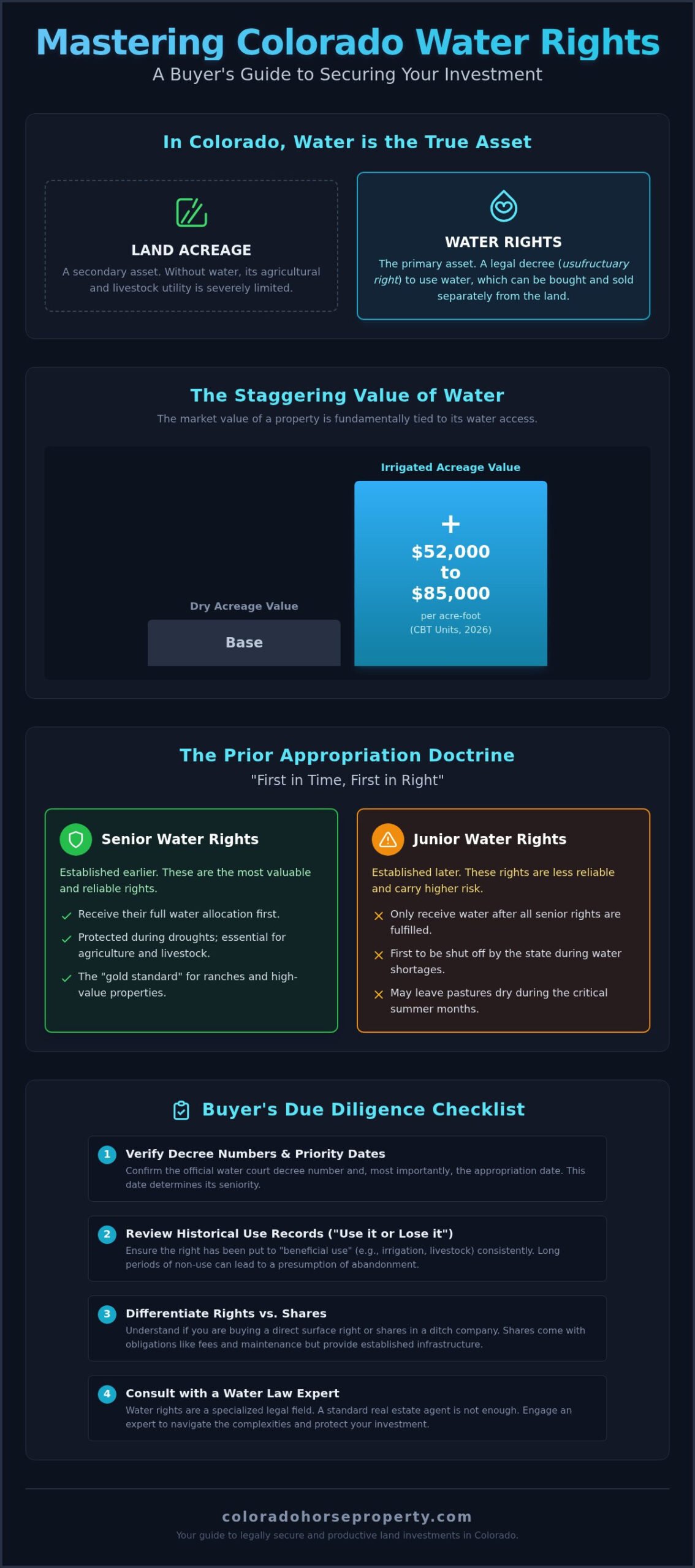
The financial gap between dry land and irrigated acreage is staggering. In the northern Front Range, for example, Colorado-Big Thompson (CBT) units traded between $52,000 and $85,000 per acre-foot in early 2026. Without these rights, a property’s utility for equestrian estates or agricultural operations drops significantly. Investors prioritize water decrees because they offer long-term protection in a semi-arid climate where drought is a constant reality. When evaluating Colorado land with water rights for sale, the decree’s priority date often carries more weight in the appraisal than the quality of the soil itself.
Beneficial Use: The Legal Requirement for Keeping Your Rights
Colorado operates on a “use it or lose it” principle. To maintain a water right, the owner must demonstrate “beneficial use,” which includes irrigation, livestock watering, and domestic consumption. If a right goes unused for an extended period, it can be presumed abandoned and cancelled by the state. Buyers must review historical use records to ensure the right is active and hasn’t been diminished through neglect. This due diligence ensures that the high-value asset you’re paying for actually exists in the eyes of the Colorado Water Court.
The Prior Appropriation Doctrine: How Water Seniority Impacts Property Value
Colorado operates under a strict legal hierarchy known as Colorado’s Prior Appropriation System. This framework is built on the principle of “first in time, first in right.” Essentially, the person who first diverted water and put it to a beneficial use holds the highest priority. When water levels drop, the state engineer enforces this hierarchy by shutting off junior users to ensure senior holders receive their full decreed amount. If you’re evaluating Colorado land with water rights for sale, the priority date is the single most important variable in determining the property’s long-term utility.
The Colorado Water Court system manages these rights through a formal adjudication process. Every decree carries two specific dates: the appropriation date and the adjudication date. For horse owners, this legal structure becomes a reality during the peak heat of July and August. If your property relies on a junior right, you might find your irrigation ditches dry exactly when your pastures require the most moisture. Senior rights provide the reliability needed to maintain healthy forage and consistent livestock hydration throughout the hottest months of the year.
Senior Water Rights: The Gold Standard for Ranches
Senior rights are the most coveted assets in the state’s real estate market. These typically consist of decrees with 19th-century appropriation dates. Because they sit at the top of the priority list, they’re rarely “called” or restricted by state officials, even during severe droughts. Investors pay a significant premium for these rights because they represent guaranteed water security. When you review a listing, look for appropriation dates prior to 1900. These legacy rights ensure that your operation remains functional when others are forced to stop diverting.
Junior Rights and Augmentation Plans
Many modern properties, especially those developed in the last fifty years, rely on junior rights. These are the first to be curtailed during dry seasons. To manage this risk, many owners utilize augmentation plans. These are court-approved arrangements that allow you to divert water “out of priority” by replacing the depletions with other water sources, such as stored reservoir water. It’s a complex but effective way to manage water scarcity in shared developments. If you’re struggling to decode the legal filings on a specific parcel, you can search for water-rich listings that already have established augmentation plans in place to protect your investment.
Types of Water Access: From Irrigated Acreage to Domestic Wells
Identifying the right Colorado land with water rights for sale requires a clear understanding of where that water originates. Most buyers deal with either surface water, diverted from streams and rivers, or groundwater accessed through a well. Surface water is highly visible but strictly regulated by ditch company bylaws. In contrast, groundwater involves complex geological classifications. Understanding the Colorado Doctrine is essential here, as it clarifies how the state manages these resources as public property while granting private usage rights based on location and source.
Geology plays a massive role in your legal rights. Tributary water is physically connected to a surface stream, meaning its use can affect other senior water holders. Non-tributary water is found in deep aquifers and is often considered a finite resource not connected to the surface system. The distinction determines whether you need a court-approved augmentation plan to pump your well or if you can operate under a standard permit. Knowing the source ensures you don’t accidentally buy a property with a water supply that could be restricted during a call on the river.
Irrigation Ditch Shares and Certificates
When you buy irrigated acreage, you aren’t usually buying the water directly from the state. Instead, you’re buying shares in a mutual ditch company. Your ownership is evidenced by a stock certificate. This certificate grants you a pro-rata share of the water the company is decreed to divert. It’s important to remember that owning the land doesn’t automatically mean you own the shares; they must be specifically transferred at closing. You’ll also be responsible for annual assessments. These fees cover the physical maintenance of the headgates and channels that deliver water to your property line.
Colorado Well Permits for Horse Properties
For many equestrian buyers, a well is the only source of water for both the home and the barn. Colorado uses the “35-acre rule” to determine permit eligibility. If your parcel is 35 acres or larger, you’re generally entitled to a domestic well permit. This allows for household use, fire protection, and the watering of domestic animals and livestock. On smaller parcels, you might be restricted to a “household-use only” permit, which forbids outdoor irrigation or watering horses. You can find more detail on acreage requirements in our Guide to Buying Colorado Land. When searching for Colorado land with water rights for sale, always verify the permit type to ensure it supports your specific livestock needs.
Due Diligence Checklist: Verifying Water Rights Before You Close
When you are browsing Colorado land with water rights for sale, you must move beyond the property’s aesthetic appeal. Verifying the legal standing of a water decree is a technical process that requires specific documentation. Don’t rely on verbal promises from a seller or general descriptions in a listing. Instead, follow this systematic checklist to ensure your investment is secure and functional from the day you take possession.
- Step 1: Obtain the Decree or Permit Number. Every legal water right in the state is tied to a specific Water Court Decree or a Well Permit number. This allows you to verify the priority date, the volume of water allowed, and the specific beneficial uses permitted by law.
- Step 2: Review Historical Use Records. In Colorado, water rights can be lost through abandonment. If a right hasn’t been put to beneficial use for ten or more years, it may be placed on the decennial abandonment list. Reviewing the diversion records ensures the right is active and defensible.
- Step 3: Verify the Point of Diversion. The decree specifies a “Point of Diversion,” which is the exact geographic location where water is taken from a stream or pumped from the ground. You must confirm that the physical headgates or well casings on the property match the coordinates filed with the state.
- Step 4: Consult a Specialized Expert. For high-value acquisitions, hiring a water attorney or a water engineer is non-negotiable. They can interpret complex decree language and ensure there are no hidden encumbrances or shared usage conflicts.
- Step 5: Explicit Deed Transfer. Water rights don’t always automatically “run with the land.” The closing deed must explicitly state that the water rights, ditch shares, or well permits are being transferred to the buyer to avoid future ownership disputes.
Common Red Flags in Water Rights Listings
Be wary of listings that use vague phrases like “water available” or “sub-irrigated” without providing a decree number. These terms often describe natural moisture rather than a legal right to divert water. Ponds are another common trap; many decorative ponds lack a formal “storage right” decree, meaning they could be ordered drained during a drought. Always compare the advertised irrigated acreage against the amount actually decreed by the court. If a listing claims forty irrigated acres but the decree only covers twenty, you’re looking at a significant valuation discrepancy.
Working with Title and Escrow Experts
It’s a common misconception that standard title insurance covers water rights. Because water is a separate property interest, most policies specifically exclude it. To protect yourself, you should request a “Water Right Title Opinion” from a specialized firm. This document provides a legal history of the water right’s ownership. At Realty Oasis, we prioritize this level of security through our partnership with Meridian Title & Escrow. This collaboration ensures that every nuance of the water transfer is handled correctly during the transaction management phase. To start your search with confidence, you can browse listings with verified water data using our specialized search tools.
Leveraging AI to Find Colorado Land with Water Rights for Sale
Traditional real estate platforms often fail because they treat water as a binary feature; a property either has it or it doesn’t. In reality, the utility of Colorado land with water rights for sale depends on the complex interplay of decree dates, ditch company health, and soil composition. Our proprietary AI-powered search tool changes this dynamic by identifying water-rich parcels before they reach mainstream databases. By indexing specific resource data, we allow investors to move past surface-level marketing and focus on the legal and physical reality of the land.
While the AI provides the raw data, Mark and Alison Eibner provide the essential context. With 40 years of experience in the Colorado Front Range, they understand the nuances of specific water districts and ditch companies that an algorithm might miss. This combination of high-tech filtering and seasoned human expertise ensures you don’t just find a property; you find a sustainable asset. Local expertise is irreplaceable when navigating the administrative hurdles of different water basins and avoiding “buy and dry” scenarios.
The Future of Equestrian Real Estate Search
Modern buyers are moving beyond simple acreage searches. They’re looking for utility. Our platform analyzes soil types, zoning restrictions, and water decrees simultaneously. This multi-layered approach ensures that the irrigated pasture you see on the map is actually supported by the legal rights required for your operation. You can see this technology in action by visiting our Equestrian Real Estate Colorado Guide. We filter for specific equestrian features like barns, arenas, and turnout areas to ensure the property meets every functional need for your livestock.
Your Next Steps: From Search to Settlement
Your due diligence should start long before you visit a property in person. We recommend requesting a customized Water Right Portfolio for any prospective land. This document compiles the decrees, permit history, and ditch share data into a clear, actionable report. Once you’ve identified a strong candidate, scheduling a consultation with our specialists is the next logical step. We’ll help you navigate the transition from data gathering to a successful closing. Search Colorado land with water rights now to begin your investment journey with a team that understands the value of every drop.
Secure Your Colorado Legacy with Protected Water Rights
Securing a productive future in the Front Range requires a shift in perspective. You aren’t just looking for land; you’re looking for a legal guarantee of resource availability. The Prior Appropriation Doctrine makes the age of your water decree more important than the size of your parcel. By focusing on senior rights and conducting rigorous due diligence on historical use, you protect your investment from the volatility of a semi-arid climate. Colorado land with water rights for sale is a finite asset. The most resilient properties are often claimed before they reach the general public.
With over 40 years of specialized experience, our team at Realty Oasis provides the technical oversight and local knowledge required to navigate these complex transactions. We combine Mark and Alison Eibner’s deep expertise with our proprietary search technology to help you identify high-value opportunities. You can find your Colorado land with water rights using our AI search tool to filter for the specific irrigation and equestrian features your lifestyle demands. Take the next step toward owning a property that is as legally secure as it is beautiful.
Frequently Asked Questions
Do water rights automatically come with the land in Colorado?
No, water rights don’t automatically transfer with the land in Colorado. They’re considered a separate property interest that can be severed from the surface acreage. When you search for Colorado land with water rights for sale, you must ensure the deed specifically includes the water decree or ditch shares. Without this explicit language, you might end up owning the land without any legal right to use the water flowing across it.
How can I tell if a Colorado well permit allows for livestock watering?
You must examine the “Conditions of Approval” listed on the actual well permit document. Permits are categorized by specific uses, and a “household use only” permit strictly forbids watering livestock or horses. If you’re on a parcel smaller than 35 acres, your permit options might be limited. Always verify the permit number with the Division of Water Resources to confirm it supports your specific animal husbandry goals.
What is the difference between senior and junior water rights?
Seniority is based on the “first in time, first in right” principle. A senior right has an older appropriation date and is fulfilled first during periods of shortage. Junior rights are newer and are the first to be shut off when water levels drop. This seniority is why 19th-century decrees command a massive price premium; they offer the only true security for your pastures during a drought year.
How much does it cost to maintain water rights on a Colorado ranch?
Maintenance costs depend on your specific water source. Ditch companies charge annual assessments for canal repairs, headgate management, and administration. These fees vary widely by company and the number of shares you own. You’re also responsible for the physical upkeep of your own delivery pipes and infrastructure. Failing to maintain these systems can lead to delivery issues or even legal claims of abandonment if the water isn’t used.
Can I sell my Colorado water rights separately from my land?
Yes, you can sell or lease your water rights independently of the acreage. This flexibility allows owners to generate income by leasing water to municipalities or other agricultural users. However, once the rights are severed, the land’s value for agriculture or livestock usually plummets. This is why it’s vital to confirm the water rights are still attached to any Colorado land with water rights for sale you’re considering for purchase.
How do I verify the historical use of water on a property I want to buy?
Verification requires a search of the state’s diversion records and ditch company ledgers. These logs show exactly how much water was diverted and when it was put to beneficial use. Buyers should look for a continuous record of use over the last decade. If the water hasn’t been used for ten years, it could be facing an abandonment decree, which would render the right worthless in court.
What is a “water call” and how does it affect my property?
A “water call” is a formal enforcement of the priority system. When a senior user downstream isn’t getting their decreed amount, they place a call on the river. The state engineer then orders junior users upstream to stop diverting water immediately. If you hold a junior right, a call can happen during the hottest part of summer, leaving your crops and pastures without any irrigation for weeks.
Is a 35-acre parcel required to have a domestic well in Colorado?
A 35-acre parcel isn’t strictly required, but it’s a major legal threshold. Owners of 35 acres or more are generally entitled to a “domestic” well permit, which allows for livestock watering and small-scale irrigation. On smaller lots, the state often limits you to “household use only” permits. These restricted permits only allow for indoor use, meaning you can’t legally water a horse or a garden without an augmentation plan.