
What if the “horse-ready” facility you’re eyeing is actually a legal liability that could stall your training program? Many listings for Colorado horse property for serious competitors look perfect on the surface, but they often hide issues like inadequate arena drainage or restrictive zoning that limits your commercial potential. In 2026, with the average equestrian property price reaching $2.1 million, you can’t afford to overlook technical details like “Domestic” well permits or soil-specific footing that affects daily soundness.
You already know that a high-performance horse requires more than just a fenced pasture; it needs an environment designed for peak athletic output and recovery. This guide will show you how to identify and secure professional-grade equestrian facilities that meet the rigorous demands of competitive training while ensuring full legal compliance for your business. We’ll analyze the critical differences between residential and commercial zoning, the impact of the latest 2026 water well regulations, and why proximity to hubs like the Colorado Horse Park is essential for your training schedule and long-term resale value.
Key Takeaways
- Learn why high-performance footing like GGT or specialized felt is the most critical infrastructure investment for maintaining equine soundness.
- Navigate complex 2026 water regulations to ensure your property has the legal well permits necessary for arena maintenance and livestock care.
- Identify the specific “Animal Unit” zoning codes required to run a compliant commercial training operation on a Colorado horse property for serious competitors.
- Discover the “Parker Advantage” and other strategic locations that minimize travel time to Colorado’s premier show circuits and veterinary hubs.
- Leverage AI-powered search technology to filter for technical specifications that generalist real estate platforms typically miss.
Beyond the Picket Fence: Defining Colorado Horse Property for Serious Competitors
Search filters on generalist real estate sites often categorize any property with a fence and a shed as “horse-ready.” For athletes engaged in competitive equestrian disciplines, this lack of specificity is a major hurdle. A professional facility isn’t just about the barn. It is about the technical infrastructure that supports peak performance and horse health. Finding a true Colorado horse property for serious competitors requires looking beyond aesthetic appeal to evaluate arena footing depth, drainage systems, and the legality of commercial operations.
In the current market, “equestrian” has become a buzzword that often masks functional deficiencies. A serious athlete needs to know if the soil can handle a 15,000-square-foot indoor arena or if the well permit allows for the high water volume required to maintain professional-grade footing. Generalist apps don’t filter for these nuances, making it easy to waste time on properties that can’t support a rigorous training schedule.
To better understand this concept, watch this helpful video:
Hobby Farm vs. Professional Training Facility
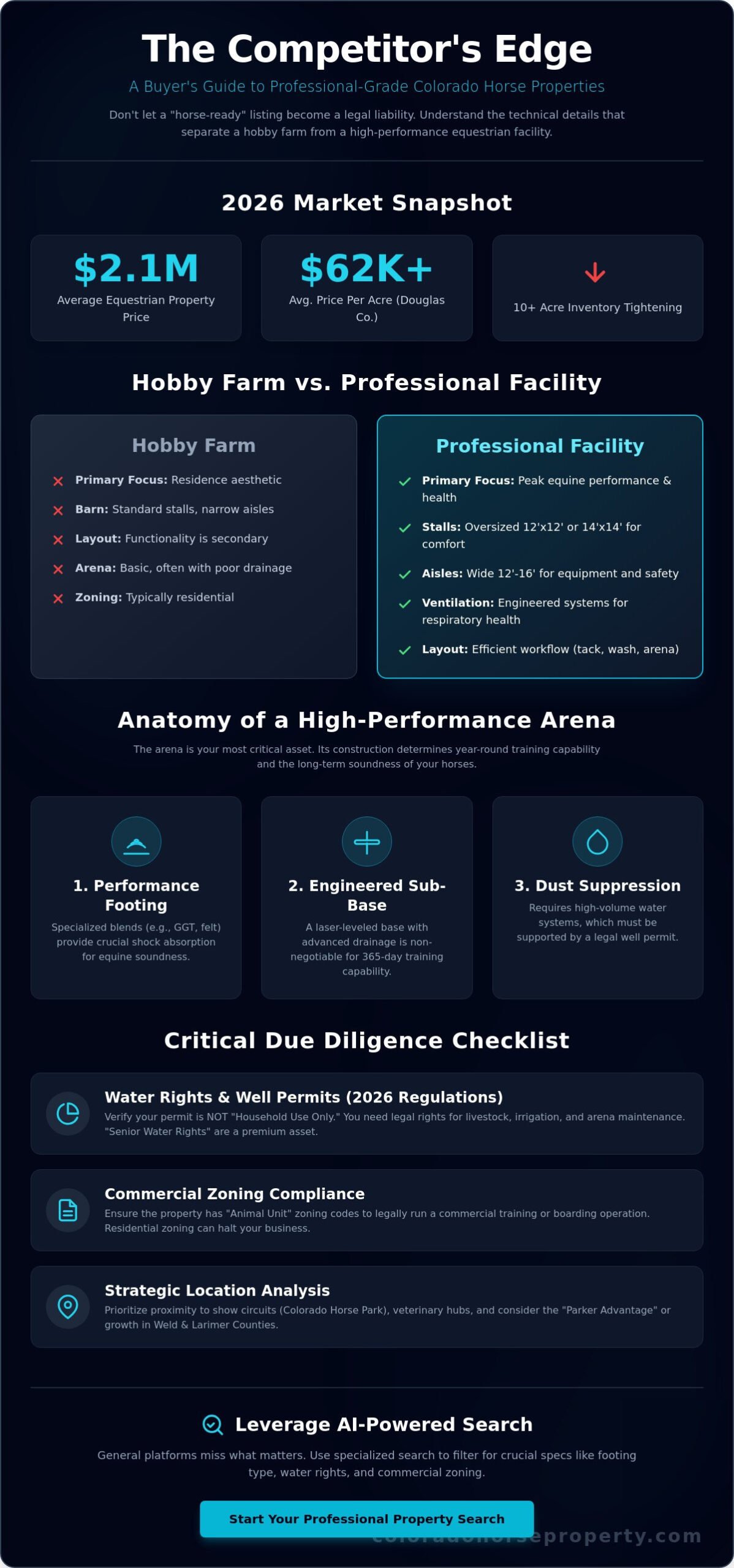
A hobby farm prioritizes the residence, while a professional facility centers on the horse. Professional barns feature 12×12 or 14×14 stalls and wide aisles, typically 12 to 16 feet, to accommodate equipment and safe horse passage. Ventilation is engineered to prevent respiratory issues, utilizing passive and active airflow systems that go beyond standard residential barn designs. Training efficiency depends on a layout where the tack room, wash rack, and arena are logically connected to minimize downtime. Serious competitors often prioritize arena quality over house square footage, recognizing that the facility is a high-performance tool.
The 2026 Colorado Equestrian Market Outlook
The shift from 2025 to 2026 shows a tightening inventory for properties over 10 acres in Douglas County. This scarcity is pushing many professional trainers toward Weld and Larimer Counties, where land is more available even as building codes become stricter. As of June 2026, the average price per acre for equestrian land in Douglas County is approximately $62,429. This valuation reflects the premium placed on proximity to major show hubs and established infrastructure. To find a Colorado horse property for serious competitors that offers long-term value, buyers are increasingly relying on AI-Powered Horse Property Search tools to filter for technical specs like “Senior Water Rights” rather than just a “Barn” tag.
The Anatomy of a High-Performance Equestrian Facility
For a professional athlete, the facility is a performance laboratory. A high-quality Colorado horse property for serious competitors must prioritize infrastructure that withstands the state’s intense environmental demands. While a standard barn might suffice for trail riders, a competition-focused estate requires specific engineering to ensure year-round training capability. Every element, from the chemical composition of the footing to the micron level of barn ventilation, impacts the soundness and longevity of your horses.
Professional Arena Specifications
The arena is the most expensive and critical asset on the property. High-performance footing, such as GGT (Great German Training) or specialized felt blends, provides the necessary shock absorption and energy return for jumping or dressage. However, the footing is only as good as the sub-base construction. Without a laser-leveled base and advanced drainage systems, a million-dollar arena becomes a mud pit during the spring thaw. This construction is what allows for 365-day training regardless of the weather.
Dust suppression is a non-negotiable for indoor arenas, yet it requires a high volume of water. Buyers must be wary of “Household Use Only” well permits, which legally restrict water use to the primary residence and exclude arena maintenance. Verifying your position within Colorado’s Prior Appropriation System for water ensures you have the legal right to keep your footing in peak condition without risking state fines. When evaluating these technical assets, using an AI-Powered Horse Property Search can help filter for specific infrastructure like indoor arenas or senior water rights.
The “Competitor’s Barn” Checklist
The barn itself must function as a high-tech recovery center. Professional 12×12 stalls with integrated rubber matting and automatic, heated waterers are the baseline. Specialized medical spaces, such as vet bays with stocks and dedicated wash racks with hot water, allow for on-site treatment of high-value athletes. Secure, climate-controlled tack rooms protect expensive leather from the dry Colorado air, preserving your investment in equipment. Colorado’s high-altitude sun and sub-zero winters demand superior climate management. Insulated barns with active ventilation prevent the respiratory strain common in stagnant, unheated spaces.
Beyond the barn, turnout management in a semi-arid climate is a balancing act. Maintaining green pastures in 2026, when over 60% of the state is affected by drought, requires senior irrigation rights or sophisticated dry-lot management. Your property must also accommodate commercial-scale equipment, including hay storage for semi-loads, trailer parking with a wide turn-around radius, and a structured manure management plan that complies with county health regulations. These technical specifications are what truly define a Colorado horse property for serious competitors.
Strategic Location: Proximity to Colorado’s Premier Show Circuits
For a competitive athlete, a property’s value is inextricably linked to its GPS coordinates. Selecting a Colorado horse property for serious competitors requires a cold-eyed calculation of “hauling hours” versus training hours. If your program involves competing three weekends a month, living two hours from the venue adds significant stress to your horses and your bottom line. Strategic placement near the state’s primary equestrian hubs preserves your equine athletes’ energy and reduces the logistical “tax” of fuel, vehicle maintenance, and travel time.
The “Parker Advantage” remains the most sought-after logistical edge for English discipline competitors. Living within 30 minutes of the Colorado Horse Park allows trainers to ship in for schooling days and return home without the expense of overnight stalling. This proximity is a primary driver for the $62,429 average price per acre currently seen in Douglas County. It’s a premium paid for access, convenience, and the ability to maintain a rigorous show schedule while sleeping in your own bed.
The Front Range Show Corridor
Douglas and Elbert Counties are the undisputed gold standard for hunter-jumpers and dressage riders. While Parker offers immediate proximity to the show grounds, many professional operations find better value and more flexible zoning in Elizabeth or Kiowa. These areas allow for larger-scale commercial permits that are often restricted in more suburbanized zones. For a deeper dive into regional specifics, consult our Complete Buyer’s Guide to Equestrian Real Estate Colorado to compare county-level infrastructure.
The Emerging Northern Circuit
Weld County has solidified its dominance as the epicenter for Western and rodeo disciplines. Proximity to the Budweiser Events Center and The Ranch in Loveland makes towns like Berthoud, Eaton, and Ault high-priority targets for 2026 buyers. These northern hubs often provide more expansive acreage than southern counterparts, allowing for full-sized roping arenas and cattle handling facilities. Additionally, the 25% agricultural land tax assessment rate in 2026 makes these larger parcels more economically viable for commercial training businesses compared to residential-zoned land closer to Denver.
While the Front Range is the primary focus for many, the Western Slope offers unique opportunities for endurance and trail-based competitors. Properties near Grand Junction provide year-round training weather and access to high-altitude terrain that Front Range facilities can’t replicate. Regardless of your discipline, the “hauling tax” is a real expense. A property that costs $100,000 less but adds 10 hours of weekly windshield time often proves more expensive over a five-year training cycle. Choosing a Colorado horse property for serious competitors means balancing upfront land costs with the long-term efficiency of your competition calendar.
Critical Due Diligence: Navigating Zoning, Water, and Soil for Professional Use
Due diligence is the phase where most equestrian deals fail. For a Colorado horse property for serious competitors, the stakes are higher than a standard residential purchase. You aren’t just buying a home; you’re buying a commercial-grade training site with specific technical requirements. Verifying specifications like soil composition and legal water usage is the only way to protect your investment from becoming a “money pit” of infrastructure repairs and legal fines.
- Soil Testing: Bentonite clay is prevalent across the Front Range. This expansive soil buckles arena foundations and creates drainage nightmares. Professional-grade arena construction requires a stable sub-base that won’t shift during Colorado’s freeze-thaw cycles.
- Access and Easements: Professional training requires space for 40-foot gooseneck trailers. If the property entrance lacks a 50-foot turning radius or has narrow easements, you’ll face constant logistical bottlenecks and potential damage to equipment.
- Title and Escrow: Transfers of agricultural land often involve complex historical grazing rights or mineral interest severances that must be cleared during escrow to ensure unencumbered use of the land.
The Colorado Water Rights Maze
Water is the lifeblood of a high-performance arena. A “Household Use Only” permit is a significant liability; it legally forbids watering livestock or suppressing arena dust. You need a “Domestic” permit or adjudicated water rights to maintain a professional facility. As of January 1, 2026, new well construction rules require permits to be physically posted at the site, and all non-exempt permits now have a strict two-year expiration date. A Water Court serves as the specialized judicial authority in Colorado that adjudicates water rights claims and confirms the priority of use during a property transfer.
Zoning for Commercial Training
Understanding “Use by Right” is vital for any trainer. In Douglas County, A-1 parcels of 35 acres or more allow up to four boarded horses by right. If you plan to board 12 or more, you must navigate an administrative review or obtain a Special Use Permit. HOA covenants can also override county zoning, sometimes banning commercial lessons entirely even if the county allows them. If you’re planning to build new facilities, see our guide on Horse Barns for Sale for building permit insights.
Protect your training business by securing expert Buyer Representation to navigate these technical and legal hurdles before you close.
Finding Your Competitive Edge with Specialized Real Estate Expertise
Generalist real estate apps are built for residential buyers who prioritize bedroom counts and kitchen finishes. For a professional athlete, these metrics are secondary to arena footing depth, soil stability, and legal animal unit densities. Searching for a Colorado horse property for serious competitors requires a dataset that standard national aggregators simply don’t provide. You need a platform that understands the difference between a decorative barn and a high-performance training facility.
Mark and Alison Eibner bring over 40 years of specialized experience to every transaction. This longevity in the Colorado market protects buyers from “Money Pit” facilities that look impressive but suffer from structural soil issues or inadequate well permits. By leveraging the Realty Oasis ecosystem, clients gain access to a network of specialized title, escrow, and land management partners who understand the complexities of agricultural property transfers. This team ensures that every technical asset, from the sub-base of the arena to the senior water rights, is verified and legally protected.
AI-Powered Precision Search
Our Colorado Horse Property AI-Powered Search gives you a distinct advantage in a low-inventory market. Instead of sifting through thousands of irrelevant residential listings, our platform filters for specific technical requirements like “Indoor Arena,” “Senior Water Rights,” and “Commercial Zoning” with 2026 accuracy. This precision allows you to identify professional-grade properties before they hit national aggregators. For pro trainers, we provide customized lead generation that focuses on the unique infrastructure needed to run a profitable training business without zoning friction.
Expert Buyer Representation
Negotiating for equestrian assets requires a different financial lens than standard residential real estate. A generalist agent might struggle to value a $200,000 professional arena versus a $200,000 kitchen remodel, yet only one of those assets generates revenue for a training program. We provide expert Buyer Representation that correctly values specialized infrastructure, ensuring you don’t overpay for aesthetics while missing critical functional flaws. From transaction management to the final closing, we handle the technical hurdles that define complex equestrian sales.
Success in the show ring starts with the right foundation at home. Don’t leave your training environment to chance with a generalist search tool. Search current Colorado horse properties for serious competitors here and find the facility that will elevate your performance program to the next level.
Securing Your Future in the Colorado Competition Circuit
Success in the professional arena starts with a facility that works as hard as you do. Identifying a Colorado horse property for serious competitors means looking past the aesthetic of a barn to the technical reality of its infrastructure. Whether it’s the specific drainage of your arena sub-base or the legal status of your 2026 well permit, these details dictate your daily training efficiency. Strategic positioning near major show circuits further ensures that your athletes remain fresh and your logistical costs remain manageable.
Mark and Alison Eibner and the Realty Oasis division offer 40 years of specialized Colorado equestrian expertise to help you navigate this high-stakes market. Our AI-powered search tools are designed to filter for the exact water rights and arena specifications that pro trainers require. We provide the data and the local knowledge necessary to protect your investment from costly oversights and zoning hurdles.
Find Your Professional Equestrian Base with Our AI Search Tool
Your next championship season is built on the foundation you choose today. We’re ready to help you secure a property that matches your competitive ambitions and provides the professional environment your horses deserve.
Frequently Asked Questions
How many acres do I need for a professional 10-stall training facility in Colorado?
A minimum of 10 to 15 acres is recommended, though 35 acres is the threshold for many agricultural tax benefits and increased horse density. In Douglas County, the animal unit system allows one horse per half-acre on smaller parcels between 2.3 and 8.9 acres. However, a professional 10-stall barn requires additional space for manure management, trailer turnarounds, and professional-sized arenas that exceed standard residential footprints.
What is the most common mistake competitors make when buying horse property in Colorado?
The most common mistake is assuming that existing horse infrastructure is legally compliant for commercial use. Many buyers purchase a Colorado horse property for serious competitors only to find that zoning codes or HOA covenants prohibit training clinics or boarding. Always verify that “commercial use” is specifically allowed and that the well permit supports the volume of horses you intend to keep before waiving your inspection contingencies.
Does a standard residential well permit allow for arena dust control?
A standard “Household Use Only” well permit does not allow for arena dust control or livestock watering. These permits legally restrict water use to inside the primary residence. Professional trainers must secure a “Domestic” well permit or adjudicated water rights to ensure they can legally maintain footing and provide water for high-performance athletes without risking state fines or permit expiration under the strict 2026 rules.
Are there specific counties in Colorado with more favorable zoning for horse trainers?
Elbert and Weld Counties generally offer more favorable zoning and larger acreage for professional trainers compared to the more suburbanized areas of Douglas County. While Douglas is a premier location, boarding more than 12 horses requires a Special Use Permit and administrative review. In contrast, Elbert County’s agricultural zones often provide more flexibility for commercial equestrian operations and larger barn footprints with fewer neighbor-related restrictions.
How much does it cost to install a professional GGT footing arena in Colorado?
Professional GGT footing installation typically ranges from $50,000 to over $150,000 depending on the arena size and sub-base requirements. This cost covers the specialized geotextile materials and high-grade sand but doesn’t include the critical laser-leveling or drainage systems required to handle Colorado’s spring thaws. Investing in this infrastructure is essential for maintaining equine soundness in a Colorado horse property for serious competitors.
What is the “Right to Farm” act in Colorado and how does it protect horse owners?
The Colorado Right to Farm Act protects established agricultural operations from nuisance lawsuits regarding common farming practices like dust, noise, or odors. This law is vital for horse owners because it prevents newer residential neighbors from filing complaints against your training facility. It only applies if your operation follows generally accepted management practices and was established before the complaining party moved into the area.
How do I verify the drainage quality of a property before buying?
Verifying drainage requires a professional soil test and a topographic survey during your due diligence period. You must look for the presence of Bentonite clay, which expands when wet and ruins arena foundations. It’s also wise to observe the property during a heavy rain or snowmelt to see if water pools in training areas or near barn entrances, which indicates a need for expensive grading.
Can I run a commercial boarding business on land zoned as “Residential-Agricultural”?
Running a commercial business on “Residential-Agricultural” land usually requires a Special Use Permit or an administrative review. While you might have the “use by right” to keep your own horses, boarding for profit or giving public lessons often triggers commercial requirements. Always check the specific county land-use code to see how many boarded horses are allowed “by right” before a permit is mandatory.