
Did you know that agriculture accounts for roughly 74% of all water use in the Colorado River basin, yet many people browsing Colorado horse farms for sale don’t verify their senior water rights until they’re already at the closing table? In a state where “buy and dry” practices are reshaping the landscape, securing a property that can actually sustain your herd is becoming increasingly complex. You aren’t just looking for a scenic view; you’re looking for a functional investment that protects your horses and your capital.
It’s natural to feel overwhelmed by the technicalities of well permits, soil quality, and the drastic climate shifts between the Front Range and the high mountains. A beautiful arena means very little if the pasture can’t grow hay or the zoning doesn’t support your specific livestock needs. This 2026 equestrian guide promises to help you master these complexities with the confidence of a seasoned expert who understands the dirt and the data.
We’ll walk you through evaluating equine infrastructure, securing essential water rights under new 2026 legislation, and selecting the ideal regional terrain for your discipline. This overview provides the technical framework you need to find a property that truly works for your lifestyle and your horses.
Key Takeaways
- Distinguish between simple residential horse properties and full-scale farms to ensure your 2026 investment aligns with your operational needs.
- Identify critical barn and arena features, including ventilation and footing, that are essential for horse health during intense Colorado winters.
- Learn how to navigate the “Prior Appropriation Doctrine” and verify well permits when evaluating Colorado horse farms for sale to protect your long-term water access.
- Compare the accessibility of the Front Range against the expansive acreage of the Eastern Plains to find the perfect balance of show circuit proximity and land value.
- Discover how proprietary AI-powered search tools can filter listings by specific equestrian infrastructure, saving you hours of manual property research.
Understanding the 2026 Colorado Horse Farm Market
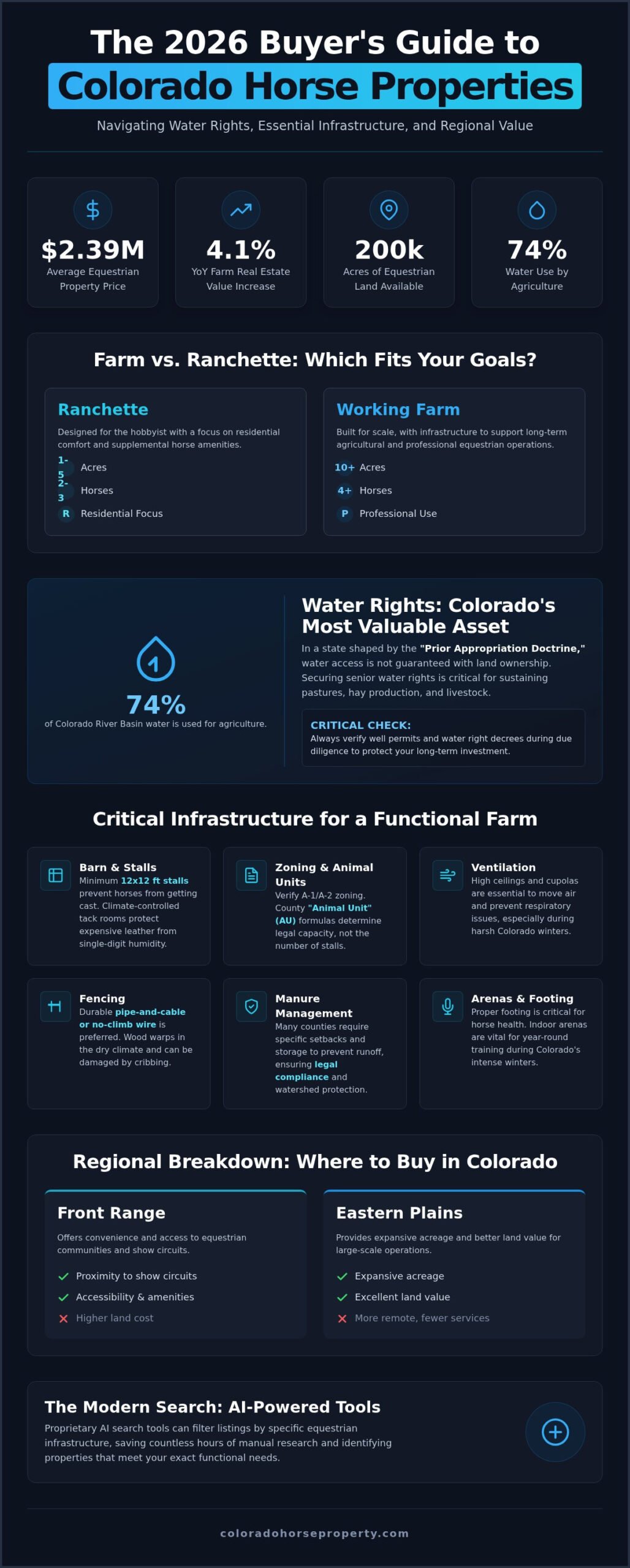
The 2026 market for Colorado horse farms for sale is defined by a flight to functionality. While the average price of an equestrian property in the state now sits at $2.39 million, serious buyers are looking beyond aesthetics. They want land that works. This shift is fueled by a 4.1% year-over-year increase in farm real estate value, making every acre a strategic asset. Whether you’re raising a traditional Colorado Ranger horse or training high-level performance animals, the land must provide more than just a scenic backdrop.
In 2026, the demand for acreage remains high, with nearly 200,000 acres of equestrian-ready land currently on the market. However, the distinction between a “horse property” and a “horse farm” is critical. A property might simply feature a fence and a shed; a farm has the infrastructure and water rights to support long-term agricultural viability. To better understand the scale of a premier facility, watch this helpful video:
Farm vs. Ranchette: Which fits your goals?
Your intended use dictates your search parameters. A “ranchette” typically describes small acreage, often between one and five acres, designed for the hobbyist who keeps two or three horses. These properties focus on residential comfort with supplemental horse amenities. In contrast, working farms usually start at 10 acres and scale upward. These larger parcels are essential if you plan on hay production, which is a significant factor considering Colorado cropland values reached an average of $2,880 per acre in 2025. If your goal is professional training or breeding, you’ll need the expansive space and specialized outbuildings that only a dedicated farm provides.
Zoning and Animal Units in Colorado
You must verify zoning before falling in love with a house. Most Colorado horse farms for sale fall under A-1 or A-2 agricultural zoning, but the “Animal Unit” (AU) calculation is what determines your actual capacity. Counties like Douglas and Elbert have strict formulas. For instance, a county might allow one AU per 35,000 square feet of pasture. You also need to look for “legal non-conforming” status in older farms. This status allows a property to maintain its current horse count even if modern zoning laws have become more restrictive. Without this verification, you risk buying a ten-stall barn that you can legally only use for four horses.
Essential Infrastructure for Colorado Equestrian Farms
High-quality infrastructure separates a premier facility from a standard acreage. When browsing Colorado horse farms for sale, you’ll notice the best properties prioritize animal safety and operational efficiency over mere aesthetics. Fencing is your first line of defense. In the Rockies, pipe-and-cable or “no-climb” wire fencing is preferred over traditional wood. Wood often warps in the dry climate or becomes a target for “cribbing” horses. Pipe fencing offers the durability needed to withstand heavy snow loads and determined livestock without constant maintenance.
Large-scale farms must also account for manure management. In 2026, many counties require specific setbacks and storage containers to prevent runoff. This is especially vital because the Colorado water rights system is strictly monitored to protect local watersheds from contamination. Proper drainage and waste placement aren’t just about cleanliness; they’re about legal compliance and being a good steward of the land.
Evaluating the Barn and Stables
A functional barn requires more than just four walls. Look for 12×12 stalls as the minimum standard for safety. This size provides enough room for a horse to turn and lie down without getting “cast” against a wall. Ventilation is equally critical. Colorado barns need high ceilings and cupolas to move air, preventing respiratory issues during the winter when doors stay shut. Tack rooms should be climate-controlled to prevent expensive leather from cracking in our single-digit humidity. For year-round utility, ensure wash racks feature frost-free hydrants and insulated plumbing to avoid mid-winter pipe bursts.
Riding Arenas and Footing Quality
The quality of an arena lies beneath the surface. A professional arena consists of a compacted sub-base, a stable base layer, and a consistent top dressing. Without proper drainage, a Colorado spring thaw can turn your arena into a swamp. Orientation matters too. Positioning an arena to use the barn or a tree line as a windbreak can extend your riding season by weeks. During dry summers, integrated dust control systems are essential to maintain air quality for both horse and rider. Identifying these technical details during a walkthrough is difficult without specialized help. You can search properties by specific infrastructure features to ensure the facility meets your professional standards.
The “Gold” of Colorado: Water Rights and Land Management
Water is the most valuable asset on any Colorado ranch. Unlike other states, owning the land doesn’t automatically mean you own the water on it. Colorado operates under the Prior Appropriation Doctrine, a “first in time, first in right” system. This means older, senior water rights have priority over newer, junior rights. During a drought, junior rights can be shut off completely to satisfy senior holders downstream. When you’re evaluating Colorado horse farms for sale, you aren’t just buying real estate; you’re buying a spot in a very long legal line.
Agriculture accounts for roughly 74% of the water used in the Colorado River basin. This high demand makes water rights a primary driver of property value. In 2025, Colorado pasture values averaged $1,150 per acre, while irrigated cropland reached $2,880 per acre. That price gap reflects the massive utility of having a reliable, legal water source for your livestock and forage.
Navigating Well Permits and Water Law
A common trap for equestrian buyers is the distinction between domestic and household-only well permits. A household-only permit generally forbids watering livestock or irrigating pastures. You need a domestic permit, often found on parcels over 35 acres, to legally provide water for your horses. If a property only has a “household-use only” well, you’ll be forced to haul water or pay for expensive cistern deliveries. Don’t take a seller’s word for it. You must pull the actual permit document from the Division of Water Resources to verify what’s legally allowed. If the rights are “junior,” you face a high risk of being “called out” during dry years, leaving your troughs empty.
Pasture Management and Hay Production
Soil quality determines how many horses your land can actually support. Sandy loam is the ideal for horse pastures. It drains well and supports strong root systems for forage. In contrast, heavy clay soils, common across the Front Range, become slick and dangerous for hooves when wet and turn into hard-packed “bricks” during dry spells. You also need to account for new 2026 regulations. Under House Bill 1340, if irrigation water is permanently removed from a property, the owner is now responsible for revegetating that land to prevent erosion.
- Rotational Grazing: Essential for preventing “over-grazing” in Colorado’s semi-arid climate.
- Weed Mitigation: You’re legally required to manage “noxious weeds” like Musk Thistle or Knapweed.
- Hay Quality: Evaluate if the soil and water shares support high-protein Alfalfa or softer Meadow Grass.
Managing a horse farm is a balance of animal husbandry and agricultural science. Secure your water first, and the rest of your land management strategy will fall into place.
Regional Breakdown: Where to Buy in Colorado
Colorado’s geography creates distinct micro-markets for equestrian real estate. Choosing the right region depends on whether you value proximity to competitive circuits or the ability to maximize your acreage. The state’s diverse terrain means that a farm in the mountains functions very differently than one on the plains. Understanding these regional nuances is essential before you begin touring Colorado horse farms for sale.
The Western Slope offers high-altitude ranching with unique water dynamics, while the Foothills provide unparalleled scenic beauty. However, the Foothills also present challenges with sloping terrain. Building an arena on a steep grade can easily double your construction costs due to the extensive dirt work and retaining walls required. For those seeking flat, functional land, the search typically narrows to two primary corridors.
Front Range Favorites: Parker, Elizabeth, and Castle Rock
This region serves as the equestrian hub of the state. Parker and Elizabeth are particularly popular due to their proximity to the Colorado Horse Park, a premier venue for hunter-jumpers, dressage, and eventing. Elizabeth offers a slightly more rural feel with larger parcels, while Castle Rock provides high-end luxury estates with refined amenities. Zoning in these areas is a moving target. As suburban development creeps eastward, many rural corridors are facing increased pressure. It’s vital to work with experts like Mark and Alison Eibner, who have 40 years of experience navigating these local zoning shifts to protect your property’s agricultural status.
The Eastern Plains: Bennett, Strasburg, and Beyond
For buyers prioritizing land volume, the Eastern Plains offer the best value. In this region, you’ll find the most consistent pricing for large-scale operations and extensive grazing land. The flat terrain is ideal for professional training facilities and long-track galloping lanes. However, the open landscape requires a specific management approach. Wind management is a priority here. Successful farms in Bennett or Strasburg often feature established shelter belts of trees or specialized wind-break fencing to protect livestock and prevent soil erosion during the winter months.
Each region has its own set of trade-offs regarding commute times, hay availability, and climate. You can view all current Colorado horse farms for sale by region to compare these distinct markets side-by-side and find the one that fits your discipline.
The Modern Search: Using AI to Find Your Dream Farm
Traditional real estate platforms are built for the average suburban homebuyer. They prioritize square footage and kitchen finishes while ignoring the technical specifications that matter to an equestrian. A generic “horses allowed” tag doesn’t tell you if the property has the drainage for an outdoor arena or the structural integrity for a hay loft. This lack of data often leads to wasted hours touring Colorado horse farms for sale that don’t actually meet livestock requirements or agricultural zoning standards.
Our approach integrates proprietary AI technology with 40 years of boots-on-the-ground experience. Led by Mark and Alison Eibner, we’ve developed a system that filters properties based on their actual utility for horses. This “ecosystem” approach doesn’t stop at the search. We coordinate the entire transaction, including specialized title and escrow services that understand the complexities of agricultural land transfers and water right deeds.
Leveraging AI for Niche Features
Efficiency is the primary benefit of our AI-powered search tool. Instead of scrolling through hundreds of irrelevant listings, you can filter for high-value assets like “Senior Water Rights” or a “Covered Arena.” The system identifies properties that meet specific animal unit minimums, ensuring you only see land that can legally support your herd size. You can also set up customized alerts to stay ahead of the market for horse properties for sale in Colorado, giving you a competitive edge in high-demand counties like Douglas or Elbert where inventory moves quickly.
Expert Representation and Closing Services
Technology is a powerful filter, but it doesn’t replace a physical inspection by a professional. You need a buyer’s agent who knows how to evaluate the health of a pasture and the condition of a well head. The Eibners’ four decades of local knowledge allow them to spot potential red flags, such as poor soil drainage or “junior” water rights, before you sign a contract. Our strategic partnership with Meridian Title & Escrow further streamlines the process, handling the technicalities of ranch transactions with precision. Taking the next step toward your goal requires Expert Buyer Representation for Your Colorado Property to ensure every detail of the infrastructure and legal rights is secured during the closing process.
Secure Your Equestrian Future in Colorado
Finding the right Colorado horse farms for sale requires more than a love for the landscape; it demands a technical understanding of senior water rights and specialized barn architecture. You’ve learned how critical it is to verify well permits and zoning before committing to a purchase. Balancing these agricultural necessities with your lifestyle goals is the only way to ensure a property retains its value and utility for years to come.
We simplify this complex journey by combining 40 years of Front Range expertise with our proprietary AI-driven equestrian feature filtering. This technology isolates the infrastructure you need, while our strategic title and escrow partnerships protect your legal interests during every phase of the transaction. Don’t settle for a generic search when your livestock’s health and your investment are on the line. Start Your AI-Powered Colorado Horse Property Search Today and find the facility that meets your highest standards.
Your ideal farm is within reach, and with the right data and expert representation, you can close your deal with total confidence.
Frequently Asked Questions
How many acres do I need for two horses in Colorado?
Generally, you need between 2 and 5 acres to support two horses, but county-specific animal unit regulations take precedence. For instance, Douglas County typically requires at least 35,000 square feet of pasture per animal unit. If you plan on rotational grazing to preserve semi-arid soil, 5 to 10 acres is more practical. Always check the specific county land use code to ensure your acreage meets legal density requirements for livestock.
What is the difference between a domestic well and a household well?
A domestic well allows for livestock watering and small-scale irrigation, while a household-use-only well is restricted to indoor residential use. This distinction is vital because most parcels under 35 acres are issued restrictive household permits. If you buy a farm with a household-only well, you cannot legally provide water for your herd. You must verify the specific well permit number with the Colorado Division of Water Resources before closing a deal.
Are water rights always included when buying a Colorado horse farm?
No, water rights are separate from land ownership and are not automatically included in a real estate transaction. In Colorado, water is a transferable property right that can be sold separately from the acreage. When searching for Colorado horse farms for sale, your contract must explicitly state that water rights, ditch shares, or well permits are included in the deed. A specialized title search is required to confirm clear ownership of these assets.
What are the best counties in Colorado for horse properties?
Douglas, Elbert, and Weld counties are the top choices for equestrian buyers due to their established infrastructure and agricultural zoning. Douglas County offers proximity to the Colorado Horse Park in Parker, while Elbert County provides larger 35-acre parcels with domestic well eligibility. Weld County is ideal for professional training facilities because it has flatter terrain and lower land costs per acre compared to the rapidly developing suburban corridors near Denver and Castle Rock.
How do I verify the zoning for a property before buying?
You can verify zoning by contacting the county planning and development department or using their online GIS mapping tools. Look specifically for agricultural designations like A-1 or A-2, which usually permit livestock. However, you must also review the specific schedule of uses to confirm the maximum number of horses allowed. Some properties might be legal non-conforming, meaning they can keep more horses than current laws allow based on documented historical usage.
What should I look for in horse arena footing for the Colorado climate?
Look for footing that incorporates moisture-retaining additives like specialized textiles or rubber crumb to combat Colorado’s low humidity. Pure sand footing often becomes dusty and unstable during dry summers, leading to respiratory issues for horses. A high-quality arena also requires a sub-base of compacted road base to ensure proper drainage during the spring thaw. Orientation should account for prevailing winds to prevent the loss of expensive top dressing during high-wind events.
Can I build a barn on any land for sale in Colorado?
No, the ability to build a barn depends on local zoning laws, setback requirements, and existing easements. Even if the land is zoned for agriculture, you might face restrictions on the height, square footage, or location of outbuildings near property lines. Some Homeowners Associations in rural subdivisions also have strict architectural guidelines that can prohibit large metal barns. Always conduct a feasibility study and check for utility easements before purchasing vacant land for development.
How do I find horse properties with senior water rights?
Finding Colorado horse farms for sale with senior water rights requires searching for properties with established ditch shares or early appropriation dates. Senior rights are those established earliest in the state’s history; they are the last to be shut off during drought cycles. Our AI-powered search tools can help filter listings by these specific legal attributes. You should also consult with a specialized water attorney to analyze the historical call on the specific river basin.