
A conservation easement can protect Colorado land while the owner retains it, but it permanently limits certain uses for current and future owners. The pros and cons of conservation easements in Colorado depend on how those restrictions fit your plans for the property, its future value, and potential tax benefits.
Weigh potential tax advantages against the loss of development flexibility. An easement may provide federal tax deductions or Colorado tax credits, and payment for a purchased easement may reflect the change in the land’s appraised value. The outcome depends on the property, the agreement’s terms, and applicable tax rules.
This guide explains what a conservation easement does, how tax credits and compensation relate to appraisal value, and which trade-offs matter for ranches, acreage, and other rural property. Use it to assess whether permanent land protection supports your goals and those of future owners.
Key Takeaways
- A conservation easement can protect land while you retain ownership, but its permanent restrictions also shape future use and resale.
- Potential federal tax deductions and Colorado tax credits may affect the financial case, alongside the easement’s terms and your tax circumstances.
- Appraisal value helps show what development rights are being given up and can inform potential compensation.
- Review how land-use limits align with your plans for buildings, agricultural operations, and future ownership before deciding.
What is a Conservation Easement?
In Colorado, a conservation easement is a voluntary legal agreement that protects land while the owner retains ownership. Its permanent terms shape how the property can be used, transferred, and developed.
Voluntary Transfer of Protection Rights
A conservation easement transfers specified land protection rights to a qualified organization, such as a land trust or government agency. Landowners may donate those rights or, less commonly, sell them. The property itself can still be sold, leased, gifted, or passed on, but the easement stays attached and binds future owners. It can cover all or part of a property and does not require public access.
Development Rights and Land-Use Limits
An easement restricts designated uses and development rights to protect a property’s conservation values. Terms may limit building, subdivision, or future development while allowing agriculture, recreation, hunting, or fishing. Some agreements permit a residence, agricultural buildings, or other structures in designated areas. The specific restrictions and reserved uses determine how owners can use the land and may affect its future value and marketability.
Establishing an easement involves a written agreement between the landowner and a qualified organization. The parties define the protected area, restrictions, and any reserved uses, then document those terms in the easement. Colorado organizations connected with easement management include Colorado Open Lands and the Colorado Cattlemen’s Agricultural Land Trust. The Colorado Division of Conservation has 36 entities that manage conservation easements; acceptance requirements depend on the property’s conservation values and the proposed terms.
Once the easement is in place, its holder enforces the terms, and the owner remains responsible for using the property within those limits. Accurate appraisals, donation records, and consistent land use matter, particularly given concerns about fraud, litigation, and tax-credit audits. Disputes may involve the value of the rights transferred or whether an activity violates the agreement. Consider these obligations alongside plans to sell, transfer, or continue agricultural use.
Federal and Colorado tax benefits
A conservation easement may offer federal tax deductions, a Colorado tax credit, and estate-planning benefits. Weigh these potential advantages against permanent limits on future development and use.
According to the Internal Revenue Service, a conservation easement donation may qualify for a federal charitable tax deduction of up to 50% of the donor’s annual income. The deduction relates to the value of the rights donated, not the landowner’s continued ownership of the property. Donors may carry forward a qualifying deduction for 15 years, which can matter when the deduction exceeds what they can use in the donation year.
Federal income tax treatment depends on the donation and applicable tax rules. A charitable deduction reduces taxable income; it is not a dollar-for-dollar credit. The agreement, valuation, and gift records help document which rights were transferred. For agricultural property, both the landowner’s tax position and the appraised value of the donated rights affect the potential result.
Colorado tax benefits may include a state credit tied to the donated easement’s value. A credit applies against tax owed, while a deduction lowers taxable income. Colorado credits may also be sold for cash, offering a potential alternative to applying the credit to a tax bill. The credit’s value and treatment depend on applicable rules and transaction details.
Other potential benefits include reduced estate taxes, which may help families retain land rather than sell it to meet tax obligations. Preserving working acreage or wildlife habitat can also align the tax decision with a landowner’s conservation goals. For owners considering a future sale, Colorado horse-property listings show how rural land and its features are presented to buyers.
Easement compensation and appraisal value
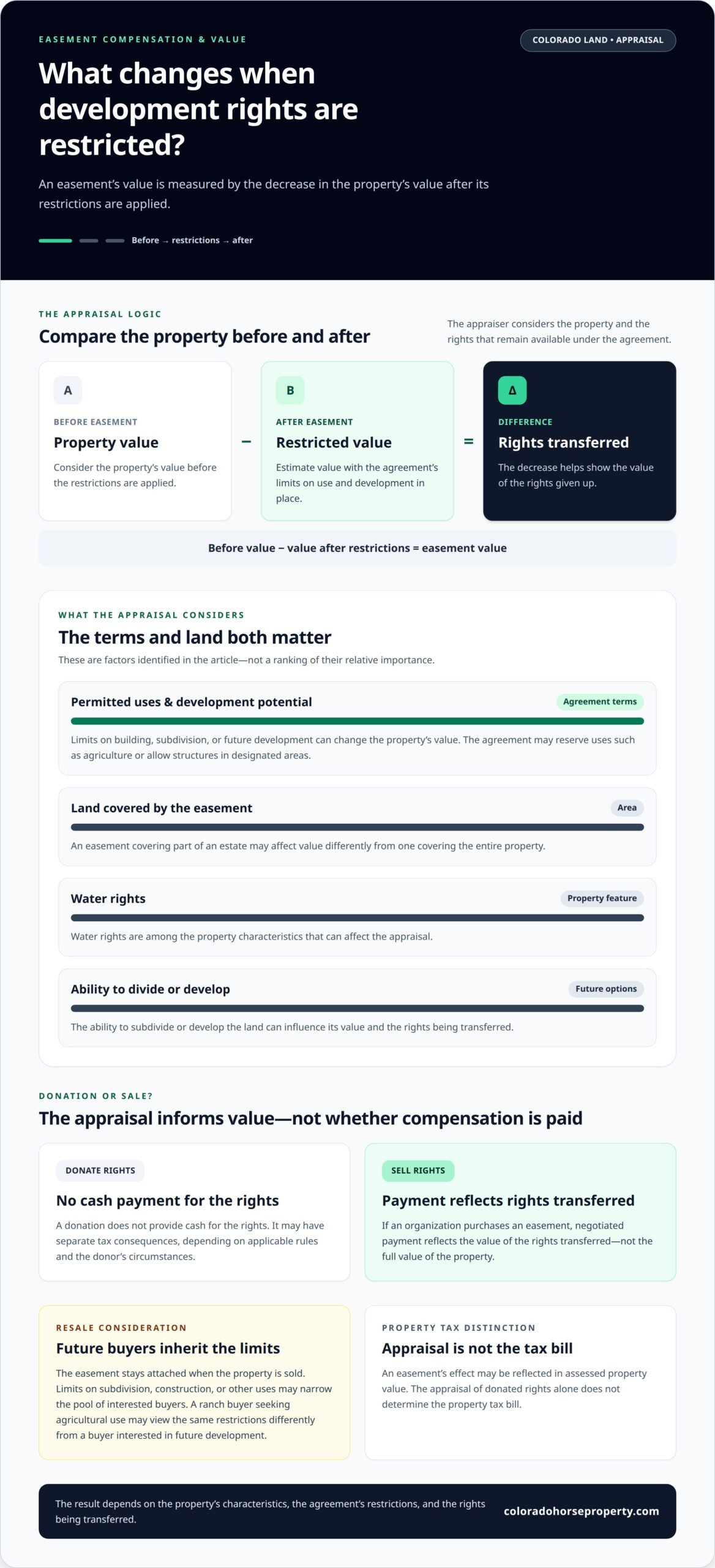
An easement’s value is measured by the decrease in the property’s value after the restrictions are applied. For a Colorado landowner, the appraisal helps clarify which development rights are being given up and, if the easement is purchased, can inform payment. The amount depends on the property’s characteristics and the agreement’s restrictions.
An appraiser compares the property’s value before and after the easement. The analysis considers permitted uses, development potential, and the land covered by the agreement. An easement on part of an estate may have a different effect from one covering the entire property. Water rights and the ability to divide or develop the land can also affect its value.
Compensation is not automatic. A landowner may donate the protection rights or, less commonly, sell them to an organization that purchases easements. A donation does not provide cash for the rights, though it may have separate tax consequences. If an easement is purchased, the negotiated payment reflects the value of the rights transferred, not the full value of the property.
Permanent restrictions can affect resale marketability. A future buyer acquires the property subject to the easement, so limits on subdivision, construction, or other uses may narrow the pool of interested buyers. A ranch buyer seeking agricultural use may view the same restrictions differently from a buyer interested in future development. The agreement’s specific terms therefore matter when selling.
For property taxes, an easement’s effect may be reflected in the property’s assessed value; the appraisal of donated rights alone does not determine the tax bill. Resale value can reflect restricted uses, while the permanent agreement may reduce estate taxes and help keep land in a family. Considering inheritance and future ownership arrangements alongside appraisal can clarify the long-term trade-offs.
Colorado conservation easement tax credits
Colorado calculates a conservation easement credit from the donated value of the rights. The credit equals 75% of the first $100,000, then 50% of donated value above that amount, subject to a $5 million maximum per donation; the federal charitable tax deduction may be up to 50% of the donor’s annual income per year.
A tax credit reduces tax owed; it is different from a federal deduction. Colorado credits can also be sold for cash, which may matter if a landowner cannot use the full credit against income tax. Choosing to use or sell a credit affects the transaction’s financial outcome. The easement itself remains a voluntary, permanent restriction on the land.
Colorado began a pre-approval process for issuing conservation easement tax credits in 2014. That history matters because credits claimed in the hundreds of millions of dollars, primarily between 2003 and 2007, were disputed; about $220 million was eventually repaid to the state. The practical takeaway is to treat appraisal support, donation records, and credit documentation as central parts of the transaction, not paperwork to handle after signing.
Tax-credit value is only one part of the decision. Consider how the agreement may preserve habitat, working land, or cultural and historic resources, as well as how it affects future use and sale. The credit calculation is based on donated value, while the restrictions continue after the property changes hands. For land with development potential, weigh conservation goals against marketability.
If you’re weighing an easement against a future sale, explore Colorado land listings to see how property features are presented to buyers.
Colorado Horse Property
Colorado Horse Property helps buyers and sellers assess rural real estate decisions in light of their goals for the land. If an easement affects permitted uses, development potential, or marketability, those details can shape a sale or purchase.
The AI-Powered Horse Property Search helps buyers find properties by equestrian features and land needs. Buyer Representation and Real Estate Listing Services support purchase and sale decisions, while Transaction Management helps coordinate the real estate process. These services bring property characteristics and transaction details into focus, but do not replace legal or tax advice about an easement.
If you’re considering a Colorado property with conservation restrictions or weighing a sale, contact Colorado Horse Property to discuss your real estate plans.
Plan for the Land’s Next Chapter
Weighing the pros and cons of conservation easements in Colorado requires a long-term view of what you want the property to make possible. Consider how you want the land to function, which uses matter most, and how those priorities may change as ownership passes to family or a future buyer. A clear understanding of the property’s intended role makes the trade-offs easier to assess.
Before your next real estate step, connect those priorities to your plans for buying or selling. Conservation terms are part of a property’s story, alongside its acreage, improvements, and suitability for your goals. Keep these factors in view so your land decision supports the life and work you’re building in Colorado.
Contact Colorado Horse Property to discuss your real estate plans. A thoughtful next step can help you move forward with greater clarity and confidence.
Frequently Asked Questions
Can CEs Be Perpetual?
Yes. A Colorado conservation easement is permanent, so its restrictions continue when ownership changes rather than ending with the original landowner. A sale, inheritance, gift, or lease does not erase the agreement. The organization holding the easement enforces its terms, and land trusts monitor protected properties. Best practices call for an inspection at least once per year, making ongoing oversight part of the easement’s long-term structure.
What about other activities are allowed, such as mining or drilling?
Mining and drilling depend on the written easement terms; don’t assume either activity is allowed simply because ownership remains private. Restrictions may limit surface disturbance to protect conservation values. A December 2002 bulletin described surface mining as prohibited for purposes of claiming a federal tax deduction for an easement donation. That historical point doesn’t set the terms of every Colorado easement or determine whether drilling is permitted.
Will I still be able to hunt on my property?
Hunting may remain allowed if the easement terms preserve that use. Landowners can address hunting and wildlife habitat when the restrictions are developed, rather than assuming conservation requires public recreation access. The agreement governs where hunting may occur and whether related structures or improvements are restricted. A private easement does not by itself require public access, so hunting access and public access are separate considerations.
What is a conservation easement in Colorado and how does it work?
A conservation easement is a voluntary agreement with a qualified organization to protect all or part of a property. The owner keeps the land, while the organization holds and enforces specified restrictions. For example, an agreement could protect a wildlife corridor while allowing agricultural use and limiting construction to designated areas. Its written terms define permitted uses for current owners and future buyers, giving the holder a basis for monitoring compliance.
What are the drawbacks and restrictions of a conservation easement in Colorado?
The main drawback is reduced flexibility: restrictions can limit construction, subdivision, and future development, potentially narrowing the buyer pool. Permanence can also complicate plans if family needs or land uses change. A land trust may require a stewardship fee to support monitoring and enforcement. The pros and cons of conservation easements in Colorado depend on how these lasting limits fit your plans and those of future owners.
How is a Colorado conservation easement valued and what does it cost to create?
An easement’s value is generally tied to the difference between appraised land value before and after restrictions. Creation costs depend on the transaction’s appraisal and documentation needs. Those are historical survey findings, not a current quote; the scope of the property and required work shape transaction costs.