
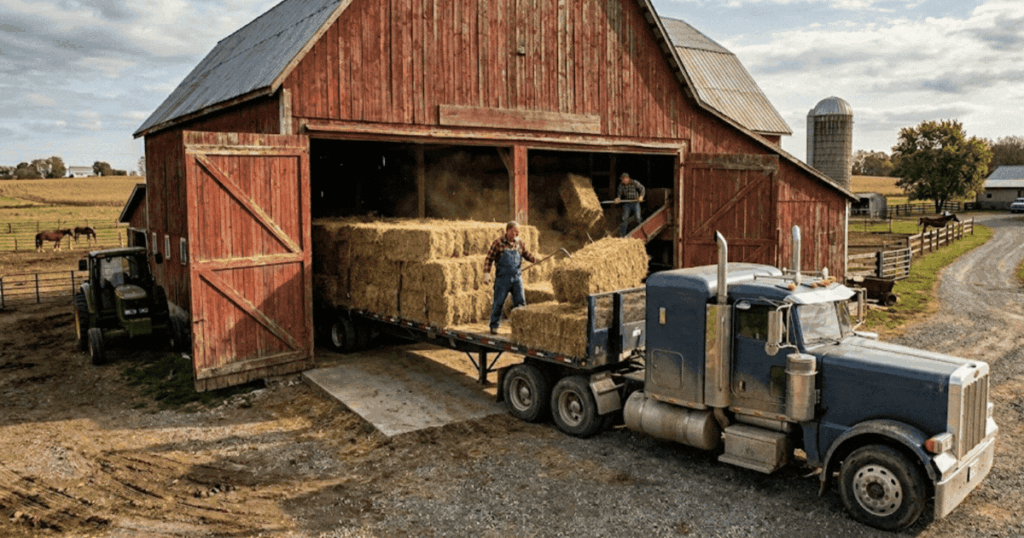
You just closed on your dream equestrian property, and winter is fast approaching. You find an incredible deal on premium orchard grass hay from a farmer a few states away, but there is a catch: you have to buy a full semi-truck load to get the discount.
You eagerly agree. But when the massive 18-wheeler arrives, the driver takes one look at your narrow, tree-lined driveway and refuses to pull in. You are now forced to frantically unload 20 tons of hay by hand, tossing bales from the trailer parked on the shoulder of a busy county highway into the back of your personal pickup truck.
Logistical access is one of the most frequently ignored aspects of buying a rural property. If you plan to manage a large herd, you will rely heavily on commercial deliveries for hay, grain, and barn shavings.
Here is how to evaluate a farm’s heavy freight accessibility before you make an offer.
Can a "Semi-Truck" Deliver Hay Directly to the Barn?
Quick Summary: The Heavy Freight Reality
- The Turning Radius: A standard semi-truck with a 53-foot trailer requires a massive turning radius. A narrow country road combined with a standard 12-foot driveway gate is a recipe for a trapped truck.
- The Overhead Clearance: Commercial trucks are typically 13 feet, 6 inches tall. Low-hanging tree branches, drooping power lines, and decorative gate arches will physically block a delivery.
- The Weight Limit: A fully loaded hay truck can weigh up to 80,000 pounds. You must verify that your private bridges, culverts, and dirt driveways are engineered to support commercial freight weight.
- The Turnaround Zone: Getting the truck to the barn is only half the battle. The property must have a hard-packed, sprawling turnaround area so the driver can exit the farm moving forward, rather than blindly backing out onto a highway.
On a working horse property, freight access affects hay costs, feed logistics, delivery options, and whether the farm can operate efficiently during winter and peak supply seasons.
1. The Geometry of the Driveway
Semi-trucks do not bend in the middle the way a standard pickup and gooseneck trailer do.
- The Gate Width: A standard 12-foot residential gate is incredibly difficult for a semi to navigate, especially if they are turning in from a narrow two-lane road. For commercial access, your main entrance gate needs to be a minimum of 14 feet wide, with 16 to 20 feet being the ideal standard.
- The Approach Angle: Look at the angle of the driveway relative to the road. If the driveway meets the road at a sharp, acute angle, the truck driver will not have the swing room required to pull the trailer through the gates without dropping their rear tires into the drainage ditch.
- The Driveway Curves: A long, winding driveway through the woods might look romantic, but a 53-foot trailer will clip the inside corners of tight curves, taking out your fencing and landscaping.
2. Overhead Clearances and Obstacles
You must look up. Commercial truck drivers are fiercely protective of their equipment, and they will not drive through an obstacle course.
- The Height Requirement: A standard commercial semi-trailer is 13 feet, 6 inches tall. To safely clear the truck, you need an absolute minimum of 14 feet of unobstructed overhead clearance along the entire route to the barn.
- The Archway Trap: Stone archways or heavy wooden ranch signs over the driveway look beautiful, but if they are built too low, they permanently lock commercial freight out of your property.
- Drooping Wires: Pay close attention to where the utility lines cross the driveway. Older power lines or telephone wires that sag in the middle are a massive liability for a tall hay truck.
Truck access is not just about the driveway width. Overhead obstacles can make an otherwise usable route completely impossible for full-height commercial trailers.
3. Weight Limits and Structural Integrity
Moving 80,000 pounds of truck and hay across rural ground requires engineered infrastructure.
- The Bridge Capacity: If your driveway crosses a creek or a deep arroyo, you must verify the weight rating of the bridge or the buried culvert pipe. Many private residential bridges are only rated for passenger vehicles and will literally collapse under the weight of a loaded semi.
- The Driveway Base: A standard dirt driveway will instantly turn to deep ruts under commercial tires, especially after a rainstorm. The route to the barn must have a thick, compacted road base of heavy gravel to prevent the truck from sinking to its axles.
4. The Unload Zone and Turnaround
Once the truck reaches the barn, the logistics are still not over.
- Parallel Parking: To efficiently unload a flatbed hay trailer with a tractor, the truck needs to be able to pull up parallel to your hay barn on flat, level ground.
- The Exit Strategy: This is the most common failure point. A semi-truck needs a massive, unobstructed circle or a deep T intersection to turn around. Drivers will almost universally refuse to back a 53-foot trailer a quarter-mile down a curved driveway to exit your property. If they cannot turn around at the barn, they will not pull in.
We Evaluate the Logistics Before You Buy
We do not just look at the barn; we look at how you supply the barn.
When Mark Eibner and Belinda Seville help you purchase a working horse property, we bring a practical, operational mindset to the tour. We evaluate the turning radiuses, check the overhead clearances, and ensure the property's infrastructure can support the heavy commercial deliveries your equestrian lifestyle requires.
Contact Us Today to find a property engineered for serious equestrian operations.
Browse Active Colorado Horse Properties: Browse Active Colorado Horse Properties that offer premium commercial accessibility
Frequently Asked Questions (FAQ) About Hay Deliveries
Can't the driver just back the semi down my long driveway?
Generally, no. Backing a 53-foot trailer down a narrow, unpaved driveway is incredibly dangerous due to blind spots. Unless it is a perfectly straight, wide driveway, most commercial freight companies will instruct their drivers to refuse the delivery due to the high risk of property damage.
What do I do if a semi-truck physically cannot fit on my property?
You will be forced to buy your hay locally in smaller quantities, using a heavy-duty pickup and a flatbed gooseneck trailer. This means you will likely pay a higher premium per bale and spend significantly more of your own time hauling and stacking hay throughout the year.
Will a hay delivery truck ruin my asphalt driveway?
It is very possible. Standard residential asphalt is often laid relatively thin. The extreme weight of a loaded semi, combined with the twisting friction of the tires when the truck turns, can crack, sink, or completely tear up a standard asphalt driveway, especially on a hot summer day.