
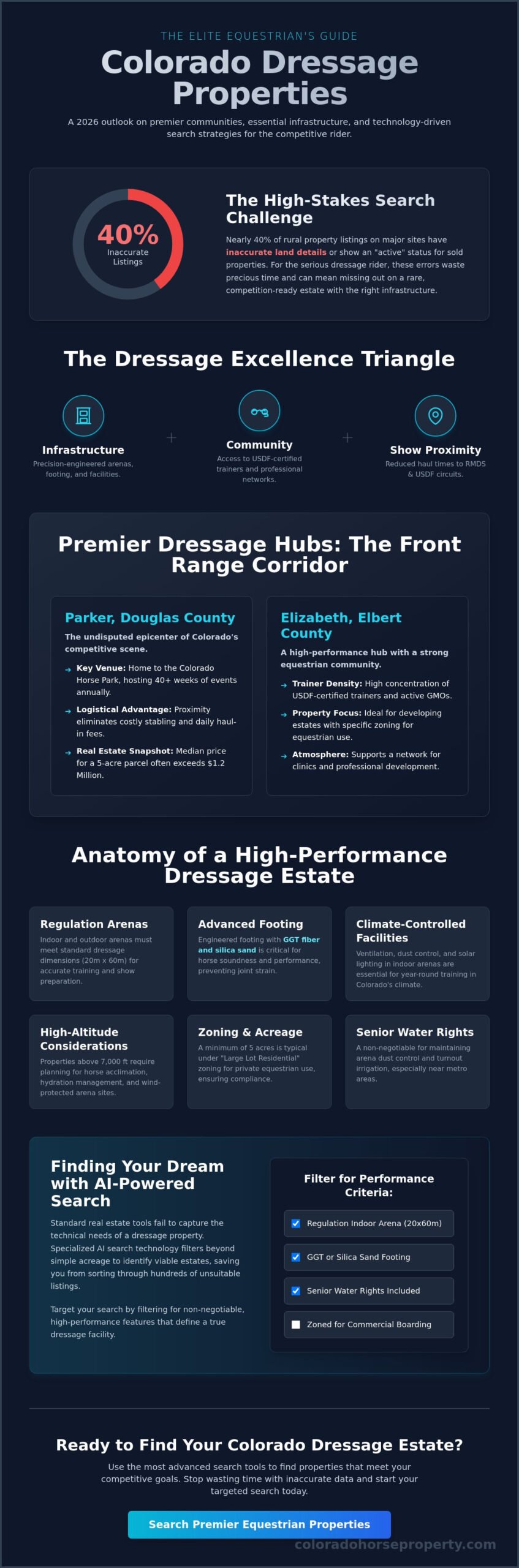
Nearly 40% of rural property listings on major national real estate sites contain inaccurate land details or show an “active” status for properties that have already sold. For a high-level equestrian, these errors don’t just waste time; they can mean missing out on a rare property that actually features a regulation-sized indoor arena or senior water rights. Finding the best horse communities for dressage riders Colorado offers requires a narrow focus on the Front Range corridor, where the median price for a five-acre parcel now often exceeds $1.2 million. You understand that dressage excellence depends on a strategic triangle of infrastructure, community, and show-circuit proximity.
This 2026 guide identifies the premier equestrian hubs that provide the high-performance footing, trainer access, and show-circuit proximity essential for serious riders. We’ll examine why Douglas and Elbert counties remain the heartbeat of the competitive scene and what specific property features you need to maintain a training schedule at 7,000 feet. You’ll also learn how to leverage AI-powered search technology to filter for technical requirements like zoning and topography, ensuring your next move supports your competitive goals rather than hindering them.
Key Takeaways
- Identify the top-performing regions like Parker and Elizabeth that serve as the primary hubs for Colorado’s competitive dressage community.
- Master the technical infrastructure requirements for dressage estates, including regulation arena sizing and advanced footing technologies like GGT and silica sand.
- Optimize your property location for the RMDS and USDF show circuits to reduce haul-in times and maintain your horse’s peak performance.
- Use specialized AI search tools to identify the best horse communities for dressage riders Colorado has available by filtering for specific arena types and zoning.
What Makes a Colorado Community ‘Dressage-Friendly’ in 2026?
Identifying the best horse communities for dressage riders Colorado offers starts with understanding that a dressage estate is a precision tool, not just a pasture. While general equestrian properties might prioritize trail access or open grazing, a dedicated facility requires specific engineering. To understand the discipline’s technical demands, one can look at What is Dressage? and see how the focus on rhythm and balance necessitates superior footing. In 2026, serious buyers look for properties that can support high-level training regardless of the unpredictable mountain weather.
To better understand how modern developments are integrating these high-performance needs, watch this overview of a specialized community in the region:
The Front Range corridor remains the undisputed hub for the sport in the Rockies. This concentration isn’t accidental. Proximity to the Colorado Horse Park in Parker, which hosts over 40 weeks of events annually, makes Douglas and Elbert counties the logical choice for competitive riders. You’ll find the highest density of USDF-certified trainers and active Group Member Organizations (GMOs) here, creating a supportive network for clinics and professional development. In 2026, there’s a significant shift toward sustainable, climate-controlled indoor training environments. Modern estates now integrate solar-powered lighting and advanced ventilation to maintain horse health during intense seasonal shifts.
The Importance of Regional Micro-Climates
Elevation and wind patterns in the foothills dictate your training schedule. High-altitude properties above 7,000 feet require careful horse acclimation and consistent hydration management. Savvy buyers target “Banana Belt” regions, such as specific pockets in the southern Front Range, where milder temperatures allow for more outdoor schooling days. Selecting sites with low-moisture soil profiles is critical; it prevents the footing compaction that leads to joint strain. If you’re looking for the best horse communities for dressage riders Colorado provides, you must prioritize areas where the wind doesn’t compromise arena usage.
Zoning for Performance: Arenas and Outbuildings
Zoning is the most overlooked factor in equestrian real estate. Douglas County’s 2026 updates emphasize “Large Lot Residential” designations, which typically require a five-acre minimum for equestrian use. You must distinguish between “Use by Right” and special use permits when planning a large-scale indoor arena. Acreage minimums aren’t just about space; they’re essential for meeting 2026 drainage compliance and manure management regulations. Securing senior water rights is also a critical trend near metro areas to maintain dust control in arenas and irrigation for turnout. Without proper zoning and water access, a property is just a house with a field, not a performance center.
Top Colorado Communities and Regions for Dressage Riders
Selecting the right location is about more than just finding a pretty view. For competitive riders, the best horse communities for dressage riders Colorado offers are defined by their proximity to sanctioned shows and elite instruction. The Front Range corridor provides the highest concentration of facilities that align with the standards of the United States Dressage Federation. Choosing a home base in these specific pockets ensures you spend more time in the saddle and less time in the trailer.
Parker: Proximity to the Colorado Horse Park
Parker serves as the undisputed epicenter of the state’s horse culture. Living within 20 minutes of the Colorado Horse Park is a logistical game-changer for active competitors. With the venue hosting over 40 weeks of events annually, proximity allows you to avoid the $280 weekend stabling fees and $35 daily haul-in costs common at major shows. The Pinery and surrounding neighborhoods remain top choices for established estates, though median prices for five-acre parcels in this corridor often exceed $1.2 million. For a broader look at regional trends and county-specific data, consult our equestrian real estate Colorado guide.
Elizabeth and Elbert County: The Growth Frontier
Elizabeth and Kiowa offer what many call the “Acreage King” lifestyle. Here, riders find the space required for full 20×60 meter private tracks and extensive turnout that is harder to secure in land-locked metro areas. Planned equestrian developments like Silverado Ranch provide a balance of rural privacy and modern infrastructure. When evaluating these properties, you must verify water rights and well permits. Maintaining a high-performance dressage arena requires consistent moisture for dust control. Without a high-producing well or senior water rights, your long-term maintenance costs will skyrocket as you struggle to keep footing at the correct consistency.
Northern Front Range: Boulder to Fort Collins
The Northern Front Range caters to the luxury market and professional training needs. The Longmont and Berthoud corridors host a high density of FEI-level trainers and frequent Rocky Mountain Dressage Society (RMDS) clinics. This region is ideal for riders who prioritize a community atmosphere and frequent educational opportunities. If you’re considering building a custom facility from the ground up, evaluate current land for sale in colorado to find parcels with the proper topography for large-scale indoor construction. Many lots in the foothills offer stunning mountain views but require significant dirt work to create the level base needed for a regulation arena.
Arvada and Golden remain the preferred choices for riders needing easy access to Denver’s business hubs while maintaining a competitive training schedule. These areas feature high-end boarding options and smaller private estates that provide a short commute to both the city and the foothills. Our team can help you identify properties in these competitive pockets before they hit the general market.
Must-Have Infrastructure for Dressage Estates
When scouting the best horse communities for dressage riders Colorado offers, the infrastructure often dictates the final sale price. A dressage property’s market value is tied directly to its training facilities. While a general horse property might focus on perimeter fencing and loafing sheds, a dedicated dressage estate requires a 20×60 meter regulation arena. Anything smaller significantly devalues the property for serious competitors because it limits the ability to school full tests at home. High-performance footing technology has also become a standard expectation. Buyers now evaluate properties based on the presence of GGT, silica sand, or fiber blends that provide the necessary cushion and rebound for joint health during intensive lateral work.
Local competitors often consult resources from the Rocky Mountain Dressage Society to ensure their home setups meet the technical standards required for sanctioned training. Beyond the arena dimensions, the 2026 buyer prioritizes indoor environments with mirrored walls for real-time bio-feedback. Proper lighting and ventilation are equally critical. In Colorado’s high-altitude sun, an indoor arena must have high-lumen, shadow-free LED systems and a design that facilitates cross-breezes without creating hazardous wind tunnels for sensitive horses.
The Technical Side of Arenas
Colorado’s clay-heavy soils present a significant engineering challenge for arena longevity. Without a professionally installed sub-base, the footing will shift and heave during the state’s frequent freeze-thaw cycles. Dust mitigation is another vital concern in our semi-arid climate. While some owners use overhead misters, many are moving toward specialized footing additives that retain moisture longer and reduce the need for constant watering. The ideal dressage arena in Colorado requires a six-inch compacted crushed stone base topped with two to three inches of specialized footing to ensure long-term stability and drainage.
Luxury Amenities for the Dressage Lifestyle
Performance stabling has evolved into a blend of European aesthetics and functional health. European-style stalls with low partitions encourage socialization and better airflow, which is essential for respiratory health at 7,000 feet. Integrated wash racks with hot water and dedicated tack rooms with climate control are no longer considered optional upgrades in the luxury market. Many owners are now exploring integrated barn-to-home designs that allow for seamless movement between the living quarters and the training area, providing the ultimate convenience for early morning schooling sessions.
When browsing horse barns for sale, it’s important to evaluate whether an existing structure can be retrofitted with these technical requirements. High-end estates also frequently feature viewing galleries and social spaces. These areas aren’t just for luxury; they serve as functional hubs for hosting clinicians and workshops, which are vital for staying connected to the broader dressage community. Investing in these specialized features ensures your property remains competitive in the specialized equestrian real estate market.
Navigating the Colorado Dressage Show Circuit and Logistics
Your training schedule is only as good as your ability to get to the show. For competitive riders, the best horse communities for dressage riders Colorado offers are those that minimize transit time to major venues. The Rocky Mountain Dressage Society (RMDS) and USDF calendars are packed from April through September, with events centered at the Colorado Horse Park in Parker and the Estes Park Events Center. Living within a 60-mile radius of these hubs reduces travel stress for high-performance horses and allows for easier day-hauling. This proximity is particularly valuable when you consider that entering the Colorado Horse Park in 2026 requires a health certificate issued within 10 days and proof of EHV 1 and 4 vaccinations within the last 180 days.
Logistics extend to the very edge of your property. A 12-foot wide driveway might suffice for a standard vehicle, but a 40-foot gooseneck trailer requires a significantly wider turning radius and reinforced culverts. Snow removal is another non-negotiable factor. If you choose a property on a secondary county road that isn’t prioritized for plowing, you risk missing early spring qualifying shows. When evaluating colorado ranches for sale, always check the county’s winter maintenance schedule and the property’s accessibility for large rigs during the mud season.
The Show Season: From the Horse Park to Estes Park
Strategic property placement allows you to navigate the “Dressage for the Cure” and regional championship circuits with minimal friction. High-performance horses often require a 14-day acclimation period if they are moved to higher altitudes, so your home base’s elevation matters. If your estate is located above 7,000 feet, you must maintain a consistent hydration and exercise protocol to ensure your horse is ready for the sea-level-like intensity of a championship test. Networking with neighbors in planned equestrian communities often leads to shared transport arrangements and private clinics with visiting FEI trainers.
Support Services for the Performance Horse
Top-tier dressage training requires a village of specialists. The “Equine Medical Corridors” stretching between Littleton and Fort Collins provide access to world-class surgical centers and sports medicine specialists. Proximity to these areas ensures that a performance farrier or a specialized vet is never more than an hour away. Additionally, sourcing high-quality forage is a regional challenge; sport horse owners often need reliable hay suppliers who provide low-sugar, high-protein alfalfa, which has seen a 35% price increase since 2022.
Understanding these granular logistical needs is what separates a general real estate agent from a specialist. Our team uses AI-driven data to identify properties that meet these technical requirements before you even schedule a tour. If you are ready to find a property that supports your competitive ambitions, start your specialized search with us today. Consulting with horse real estate for sale experts ensures you don’t overlook the zoning or access issues that could stall your dressage career.
Finding Your Dressage Dream with AI-Powered Search
Securing a high-performance training facility requires more than a standard search. Generic real estate platforms often fail to distinguish between a recreational pasture and a professional-grade dressage estate. Our proprietary AI-driven technology bridges this gap by identifying dressage-specific features like indoor arenas and specialized footing types in real-time. This allows you to filter for “Dressage-Ready” properties, ensuring that the listings you view already meet the technical requirements for upper-level training. Finding the best horse communities for dressage riders Colorado provides is now an efficient, data-backed process rather than a game of trial and error.
The Precision of AI in Equestrian Real Estate
National property aggregators don’t recognize the difference between a 60-foot round pen and a 20×60 meter regulation arena. Our AI analyzes property descriptions, zoning documents, and satellite imagery to verify infrastructure before you spend time on a site visit. This technology is particularly effective at evaluating water rights and well permits, which are essential for maintaining dust-free footing. When you use our system to find horse property for sale in colorado, you’re accessing a database that understands the 2026 Douglas County zoning updates and acreage minimums. This precision saves weeks of manual research and prevents the frustration of touring properties that lack the legal capacity for your training goals.
Expert Representation: From Contract to Closing
Technology is a powerful tool, but it’s most effective when paired with decades of niche expertise. Mark and Alison Eibner bring a deep understanding of the Colorado equestrian landscape to every transaction. They don’t just find listings; they provide comprehensive buyer representation and transaction management. This includes overseeing title and escrow services that are specifically tailored to the complexities of ranch and performance horse estates. They ensure that your plans for a new indoor arena or stable expansion are feasible within the property’s legal framework and drainage requirements.
The path to your next Grand Prix-ready home starts with the right data and the right partners. Our team is ready to guide you through the premier dressage pockets of the Front Range, from the luxury estates of Boulder to the expansive acreage of Elbert County. We understand that your horse’s health and your competitive success depend on the land you choose. Don’t settle for a generalist approach to a specialized lifestyle. Start your AI-powered dressage property search today and discover the best horse communities for dressage riders Colorado has to offer in the current market.
Elevate Your Training in Colorado’s Premier Communities
Choosing the right estate is a commitment to your horse’s health and your competitive growth. We’ve explored how regulation arenas, advanced footing, and proximity to the Front Range show circuit define the best horse communities for dressage riders Colorado offers. Whether you are targeting the FEI levels or establishing a private training hub, the technical details of the land matter as much as the structure of the barn.
With 40 years of Front Range real estate expertise, our team provides the specialized representation required for high-value equestrian transactions. Our proprietary AI technology simplifies the process by filtering for the specific infrastructure and zoning needs that general search tools miss. Don’t leave your training goals to chance on an inaccurate listing site. We understand the nuances of water rights, soil profiles, and show logistics that impact your daily life.
Find Your Perfect Dressage Estate with Our AI Search Tool and start your next chapter in the Rockies. We look forward to helping you find a property that matches your ambition and supports your horse’s peak performance.
Frequently Asked Questions
Which Colorado county has the most dressage-friendly zoning laws?
Douglas and Elbert Counties are the most accommodating for dressage infrastructure. 2026 zoning updates in Douglas County prioritize “Large Lot Residential” with a five-acre minimum, which simplifies the process for building regulation-sized indoor arenas. These counties have long histories with equestrian use, meaning “Use by Right” clauses often cover private training facilities without the need for complex special use permits or lengthy public hearings.
Is it better to buy a property with an existing arena or build one in 2026?
Buying a property with an existing regulation arena is generally more cost-effective due to rising construction and material costs. Building a new 20×60 meter indoor arena in 2026 involves navigating strict drainage compliance and high labor costs. However, if you require specific high-performance footing like GGT or silica sand, building new ensures the sub-base is engineered correctly for Colorado’s clay-heavy soils from the start.
How much acreage is truly needed for a private dressage training facility?
A minimum of five acres is the standard requirement for a functional facility in the best horse communities for dressage riders Colorado offers. This provides enough space for a regulation indoor arena, a small barn, and at least two to three turnouts. If you plan on hosting clinics or require more extensive grazing for multiple performance horses, ten to fifteen acres is preferred to meet 2026 manure management and drainage regulations.
What are the most popular dressage show venues in Colorado besides the Horse Park?
The Estes Park Events Center and the Boulder County Fairgrounds are the most popular venues outside of Parker. These locations host several Rocky Mountain Dressage Society (RMDS) sanctioned shows throughout the summer. While the Colorado Horse Park remains the central hub with over 40 weeks of events, these secondary venues offer high-quality footing and competitive atmospheres that are essential for qualifying for regional championships.
Can I find dressage properties with mountain views within an hour of Denver?
The corridors between Golden, Arvada, and Boulder offer high-end dressage estates with stunning Front Range views. These properties provide a balance of luxury living and proximity to elite FEI trainers. While land in these areas is more expensive and parcels are often smaller than in Elbert County, they remain the top choice for riders who need easy access to Denver’s business districts while maintaining a competitive training schedule.
What is the average cost of maintaining a high-performance dressage arena in Colorado’s climate?
Annual maintenance costs typically center on dust control and footing replenishment. In Colorado’s semi-arid environment, you’ll invest in water usage or specialized additives to keep silica sand or fiber blends from becoming too deep or dusty. Owners should budget for regular grooming equipment maintenance and the occasional addition of new footing material to counteract the compaction that naturally occurs over several seasons of intensive lateral work.
Are there specific communities in Colorado that cater exclusively to dressage riders?
While few developments are “dressage only,” communities like Silverado Ranch in Elizabeth are designed with high-performance riders in mind. These areas offer the specific zoning and infrastructure required for large indoor arenas and professional-grade stables. They attract a high density of serious equestrians, creating a community culture where neighbors often share the logistics of hosting traveling clinicians and sourcing specialized low-sugar hay deliveries.
How do water rights affect my ability to maintain a dressage arena and pastures?
Water rights are critical for dust mitigation in arenas and the irrigation of turnout pastures. In many Front Range areas, a standard domestic well might not allow for the high-volume watering required to keep a 20×60 meter arena footing at the correct moisture level. Securing senior water rights or an augmentation plan is essential for any high-level training facility to ensure year-round arena usability and the long-term health of your horses.