
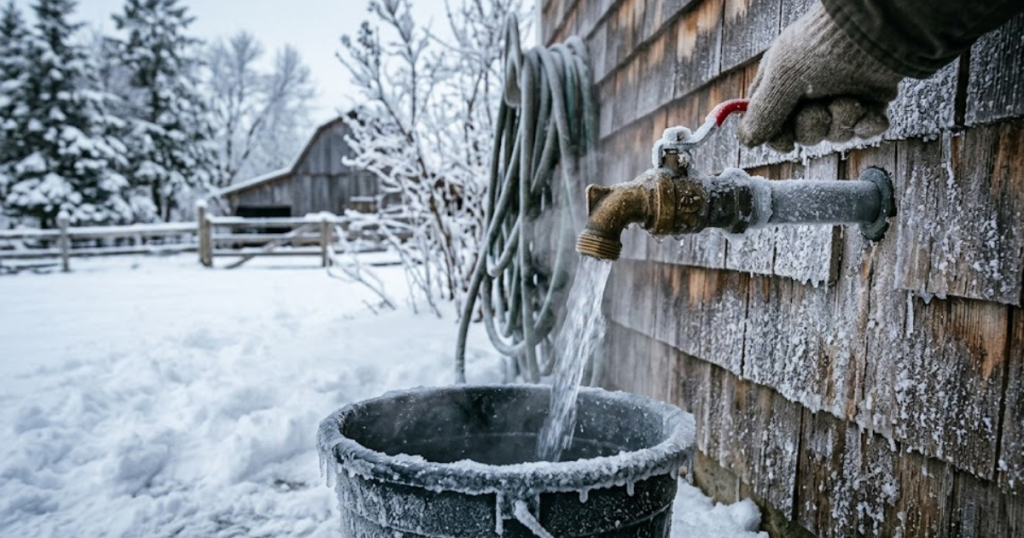
You bundle up for the morning chores as the Colorado temperature hovers at a bitter minus 10 degrees. You walk out to the paddock, grab the handle of the heavy iron yard hydrant, and lift it to fill the horses’ water buckets.
The handle does not budge. It is frozen completely solid. You try forcing it, and you hear a sickening snap of metal deep underground. You now have no water in the pasture, and you just caused a massive underground leak that will require a backhoe to fix.
When evaluating a horse property in the West, seeing blue or red cast-iron water spigots sticking out of the ground gives buyers a false sense of security. Not all hydrants are created equal, and not all of them were installed correctly.
If you rely on outdoor water to keep your herd alive, you must understand how frost-free hydrants actually work and how to evaluate their installation before you buy.
Are the Outdoor Hydrants "True Frost-Free" Models for Sub-Zero Temps?
Quick Summary: The Winter Water Lifeline
- The Underground Secret: A frost-free hydrant works because the actual water shut-off valve is not located in the iron handle you pull. It is located at the very bottom of the pipe, buried deep below the freezing dirt.
- The Weep Hole Drainage: When you push the handle down to turn the water off, a small weep hole opens at the base, allowing the water left inside the vertical pipe to drain out into the soil so it cannot freeze.
- The Gravel Bed Requirement: If the hydrant was installed directly into heavy, compacted clay without a proper drainage bed of crushed rock, the water cannot escape the weep hole, meaning the pipe will stay full and freeze solid.
- The Fatal Hose Mistake: Leaving a garden hose attached to a frost-free hydrant in sub-zero temperatures creates a vacuum lock. The water cannot drain out of the bottom, guaranteed to freeze and shatter the internal mechanism.
Outdoor hydrants can look perfectly normal in warm weather while being one hard freeze away from failure if they were installed incorrectly or used carelessly.
1. The Mechanics of the "Frost-Free" Design
To understand why a hydrant fails, you have to understand how it is supposed to work.
- The Plunger Valve: When you lift the heavy iron handle, you are pulling a long fiberglass or steel rod that runs all the way down the inside of the vertical pipe. This rod lifts a rubber plunger valve at the very bottom of the trench, allowing pressurized well water to shoot up and out of the nozzle.
- The Shut-Off Depth: Because that plunger valve is located four to six feet underground, safely below the Colorado frost line, the pressurized water supply stays warm and liquid, never exposed to the freezing surface air.
- The Empty Standpipe: The genius of the design is that when you push the handle down to close the valve, the vertical pipe sticking out of the ground completely empties itself. Because the pipe is filled only with air, there is nothing left inside to freeze.
2. The Invisible Gravel Bed
A frost-free hydrant is only as good as the dirt it is buried in.
- The Drainage Requirement: For the vertical standpipe to empty itself, the water must drain out of a tiny weep hole at the base of the underground valve.
- The Rock Trap: To work properly, the installer must surround the base of the hydrant with several cubic feet of washed river rock or drainage gravel before burying it. This creates a porous pocket for the drained water to safely flow into.
- The Clay Failure: If a DIY owner or lazy contractor just drops the hydrant into the trench and buries it in native Colorado clay, the dense soil will smother the weep hole. The water cannot drain out, the standpipe stays full to the top, and the entire unit will freeze and burst during the first deep chill.
The performance of a frost-free hydrant depends as much on subsurface drainage installation as it does on the hydrant model itself.
3. The Number One User Error: The Attached Hose
You can buy the most expensive hydrant on the market, but human error will destroy it in one night.
- The Vacuum Lock: The weep hole relies on gravity and air flow to drain the pipe. If you leave a hose attached to the nozzle, even if the nozzle is turned off, you create a vacuum seal.
- The Frozen Core: Because air cannot enter the top of the hydrant, the water cannot drain out the bottom. The water gets trapped inside the iron standpipe, freezes solid, and expands, easily splitting the heavy galvanized steel.
- The Warning Sign: When touring a property in the winter, if you see hoses left attached to the yard hydrants, it is a massive red flag. It indicates the current owner does not understand winter water management, and the internal components of those hydrants are likely already damaged.
4. Matching the "Bury Depth"
Buying a true frost-free hydrant does not matter if it is the wrong length for your specific county.
- The Frost Line Math: As covered in our previous guides, the frost line varies wildly across Colorado. It might be 36 inches in the eastern plains and 60 inches in the high mountain valleys.
- The Hydrant Rating: Hydrants are sold by their bury depth. You cannot install a 3-foot bury hydrant in a county with a 4-foot frost line. The shut-off valve will sit entirely inside the freezing zone, rendering the frost-free mechanism completely useless.
We Test the Water Before You Buy
We do not just check if the water turns on; we verify how it turns off.
When Mark Eibner and Belinda Seville help you purchase a working horse property, we look closely at the outdoor plumbing infrastructure. We check the action of the yard hydrants, listen for the telltale sound of water draining into the gravel bed when they shut off, and ask the hard questions about bury depths to ensure your winter chores will not be derailed by frozen pipes.
Contact Us Today to find a property with reliable, professionally installed winter water systems.
Browse Active Colorado Horse Properties: Browse Active Colorado Horse Properties fully equipped to handle harsh Western winters
Frequently Asked Questions (FAQ) About Frost-Free Hydrants
If my hydrant freezes, can I thaw it out with a blowtorch?
No, this is highly dangerous. Applying a blowtorch to the galvanized steel pipe will conduct intense heat down the internal metal rod, instantly melting the crucial rubber plunger valve and O-rings buried underground. You will ruin the hydrant and create an underground leak. Instead, pour hot water over the iron head or use a hair dryer to gently thaw the upper mechanism.
Why does water bubble up from the ground around the pipe when I turn the hydrant on?
If water is pooling at the base of the hydrant while it is running, the internal pipe has either burst underground due to freezing, or the lower O-rings have completely failed. The hydrant must be dug up and replaced or rebuilt immediately, or you risk washing out the soil and draining your well.
Can I adjust the handle if my hydrant is leaking out of the nozzle when it's turned off?
Yes. Over time, the internal rubber plunger wears down. Most premium hydrants, like Woodford or Simmons, have an adjustable set-screw on the handle linkage. By adjusting this linkage, you can force the plunger to press tighter against the valve seat, easily fixing a slow drip without having to dig up the entire unit.