
A fence line can determine whether livestock stay off a Colorado property and whether a landowner may seek damages after animals cross it. Understanding Colorado’s open range law starts with a key rule: livestock owners generally are not required to fence animals in, so landowners who want to keep livestock out must fence them out. Colorado law describes a lawful fence as a well-constructed fence with three barbed wires.
It’s easy to assume a property boundary alone keeps neighboring livestock off your land. In Colorado, the fence’s type and condition, along with local rules, can affect how that boundary works in practice.
This article explains Colorado’s fence requirements, how livestock trespass and property damage are treated, and when local closed-range rules may change what applies. It also covers why residential zoning and parcel characteristics matter when assessing whether livestock can be kept on a property, helping you understand the rules before buying or managing Colorado land.
Key Takeaways
- Check whether a fence meets Colorado’s lawful-fence requirements and is maintained; its condition can affect whether a landowner may seek damages for livestock-caused property damage.
- If livestock wander onto your land, the response depends in part on whether you know who owns them and whether you have taken temporary custody.
- In Park County, some properties smaller than 10 acres and created after August 23, 2003, generally cannot keep large livestock without an applicable exemption. Local rules can change what’s allowed.
- Before choosing a residential property for livestock, look beyond acreage to the parcel’s zoning and applicable land-use restrictions.
Lawful fence requirements
Colorado’s open-range approach generally places responsibility on landowners who want to keep livestock off their property. Understanding Colorado’s open range law means knowing how fence construction and upkeep affect boundaries and livestock access.
Fence-Out Responsibilities
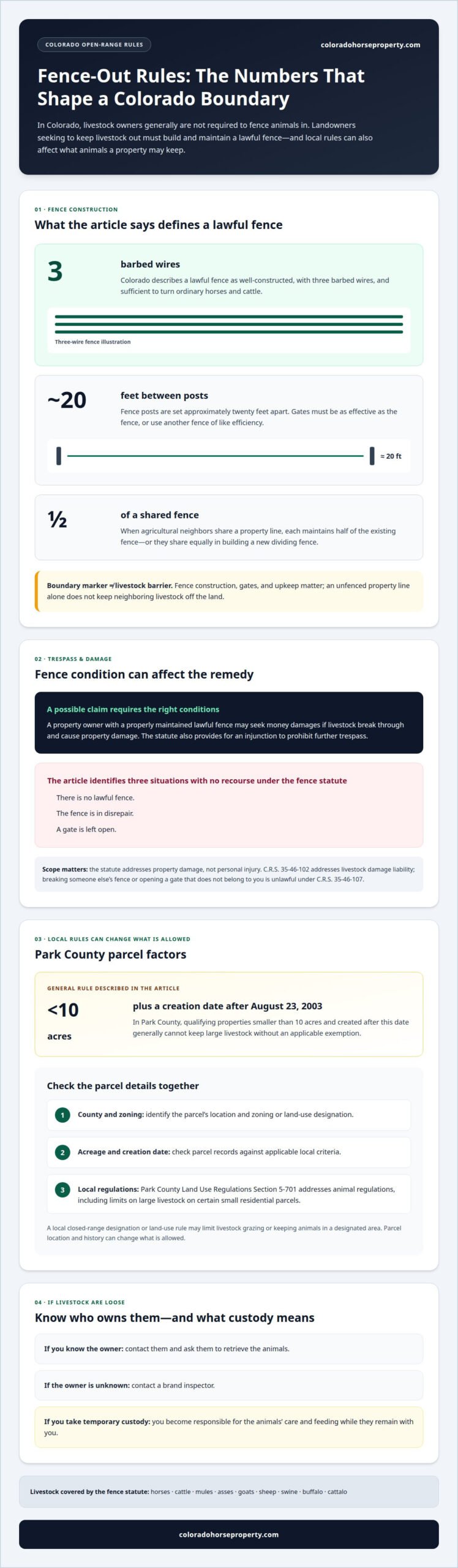
Colorado follows a fence-out approach: livestock owners generally aren’t required to fence animals in, while landowners seeking to exclude them must build and maintain a lawful fence. This matters at ranch boundaries because an unfenced line alone doesn’t keep neighboring animals off pasture. When agricultural neighbors share a property line, each must maintain half of the existing fence or share equally in building a new dividing fence.
Fence and Gate Rules
Colorado’s fence statute describes a lawful fence as well-constructed, with three barbed wires, according to the Colorado General Assembly. It also defines a lawful fence as sufficient to turn ordinary horses and cattle. Posts are set approximately twenty feet apart, and gates must be as effective as the fence or use another fence of like efficiency. Under Colorado State statute 35-46-107, breaking someone else’s fence or opening a gate that doesn’t belong to you is unlawful. A practical understanding of Colorado’s open range law includes recognizing that an open gate can undermine an otherwise sound barrier.
Keeping Livestock Off Property
Yes. Landowners can legally keep livestock off their Colorado property by fencing them out with a lawful fence. The fence’s construction, gates, and upkeep matter; a boundary marker alone is not the same barrier. For example, if you are concerned about cattle entering a pasture, assess the fence line and gates, not just the surveyed boundary. This fence-out rule explains why responsibility may fall on the property owner seeking to exclude livestock.
After hitting livestock on a Colorado road, pull over somewhere safe, avoid approaching the animal, and contact local law enforcement. Reporting the collision helps address the immediate road hazard and lets officers direct the next steps.
Livestock trespass and property boundaries
Colorado’s open-range framework affects what happens when livestock cross a property boundary. The animal involved, the fence’s condition, and any resulting property damage can all matter.
Livestock Covered by the Rules
Colorado’s fence statute includes horses, cattle, mules, asses, goats, sheep, swine, buffalo, and cattalo as livestock. The rules therefore cover more than cattle crossing a ranch line. Identifying the animal helps clarify whether livestock provisions apply when it enters a field, damages pasture, or reaches a boundary fence.
The same fence-out approach applies to all these listed livestock categories. For example, a horse or goat crossing onto neighboring acreage is still livestock under the statute’s definition. The species list matters when owners and neighbors discuss trespass, because the relevant rules are not limited to cattle or horses.
Trespass Remedies and Damages
Colorado’s fence statute provides civil remedies for livestock-related property damage, including money damages and an injunction to prohibit further trespass. A property owner with a properly maintained lawful fence may seek damages if livestock break through and cause damage. The statute addresses property damage, not personal injury, so the type of harm matters.
Fence condition can affect the available remedy. The statute provides no recourse when there is no lawful fence, the fence is in disrepair, or gates are left open. For example, a damaged pasture after cattle break through a maintained lawful fence differs from damage after livestock pass through an open gate. C.R.S. 35-46-102 addresses livestock damage liability.
A person who finds loose livestock may take temporary custody and becomes responsible for the animals’ care and feeding while they remain there. If you know the owner, contact them and ask them to retrieve the animals. If the owner is unknown, contact a brand inspector. These steps address immediate custody without treating the animals as abandoned property.
For readers assessing acreage and boundary needs before a purchase, Colorado acreage listings can help narrow property options.
Closed-range areas and local rules
Colorado’s fence-out framework does not answer every livestock question for every parcel. Local closed-range designations and land-use rules can restrict which animals owners may keep.
Local Closed-Range Rules
A local closed-range rule can limit livestock grazing or keeping animals within a designated area. In Park County, C.R.S. 35-46-112 is identified as a possible basis for a closed-range designation. Park County Land Use Regulations Section 5-701 also addresses animal regulations, including limits on large livestock on certain small residential parcels. These local rules matter because a property’s location and parcel history can change what livestock use is allowed.
Checking Open-Range Status
To determine a parcel’s status, identify its county, zoning, acreage, and creation date, then compare those details with local land-use rules. In Park County, qualifying properties smaller than 10 acres, created after August 23, 2003, generally cannot keep large livestock without an applicable exemption. Those criteria make parcel records and the county’s regulations relevant to an owner’s decision.
For a Park County parcel, start by locating its zoning and land-use designation. Then review Section 5-701 for applicable animal limits and determine whether the parcel meets the stated acreage and creation-date criteria. For example, two neighboring lots may have different outcomes if one was created before August 23, 2003, or does not meet the same size condition.
Keep the parcel-specific details together: county, zoning, lot size, and creation date. A street address alone may not reveal whether a property is subject to a local restriction. Compare the property records with applicable county provisions before planning livestock use. This distinction is especially important for residential parcels, where local animal limits may apply even when nearby land supports grazing.
Colorado’s state-level fence-out approach and a county’s land-use restrictions address different questions. The former concerns livestock and fencing responsibilities; local rules can determine whether particular animals may be kept on qualifying parcels. Considering these rules separately helps buyers and owners avoid assuming that open-range principles settle every question about land use.
Grazing on private residential properties
A residential parcel’s acreage alone doesn’t establish whether livestock grazing is allowed. In Park County, zoning, parcel size, and applicable animal regulations all matter when assessing a property for livestock use.
Park County’s Residential-20 zoning has a minimum lot size of 20 acres. The typical minimum lot size for Residential zoning is 1 acre, though requirements vary with utilities and location. These figures describe zoning lot-size requirements, not a general statewide rule for keeping animals. A parcel’s zoning designation therefore provides important context, but it doesn’t answer every livestock-use question by itself.
For a residential property, start with its county and zoning designation, then compare the parcel’s size and creation date with the applicable land-use rules. Park County Land Use Regulations Section 5-701 addresses animal regulations, including limits on large livestock on certain small residential parcels. That distinction matters for buyers considering a home where pasture or a small paddock seems suitable.
Consider a Park County parcel advertised for residential use. Its acreage may meet a zoning minimum, yet separate animal limits can still affect whether large livestock may be kept there. A practical review considers the property’s land-use designation and intended livestock use, rather than treating acreage or open-range status as the only deciding factor.
Before making plans, note the property’s county, zoning, acreage, and intended use. Compare those details with the relevant local provisions. This helps distinguish land with room for grazing from a residential property where local rules may restrict livestock. It also gives buyers a clearer basis for matching a property to their horse-property goals.
Explore Colorado acreage listings to find properties that fit your land and livestock priorities.
Colorado Horse Property: AI-Powered Horse Property Search
Colorado Horse Property helps buyers narrow their search for Colorado equestrian properties with its AI-Powered Horse Property Search. Search for features that fit your plans, including barns, arenas, water rights, and varied pasture sizes. This can help you compare acreage and livestock needs alongside the local rules discussed above.
For buyers weighing property options, Buyer Representation supports the purchase process, while Transaction Management helps coordinate the transaction. Sellers can use Real Estate Listing Services to present their property to prospective buyers. Matching your search to your intended use can help you focus on properties suited to your goals, rather than acreage alone.
For help finding a Colorado property that fits your equestrian plans, contact Colorado Horse Property.
Choose Land That Fits Your Plans
Understanding Colorado’s open range law is one part of choosing a property that works for life with horses. Start by defining how you want to use the land. Consider priorities such as daily access, facilities, pasture, and the kind of property you can manage over time. Clear priorities make it easier to compare listings by practical fit, not just first impressions.
As you evaluate options, match your plans for the property with the features that support them. A rural home should suit both your daily routine and longer-term goals. Keeping those needs in view can focus your search and help you move forward with confidence.
Explore Colorado Horse Property and take the next step toward finding land that fits your equestrian plans.
Frequently Asked Questions
Is Colorado an open range or fence-out state?
Colorado is generally a fence-out state: livestock owners usually aren’t required to fence animals in, and landowners who want to exclude them must fence out. That rule doesn’t mean livestock may run freely everywhere. Separate statutes address livestock running at large on public highways and within municipalities, including C.R.S. 35-46-105 and C.R.S. 35-47-101. A road or town setting can therefore involve additional rules.
What are Colorado’s livestock fencing requirements and fence standards?
Colorado’s fence standards call for a barrier capable of turning ordinary horses and cattle, with gates that are equally effective or another fence of like efficiency. The statute describes a lawful fence as well-constructed, with three barbed wires and posts approximately twenty feet apart. If a boundary dispute arises, note the fence’s condition and gate position: damage after an animal passes through an open gate differs from a breach of a maintained barrier.
Who is liable when livestock stray onto roads or private property in Colorado?
Liability isn’t automatic just because livestock appear on a road or private parcel. For property damage, a landowner with a properly maintained lawful fence may seek money damages if livestock break through; civil remedies can also include an injunction against continuing trespass. The fence statute addresses property damage, not personal injury. Livestock on public highways are covered by a separate provision, so road incidents aren’t resolved solely by private-boundary rules.
Are there local open range ordinances or exceptions in Colorado counties and municipalities?
Yes. Local restrictions can affect what livestock a parcel may keep, even where statewide fence-out rules apply. In Park County, certain properties smaller than 10 acres and created after August 23, 2003, generally cannot keep large livestock without an applicable exemption. Park County Land Use Regulations Section 5-701 addresses animal limits on some small residential parcels. Review county and municipal zoning provisions for the specific parcel before planning livestock use.