
Did you know that homes marketed with high-quality, professional photos can sell for up to 47% more per square foot? In the specialized world of equestrian real estate, the stakes are even higher because you aren’t just selling a roof and four walls. You’re selling a functional dream and complex infrastructure. Learning how to photograph a horse property to sell requires more than a steady hand; it demands an understanding of how to translate acreage and utility into a compelling visual narrative.
It’s a common frustration for ranch owners. You have a sprawling pasture that looks like a tiny patch of grass in photos, or a premium barn that appears dark and cluttered on screen. You know your property has immense value, but the images aren’t proving it to the market. We understand that your land is an investment and a lifestyle. This 2026 guide provides the technical roadmap you need to showcase your ranch’s true value. We’ll cover everything from capturing the scale of large acreage to properly lighting indoor arenas and highlighting expensive assets like water rights. By the end, you’ll know exactly how to create a listing that attracts high-intent buyers and secures a faster sale at a higher valuation.
Key Takeaways
- Understand why equestrian buyers prioritize barn functionality over home aesthetics and how to use visual storytelling to meet this “barn-first” logic.
- Learn the “Clean and Clear” rule for staging stalls and tack rooms, including why a freshly dragged arena surface is a non-negotiable requirement for high-end listings.
- Discover how to photograph a horse property to sell by utilizing Colorado’s golden hour and selecting lenses that capture expansive acreage without distorting infrastructure scale.
- Identify the critical equestrian assets to document, from professional-grade fencing and barn ventilation to the visual proof of essential water rights and well infrastructure.
- See how professional imagery fuels our AI-Powered Horse Property Search to categorize your ranch accurately and connect it with high-intent, niche buyers.
The Impact of Visual Storytelling in Equestrian Real Estate
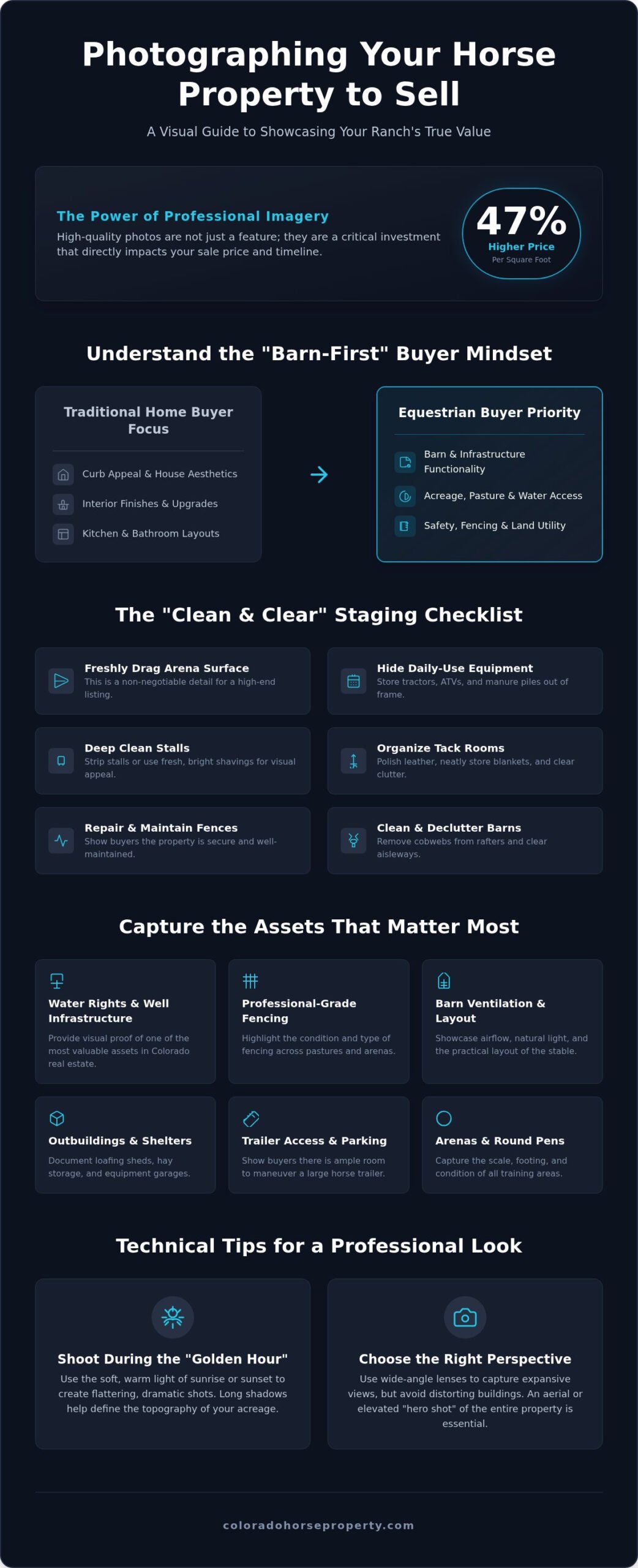
Visual storytelling in the ranch market is fundamentally different from standard residential sales. While traditional real estate focuses on interior finishes and curb appeal, equestrian buyers operate with a “barn-first” logic. They prioritize the safety of their livestock and the utility of the land over the granite countertops in the kitchen. Understanding how to photograph a horse property to sell requires a shift in perspective; you aren’t just documenting a building, you’re verifying the property’s capacity to support a specific lifestyle. This specialized approach draws its technical roots from Architectural photography, but it adds layers of land management and animal husbandry requirements that generalists often miss.
High-quality imagery is the primary fuel for modern marketing. For instance, our AI-powered search tools rely on clear, detailed photos to correctly categorize features like loafing sheds or round pens. When these assets are captured poorly, the property loses visibility. Beyond searchability, visual quality directly impacts your horse real estate for sale valuation. Industry data from 2026 shows that listings with professional photography can sell for up to 47% more per square foot. In a competitive market, those pixels translate directly into equity.
Selling the Lifestyle vs. the Listing
Equestrian buyers are chasing the “Colorado Dream,” which consists of expansive horizons and mountain backdrops. Your photos must answer critical questions before the buyer even schedules a showing. Is there enough room to turn around a 4-horse trailer? Does the barn have proper ventilation? By capturing the horse-centric utility of the ranch, you establish trust. A well-composed shot of a sturdy fence line or a pristine arena tells the buyer that the property has been maintained with care. This emotional connection to the land’s freedom is what moves a listing from a “maybe” to a “must-see.”
First Impressions and Click-Through Rates
The “hero shot” is the most important image in your digital arsenal. In the acreage market, this is rarely the front door of the house. It’s often an aerial view of the entire estate or a cinematic shot of the main stable at sunset. Professional imagery significantly reduces days on market by increasing engagement. Buyers spend more time on listings with a high photo count, provided those images offer new information. Each photo should serve a purpose, whether it’s showing the proximity of the pasture to the barn or the condition of the water stock tanks. When you provide a comprehensive visual tour, you filter for high-intent leads who already understand the property’s layout and value.
Preparing Your Colorado Property for the Lens
Professional teams like the CalgaryListings Group leverage these high-quality visual standards to ensure that every property—from sprawling acreages to urban residences—is presented with the clarity that modern buyers demand.
Similarly, The Agency Coffs Coast maintains a reputation for excellence in property marketing, ensuring that every listing benefits from a sophisticated and professional visual approach.
High-quality preparation is the difference between a listing that lingers and one that sparks a bidding war. While the foundational principles of real estate photography apply to the main residence, the equestrian infrastructure requires a specialized “Clean and Clear” protocol. Buyers in 2026 are more selective than ever. When they look at a property in high-demand areas like Flying Horse, where the median sale price reached $857K recently, they expect to see facilities that are ready for immediate use. Learning how to photograph a horse property to sell starts with a rigorous staging process that removes the “messy” reality of ranching from the frame.
Manure management and equipment storage are the two biggest hurdles in ranch photography. Manure piles, even if they’re located in a logical spot for daily operations, should never appear in your marketing photos. Similarly, tractors, ATVs, and implements should be tucked away in a shed or parked neatly out of sight. You want the buyer to focus on the lush pastures and the integrity of the fence lines, not the maintenance chores. If you’re preparing to list, viewing our current exclusive equestrian listings can show you the standard of cleanliness required for a top-tier Colorado ranch.
The Equestrian Staging Checklist
A “turn-key” barn is a major selling point. Start by deep cleaning every stall. This means stripping them to the floor or using fresh, bright shavings that pop on camera. Remove all cobwebs from rafters and light fixtures; they’re notorious for catching camera flashes and looking like clutter. Organize the tack room by removing personal items and leaving only a few high-quality saddles or bridles to showcase the storage capacity. Finally, polish the wash racks and grooming bays. A wet floor in a wash rack can create beautiful reflections, but ensure all hoses are coiled neatly and drains are clear of debris.
Curb Appeal for Ranches and Acreage
For the outdoor facilities, the arena is your centerpiece. Staging the arena is non-negotiable; it must be freshly dragged before the photographer arrives. A smooth, patterned surface looks professional and inviting. Beyond the arena, define your property lines by mowing paths along the perimeter and clearing brush near gates. Ensure all gates are functional and freshly painted if necessary. If your property features a Rocky Mountain view, stage your outdoor living areas or porch with simple, high-quality furniture to emphasize the lifestyle. This helps buyers visualize themselves enjoying the landscape after a day of riding.
Mastering Light and Angles for Large Acreage
High-altitude sunlight in Colorado creates extreme contrast that can wash out the details of your land. To master how to photograph a horse property to sell, you must prioritize the “Golden Hour.” This window occurs during the first hour after sunrise or the last hour before sunset. The light is softer and warmer, which helps define the rolling topography of the pastures. It minimizes the harsh, vertical shadows that often hide the quality of your fencing or the texture of your arena footing. If you shoot at midday, the sun often makes the landscape look flat and less inviting.
Lens selection is equally critical for capturing the scale of the property. A wide-angle lens, typically between 16mm and 24mm, is essential for showing the expansive feel of land for sale in colorado. However, you must use it carefully around structures. If you stand too close to a barn with a wide-angle lens, the edges will distort, making the stable look unstable or disproportionate. Step back and use the wide lens to frame the barn within the context of the surrounding acreage. This proves the property’s utility while maintaining its architectural integrity.
In the 2026 market, drone photography is no longer a luxury; it’s a requirement for acreage listings. Aerial shots provide the only way to prove the logistical layout of a ranch. Ensure your pilot holds a current FAA Part 107 Remote Pilot Certificate and complies with Remote ID requirements. Be aware of Colorado-specific drone ordinances. For instance, launching or landing is prohibited in all state parks and wildlife areas, except for designated model-aircraft fields. Aerial imagery allows buyers to see the relationship between the house, the stables, and the water sources in a single frame.
Aerial Strategy for Equestrian Estates
Use drones to map the functional layout of the estate. Highlight the proximity of the barn to the main house and the arena. Buyers want to see an efficient workflow for daily chores. Aerial shots should clearly show:
- Property boundary lines and their relationship to neighboring trail access.
- The location and condition of water features, including stock tanks, ponds, and irrigation systems.
- The layout of cross-fencing and rotational grazing patterns.
Interior Photography for Barns and Homes
Barn interiors are notoriously difficult to shoot because of the contrast between dark stalls and bright windows. Use High Dynamic Range (HDR) techniques to merge multiple exposures. This ensures the viewer can see the detail in the stall latches and the view out the barn doors simultaneously. Set your tripod at chest height rather than eye level. This lower perspective emphasizes the depth of the stable aisle and makes the ceiling feel more impressive. For indoor arenas, time your shoot to manage indoor/outdoor light transitions, ensuring the arena floor remains the focal point without being obscured by heavy shadows.
Capturing Essential Equestrian Infrastructure
The “Big Three” of equestrian real estate consists of barns, arenas, and fencing. These are not merely buildings; they are capital assets that dictate the property’s market value. To master how to photograph a horse property to sell, you must treat these structures as high-value infrastructure. In Colorado, this includes documenting water rights and well infrastructure visually. A clear shot of a well head or a headgate for irrigation proves the land’s viability. Buyers want to see the physical evidence of the resources that sustain their livestock and maintain the forage. It’s about providing proof of utility.
Photographing the Modern Horse Barn
A functional barn is about safety and efficiency. Capturing the “flow” is vital. This means showing the logical progression from the feed room to the stalls and then out to the turnout. High-quality photos should highlight ventilation systems and natural lighting. Detail shots of automatic waterers and thick rubber matting prove the owner hasn’t cut corners. These specifics are essential because our AI-powered search tools use these visual cues to categorize your listing for the most relevant buyers. A barn that looks dark or poorly ventilated will immediately turn off a serious equestrian.
Showcasing Pasture and Fencing Quality
Fencing is one of the most expensive investments on a ranch. Buyers specifically look for high-quality materials like pipe fencing or no-climb mesh with a top rail. When you are preparing a horse property for sale in colorado, your photos must clearly show the condition and type of every fence line. Close-up shots of corner posts and gate latches verify the property’s security. Don’t forget the ground itself. Healthy, weed-free forage and evidence of rotational grazing patterns are major selling points. Capturing the health of the soil indicates a well-managed operation.
Specialty features like round pens, hot walkers, and wash racks also deserve their own frames. For the riding arena, take a close-up shot of the footing. Whether it’s a sand-and-fiber mix or traditional screened dirt, the texture and depth are critical for performance-horse owners. A freshly dragged arena surface is a non-negotiable requirement for a professional listing. If you want to ensure your property’s infrastructure is presented with professional authority, consider our real estate listing services to reach a targeted audience of equestrian enthusiasts.
From Photos to Fast Sale: The Colorado Horse Property Strategy
Capturing high-quality images is only the first step. To achieve a faster sale at a higher valuation, you must deploy those visuals strategically. In the 2026 real estate market, your digital presence serves as the first showing. Data shows that homes marketed with professional photos can sell for up to 47% more per square foot. This isn’t just about aesthetics; it’s about data. Our AI-Powered Horse Property Search relies on these images to correctly categorize your ranch’s specific features, such as arena dimensions or stall counts. When you understand how to photograph a horse property to sell, you provide the fuel that powers these advanced search tools, ensuring your listing reaches the right niche buyers.
A successful listing doesn’t require a hundred photos. It requires the right ones. Focus on selecting five “anchor” images that define the property’s value immediately. These should include an aerial hero shot showing the entire estate, a clear view of the main stable aisle, a cinematic shot of the primary riding arena, a wide-angle pasture view featuring high-quality fencing, and a welcoming exterior of the main residence. For out-of-state buyers, who represent a significant portion of the Colorado acreage market, integrating cinematic video tours and 3D walkthroughs is essential. These tools provide the spatial context that still photos occasionally lack, allowing a buyer in another state to feel the property’s flow before they ever step foot on the soil.
Optimizing for AI and Search Visibility
Search visibility in 2026 depends on how well an AI can “read” your listing. High-resolution files are a requirement for mobile-first buyers who expect to zoom in on gate latches or stall hardware without losing clarity. Beyond resolution, metadata plays a critical role. When we upload your professional photos, we ensure every image is tagged correctly. This helps our AI identify your “indoor arena” or “loafing shed,” pushing your property to the top of filtered search results. Without these technical optimizations, even the best photography can remain invisible to high-intent buyers.
Choosing Your Marketing Partner
Generalist realtors often miss the mark because they focus on the house and ignore the infrastructure. They might take a great photo of the kitchen but fail to capture the well head or the irrigation headgate. At Colorado Horse Property, we bring 40 years of experience via Realty Oasis to every transaction. We understand that a ranch is a complex asset involving water rights, soil quality, and livestock safety. We don’t just list your property; we market the lifestyle and the utility that equestrian buyers demand. List your property with the Colorado Horse Property experts today!
Secure Your Ranch’s Future with Professional Visuals
Master the art of visual storytelling to transform your land into a high-value listing. We’ve covered the essential steps, from staging your arena with a fresh drag to capturing critical infrastructure like well heads and water rights. Understanding how to photograph a horse property to sell ensures you aren’t just showing a house; you’re proving the utility of a specialized capital asset to serious buyers. Every pixel should work toward establishing trust and demonstrating the property’s capacity for livestock and lifestyle.
High-quality imagery is the primary fuel for our AI-Powered search tool, which categorizes your ranch’s unique features for maximum exposure. With 40 years of market-leading experience and specialized Colorado equestrian expertise, we understand the nuances that generalists often miss. Don’t leave your property’s valuation to chance with amateur snapshots or poor lighting. Maximize your ranch’s value—get a professional property valuation today. We’re ready to help you navigate the 2026 market with confidence and secure the return your investment deserves. Your Colorado dream property is a significant asset, and it’s time to show the world its true worth.
Frequently Asked Questions
Do I really need a professional photographer for my ranch?
Professional photography is vital because homes with high-quality images sell for up to 47% more per square foot. Beyond aesthetics, our AI-Powered Horse Property Search requires clear, high-resolution files to correctly identify and categorize your ranch’s infrastructure. A professional knows how to photograph a horse property to sell by managing the extreme light contrast of Colorado’s high altitude. This ensures your barn and land look functional and valuable to high-intent buyers.
What is the best time of day to take photos of a Colorado horse property?
The “Golden Hour” is the ideal time for ranch photography. This occurs during the first hour after sunrise or the last hour before sunset. During these windows, the light is soft and warm; it creates long shadows that define the topography of your land. Midday sun in Colorado is often too harsh and creates flat, unappealing images. Timing your shoot correctly highlights the texture of your arena footing and the quality of your pastures.
Should I have horses in the photos when selling the property?
It’s usually best to photograph the property without horses to keep the focus on the infrastructure and land. Buyers need to visualize their own animals in the stalls and pastures. However, a few lifestyle shots with well-groomed horses can demonstrate the property’s utility. Ensure the horses don’t block views of fencing or barn features. The goal is to show the facility’s value rather than the specific livestock currently living there.
How many photos should a horse property listing have?
Most high-end equestrian listings benefit from 25 to 50 professional photos. You need enough variety to cover the main residence, the barn, the arena, and the acreage. While you want to be thorough, every image must serve a purpose. Avoid repetitive shots of the same stall or pasture. Focus on the five “anchor” images mentioned earlier in this guide to capture the buyer’s attention immediately within search results and AI-driven platforms.
How do I photograph a riding arena to show its size?
Use a combination of wide-angle lenses and aerial drone photography to capture the full scale of a riding arena. A drone shot from a 45-degree angle provides the best perspective on the arena’s dimensions relative to the rest of the property. For ground-level shots, stand in a corner and use a 16mm to 24mm lens. This technique is essential when learning how to photograph a horse property to sell with professional-grade clarity.
What are the most important features to photograph in a barn?
Focus on the features that prove safety and efficiency. This includes clear shots of stall latches, rubber matting, and automatic waterers. Highlighting ventilation systems and natural lighting is also critical for equestrian buyers. Detail shots of the tack room’s storage capacity and the condition of the wash racks add significant value. These visual cues help our AI tools categorize your barn’s premium features, making your listing stand out to serious horse owners.
Do drone photos really help sell ranches faster?
Drone photography is a requirement for acreage listings in 2026. Aerial shots provide the only way for buyers to understand the logistical layout of the ranch, including the proximity of the barn to the pastures. It also helps visualize property boundaries and water features. Ensure your pilot follows FAA Part 107 regulations and Colorado-specific ordinances. These cinematic views are particularly effective for attracting out-of-state buyers who can’t visit the property in person immediately.
How do I prepare my pastures for real estate photography?
Start by mowing paths along the perimeter and clearing any brush near gates to define the property lines. Ensure all fences are in good repair and gates are functional. If you have rotational grazing patterns, make sure the forage looks healthy and weed-free. Remove any visible equipment or manure piles from the frame. Lush, well-managed pastures are a major selling point and require a “Clean and Clear” approach to look their best on camera.