
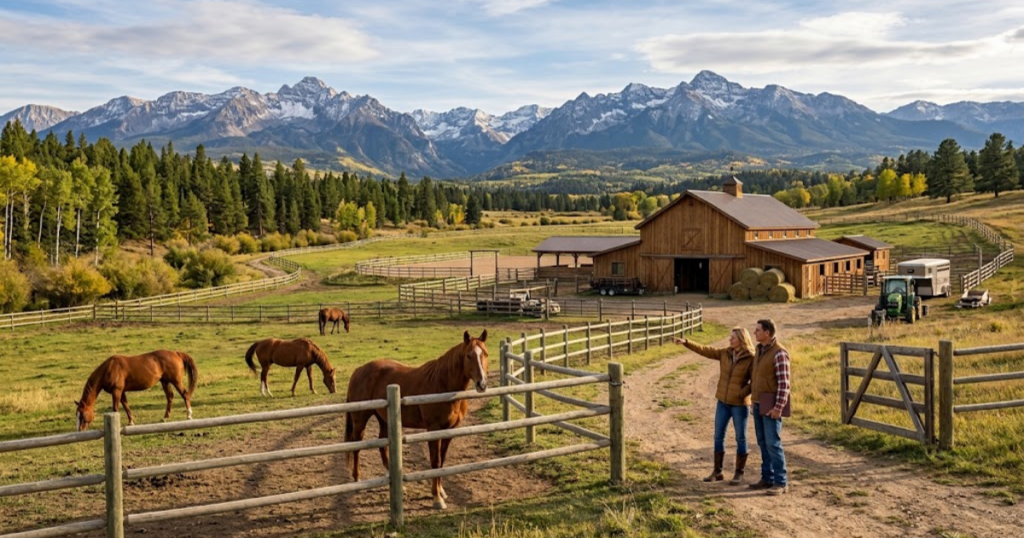
You have finally found the perfect Colorado equestrian estate. It features a beautiful custom home, a heated six-stall barn, a premium indoor riding arena, and twenty acres of irrigated pasture. You call your standard residential mortgage broker, the same person who helped you buy your suburban home a decade ago. They run your excellent credit score, verify your high income, and quickly issue a pre-approval letter. You submit a strong offer, the seller accepts, and you begin packing your bags.
Three weeks later, your lender calls with devastating news. The bank’s underwriter reviewed the property appraisal and immediately killed the loan. The underwriter determined that the massive indoor arena and the sprawling acreage make the property a commercial agricultural asset, not a residential home. Your suburban lender cannot finance a farm, your contract falls through, and you lose your dream property.
When searching for horse properties in Cin Colorado, securing the right financing is as important as verifying water rights or evaluating soil drainage. Equestrian real estate straddles a complicated line between residential comfort and commercial agriculture. If you approach a rural purchase with a standard suburban financing strategy, you are setting yourself up for failure.
To buy a ranch or equestrian facility successfully, match the property’s specific characteristics with the right lending institution. Here is the comprehensive guide to navigating rural mortgages and financing a horse property purchase in Colorado.
How to Finance a Horse Property Purchase in Colorado?
Quick Summary: Navigating Rural Mortgages
- The Acreage Myth: Fannie Mae does not have a strict acreage limit, but it does have a strict value limit. To qualify for a standard conventional loan, the house must make up the majority of the property's appraised value.
- Agricultural Lenders Versus Traditional Banks: Standard banks want to finance residential homes. Agricultural lenders want to finance land, barns, and arenas. Knowing which category your property falls into is the first step to securing funding.
- The Commercial Disconnect: If you plan to run a public boarding facility, host riding clinics, or breed horses professionally, you will likely need a commercial agricultural loan, which carries entirely different down payment and income requirements.
- Prepare for Higher Down Payments. While suburban home buyers can sometimes secure loans with a 3% to 5% down payment, buyers purchasing heavy agricultural land or commercial equine facilities should prepare for at least a 20% down payment.
1. The Conventional Loan Trap and the Acreage Myth
Most buyers start their purchasing journey by applying for a conventional conforming loan. These are standard residential mortgages that meet the underwriting guidelines set by Fannie Mae or Freddie Mac.
A persistent myth in the real estate industry is that Fannie Mae will not finance any property larger than ten acres. This is entirely false. Fannie Mae does not have a strict maximum acreage limit. However, it does have a strict rule about the property's nature: it must be primarily residential in use and value.
This creates the land-to-home value ratio problem. To qualify for a conventional loan, the primary residence must be the most valuable asset on the property. If you are buying a $1.5 million equestrian estate, and the house is worth $500,000, while the forty acres of land, the custom barn, and the indoor arena are worth $1 million, a conventional lender will deny the loan. In their eyes, you are buying an agricultural facility that happens to have a house on it, rather than a house that happens to have a large yard.
Furthermore, conventional lenders will balk at properties that generate commercial agricultural income. If the property has a history of operating as a commercial boarding stable or a public riding school, standard residential lenders will immediately flag it as a commercial enterprise and deny the residential loan application.
2. Hobby Farm Loans and Portfolio Lenders
If your property is too agricultural for a conventional Fannie Mae loan but you don't intend to run a commercial business, you may fall into the hobby farm category.
A hobby farm is a property used for personal agricultural enjoyment where the owner's primary income comes from outside sources, such as a standard corporate salary, rather than from farming activities. Financing a hobby farm often means looking beyond large national banks and seeking portfolio lenders.
A portfolio lender is typically a regional bank, local credit union, or private mortgage institution that originates loans and keeps them on its own balance sheet, rather than selling them to government-sponsored entities on the secondary market. Because they keep the loans in their own portfolio, they can set their own rules.
Portfolio lenders are far more flexible regarding acreage limits, outbuilding valuations, and agricultural zoning. They will often finance a property where the land and barns hold significant value, as long as the borrower has excellent credit, strong cash reserves, and a reliable off-farm income stream. However, because portfolio lenders assume more risk, expect slightly higher interest rates and potentially higher down payment requirements than standard conventional loans.
3. Commercial Agricultural Loans and Farm Credit
If you are purchasing a property with heavy equestrian infrastructure, massive acreage, or the intent to run a commercial equine business, you must leave the residential market entirely and work with a dedicated agricultural lender.
In Colorado, institutions like the Farm Credit system, including Premier Farm Credit or Farm Credit of Southern Colorado, specialize exclusively in rural land and agricultural operations. These lenders understand the true value of a barn; they know how to evaluate irrigated pasture, and they are comfortable financing properties where the land represents the vast majority of the purchase price.
Securing a commercial agricultural loan requires a completely different underwriting process.
The Business Plan Requirement
If you plan to generate income from the property through boarding, training, or breeding, an agricultural lender will require a comprehensive business plan. You must provide projected revenue, operating expenses, and a market analysis to prove the farm can cash flow its own debt.
Higher Down Payments
Farm properties rarely qualify for low-down-payment programs. If you are securing a commercial agricultural loan, you must prepare to put down a minimum of 20 percent of the purchase price. If the property does not include a primary residence and consists only of land and outbuildings, the required down payment can jump to 30 percent or more.
Agricultural Experience
Lenders want to know that you actually understand how to manage the asset you are buying. They will review your resume and previous agricultural experience to ensure you can maintain the property and execute your business plan.
4. USDA Rural Development and FSA Loans
For certain buyers, government-backed rural loans offer an alternative path to property ownership.
The U.S. Department of Agriculture (USDA) offers Rural Development loans designed to encourage homeownership in sparsely populated areas. These loans are attractive because they often allow zero-down-payment financing. However, USDA loans have strict geographical boundaries: the property must be located outside city limits in an eligible rural area, and they enforce strict household income limits. Furthermore, USDA loans are primarily designed for modest residential properties, meaning they will not finance a multi-million dollar luxury equestrian estate with commercial outbuildings.
For buyers looking to farm or ranch actively, the Farm Service Agency (FSA), a USDA branch, offers Farm Ownership Loans. These loans are designed specifically to help farmers and ranchers purchase land and construct agricultural buildings. The FSA offers both direct loans and guaranteed loans, where they back a loan issued by a local agricultural bank.
The FSA also offers specialized Down Payment Programs for beginning farmers, which can drastically reduce the upfront cash required to purchase a working farm, sometimes allowing buyers to secure land with as little as a 5 percent down payment, provided they meet strict eligibility and experience requirements.
5. Preparing for the Specialized Rural Appraisal
Regardless of which lender you choose, the loan is entirely contingent on the appraisal. This is where many equestrian transactions fall apart.
Standard residential appraisers evaluate houses based on comparable sales in suburban neighborhoods. If a standard appraiser is sent to value a horse property, they will struggle to assign accurate value to the specialized infrastructure. They might look at a $100,000 heated barn and give it zero value because they cannot find a comparable property in the nearby residential subdivision.
When financing a horse property, you or your real estate agent must aggressively advocate for a certified rural or agricultural appraiser. These specialists know how to pull niche agricultural comparable sales from across county lines. They understand the replacement cost of premium arena footing, the value of specialized pipe fencing, and the premium associated with deeded water rights. Securing the right appraiser ensures the bank recognizes the true value of the equestrian assets, preventing a massive appraisal gap that could kill your financing.
We Connect You With the Right Rural Lenders
You should never write an offer on a horse property without knowing exactly how the bank views the asset.
When Mark Eibner's team represents you, we do not leave your financing to chance. We evaluate the property upfront to determine whether it qualifies for conventional lending, requires a portfolio bank, or mandates a commercial agricultural loan. We maintain a curated network of trusted Colorado agricultural lenders, farm credit specialists, and rural appraisers. We connect you with the right financial partners before you ever submit a contract, ensuring your capital is protected and your transaction crosses the finish line smoothly.
Contact us today at coloradohorseproperty.com to find premium horse properties Colorado buyers trust.
Browse active Colorado horse ranches for sale or ask our team about finding a functional horse property for rent in Colorado while you organize your agricultural financing.
Frequently Asked Questions (FAQ) About Horse Property Financing
Can I use an FHA or VA loan to buy a horse property?
Yes, under certain conditions. Both FHA and VA loans allow properties with agricultural zoning, provided the property is primarily residential, and the home's value far outweighs the land and outbuildings. However, they will not finance commercial farming operations.
Are interest rates higher for agricultural loans compared to standard home loans?
Generally, yes. When most of the property value is tied up in land and agricultural outbuildings, lenders view the loan as higher risk than a standard suburban home. You should anticipate interest rates to be roughly half a percent to a full percent higher for a commercial agricultural loan.
Can I roll the cost of building a new barn into my mortgage?
If you are using a standard residential loan, usually not. However, if you are working with an agricultural lender like Farm Credit, they offer specific construction and farm improvement loans that can finance the cost of building new arenas or barns alongside the land purchase.
Does a property need to have an existing house to get a loan?
No, but buying raw land or a parcel with only a barn requires a dedicated land loan or a commercial agricultural loan. Standard residential lenders will not finance a property unless it has a habitable primary residence. Land loans typically require a 25% to 30% down payment.