
In 2026, a senior water rights holder placing a “call” on a stream can legally shut down a junior rancher’s water supply overnight. It’s a sobering reality for anyone looking at small ranches for sale in Colorado. You likely want more than just a scenic mountain view; you’re seeking a manageable piece of land that supports your horses while serving as a long-term legacy for your family. It’s a dream of freedom and open space, but the technical hurdles regarding soil drainage and livestock zoning can quickly feel overwhelming.
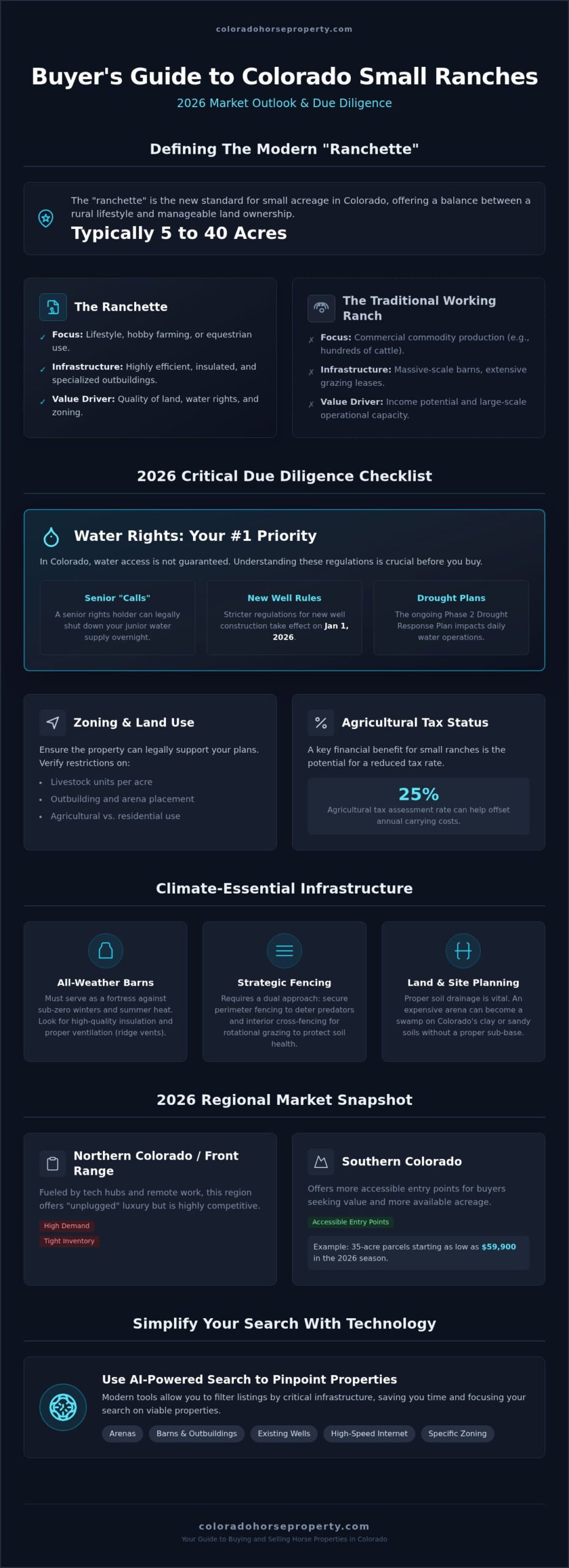
We believe that buying ten acres requires just as much due diligence as buying ten thousand. This guide provides the expert insights you need to evaluate properties with confidence. You’ll learn how to handle the new well construction rules effective as of January 1, 2026, and how the current Phase 2 Drought Response Plan impacts your daily operations. We’ll also explore using AI-powered search technology to filter for specific infrastructure like arenas and barns. From understanding the 25% agricultural tax assessment rate to identifying hidden infrastructure costs, this is your roadmap to securing a ranch that balances lifestyle with real-world utility.
Key Takeaways
- Define the 5 to 40-acre “ranchette” to balance your lifestyle aspirations with realistic land management expectations in the current market.
- Evaluate climate-essential infrastructure like insulated barns and specialized cross-fencing to protect your livestock from Colorado’s diverse weather patterns.
- Contrast the metro-accessible Front Range with the Western Slope’s high-desert estates to select a region that fits your logistical and recreational priorities.
- Use AI-powered property search technology to pinpoint small ranches for sale in colorado that meet specific criteria for arenas, barns, and outbuilding zoning.
- Master the nuances of livestock units per acre and local zoning restrictions to ensure your property can legally support your intended agricultural use.
Defining the Small Ranch: What to Expect in Colorado’s 2026 Market
In the 2026 market, the definition of a small ranch has solidified around the “ranchette” concept. These properties typically range from 5 to 40 acres. They serve a specific niche that sits between a standard residential lot and a massive commercial operation. Buyers looking for small ranches for sale in colorado often find that these parcels offer the ideal balance of privacy and manageable agricultural potential. Unlike a traditional suburban estate, the value here is found in the dirt, the water rights, and the specific zoning designations.
To understand the historical context and utility of these lands, it helps to ask: What is a ranch? In Colorado, even a small acreage must function as a mini-ecosystem. You aren’t just buying a house with a big lawn. You’re acquiring a responsibility that involves land management, animal husbandry, and resource conservation. Don’t let the smaller footprint fool you. In the Rockies, a 20-acre ranch can demand more daily attention than a 200-acre grazing lease because the intensity of use on smaller parcels is often much higher.
To better understand this concept, watch this helpful video:
The Ranchette vs. The Working Ranch
Daily operations on a ranchette focus on hobby farming or specialized equestrian use rather than commercial commodity production. While a large working ranch might run hundreds of head of cattle, a small rancher might focus on high-value boutique livestock or personal-use horses. Infrastructure scales differently here. You don’t need a massive hay barn, but you do need highly efficient, insulated outbuildings that can withstand Colorado’s sudden temperature swings. Income potential is usually secondary to lifestyle, though many owners use the 25% agricultural tax assessment rate to offset their annual carry costs.
Market Trends for Small Acreage in 2026
We’ve seen a shift in demand near Front Range tech hubs. Professionals are seeking “unplugged” luxury where they can work remotely while keeping horses in the backyard. This demand has kept inventory tight in Northern Colorado. In contrast, Southern regions offer more accessible entry points. For example, 35-acre parcels in areas like Vista Ranch have started as low as $59,900 in the 2026 season. Remote work continues to sustain high property values for small ranches for sale in colorado, making them a resilient asset class for those balancing career goals with rural aspirations.
Essential Infrastructure for Small Colorado Ranches
When browsing small ranches for sale in colorado, the quality of existing outbuildings often dictates the property’s true value. A barn in the Rockies must serve as a fortress against extreme weather. High-quality insulation prevents pipes from freezing during sub-zero winters, while ridge vents and windows ensure proper airflow to prevent respiratory issues in livestock. Fencing requires a dual-strategy approach. Perimeter fencing should be secure enough to deter predators; meanwhile, interior cross-fencing allows for rotational grazing. This is vital on limited acreage to prevent overgrazing and maintain soil health.
Proper site planning includes evaluating soil drainage and arena placement. Colorado’s heavy clay or sandy soils can turn an expensive arena into a swamp without a proper sub-base. Infrastructure is only half the battle. You must also ensure the land has legal access to water. The state manages this through Colorado’s Prior Appropriation System, which determines who gets water during drought cycles. If you’re unsure about a property’s utility status, our AI-powered horse property search can help you filter listings by specific features like existing wells or high-speed internet availability.
Equestrian Facilities on a Smaller Scale
On a 10-acre parcel, every square foot counts. Optimizing paddock layouts often means creating “sacrifice lots” where horses stay during wet weather to protect your pastures. Indoor arenas are a luxury that extends the riding season, but outdoor arenas are more common on smaller tracts. You’ll also need a dedicated plan for manure management and hay storage. Storing hay away from the main barn reduces fire risk. This is a critical consideration in our dry climate, especially with the Phase 2 drought response plan active in 2026.
Outbuildings and Multi-Use Structures
The “Barndominium” has become a staple for those seeking a streamlined lifestyle. These structures combine living quarters with shop or stable space, reducing the footprint on your land. Workshops and equipment storage are essential for maintaining the tractors and implements needed for ranch work. Adding a guest house or an Accessory Dwelling Unit (ADU) can significantly boost property value. It provides space for caretakers or additional rental income; you can discover Allura Homes to explore full-service vacation rental management that helps offset the higher interest rates seen in the 2026 land loan market.
Top Regions for Small Ranches: Where to Buy in Colorado
Colorado’s varied geography creates distinct micro-markets for land buyers. When searching for small ranches for sale in colorado, you must decide between the convenience of the Front Range and the rugged seclusion of the Western Slope. Each region carries unique climate burdens and infrastructure requirements. For instance, a ranch in the San Luis Valley faces different water challenges than a property along the I-25 corridor. Buyers often find that Southern Colorado offers the most acreage for the price; 35-acre parcels at Vista Ranch have hit the market starting at $59,900 in 2026. However, these lower price points often come with longer commutes to major medical facilities and airports.
Climate is a non-negotiable factor in your regional search. Snow load requirements for outbuildings vary significantly by county. A barn built in Weld County might not meet the structural standards needed in the high country of Summit County. Growing seasons also fluctuate; the Western Slope provides a longer window for fruit and hay production compared to the short, intense seasons found in the mountain valleys. Understanding these regional nuances ensures your legacy property remains functional year-round.
Front Range Favorites: Douglas and Weld Counties
Douglas County remains the premier hub for high-end equestrian estates. Its proximity to Denver and Colorado Springs makes it ideal for professionals who need to balance ranch life with a corporate career. Weld County offers a more diverse agricultural landscape. It’s a region where you’ll find a mix of hobby farms and serious livestock operations. While Douglas County emphasizes luxury and commutability, Weld County provides more room for traditional ranching activities at a slightly more accessible entry point for small ranches for sale in colorado.
High Country and Mountain Ranches
The Buyer’s Due Diligence: Water, Zoning, and Taxes
For parcels under 35 acres, water rights are often the biggest hurdle. Most small ranches for sale in colorado rely on wells rather than municipal systems. You’ll likely encounter “household-use-only” permits. These restrict water to indoor use and strictly forbid watering livestock or gardens. To water horses, you generally need a “domestic” permit. The “35-acre rule” is a critical threshold. Parcels of this size or larger often have a presumed right to a domestic well permit that allows for livestock watering. As of January 1, 2026, new well construction rules (2 CCR 402-2) have updated the standards for pump and cistern installations. Always verify the specific permit type and its history before closing.
Navigating Local Zoning and Covenants
Zoning determines your “livestock units” per acre. A county might allow four horses on ten acres, but a Homeowners Association (HOA) or Property Owners Association (POA) could restrict that to two. Outbuilding restrictions are equally important. Some counties limit the total square footage of barns based on the size of the primary residence. You must also account for easements that might cross your property, such as utility lines or conservation restrictions. Colorado’s right-to-farm laws protect established agricultural operations from nuisance lawsuits filed by neighbors over common ranching issues like noise, dust, or odors. If you’re ready to find a property that meets these complex criteria, use our buyer representation services to ensure no technical detail is overlooked.
Finding Your Legacy: How AI and Expertise Simplify the Search
Locating small ranches for sale in colorado is a technical challenge that standard real estate platforms aren’t equipped to handle. Most search engines fail to distinguish between a “fenced yard” and “perimeter cross-fencing for livestock.” We solve this by using AI-powered search technology that filters for specific equestrian and agricultural features. Whether you need a property with senior water rights or a specific arena sub-base, our proprietary tech identifies listings that match your operational requirements. This precision saves you from touring dozens of properties that look good in photos but lack the infrastructure needed for a functional ranch.
Expert buyer representation is your best defense in a market where the combined value of ranches for sale approaches $2 billion. Negotiations for land involve more than just the purchase price; they require a deep understanding of mineral rights, grazing leases, and equipment inclusions. Our team manages the complex title and escrow coordination required for these specialized transfers. We also help you build your “Ranch Team” by connecting you with trusted local veterinarians, farriers, and fencing contractors who understand the unique demands of the Front Range and Western Slope.
The Colorado Horse Property Advantage
Our specialized division at Realty Oasis offers 40 years of local network connections. This experience allows us to identify off-market opportunities that never reach public listing sites. In one recent case, we located a “needle in a haystack” small ranch for a buyer who required senior water rights and a covered arena within 45 minutes of a tech hub. By leveraging our deep industry tenure, we secured the property before it faced a competitive bidding war. We don’t just find land; we find assets that align with your long-term legacy goals.
Your Next Steps to Ranch Ownership
Preparation is vital before you begin touring properties. Start by getting pre-approved for land or agricultural loans. In the 2026 market, interest rates for these loans generally range from 4% to 10%, and they often require higher down payments than residential mortgages. Once your financing is in place, schedule a strategy session with Mark and Alison Eibner to define your must-have features. For a deeper look at the market, read our guide on equestrian real estate Colorado to understand the broader regional trends. We’re ready to help you transition from the search phase to securing your piece of the Colorado landscape.
Securing Your Colorado Legacy
Owning a small ranch is more than a real estate transaction; it’s a commitment to a specific lifestyle and the responsible management of the land. Success in the 2026 market depends on your ability to navigate technical hurdles like domestic well permits, agricultural tax assessments, and local zoning restrictions. You’ve learned that infrastructure quality and regional climate factors are just as important as the acreage itself. Finding the right small ranches for sale in colorado doesn’t have to be a confusing process when you have access to the right tools and expertise.
We combine 40 years of specialized experience with AI-driven property matching to help you find a ranch that meets your exact requirements. Our team provides expert buyer and seller representation to ensure every detail of your transaction is managed with precision. We understand that you’re building a legacy, not just buying a house. Start Your AI-Powered Colorado Ranch Search Today and take the first step toward the freedom of the Rockies. Your ideal property is out there, and we’re ready to help you secure it.
Frequently Asked Questions
What is considered a “small ranch” in Colorado?
How many horses can I keep on 5 acres in Colorado?
The number of horses you can keep depends entirely on county zoning laws and specific Homeowners Association (HOA) rules. Most counties use a “livestock unit” system, often allowing one or two horses per acre of usable pasture. However, some 5-acre small ranches for sale in colorado might be restricted to just two horses total due to soil sensitivity or water limitations. Always verify the specific animal density allowed by the county planning department before you buy.
Do small ranches in Colorado always come with water rights?
Not all small properties include deeded water rights. Many smaller parcels rely on well permits, which are often restricted to “household use only” inside the home. To water livestock or gardens, you specifically need a domestic well permit. Properties over 35 acres generally have a better chance of securing these domestic rights. Because Colorado follows the prior appropriation doctrine, senior rights holders always take priority during drought cycles, making water due diligence a top priority.
What is the difference between a ranch and a ranchette?
The primary difference lies in scale and intent. A ranch is typically a larger commercial operation focused on livestock production or agriculture as a primary income source. A ranchette is a smaller lifestyle property, usually 5 to 40 acres, where the owner enjoys the rural setting without the pressure of commercial farming. While a ranchette might have a barn and a few animals, it’s designed for personal enjoyment and hobby use rather than high-volume commodity output.
How do I qualify for agricultural tax status on a small property?
To qualify for the 25% agricultural tax assessment rate in 2026, you must demonstrate a primary intent of agricultural use. This usually involves showing a consistent history of activities like grazing livestock, boarding horses for profit, or producing hay. The county assessor will require documentation of these activities over the previous two years. Simply owning a large lot isn’t enough; the land must be actively contributing to an agricultural product or service to receive the tax benefit.
Can I build a second home or ADU on my Colorado ranch land?
Building an Accessory Dwelling Unit (ADU) or guest house depends on your specific county’s zoning and the capacity of your septic system. Many rural areas allow for one primary residence and one smaller guest structure, provided you meet setback requirements and have adequate water permits. Adding an ADU can significantly increase your property value and provide space for a caretaker. However, you must check for any outbuilding square footage limits that might be tied to your primary home size.
What are the hidden costs of owning a small ranch?
How does the AI search tool help me find specific equestrian facilities?
Our proprietary AI search technology goes beyond basic keywords to identify complex property features. When looking for small ranches for sale in colorado, you can filter for specific combinations like an indoor arena paired with senior water rights. Standard platforms often confuse a basic backyard shed with a professional-grade horse barn. Our tool analyzes data to ensure the infrastructure matches your specific requirements, saving you time by highlighting only the most relevant properties in the 2026 market.