
Choosing between a municipal gas line and a private propane tank isn’t just a utility preference; it’s a strategic decision that defines your ranch’s operational survival during a sub-zero Front Range blizzard. You already know that heating a large-scale property is one of your biggest annual expenses, especially when high-altitude temperatures plummet. When evaluating propane vs natural gas for a Colorado ranch home, the choice often comes down to a trade-off between the convenience of a utility grid and the independence of on-site storage.
This guide provides the clarity you need to choose the most reliable fuel source for the 2026 winter season and beyond. We’ll explore how infrastructure costs impact your bottom line and how the upcoming “Right to Natural Gas” ballot initiative might shift the state’s energy landscape. You’ll discover which option better supports your property’s resale value and how to navigate Colorado’s latest heat pump tax credits. By the end, you’ll have a clear roadmap for securing your ranch’s energy future while accounting for the recent 8.6 percent rate increases hitting the market this October.
Key Takeaways
- Understand how “Last Mile” connection costs for natural gas can outweigh the fuel’s lower operational price on remote properties.
- Learn why propane’s higher energy density provides a distinct heating advantage for high-altitude Colorado barns and arenas.
- Discover how utility infrastructure choices directly influence the appraisal and marketability of specialized equestrian real estate.
- Evaluate five critical variables for choosing propane vs natural gas for a Colorado ranch home, including distance from mains and total energy load.
- Stay informed on how the 2026 Colorado legislative landscape and ballot initiatives impact long-term energy security for rural landowners.
The Energy Reality of Colorado Equestrian Properties
When you’re scouting for a ranch, it’s easy to get caught up in the quality of the hay or the view of the Continental Divide. However, the energy infrastructure under the ground is just as vital to your long-term success. For a large property, your choice between propane vs natural gas for a Colorado ranch home dictates your monthly overhead and your winter resilience. In the Front Range, natural gas is common in developed pockets, but as you move into the High Country or sprawling rural tracts, the grid often ends. This creates a fundamental choice between the convenience of a utility connection and the total independence of on-site storage.
Large ranch houses and equestrian facilities have energy demands that far exceed a standard suburban home. You aren’t just heating a living room; you’re often maintaining temperatures in expansive garages, guest houses, and agricultural structures. With Colorado natural gas rates seeing an 8.6 percent increase in October 2026, understanding your energy mix is no longer a secondary concern. It’s a primary pillar of your property’s operational budget.
Zoning and Utility Availability in Rural CO
Proximity to a gas main is a binary reality in counties like Elbert or Douglas. If a property sits more than 500 feet from the nearest main, the cost to extend that line can be a massive hurdle. During the due diligence phase of purchasing equestrian real estate Colorado, identifying utility easements is critical. These legal rights-of-way determine where lines can be buried and who is responsible for their maintenance. Because many ranches are set far back from the road to ensure privacy, a standard hookup often becomes a complex engineering project. If the infrastructure doesn’t already exist, you must weigh the upfront connection fees against the long-term price stability of a regulated utility.
Heating More Than Just the Home
Ranch life involves more than just keeping the kitchen warm. You have to consider heated tack rooms, workshops, and indoor riding arenas that require massive amounts of energy to remain functional in January. Understanding Liquefied Petroleum Gas (LPG) Basics is helpful here, as propane’s portability allows you to place tanks near remote outbuildings where running a gas line isn’t feasible. Many owners adopt a dual-fuel strategy. They use natural gas for the main residence if it’s available, while relying on propane for detached barns or backup generators. In a heavy Colorado snowstorm, a dedicated propane supply for a generator ensures your well pump and heaters keep running even if the local electric grid fails. This independence is a major draw for buyers who prioritize security in the High Country.
Energy Density and Altitude: High-Country Performance
High altitude changes the physics of home heating. When you’re comparing propane vs natural gas for a Colorado ranch home, you have to look beyond the monthly bill and consider how these fuels perform at 7,000 feet or higher. The primary difference lies in energy density. Propane contains roughly 2,500 BTUs per cubic foot, while natural gas offers only about 1,000 BTUs. In practical terms, propane delivers more heat per volume of fuel consumed. This becomes a significant advantage when you’re trying to maintain a comfortable temperature in a sprawling ranch house with vaulted ceilings and large windows facing the Divide.
Altitude affects combustion efficiency. As the air gets thinner, your furnace or boiler needs to be properly “derated” to ensure the fuel-to-oxygen ratio remains safe and effective. While both fuels require adjustments, propane’s higher energy density often results in a “hotter” feel from forced-air systems. During a relentless January blizzard, that higher discharge temperature can make a noticeable difference in how quickly your home recovers from heat loss. Understanding Propane Fuel Basics helps clarify why this chemical composition is so effective for high-output agricultural and residential needs.
Efficiency Ratings in the Rockies
Energy density is the ‘heat-per-tank-fill’ metric for ranch owners. Because propane is more concentrated, you need less of it to achieve the same thermal output as natural gas. This is particularly relevant for equestrian properties with high-volume spaces like indoor arenas or large workshops. While natural gas is often cheaper per unit of energy, the upfront efficiency of propane means your equipment doesn’t have to work as hard to move the needle on the thermostat. If you’re currently evaluating a potential purchase, using an AI-powered property search can help you filter for homes that already feature high-efficiency systems tailored for these mountain conditions.
Reliability During the ‘Bomb Cyclone’ Events
Colorado’s “Bomb Cyclone” events and heavy spring snows test the limits of any utility. Natural gas relies on a pressurized underground pipeline system. During extreme cold snaps, high demand across the entire grid can lead to pressure drops, potentially affecting the performance of your appliances. Propane offers a different kind of security. With a 500 or 1,000-gallon tank on-site, you own your entire winter fuel supply. You aren’t vulnerable to grid-wide fluctuations or line breaks miles away from your gate.
The main technical hurdle for propane is the vaporization point. Propane turns back into a liquid at -44 degrees Fahrenheit, at which point it stops flowing to your house. In the coldest parts of the Front Range and High Country, proper tank placement is vital. Burying the tank keeps the fuel at a consistent temperature, ensuring it continues to vaporize and provide heat even when the outdoor air temperature reaches dangerous lows. Modern tank monitoring systems now allow you to check your levels from your smartphone, providing peace of mind during remote winter stretches.
Infrastructure vs. Independence: The Cost of Connection
The “Last Mile” challenge is the primary financial hurdle for any rural Colorado developer or buyer. While natural gas is often touted for its lower monthly rates, the cost to bring that service from the main road to a secluded home site can be prohibitive. In many parts of the Front Range, extending a gas line typically costs between $15 and $25 per linear foot. On a 40-acre ranch where the home sits a quarter-mile from the gate, those infrastructure fees can easily exceed $30,000 before you even turn on the furnace. This “cost of entry” often outweighs decades of potential operational savings.
Propane offers a different path through independence. Because it’s a byproduct of natural gas processing and crude oil refining, as noted by the Energy Information Administration on Propane, it’s readily available in regions where pipelines simply don’t exist. When evaluating propane vs natural gas for a Colorado ranch home, you must decide if you prefer the reliability of a utility-managed grid or the self-sufficiency of an on-site fuel supply. Each model carries different maintenance burdens. With natural gas, the utility owns the line to the meter. With propane, you are responsible for the tank and the lines leading to your structures, giving you total control but also total accountability.
Trenching and Line Extension Realities
Colorado’s geography presents unique challenges for utility installation. If your property sits on the rocky soil of the Palmer Divide or the foothills, trenching requires specialized equipment like hydraulic hammers or rock saws. These complications can double your installation timeline and budget. This is a critical factor when looking at land for sale in colorado, as undeveloped lots may seem like a bargain until you calculate the utility hookup costs. Some equestrian subdivisions mitigate this by using community-shared gas systems, but these often come with specific HOA regulations and shared maintenance fees that you should review during the due diligence phase.
Propane Tank Logistics: Lease vs. Buy
Choosing propane gives you the flexibility to either lease your tank from a supplier or purchase it outright. Buying your tank requires a higher upfront investment but allows you to shop around for the best seasonal rates from multiple providers. Leasing is more common but typically locks you into a single company’s delivery schedule. For high-altitude ranches, underground tanks are the gold standard. They preserve the property’s aesthetics and use the earth’s natural insulation to prevent vaporization issues during extreme cold. Most large Colorado equestrian properties opt for 1,000-gallon tanks or larger. This capacity ensures you have enough fuel to last through the most severe winter months without needing a delivery truck to navigate snow-clogged ranch roads during a blizzard.
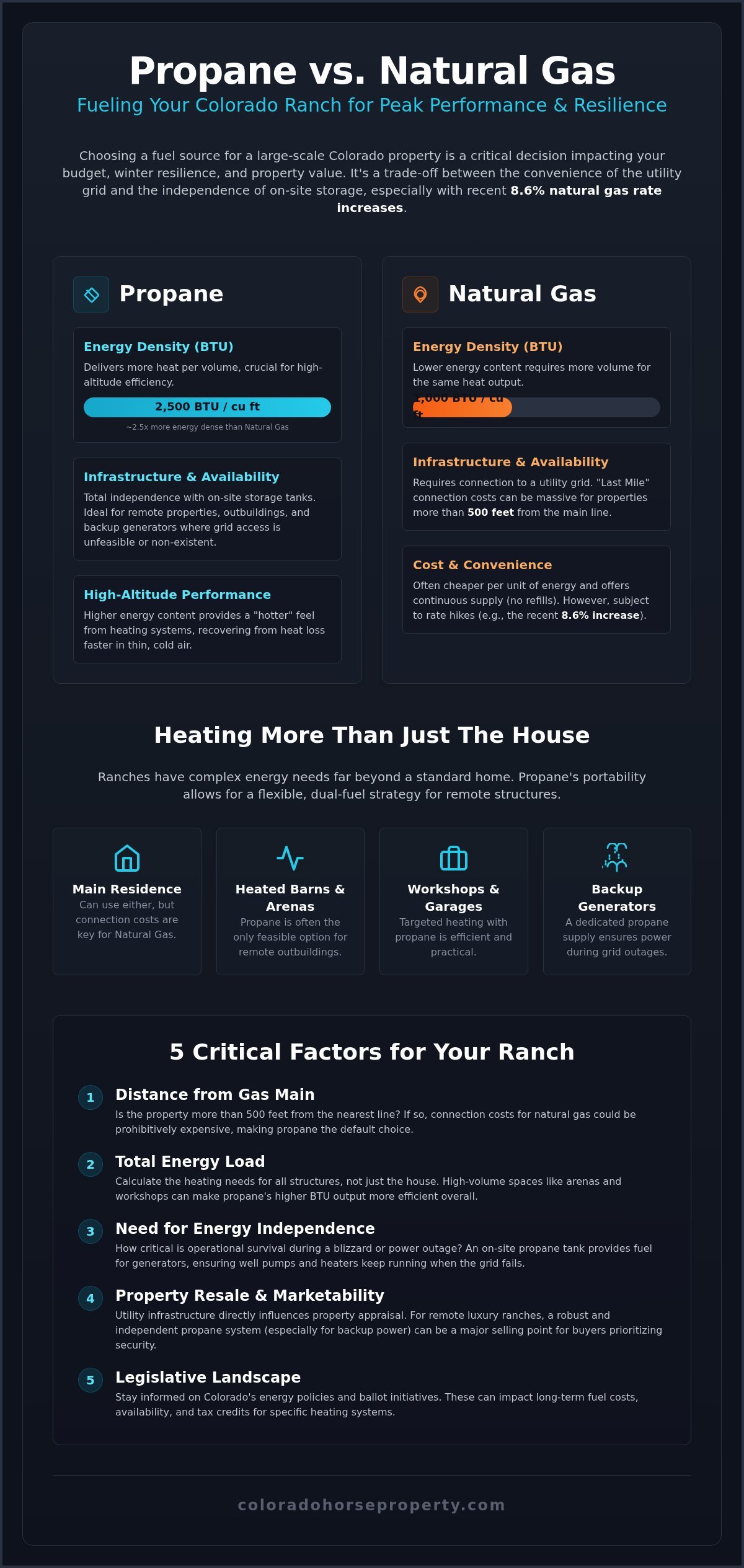
5 Factors to Evaluate for Your Colorado Ranch
Deciding between propane vs natural gas for a Colorado ranch home requires more than a simple cost-per-BTU calculation. You must look at the specific physical constraints and future goals of your acreage. If your building site is more than 500 feet from the nearest gas main, the capital expenditure for a line extension often makes natural gas a poor financial choice. Conversely, a ranch with a high energy load, such as a heated indoor arena, a guest house, and a year-round pool, may eventually justify those upfront costs through lower monthly utility rates. Your environmental goals also play a role. While both are fossil fuels, natural gas typically has a lower carbon footprint for local combustion, though propane remains a highly efficient alternative for off-grid applications.
Future expansion is the final piece of the puzzle. If you plan to add more equestrian facilities or a workshop in the next five years, propane offers immediate scalability. You can simply add a second tank or upgrade to a larger vessel without waiting for utility company approvals or additional trenching permits. Before you commit to a property, use our AI-powered horse property search to filter listings by their existing utility infrastructure and see what’s already in place.
The Delivery Access Audit
For propane-dependent ranches, your driveway is your lifeline. A 3,000-gallon delivery truck is heavy and wide. If your private road has a steep grade or narrow switchbacks, a driver may refuse to make a delivery during a heavy January snowpack. You must maintain a reliable snow removal contract to ensure clear access to your tank at all times. Most remote owners choose “Auto-Fill” programs. This allows the supplier to use weather tracking and historical data to schedule deliveries before your tank hits a critical level, which is much safer than “Will Call” service when a blizzard is in the forecast.
Appliance Compatibility and Conversions
Modern ranch life often includes professional-grade kitchens. High-end ranges from brands like Wolf or Viking are usually built for natural gas but come with conversion kits for propane. However, these conversions must be handled by a certified technician to ensure the orifices are correctly sized for the different pressure requirements. Tankless water heaters also perform differently depending on the fuel. Propane’s higher energy density allows some tankless models to reach their target temperature faster, which is a major benefit when you’re filling large soaking tubs or washing down horses in a heated wash rack. Don’t forget to plan for outdoor amenities. Fire pits and outdoor kitchens are much easier to install when you can simply tap into an existing propane line rather than extending a buried gas pipe across a finished patio.
Property Value and Resale: The Real Estate Perspective
In the specialized market for ranches for sale colorado, energy infrastructure is a significant line item on an appraisal. While a suburban buyer might take a natural gas hookup for granted, a seasoned ranch buyer views it as a valuable asset that eliminates the logistical burden of fuel deliveries. This “Natural Gas Premium” often manifests as a faster sale time and a higher closing price. However, the shift in market sentiment for 2026 shows that many buyers now prioritize independence. A well-maintained propane system with high-capacity storage can be marketed as a “self-sufficient” feature, especially when paired with a backup generator and a large-volume tank.
When you list a property, transparency regarding your winter heating costs is vital. Buyers looking at propane vs natural gas for a Colorado ranch home will ask for at least two years of utility history to understand the operational overhead. If your ranch relies on propane, highlighting a recently inspected 1,000-gallon tank and a record of seasonal “Auto-Fill” deliveries provides the reassurance a buyer needs. Positioning your energy system as a robust, reliable piece of infrastructure rather than a monthly chore is the key to protecting your property’s equity.
Market Trends in Colorado Ranching
The 2026 market is seeing a distinct trend toward “off-grid capable” luxury properties. Buyers are increasingly wary of grid instability and rising utility rates, making private propane systems more attractive than they were a decade ago. Modern propane technology has bridged the convenience gap that once favored natural gas. Smart meters and cellular tank monitors allow owners to track their fuel levels with the same precision as a digital utility bill. By framing a propane-powered home as a choice for energy security and independence, you appeal to a growing demographic of buyers who want to be insulated from municipal grid failures during extreme High Country winters.
Expert Guidance from Colorado Horse Property
With 40 years of experience in the Colorado Front Range market, we understand that the value of a ranch is built on more than just the house and the barn. It’s built on the resource infrastructure that keeps the property running. Our specialized knowledge in land management allows us to help sellers highlight these technical assets and help buyers identify potential “Last Mile” connection costs before they make an offer. Our AI-powered search tools are specifically designed to filter for these details, ensuring you find a property that matches your operational needs and long-term financial goals. Search current Colorado horse properties with the right infrastructure to see how we can streamline your due diligence process and ensure no surprises at the closing table.
Securing Your Colorado Ranch’s Energy Future
Deciding on propane vs natural gas for a Colorado ranch home is a foundational part of your property due diligence. It requires balancing the high upfront infrastructure costs of natural gas against the logistical independence of on-site propane storage. As we move through 2026, your choice should reflect both your immediate operational needs for heated barns and your long-term goals for property equity. Whether you prioritize the regulated rates of a utility grid or the self-sufficiency of a private 1,000-gallon tank, understanding these systems is essential for winter resilience in the High Country.
As specialized equestrian real estate experts with 40 years of Front Range experience, we provide the technical insights you need to make an informed investment. Our proprietary AI property search technology allows you to filter listings based on specific utility infrastructure, ensuring your new home meets your standards for reliability and efficiency. We are here to help you navigate these complex infrastructure details so you can focus on the lifestyle you’ve worked to achieve. You don’t have to navigate the complexities of rural land management alone.
Start Your AI-Powered Search for the Perfect Colorado Ranch today and build your legacy on a solid foundation.
Frequently Asked Questions
Is it cheaper to heat a Colorado home with propane or natural gas in 2026?
Natural gas is typically 2 to 2.8 times cheaper than propane per BTU in the current market. While October 2026 brings an 8.6 percent rate increase for residential customers in Colorado, the operational costs for natural gas remain significantly lower. However, you must factor in the high upfront connection fees for remote properties. For many, the long-term savings on monthly bills eventually offset the initial investment required to extend a municipal line.
Can I convert my ranch house from propane to natural gas later?
You can convert a home from propane to natural gas if a municipal line becomes available. This process involves replacing the orifices on your appliances, such as your stove, water heater, and furnace, to accommodate the lower pressure of natural gas. You’ll also need a certified technician to inspect the existing interior piping. While the conversion itself is straightforward, the primary expense remains the trenching and connection fees from the main road.
How long does a 500-gallon propane tank last for a typical ranch home?
A 500-gallon tank typically lasts between two and four months for an average ranch home during a standard Colorado winter. This duration varies based on your home’s square footage, insulation quality, and whether you’re also heating outbuildings like a tack room or workshop. Because propane tanks are only filled to 80 percent capacity for safety, a 500-gallon tank actually holds 400 gallons. Most large equestrian properties opt for 1,000-gallon tanks for better seasonal security.
What happens to my natural gas supply during a Colorado power outage?
Natural gas continues to flow during a power outage because the pipeline system doesn’t rely on the local electric grid. However, most modern gas furnaces require electricity to operate the blower motor and electronic ignition. Without a backup generator, your heating system won’t run despite having a fuel supply. This is why many owners who choose propane vs natural gas for a Colorado ranch home also invest in a gas-powered standby generator to maintain warmth.
Do I need a special permit to install a large propane tank on my equestrian property?
You generally need a permit from your local building department or fire marshal to install a propane tank larger than 125 gallons. Regulations in counties like Douglas or Elbert specify set-back distances from property lines, buildings, and ignition sources. If you’re installing an underground tank, you’ll also need to account for soil conditions and utility easements. Always check with your local jurisdiction before finalizing the placement of a high-capacity tank on your acreage.
Does the altitude in the Colorado Rockies affect gas appliance performance?
High altitude significantly impacts combustion efficiency because there’s less oxygen available for the fuel to burn. Appliances in the Colorado Rockies must be “derated,” which involves adjusting the gas flow to maintain a safe and efficient flame. While propane’s higher energy density provides a thermal advantage at 7,000 feet, both fuels require professional calibration to prevent carbon monoxide buildup and ensure your equipment reaches its rated lifespan in thin mountain air.
Should I buy or lease my propane tank for a new ranch build?
Purchasing your own tank is often the better long-term choice for a new ranch build. Owning the tank allows you to shop around for the most competitive fuel rates from any supplier in the region. If you lease, you’re usually locked into a single provider’s pricing and delivery schedule. While buying has a higher upfront cost, the freedom to choose your vendor provides significant leverage in the volatile 2026 energy market.
How do I find out if natural gas is available for a specific Colorado land parcel?
You can determine availability by contacting the local utility provider, such as Xcel Energy or Colorado Natural Gas, with the property’s specific parcel number. They’ll confirm if a main line exists nearby and provide an estimate for extension costs. When evaluating propane vs natural gas for a Colorado ranch home, our team at Colorado Horse Property uses specialized knowledge to help you identify these infrastructure details early in the due diligence phase.