
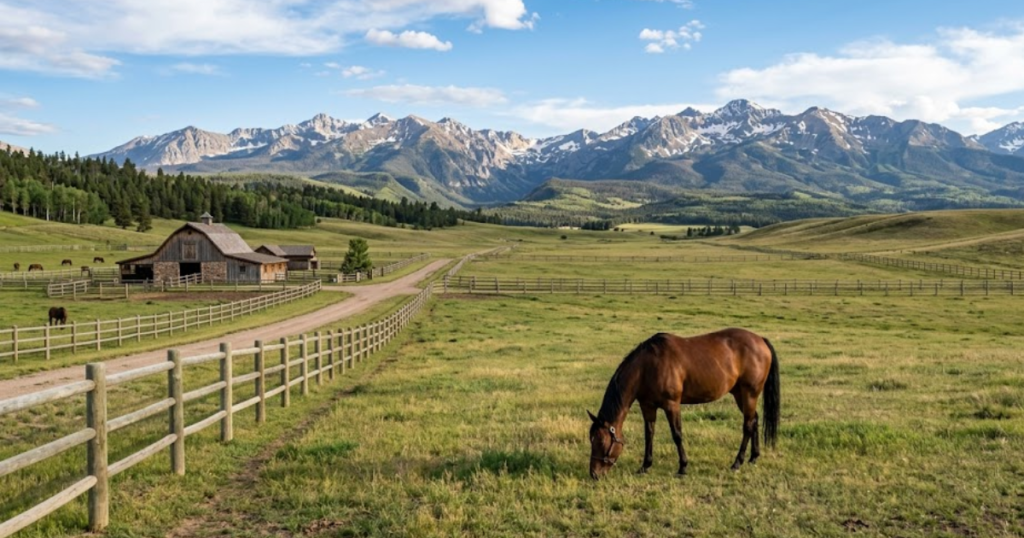
You move to the Colorado Front Range from the Midwest, excited to finally bring your three beloved geldings home. You purchase a picturesque 3-acre property with a small barn, assuming the one-acre-per-horse rule applies everywhere. The grass is green when you move in during the wet month of May.
By the end of June, the horses have grazed every blade of grass down to the dirt. By August, the topsoil has turned to powder and is blowing into your neighbor’s yard. A week later, you receive a cease-and-desist letter from the county code enforcement officer informing you that your specific zoning requires 2.5 acres for the first horse and an additional acre for every horse thereafter. You are legally over the limit and biologically out of feed.
When searching for horse properties, Colorado buyers often have a specific acreage number in mind. But in the West, acreage is not just a measure of space; it is also a measure of biological fuel and legal compliance.
Here is how to accurately calculate how much land you actually need before you buy the farm.
How Many Acres Do I Need Per Horse When Purchasing Equestrian Property in Colorado?
Quick Summary: The Acreage Equation
- The Eastern Myth: The age-old rule of one acre per horse works beautifully in Kentucky or Ohio, where rainfall is plentiful, and grass grows aggressively. In the arid, high-altitude climate of Colorado, applying this rule will turn your pasture into a barren dust bowl in a matter of weeks.
- The Dryland vs. Irrigated Divide: The carrying capacity of Western land depends entirely on water. A heavily irrigated, well-managed pasture might support one horse per 1.5 acres. Conversely, native, non-irrigated dryland pasture often requires 5 to 15 acres per horse just to sustain seasonal grazing.
- The Legal Zoning Trap: Biological capacity is different from legal capacity. Many Colorado counties have strict zoning ordinances that require a minimum of 2.5 to 5 acres before you are legally permitted to house your very first horse, regardless of your feeding strategy.
- The Dry-Lot Loophole: You can keep horses on smaller acreage, but you must completely abandon the dream of them surviving on grass. High-density horsekeeping requires a dedicated dry lot system in which 100% of their forage, baled hay, is trucked in, and manure management becomes a daily, exhausting chore.
In Colorado, acreage is both a biological and legal calculation. The right answer depends on rainfall, irrigation, zoning, and whether you expect the land to feed horses or just hold them.
1. The Death of the One-Acre Rule
To understand Western land, you must understand the limits of the native ecosystem.
- The Rainfall Deficit: Most of the Colorado Front Range receives only 14 to 16 inches of precipitation annually, classifying it as a semi-arid steppe. Grass simply does not grow fast enough to outpace a 1,200-pound animal that eats 2.5% of its body weight in forage every single day.
- The AUM Metric: Agricultural land capacity is measured in Animal Unit Months, AUM, the amount of forage required to sustain a 1,000-pound animal for one month. In many non-irrigated regions of Colorado, it takes anywhere from 3 to 10 acres to produce a single AUM.
- The Overgrazing Death Spiral: If you put too many horses on too little dryland acreage, they will eat the grass down to the crown, the plant's energy center. The grass dies, the roots rot, and the bare dirt is immediately overtaken by toxic, deep-rooted summer weeds like Russian Knapweed.
2. Irrigated vs. Dryland: The Great Divide
The presence of legal water rights drastically alters the acreage equation.
- The Irrigated Oasis: If the property owns historic, senior ditch rights, surface water, and you can flood-irrigate or run heavy sprinklers across the pasture all summer, the carrying capacity skyrockets. On expertly managed, fertilized, and irrigated orchard grass pastures, you can often sustain one horse per 1.5 to 2 acres.
- The Native Dryland Reality: If the property relies solely on natural rainfall, you are managing dryland pasture, often Blue Grama or Buffalo grass. To allow a horse to graze all summer without destroying the turf, you generally need a minimum of 5 to 10 acres per horse. If you expect them to graze year-round without supplemental hay, that number jumps to 20 or 30 acres per horse.
The acreage number means very little without knowing whether the pasture is irrigated, what kind of forage grows there, and whether the water supply is legal and reliable.
3. County Zoning and HOA Mandates
Before you calculate the grass, you must calculate the law.
- The Baseline Minimum: Almost every county in Colorado, Douglas, Elbert, Boulder, and Larimer, has specific zoning codes that dictate livestock density. A highly common ordinance requires a minimum lot size of 2.5 acres or 4.5 acres to legally keep large livestock.
- The Sliding Scale: Counties often use formulas. For example, the code might state: A minimum of 2.5 acres is required for the first horse, and an additional 1 acre is required for each subsequent horse. Under this rule, keeping three horses requires at least 4.5 acres.
- The HOA Override: Even if the county allows four horses on your 5-acre lot, the neighborhood Homeowners Association, HOA, covenants can override the county and enforce stricter rules, legally limiting you to only two horses. You must read the HOA covenants word-for-word before closing.
4. The High-Density Dry-Lot Strategy
What if you can only afford 3 acres, but you still want your horses at home? You can do it, but your management strategy must completely change.
- Abandoning the Pasture: You must accept that your acreage is for turnout, not for grazing. You will build a heavy-duty, sand- or gravel-based dry lot where the horses spend the majority of their time.
- The 100% Hay Diet: Because they are not eating your grass, you must purchase and store enough baled hay to feed them 365 days a year. This requires a massive hay budget and a dedicated, watertight hay storage barn.
- The Manure Burden: Three horses produce over 150 pounds of manure every single day. On 35 acres, that manure naturally decomposes into the ecosystem. On a 3-acre dry lot, it piles up instantly. You must have a tractor, a designated composting zone, and frequently a paid commercial service to haul the manure off the property to prevent fly infestations and groundwater contamination.
We Calculate the Carrying Capacity Before You Buy
We do not just look at the property lines; we analyze the soil's biological and legal capacity.
When Mark Eibner and Belinda Seville represent you in buying a rural equestrian estate, we review the county zoning codes, the HOA covenants, and the local soil and water availability. We help you match your specific herd size to the precise acreage required to keep them healthy, legal, and well-fed in the Colorado climate.
Contact Us Today to find premium horse properties Colorado buyers trust for sustainable, legally sound, and perfectly sized agricultural layouts.
Browse Active Colorado Horse Properties: Browse active Colorado horse ranches for sale or ask our team about finding a premium horse property for rent in Colorado while you search for an estate that perfectly fits your herd
Frequently Asked Questions (FAQ) About Horse Acreage
Do miniature horses or donkeys count as a full horse for zoning purposes?
Usually, yes. While a miniature horse eats significantly less than a draft horse, most county zoning ordinances classify any equine, regardless of height or weight, as one Animal Unit. If your county allows two horses per acre, that limit typically applies whether they are 17-hand Warmbloods or 34-inch minis. Always verify specific definitions with the county zoning office.
Can I keep my horses in the forest if my property borders National Forest land?
No. You cannot turn your horses loose to graze on adjacent public lands, BLM or National Forest, without a highly regulated, commercially issued grazing lease. Your horses must be securely fenced within your deeded private property lines.
If I buy a property with a domestic well, can I use it to water the pasture to grow more grass?
Almost universally, no. A standard residential Domestic and Livestock well permit in Colorado strictly limits water use to indoor household use and to filling drinking troughs for the animals. It is illegal to connect massive agricultural sprinklers to a residential well to irrigate pasture grass, and doing so can result in massive fines or the loss of your well permit.