
Did you know that 67% of home buyers used AI as their primary research tool in the first quarter of 2026? While adoption is soaring, many horse owners still find that a standard AI real estate search for equestrian properties fails to understand their specific needs. You’ve likely spent hours scrolling through listings only to discover they lack the proper livestock zoning or have poor pasture quality. It’s exhausting to realize that generic search engines often ignore the very details, like water rights and historical grazing capacity, that make a ranch viable.
This shift represents a significant revolution for buyers who need more than a generic house search. By leveraging specialized algorithms, you can now find a property that meets 100% of your requirements in half the time. We’ll show you how this data-driven approach uncovers hidden details like soil composition and ensures you never miss a listing because of a human tagging error. Discover how to move beyond generic filters and connect with the technical insights needed for a successful Colorado ranch transaction.
Key Takeaways
- Learn how an AI real estate search for equestrian properties identifies specific zoning and infrastructure details that general listing platforms often overlook.
- Discover how specialized AI integrates with Geographic Information Systems (GIS) to analyze soil quality and navigate complex Colorado water rights documents.
- Compare standard MLS searches against AI-driven tools to see how cutting-edge technology significantly reduces your “Time to Discovery” for niche ranch listings.
- Master a 5-step framework for setting lifestyle-first search parameters that prioritize pasture health and livestock capacity over simple bedroom counts.
- Understand why the most successful ranch purchases require a blend of proprietary technology and seasoned expertise from local real estate authorities.
Beyond Bedrooms: Why AI is Revolutionizing Equestrian Real Estate Search
Traditional home searching often fails when applied to the complex needs of a ranch. While a standard search engine identifies a house based on bedroom count or square footage, it lacks the context required for livestock management. This is where an AI real estate search for equestrian properties becomes an essential tool. By utilizing advanced algorithms, this technology analyzes land utility and infrastructure at a granular level. It’s a key development within Property technology (PropTech), focusing on the specific assets, like fencing and barn quality, that define a functional horse property.
To better understand how these digital tools are changing the market, watch this helpful overview of AI integration in real estate:
The Problem with Generic Property Portals
Most mainstream real estate sites rely on manual tags provided by listing agents. This often results in “false positives” where a property is labeled as “equestrian-friendly” simply because it has a large lot. You’ve likely encountered listings that claim to have acreage, only to find the land is a vertical cliff or a rocky ravine unsafe for horses. These portals don’t distinguish between aesthetic appeal and agricultural utility. Without specialized filters, you’re forced to manually vet every photo to see if the “barn” is actually a shed or if the “pasture” is overgrown with toxic weeds. This manual process is the primary reason buyers miss out on ideal properties that were simply tagged incorrectly by a generalist agent.
The AI Solution: Computer Vision and Data Synthesis
Modern AI solves this by “seeing” the property through computer vision. It identifies specific structures, such as a round pen, hay loft, or perimeter fencing, directly from listing images without needing human input. Machine learning models then synthesize this visual data with historical land records to predict the property’s actual utility for livestock. AI search is the automated identification of property features through visual and historical data analysis. This creates a new standard for 2026: “Horse-Ready Data.” Instead of relying on subjective agent claims, an AI real estate search for equestrian properties provides a data-backed assessment of every outbuilding and acre. This approach ensures that the infrastructure exists to support your animals from day one, rather than discovering missing essentials during a physical tour.
Decoding the Dirt: How Specialized AI Analyzes Pasture and Water Rights
Finding a home is one thing, but finding a sustainable ranch requires a deep dive into the land’s technical specifications. The technological transformation of real estate has introduced tools that analyze environmental data with surgical precision. When using an AI real estate search for equestrian properties, you aren’t just looking at aesthetics. You’re accessing a synthesized database of soil health and legal entitlements that traditional search engines simply cannot process.
Parsing Colorado Water Rights with Natural Language Processing
Colorado water law is notoriously complex. It involves decades of court decrees that can be hundreds of pages long. Specialized AI uses natural language processing (NLP) to scan these historical documents. It identifies senior water rights and clarifies well-depth or flow rates that human agents might overlook. It’s vital to understand Water Rights in Colorado: What Every Buyer Must Know before committing to a purchase. Without verified water access, a beautiful barn is just an expensive storage shed.
Soil and Topography: Finding “Usable” Acreage
GIS integration allows AI to overlay topographic maps with soil composition data. This identifies “usable” acreage by filtering out steep slopes or rocky terrain that could injure a horse. It distinguishes between prime farmlands and high-country grazing lands automatically. This level of automated soil mapping predicts where mud will settle during the spring thaw, helping you avoid drainage nightmares. You’ll know the difference between a property that looks good in photos and one that functions in reality.
Sustainable ranching also relies on “Grazing Capacity Modeling.” AI tracks historical weather patterns to estimate how many animal units a pasture can support throughout the year. It accounts for snowpack levels and drought cycles in the Colorado high country. This data ensures you don’t overgraze your new land. Utilizing a specialized AI real estate search for equestrian properties gives you the confidence to buy based on facts rather than hope. If you want to see how these data points come together for your specific search, you can explore our AI-powered ranch listings.
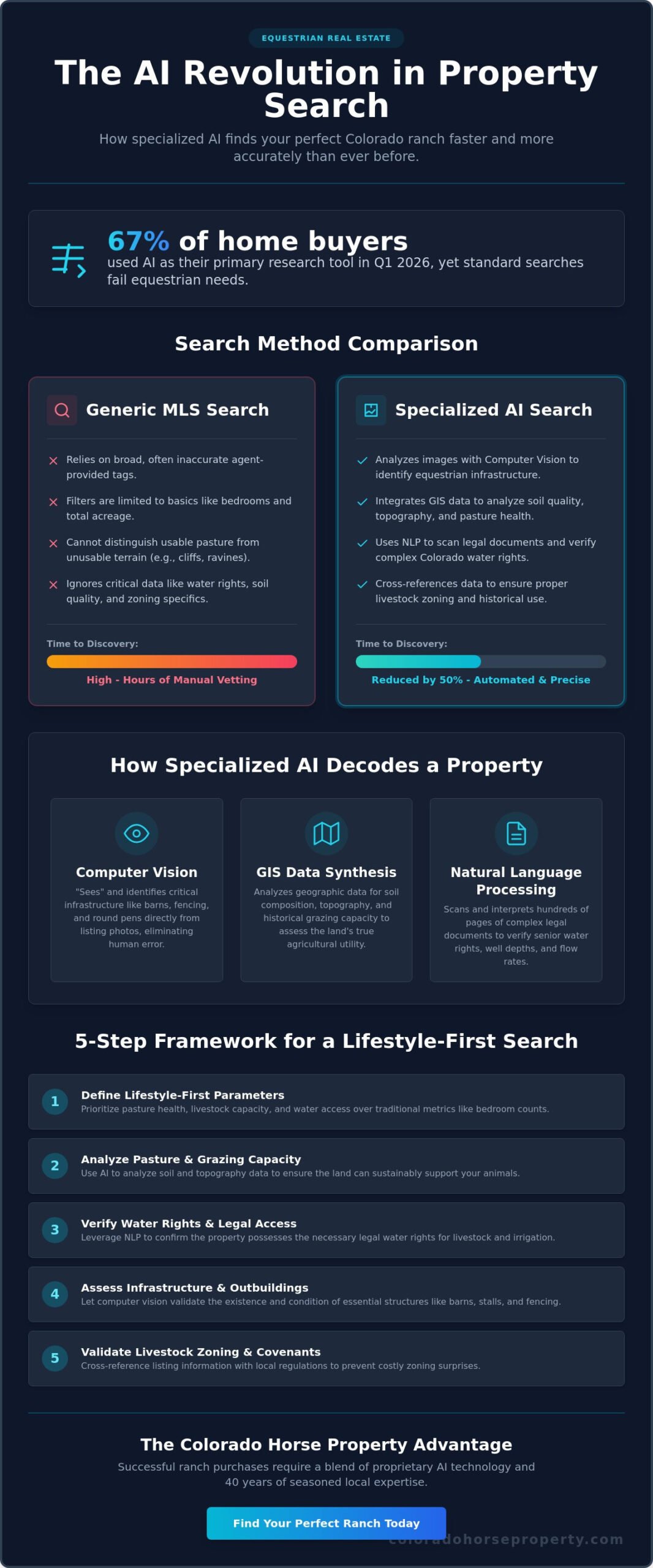
Generic Search vs. AI Real Estate Search for Equestrian Properties
The primary difference between a standard property portal and a specialized search engine lies in the depth of the data processed. In a standard MLS search, you are at the mercy of the listing agent’s attention to detail. If an agent forgets to check the “livestock allowed” box or mislabels a property’s acreage, that listing becomes invisible to you. An AI real estate search for equestrian properties eliminates this human error by scanning every data point, from satellite imagery to historical tax records, to ensure a property actually fits your criteria. This shift in technology has redefined “Time to Discovery” as the most critical metric for the modern ranch buyer. Instead of spending months filtering through irrelevant listings, buyers can now find their ideal property in a matter of days.
Standard Search: The Human Error Factor
Standard search engines rely on literal keyword matching. When you search for “horse barn” on a generic site, you often get “barn-style” living rooms or suburban homes on “Barn Road.” These platforms don’t understand the context of your lifestyle. Additionally, radius-based searches are notoriously unreliable for rural real estate. A five-mile radius in a city is a short drive; in the Colorado high country, that same radius might include three different mountain passes that make trailer transport impossible. Standard portals simply don’t account for the logistical realities of owning livestock.
AI Search: The Predictive Advantage
Specialized AI provides a predictive edge that manual searching cannot replicate. It identifies “equestrian potential” in properties that aren’t currently used for horses. For example, the system might find a flat, well-irrigated parcel with an existing outbuilding that could easily be converted into a four-stall stable. It also uses computer vision to detect “hidden features” in photos, such as a heated wash rack or high-tensile fencing, even if the agent didn’t mention them in the description. By analyzing historical land-use models, the AI can even predict future zoning changes in developing areas. To see how these tools fit into a broader acquisition strategy, consult our Horse Property for Sale in Colorado: The Ultimate 2026 Buyer’s Guide. This level of insight ensures you aren’t just reacting to the market; you’re anticipating it.
Accuracy is the ultimate goal. While general platforms achieve median error rates of 2-3% for suburban home valuations, those numbers skyrocket when applied to complex ranches. A specialized AI real estate search for equestrian properties maintains high accuracy by focusing on the technical infrastructure that actually drives ranch value. It provides a structured, data-driven experience that respects the complexity of your search.
Maximizing Your Search: A Strategic Guide to AI-Powered Ranch Hunting
Success in the 2026 market requires a shift in how you interact with listing data. Instead of searching for “house parameters” like granite countertops, you must train the AI real estate search for equestrian properties to prioritize “Lifestyle Parameters.” This involves using visual prompting; you upload a photo of a specific barn style or arena layout you admire, and the AI finds matching infrastructure across the state. This high-tech vetting process saves you from driving hours to properties that look good on paper but fail to meet your operational standards in person.
Step 1: Define Your Infrastructure Non-Negotiables
Be specific with your technical requirements. You aren’t just looking for a “barn”; you’re looking for a facility that supports your specific discipline. Tell the AI if you require an indoor arena with specialized footing, at least four stalls, and established cross-fencing. There’s a massive difference between a “hobby farm” and a “professional training facility.” Understanding these distinctions is easier when you review resources like Horse Barns for Sale, which outlines the infrastructure needed for different equestrian goals. The AI uses this data to filter out properties that lack the structural integrity or layout your animals require.
Step 2: Layering Geographic and Legal Data
Location is about more than just a zip code. Use AI to overlay critical geographic layers such as flood maps, wildfire risk zones, and proximity to public trailheads. A revolutionary feature in 2026 is searching by “commute time for the horse.” This calculates the distance to specialized equine vets and major show grounds. The technology also identifies properties with conservation easements or legacy status, which can impact your long-term land use. By layering this legal and environmental data, you ensure the land is as secure as the buildings on it.
The remaining steps in this framework involve refining your search through iterative feedback and connecting with a human expert to verify the machine’s findings. Utilizing an AI real estate search for equestrian properties is the first step toward a more efficient acquisition. If you’re ready to see these tools in action, start your AI-powered ranch search today to find a property that truly fits your lifestyle.
The Colorado Horse Property Advantage: Merging 40 Years of Expertise with Proprietary AI
Technology is a powerful tool, but it lacks the nuance of lived experience. At Colorado Horse Property, we don’t just provide access to a search engine; we offer a system refined by Mark and Alison Eibner’s 40 years of specialized experience. They act as the “logic layer” for our technology, ensuring that the search parameters reflect the actual requirements of the Colorado Front Range. This isn’t just about finding land; it’s about identifying a property that can sustain a legacy. By merging an AI real estate search for equestrian properties with decades of boots-on-the-ground knowledge, we ensure that every digital insight is verified by a seasoned expert who understands the unique challenges of high-altitude ranching.
High-Tech Search, High-Touch Representation
AI can identify a structure, but it can’t evaluate the craftsmanship of a timber-frame barn or the reliability of a specific local well driller. This is where high-touch representation becomes vital. Once the AI real estate search for equestrian properties flags a potential match, our agents step in to verify the findings. We check for the nuances that sensors might miss, such as the quality of the stall mats, the ventilation in an indoor arena, or the condition of the perimeter fencing. This dual-verification process eliminates the risk of “digital illusions” where a property looks better in a data set than it does in reality. For a comprehensive look at the regional market, consult our Equestrian Real Estate Colorado: A Complete Buyer’s Guide. It serves as a roadmap for how we apply our decades of experience to the machine’s findings.
Closing the Gap from Search to Sale
Our service doesn’t end when the search is complete. We manage the entire ecosystem of the transaction, including buyer representation, transaction management, and title services. By working with trusted partners like Meridian Title, we ensure that every legal document is scrutinized for accuracy. This is particularly important when dealing with the water rights and conservation easements discussed earlier. A no-nonsense expert approach is necessary to navigate these high-stakes transactions. We coordinate every detail from the initial AI query to the final escrow signature, providing a seamless transition from buyer to landowner. We are the only specialized equestrian division in Colorado providing this level of integrated tech and tenure.
If you’re ready to find a property that meets 100% of your requirements without the traditional search fatigue, it’s time to leverage our tools. Start your AI-powered horse property search today and see the difference that 40 years of experience makes.
Secure Your Colorado Legacy with Precision Search
The shift toward data-driven ranch hunting isn’t just about convenience; it’s about the security of your livestock and your investment. By moving past the limitations of generic portals, you now have access to technical insights into water rights, soil health, and infrastructure that were previously hidden in manual records. Utilizing an AI real estate search for equestrian properties empowers you to filter for your specific lifestyle needs, ensuring that every acre you view is truly functional for your goals.
Specialized focus on Colorado equestrian and agricultural land is at the heart of what we do. Led by Mark and Alison Eibner, our team combines 40 years of experience with proprietary AI-powered search technology to verify every property feature on the ground. This partnership between high-tech data and seasoned human expertise ensures you don’t just find a house, but a viable ranch that supports your long-term vision. It’s time to move beyond the guesswork of traditional real estate.
Find your dream Colorado ranch faster with our AI Search Tool. Your ideal property is closer than you think, and you now have the tools to claim it with confidence.
Frequently Asked Questions
How does AI real estate search differ from mainstream property portals?
Mainstream real estate portals rely on manual checkboxes and basic keyword matching, which often leads to irrelevant results like “barn-style” homes. An AI real estate search for equestrian properties uses computer vision to analyze satellite imagery and listing photos directly. It identifies actual infrastructure like round pens or cross-fencing that generic sites often ignore or mislabel because they lack a specialized data layer.
Can AI really identify if a property has senior water rights in Colorado?
Specialized AI uses natural language processing to scan hundreds of pages of historical court decrees and state water records. It identifies senior water rights and clarifies well-flow rates by parsing complex legal language that general search engines cannot process. This technical analysis provides a level of due diligence that ensures your ranch has a sustainable water supply before you commit to a purchase.
Will using an AI search tool cost me more as a buyer?
Using these advanced tools typically doesn’t increase your costs as a buyer when working with specialized representation. We integrate this technology into our standard buyer services at Colorado Horse Property to provide a more efficient experience. The goal of an AI real estate search for equestrian properties is to save you time and prevent expensive mistakes by identifying technical land issues early in the process.
How accurate is AI at identifying horse barn features from photos?
Modern computer vision is highly accurate at detecting specific features like heated wash racks, hay lofts, and stall configurations within listing images. It identifies these elements even if the listing agent forgot to mention them in the written description. We always follow this digital detection with a physical site visit to verify the structural condition and quality of the identified infrastructure.
Does AI search for horse properties include zoning and land-use data?
The system automatically cross-references property boundaries with local municipal codes and county zoning maps. It verifies the number of livestock allowed per acre and identifies any specific land-use restrictions or setbacks. This prevents you from wasting time on properties that look perfect but don’t legally support the number of horses you own or the structures you plan to build.
Can I use AI to find equestrian properties near specific public trails like Fox Run?
You can set geographic parameters to find ranches within a specific distance of trailheads like Fox Run or other regional parks. The AI calculates “commute time for the horse,” measuring the actual travel distance to public riding areas and show grounds. This ensures your new property offers the lifestyle access you need for training and recreation without relying on vague “nearby” descriptions.
What is the “human element” in an AI-powered real estate transaction?
The human element involves seasoned experts who interpret the AI’s data through the lens of decades of local experience. Technology identifies the best opportunities, but experienced agents handle the nuanced negotiations and complex contract details. This partnership ensures that every data-driven insight is backed by professional judgment and a deep understanding of the Colorado ranching community.
How do I start an AI-powered search for a Colorado ranch in 2026?
You can begin by visiting our platform and defining your “Lifestyle Parameters” rather than just house specs. Input your non-negotiables, such as arena size or pasture type, to launch the search engine. Our team then reviews your data-driven matches to provide personalized guidance and professional representation throughout the entire acquisition process.