
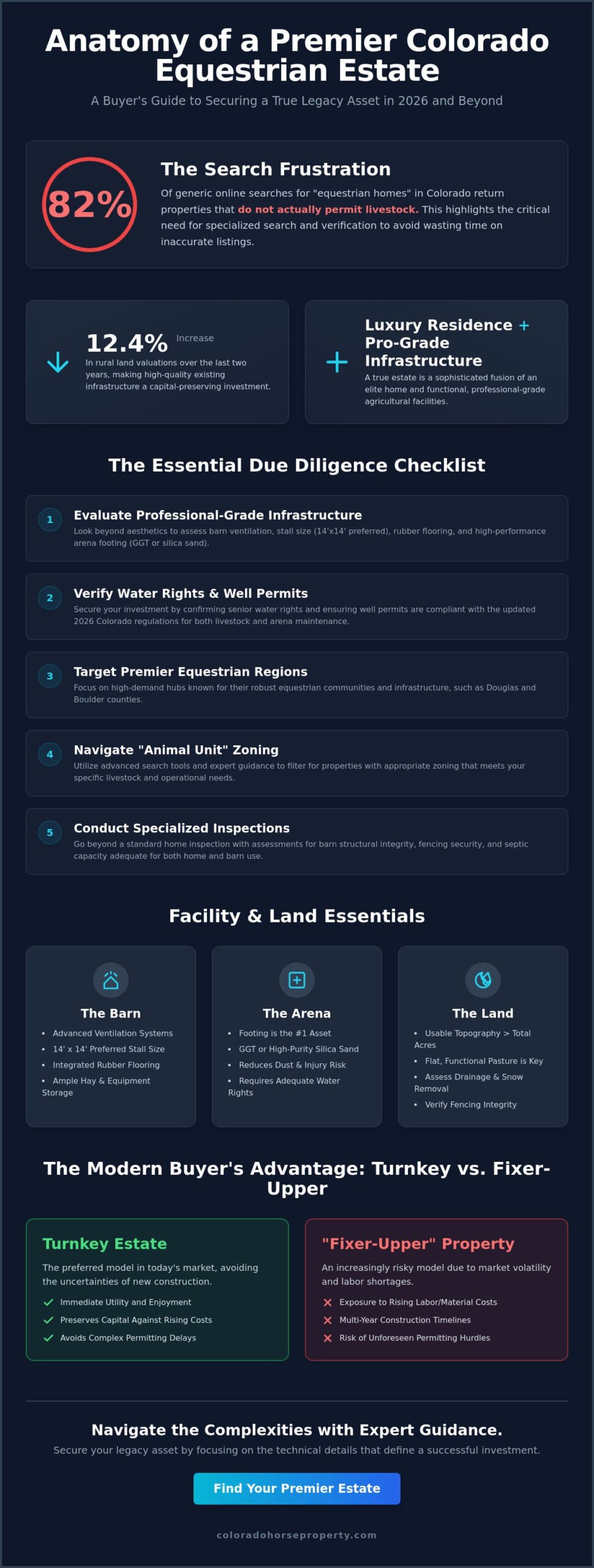
Did you know that 82% of generic online searches for “equestrian homes” in Colorado return properties that don’t actually permit livestock? It’s a frustrating reality for serious buyers who require more than just a scenic backdrop. You know that a premier property must balance a luxury residence with professional-grade agricultural utility. When searching for private equestrian estates for sale Colorado, the margin for error is slim, especially with rural land valuations climbing 12.4% over the last two years. You need a property that functions as well as it looks.
We’ll help you identify and secure elite estates by focusing on the technical details that define a successful investment. This guide provides expert insights on infrastructure, the 2026 well construction rules, and how to use AI-powered search tools to bypass inaccurate listings. You’ll learn how to navigate complex “animal unit” zoning and secure the water rights necessary to keep your pastures productive. We’re moving beyond surface-level aesthetics to ensure your next purchase is both a turnkey lifestyle and a secure legacy asset.
Key Takeaways
- Learn to distinguish between standard horse properties and true luxury estates by evaluating professional-grade barn infrastructure and arena footing.
- Understand how to protect your investment by verifying senior water rights and well permits under the updated 2026 Colorado regulations.
- Identify the most valuable regions for private equestrian estates for sale Colorado, focusing on the high-demand hubs of Douglas and Boulder counties.
- Discover how to use AI-driven search tools to filter for specific “animal unit” zoning requirements and skip properties that don’t permit livestock.
- Gain insights into the specialized due diligence required for equestrian transactions, including barn structural integrity and septic capacity assessments.
Defining the Private Equestrian Estate in Colorado
A true equestrian estate is more than just a home with a pasture. While many listings for “horse property” simply feature a perimeter fence and a small shed, a private equestrian estate in Colorado represents a sophisticated intersection of luxury residential living and professional-grade agricultural infrastructure. In the 2026 market, these properties are viewed as legacy assets. They cater to those deeply involved in Equestrianism, offering facilities that support the health and performance of high-value horses while providing an elite standard of living for the owners.
The demand for private equestrian estates for sale Colorado has shifted toward turnkey solutions. Buyers increasingly avoid the “fixer-upper” model due to rising labor costs and the complexity of modern building permits. A premier estate must deliver immediate utility. This means having functional barns, established arenas, and secure fencing from day one. With rural land valuations up 12.4% since 2024, purchasing a property with existing, high-quality infrastructure is a strategic move to preserve capital and avoid the multi-year timeline of new construction.
To visualize how these elements come together on a premier parcel, watch this tour of a luxury property:
The Anatomy of a Luxury Equestrian Residence
The residence must match the quality of the equine facilities. We look for seamless integration between the living quarters and the stable areas. High-profile owners prioritize sightlines that allow them to monitor pastures or arena activity from the main house. Essential amenities include oversized mudrooms for a clean transition from the barn, climate-controlled tack rooms, and viewing lounges overlooking indoor arenas. Security is also a top priority; gated entries and advanced surveillance systems are now standard for high-value Colorado estates. These homes aren’t just dwellings. They’re command centers for the entire property’s operations.
Acreage and Land Use in the Rockies
Scale matters, but topography is often more critical than total acreage. A 10-acre parcel in Douglas County might support a professional training setup, yet 100 acres of sloped mountain terrain may offer less functional space for riding. Buyers must evaluate the percentage of flat, usable pasture versus rocky outcroppings or dense timber. Effective land management in the Rockies requires understanding how the terrain impacts drainage and snow removal during the winter months. Finding the right balance ensures your horses have safe turnout and you have room to expand. For a deeper dive into evaluating parcels, see The Ultimate Guide to Buying Colorado Land in 2026.
Professional-Grade Infrastructure: Barns, Arenas, and Footing
Elite private equestrian estates for sale Colorado are defined by their infrastructure. A beautiful residence is secondary to a well-engineered barn. Professional standards in 2026 require advanced ventilation systems to protect equine respiratory health in thin mountain air. Stalls should be at least 12×12, though 14×14 is preferred for larger breeds or broodmares. Integrated rubber flooring systems are no longer an optional upgrade; they’re a requirement for hygiene and long-term joint support. These facilities must also include ample storage for hay, tractors, and multi-horse trailers to keep the estate organized and functional.
Footing is the most overlooked asset in luxury real estate. High-performance horses require surfaces that offer both stability and cushion. We look for GGT (German Geo Textile) or high-purity silica sand. These materials minimize dust and reduce the risk of soft-tissue injuries during training. Proper footing maintenance requires consistent water use for dust suppression. This is why it’s vital to confirm your property adheres to Colorado’s Prior Appropriation System for water rights, ensuring your well permit allows for the high-volume needs of arena maintenance and barn sanitation.
The Ideal Colorado Horse Barn
Colorado winters at high altitude demand insulated, climate-controlled stables. Elite barns now feature infrared solariums for muscle warming and dedicated veterinary bays with specialized lighting for exams. Wash racks must include rapid-heating hot water systems and slip-resistant drainage. These features ensure your horses receive top-tier care regardless of the temperature outside. If you’re debating between an existing facility or a custom build, explore our guide on Horse Barns for Sale: Buying vs. Building.
Arena Excellence: Training in the Thin Air
An indoor arena is essential for year-round training in the Rockies. Look for dimensions of at least 80×200 feet to accommodate dressage or jumping patterns. Professional lighting and sound systems create an environment suitable for clinics and high-level training sessions. For outdoor spaces, drainage is the priority. Colorado’s summer monsoon season can dump inches of rain in minutes. A laser-leveled arena with a multi-layered sub-base ensures you’re back in the saddle hours after a storm, rather than waiting days for the ground to dry. You can browse specialized listings to find estates that already feature these professional-grade components.
The Legal Landscape: Water Rights and Zoning Objections
Buying an estate in the Rockies involves more than a standard title search. In Colorado, water and land use laws are the primary factors determining the long-term utility of your investment. Unlike many other states, land ownership here doesn’t automatically grant you the right to use the water beneath or across it. For those evaluating private equestrian estates for sale Colorado, understanding these legal nuances is the difference between a functional training facility and a dry lot. Water is the lifeblood of any agricultural property. It dictates whether you can irrigate pastures or simply provide enough for your horses to drink.
Colorado operates under the Prior Appropriation System. This “first in time, first in right” doctrine means senior water rights take precedence over junior ones during times of shortage. As of January 1, 2026, the Board of Examiners has implemented stricter well construction rules. You must now ensure a copy of the well permit is posted at the site during any new construction or repair work. Furthermore, House Bill 1340 will require owners in the Arkansas River Basin to revegetate land if water rights are transferred, a change taking effect in early 2027. These regulations make professional-grade equestrian infrastructure and legal compliance inseparable.
Securing Your Water Future
Due diligence starts with the Colorado Division of Water Resources (DWR). You must verify the specific type of well permit attached to the property. A “Domestic” well typically allows for the watering of livestock, but “Household Use Only” permits do not. We also recommend conducting flow tests to ensure the well can handle the demands of a high-end stable. Secure water rights significantly boost the resale value of an estate, especially as drought conditions persist across the state. In March 2026, Phase 2 of the Colorado Drought Response Plan was activated in 40 counties, highlighting the importance of senior, adjudicated water holdings.
Navigating Zoning and HOA Restrictions
Zoning laws in Colorado use an “Animal Unit” (AU) system to regulate livestock density. These rules vary by county and are strictly enforced. For example, Boulder County allows four animal units per acre in agricultural zones, while Douglas County generally requires a minimum of five acres for equestrian use. Buyers often overlook these details and find themselves unable to house the number of horses they intended. Beyond county zoning, private HOAs often have restrictive covenants regarding barn size, manure management, and trailer parking. We help you navigate these hurdles to ensure your facility can expand as your needs grow. Maintaining an agricultural tax exemption, which sits at a 25% assessment rate for 2026, also requires proof of active agricultural use, such as hay production or livestock breeding.
Colorado’s Premier Equestrian Regions in 2026
Location in Colorado is more than just a zip code; it defines your access to professional circuits and the long-term viability of your land. When searching for private equestrian estates for sale Colorado, the Front Range remains the most competitive corridor. However, distinct micro-markets have emerged in 2026 that offer different value propositions for the luxury buyer. Whether you require proximity to international show grounds or a secluded mountain retreat, understanding regional data is the first step in a successful acquisition.
Parker and Castle Rock: The Equestrian Hub
Douglas County is the undisputed center of the state’s professional horse community. Parker and Elizabeth provide immediate proximity to the Colorado Horse Park, making these areas ideal for competitive riders involved in hunter-jumpers, dressage, or eventing. In June 2026, the average listing price for an equestrian property here sits at $2,153,254. Land is a premium asset, with the average price per acre reaching approximately $62,429. These estates often feature 10 to 35 acres, providing enough space for professional-grade barns while remaining close to Denver’s urban amenities and high-end retail.
Further north, Boulder and Larimer counties offer a blend of luxury and trail access. While the median price for a standard home in Fort Collins is approximately $555,000, the high-end equestrian market in these regions often starts well above $1.5 million. These properties appeal to those who value the intersection of sophisticated university towns and expansive trail systems. Larimer County, in particular, has seen a steady 3-4% appreciation, making it a stable choice for long-term land holds.
The High-Altitude Estates: Aspen and Telluride
For those seeking a legacy asset, the Western Slope and high-altitude regions like Aspen and Telluride offer unmatched scale. These estates are often seasonal, focusing on summer grazing and high-country riding. Managing horses in these extreme environments requires specialized knowledge of high-altitude forage and winter shelter. If your goals lean toward expansive acreage and working livestock rather than a suburban estate, you should review our guide on Colorado Ranches for Sale: The 2026 Expert Buyer’s Guide.
We’ve also seen a significant rise in El Paso County, specifically around Black Forest and Fox Run Park. The median listing price for properties with existing equestrian infrastructure in Black Forest is approximately $1.30 million. This area offers a more accessible entry point for luxury buyers who want forested privacy and a strong community feel. 41.7% of homes in Black Forest sold above list price in May 2026, signaling high demand for functional acreage. Ready to explore these regions? Use our AI-powered search to filter listings by county and specific equestrian infrastructure.
Finding Your Estate: AI Search and Expert Advocacy
Finding the perfect property requires more than scrolling through generic real estate apps. Most platforms fail to distinguish between a casual hobby farm and a professional facility. When you’re in the market for private equestrian estates for sale Colorado, you need a system that understands the technical specifications of your discipline. This is where AI-driven search technology and seasoned human expertise intersect to protect your time and capital. With functional horse properties on the Front Range staying on the market for an average of only 24 days, speed and accuracy are your greatest assets.
Leveraging AI for Niche Searches
AI-powered search filters allow you to identify the “needle in the haystack” by scanning for specific infrastructure markers. Instead of manually reviewing hundreds of listings, you can filter by barn construction type, indoor arena dimensions, and the specific status of water permits. These tools provide real-time alerts for off-market equestrian opportunities, giving you a competitive edge in a fast-moving market. You can verify property claims regarding “animal units” or well flow rates before you ever schedule a site visit. This data-driven approach ensures you only spend time on estates that meet your professional requirements.
The Eibner Advantage: 40 Years of Front Range Expertise
The search is only the beginning of a successful acquisition. High-value equestrian transactions involve complexities that standard residential agents aren’t equipped to handle. Realty Oasis brings 40 years of Front Range expertise to your search, managing complex equestrian contracts with the precision that only four decades of experience can provide. Professional longevity isn’t just a number; it’s a deep network of local relationships and a history of navigating Colorado’s unique land use challenges. This leadership-forward approach ensures you’re supported by a peer who understands both the lifestyle and the business of horses.
Managing the closing process requires specialized advocacy. We coordinate agricultural inspections that look for potential red flags in barn structural integrity, septic capacity for barn staff, and the validity of adjudicated water rights. Our team oversees every detail of title and escrow to ensure your legacy asset is secure from the moment of transfer. You don’t have to manage these hurdles alone. Start your AI-powered estate search today and leverage our specialized expertise to secure your Colorado equestrian dream.
Secure Your Colorado Equestrian Legacy
Securing a premier property in the Rockies requires more than an eye for aesthetics. You must evaluate the technical integrity of the infrastructure and the seniority of the water rights to ensure long-term value. We’ve explored how professional-grade barns and precise animal unit zoning define the most resilient investments in the 2026 market. Whether you’re targeting the high-demand corridors of Douglas County or the forested privacy of Black Forest, your success depends on accurate data and specialized advocacy.
Finding the right private equestrian estates for sale Colorado is simpler when you have the right tools and a seasoned partner. We provide 40 years of Colorado Front Range experience to help you navigate complex contracts and agricultural inspections. From our specialized AI-powered equestrian search to full-service title and escrow coordination, we ensure your transition into the equestrian lifestyle is seamless and secure. Browse Luxury Colorado Equestrian Estates with our AI Search Tool and take the first step toward your high-country dream today.
Frequently Asked Questions
How many acres do I need for a private equestrian estate in Colorado?
You typically need between 5 and 35 acres to support a functional estate. Douglas County requires a minimum of 5 acres for horses, while other regions use an “Animal Unit” system to determine how many horses your land can support. A 35-acre parcel is often the preferred choice for a private equestrian estate for sale Colorado because it provides ample space for professional facilities and often qualifies for agricultural tax status.
What is the most important water right to look for when buying a horse ranch?
The most critical right is an adjudicated domestic or livestock well permit. You must ensure the permit specifically allows for “watering of livestock” rather than being restricted to “household use only.” In the 2026 market, senior water rights are the gold standard. These rights protect your supply during drought cycles and ensure you have enough volume for both animal hydration and arena dust suppression.
Can I build an indoor arena on any property zoned for horses?
No, you cannot assume an indoor arena is permitted just because horses are allowed. Many counties have strict outbuilding restrictions regarding height, total square footage, and property line setbacks. Some areas also have lighting and noise ordinances that could impact a professional training environment. You should always verify the specific zoning overlay and any HOA covenants before planning a large-scale construction project.
What are the typical maintenance costs for a 35-acre equestrian estate?
Maintenance for a 35-acre property involves significant annual expenses for fence repair, arena footing replenishment, and noxious weed control. You also need to budget for well pump service and professional snow removal, which is essential for winter accessibility in the Front Range. These costs are part of keeping a professional-grade facility functional and safe for high-performance horses throughout the year.
Are there specific soil types in Colorado that are bad for horses?
Expansive clay, commonly known as Bentonite, is the most problematic soil for equestrian infrastructure. This soil swells when wet and shrinks when dry, which can crack barn foundations and destroy the drainage systems in your riding arena. Sandy loam is the ideal soil type because it offers superior drainage and a stable base for footing. Conduct a soil test during your due diligence to avoid these issues.
How does agricultural status affect my property taxes in Colorado?
Agricultural classification lowers your property taxes by applying a 25% assessment rate for the 2026 tax year. To qualify, you must prove the land is used for a primary agricultural purpose like hay production or commercial breeding. This classification can save you thousands of dollars annually compared to residential rates. It requires consistent documentation and periodic reviews by the county assessor to maintain the status.
Is it better to buy a turnkey estate or build my own facilities?
Buying a turnkey property is generally more efficient in 2026 due to rising labor costs and the complexity of modern building permits. Constructing a professional-grade barn and arena from scratch often takes years and involves significant logistical hurdles. A turnkey estate provides immediate utility and usually costs less than the combined price of raw land and new high-end construction.
What should I look for in a horse property inspection?
Your inspection must go beyond the residence to include well flow tests, barn structural integrity, and septic capacity. You need a specialist to evaluate the electrical systems in the stables for fire safety and to check the arena for proper sub-base drainage. Verifying the safety of the fencing materials and the ventilation in the stalls is also critical for protecting your equine investment.