
You tour a breathtaking horse property on a sunny Tuesday afternoon. The outdoor arena looks immaculate the sand is fluffy, perfectly white, and beautifully dragged. You fall in love, put in an offer, and buy the farm.
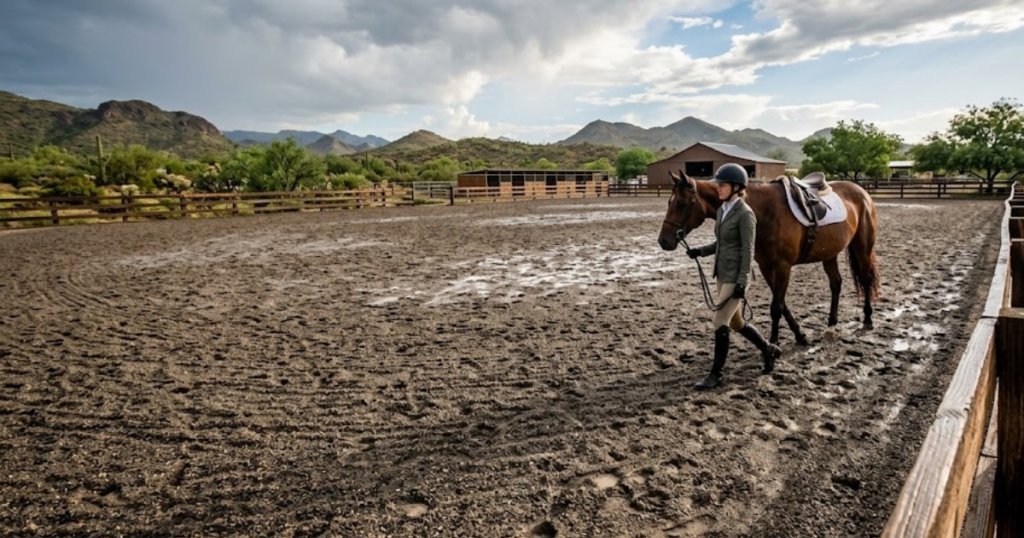
In late July, a classic Colorado monsoon rolls over the foothills, dumping two inches of rain in just 45 minutes. The next morning, the sun comes out, and you walk down to the barn to ride. You are horrified to find that your beautiful arena is under four inches of standing water.
Three days later, the puddles finally recede, leaving behind a slick, sticky mud pit. Eager to train, you tack up your horse and walk into the arena. On the very first trot circle, your horse’s hoof punches entirely through the wet sand and deep into the softened clay base below, pulling up fist-sized rocks. In five minutes of riding, you just caused $15,000 worth of structural damage to your footing.
When buyers look at colorado horse ranches for sale, they evaluate the arena with their eyes. But a true equestrian property expert evaluates an arena by how it handles water.
Here is how to inspect the footing, base, and drainage of an outdoor riding arena before you buy.
Does the Arena Footing Contain Enough Coarse Sand or Specialized Drainage to Absorb a 2-Inch Monsoon Dump and Be Rideable the Next Day?
Quick Summary: The Monsoon Mud Trap
- The Bathtub Effect: An outdoor arena built perfectly flat without a 1% to 2% crowned sub-base is essentially a bathtub. When a summer monsoon hits, the water has nowhere to go, turning your expensive riding surface into a stagnant lake.
- The Particle Physics: Fine, round sand, like masonry sand, holds onto water and turns to deep soup. A premium outdoor arena requires washed, coarse, angular sand, like concrete sand, that locks together for traction but allows heavy rain to percolate straight through.
- The Washout Threat: Without proper perimeter drainage, swales or French drains, heavy runoff from surrounding hillsides will blast directly across your arena, literally washing thousands of dollars of premium footing away into the neighboring pasture.
- The Base Destroyer: The most expensive mistake an equestrian can make is riding on a wet arena with poor drainage. If the compacted sub-base is soaking wet, the weight of a horse will punch straight through the sand, mixing underlying rocks and clay into the surface and permanently ruining the arena.
An arena’s appearance on a dry day tells you very little. The true test is whether it can shed storm water quickly enough to protect the footing and stay usable after a heavy monsoon.
1. The Invisible Slope: Inspecting the Sub-Base
The sand you ride on is only as good as the hidden foundation beneath it.
- The 1% Crown: A professionally engineered outdoor arena is never perfectly flat. The highly compacted stone or clay sub-base must be graded with a subtle 1% to 2% slope, usually crowned in the middle like a highway, or pitched gently to one side, sheet flow.
- The Percolation Path: When a monsoon dump hits, the water percolates rapidly down through the loose sand, hits the rock-hard, angled sub-base, and slides laterally out from under the arena. If the seller tells you the arena was laser-leveled to zero, you will have a severe standing water problem.
- The Punch-Through Risk: The sub-base must be compacted to 95% density. If the base was built improperly or lacks a protective geotextile fabric layer, heavy rain will soften it. Riding on a compromised base destroys the separation between the native rocky dirt and your clean riding sand.
2. Angular Sand vs. The Soup Squeeze
Not all sand is meant for horses, and the wrong sand becomes dangerous when wet.
- The Problem with River Sand: Cheap, unwashed sand or fine masonry sand features tiny, perfectly round particles. When saturated with monsoon rain, these round particles act like tiny ball bearings. The footing loses all shear strength, becoming deep, shifting soup that severely strains horse tendons and suspensory ligaments.
- The Coarse Angular Standard: A high-end outdoor arena utilizes washed, coarse, angular sand, often referred to as a specific sieve of concrete sand. Because the particles have sharp, jagged edges, they lock together under the weight of a hoof, providing supreme traction and stability even when completely soaking wet.
- The Additive Advantage: Many premium Colorado arenas mix the coarse sand with synthetic additives like shredded geotextile felt or specialized rubber, often called FIBR or FLEX systems. These fibers act like tree roots in the sand, stabilizing the footing and holding the perfect amount of moisture while allowing excess storm water to pass through.
The right footing is not just about color or softness. Particle shape and drainage behavior are what determine whether the surface stays safe after a storm.
3. Perimeter Defense: Stopping the Washout
You cannot just worry about the water falling on the arena. You must manage the water rushing toward it.
- The Hillside Hazard: Many arenas are carved into the sides of gentle slopes to save on excavation costs. If a monsoon hits the hillside above the arena, a massive sheet of water will rush down the hill.
- The Interceptor Swale: Before you buy the property, look closely at the high side of the arena fence line. There must be a deep, grassy interceptor swale or a gravel French drain designed to catch the hillside runoff and route it around the outside of the arena.
- The $5,000 Runoff: If that perimeter drainage is missing or clogged with weeds, the floodwater will shoot straight through the arena fencing, pick up your expensive angular sand, and wash it out the opposite side of the ring. Replacing washed-out footing is a massive, unexpected expense for a new buyer.
4. The Geocell Stabilization Upgrade
If you are looking at a luxury equestrian estate, ask if the arena utilizes modern cellular confinement systems.
- The Geocell Grid: Advanced arena builders in Colorado frequently use heavy-duty HDPE geocell grids, like BaseCore, installed directly over the sub-base. These expanding honeycomb grids are filled with crushed stone before the sand is placed on top.
- The Ultimate Drainage: This creates a massive, structural void space beneath the riding surface. The grid prevents the base from ever shifting or rutting, while allowing massive volumes of monsoon water to immediately flush out of the footing horizontally. An arena equipped with this technology can literally take a 3-inch rain dump at 2:00 PM and be perfectly safe to gallop on by 4:00 PM.
We Inspect the Dirt Before You Buy
We do not just admire the white fencing; we dig into the engineering of the dirt.
When Mark Eibner and Belinda Seville represent you in buying a rural estate, we evaluate the training infrastructure with a highly critical eye. We look for crown drainage, assess the perimeter swales, and help you identify if the sand is true, angular equestrian footing or just cheap fill dirt. We want to ensure that when the summer storms roll through, your training schedule does not miss a beat.
Contact Us Today to find premium horse properties Colorado buyers trust for professional-grade, all-weather equestrian facilities.
Browse Active Colorado Horse Properties: Browse active Colorado horse ranches for sale or ask our team about finding a premium horse property for rent Colorado while you search for an estate with bulletproof arena engineering
Frequently Asked Questions (FAQ) About Arena Drainage
My arena is muddy after a rain. Can I just buy a few truckloads of new sand and dump it on top to dry it out?
No, this is a very common and expensive mistake. If the arena is holding water, the problem is a failed or flat sub-base, not a lack of sand. Adding more sand simply creates a deeper, heavier sponge that traps the water even longer. The only permanent fix is to push all the sand to the side, re-grade and re-compact the base to a 1% slope, and then pull the sand back over.
Can I use wood chips or hog fuel in an outdoor arena to stop the mud?
Wood chips are acceptable for small confinement paddocks, but they are terrible for outdoor riding arenas in Colorado. When a monsoon hits, lightweight wood chips will literally float away and wash out of the arena. Furthermore, as they decompose, they turn into a slick, slippery organic slime that is highly dangerous to jump or turn sharply on.
How soon can I drag my arena after a heavy rainstorm?
You should never drag an arena while there is still standing water or while the sand is fully saturated. Dragging wet footing can pull the moisture deeper into the sub-base and accidentally gouge the softened foundation layer. You must wait until the water has fully drained and the top layer of sand has begun to dry and turn lighter in color before pulling your tractor onto it.