
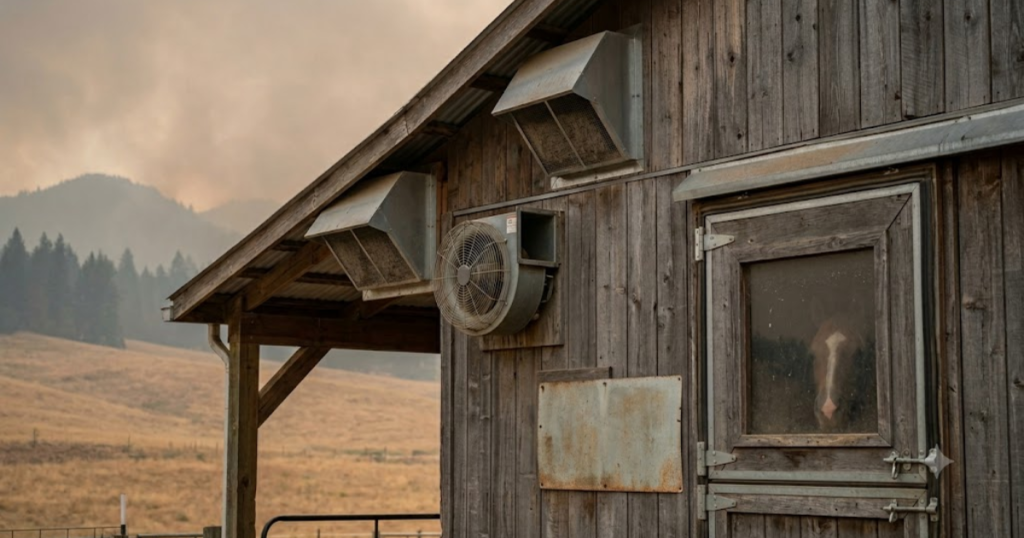
It is mid-August, and your property is perfectly safe from local fires. However, a massive complex of wildfires is burning two states away. You wake up to an eerie, dark orange sky and an Air Quality Index (AQI) warning of 180 categorized as “Unhealthy for All Groups.” The air smells like a campfire.
Wanting to protect your horses from the haze, you bring them in from the pasture and lock them safely in their stalls. But as you stand in the barn aisle, you realize the air inside the barn is just as thick and acrid as the air outside. By the next morning, your senior gelding is developing a dry, hacking cough, and your performance mare is taking shallow, rapid breaths. You put them in the barn for protection, but without a filtration system, you simply locked them inside a smoke box.
When shopping for horse properties colorado buyers love, clients often admire beautiful, airy barns with massive open cupolas and high ceilings. But in an era of intense, regional wildfire smoke, a barn that cannot be completely sealed and mechanically filtered is a massive liability to your herd’s respiratory health.
Here is how to evaluate a barn’s ventilation and smoke-mitigation infrastructure before you buy the farm.
Does the Barn Ventilation System Have Filtration or Closing Capabilities to Mitigate Toxic Wildfire Smoke from Neighboring States?
Quick Summary: The Invisible Threat
- The High-AQI Reality: In the modern West, your property does not have to be on fire to be suffocated by smoke. Summer wind currents frequently drag massive, toxic smoke plumes from wildfires in California, Oregon, or Canada directly across the Colorado Front Range.
- The Lung Capacity Danger: A resting horse inhales thousands of liters of air per day. When the Air Quality Index spikes, the microscopic particulate matter, PM2.5, in wood smoke bypasses their natural airway defenses, settling deep in the lungs and triggering severe Equine Asthma, heaves.
- The Breezeway Trap: Traditional center-aisle barns are explicitly engineered for maximum passive airflow. Open eaves, ridge vents, and cupolas act like chimneys. During a smoke event, these features constantly pull toxic, unfiltered air straight into the horses' stalls.
- The Clean Air Oasis: A premium, climate-resilient equestrian facility must have the architectural ability to button up, seal off passive vents, and utilize mechanical, positive-pressure ventilation equipped with MERV-13 or HEPA filtration to create a safe breathing environment.
An airy barn is not always a safe barn. During regional smoke events, passive openness can become a liability unless the building has a real way to close, filter, and control incoming air.
1. The Biology of Equine Smoke Inhalation
Horses are elite athletes with massive, incredibly sensitive respiratory tracts. They suffer from smoke inhalation much faster than humans do.
- The Particulate Matter (PM2.5) Threat: Wildfire smoke is filled with microscopic particles, PM2.5, that are 30 times smaller than a human hair. Because they are so small, they bypass the horse's nasal cilia and travel directly into the deepest terminal bronchioles of the lungs.
- The Asthma Trigger: Once these particles settle, they cause massive internal inflammation. This triggers a condition similar to Equine Asthma, Recurrent Airway Obstruction, or heaves. The horse’s airways physically swell shut, and their lungs fill with thick mucus, making every breath a struggle.
- The Performance Toll: Even after the smoke clears, it can take a horse's lungs four to six weeks to heal from the cellular damage of a severe smoke event. If your barn cannot protect them, your entire fall competition season will be completely ruined.
2. The Traditional "Open Air" Barn Trap
Most historic and standard-built barns are completely defenseless against regional smoke.
- Passive Ventilation Defaults: Standard barns rely on passive ventilation—breezeways, open soffits, ridge vents, and cupolas—to let hot, ammonia-filled air escape while pulling fresh air in from the outside.
- The Lack of Off Switches: The problem is that most of these passive vents cannot be closed. If the AQI outside is 200, the barn is actively pulling that toxic air inside 24/7. When touring a barn, you must look up: Are there physical dampers, louvers, or trapdoors that allow you to seal off the cupolas and roof vents during an emergency?
- The Box Fan Myth: Many owners try to solve poor air quality by hanging standard box fans on every stall door. During a smoke event, this is the worst thing you can do. A box fan does not filter air. It simply acts as a vortex, blasting the microscopic smoke particles directly into your horse’s face at a higher velocity.
Ventilation that is excellent for everyday ammonia control may be dangerous during smoke season if the barn has no practical way to temporarily seal those openings.
3. The Mechanics of a "Clean Air Oasis"
A modern, high-end equestrian property should treat the barn's air quality with the same seriousness as a residential home.
- The Button Up Capability: A premium barn is designed with an airtight envelope. It features solid doors, weather-stripped windows, and sealable roof vents. This allows you to completely lock out the ambient outside air when a smoke plume rolls in.
- Positive Pressure Systems: Once the barn is sealed, it requires a mechanical ventilation system. The gold standard is a positive pressure HVAC system. This system pulls outside air through heavy-duty industrial filters and pumps the clean air into the barn. Because the barn is now slightly pressurized with clean air, any remaining smoke outside is physically pushed away from the cracks around the doors.
- MERV-13 and HEPA Standards: The ventilation system is only as good as its filter. Standard fiberglass furnace filters do absolutely nothing to stop smoke. The barn's air-handling unit must be powerful enough to push air through a MERV-13, MERV-16, or true HEPA filter without burning out its blower motor.
4. Evaluating the Tack Room as a Medical Sanctuary
If the entire barn cannot be retrofitted for positive pressure filtration, the property must at least have an emergency medical sanctuary.
- The Insulated Safe Room: As discussed in our previous tack room guide, a fully insulated, drywalled, and climate-controlled tack room is perfectly sealed against the outside elements.
- The Emergency Stall Conversion: Smart property layouts will design an oversized tack room or an attached, fully enclosed wash rack that can easily be converted into an emergency, heavily filtered medical stall for a single horse suffering from severe respiratory distress during a week-long smoke event.
We Evaluate the Airflow Before You Buy
We do not just admire the architecture; we inspect the respiratory safety of the facility.
When Mark Eibner and Belinda Seville represent you in buying a rural estate, we analyze how the barn breathes. We inspect the ridge vents, look for sealable louvers, and evaluate whether the electrical sub-panel can support the installation of commercial-grade, filtered ventilation systems. We want to ensure your horses can breathe easy, even when the Western skies turn grey.
Contact Us Today to find premium horse properties Colorado buyers trust for exceptional, climate-resilient barn engineering.
Browse Active Colorado Horse Properties: Browse active Colorado horse ranches for sale or ask our team about finding a functional horse property for rent Colorado while you search for an estate with bulletproof infrastructure
Frequently Asked Questions (FAQ) About Wildfire Smoke and Horses
Can I buy a particulate smoke mask for my horse to wear in the pasture?
No. While there are some equine nebulizer masks for medical treatments, there are no safe, functional N95-style masks designed for horses to wear full-time while grazing or in a stall. A horse’s primary cooling mechanism involves their respiratory tract. Restricting their breathing with a tight mask in the summer heat can quickly cause fatal heatstroke.
Should I exercise my horse lightly to clear their lungs during a smoke event?
Absolutely not. Any increase in cardiovascular exertion causes a horse to take deeper, faster breaths, pulling the toxic particulate matter deeper into their terminal bronchioles. During high AQI days, horses must be kept as quiet and sedentary as possible.
How do I remove the lingering smell of smoke from my barn after the fires are out?
Once the outside air is clean, open all doors and cupolas to flush the barn. You will likely need to power-wash the stall walls and completely strip and replace all the bedding and stored hay in the immediate barn area, as porous materials absorb and hold smoke odors for months, which can continue to irritate your horse's airways.