
Colorado law now mandates that drivers maintain at least a six-foot distance and slow to ten miles per hour when passing horses, a change that reflects the state’s deep commitment to its 180,000-strong equine population. If you’ve ever struggled with overcrowded trailheads or discovered your dream property lacks direct access to public land, you know that not all mountain towns are created equal for riders. Scenery alone doesn’t make a town horse-friendly. Identifying the best Colorado towns for trail riding requires looking beyond the views to find specific equestrian zones and trailer-friendly infrastructure that actually supports your lifestyle.
We understand the frustration of navigating restrictive zoning or finding yourself blocked by hiker-only paths where horses aren’t welcome. This guide will show you exactly where world-class trail access meets a functional, long-term equestrian investment. You’ll learn which regions offer the best value for horse properties in 2026, how new legislation is creating dedicated equestrian zones, and which specific hubs provide the rare ride-out potential every horse owner craves.
Key Takeaways
- Define the “ride-out” gold standard and learn why proximity to BLM or National Forest borders is a non-negotiable requirement for equestrian property utility.
- Identify the best Colorado towns for trail riding where low-density traffic meets high-density trail access in regions like Salida and Durango.
- Compare high-alpine and high-desert environments to determine which terrain best suits your horse’s respiratory health and specific hoof care needs.
- Gain strategies for navigating local zoning laws and finding secluded “hidden gem” trailheads that the general public often overlooks.
- Learn how to leverage specialized AI-powered search technology to pinpoint real estate listings with verified, direct access to world-class equestrian trails.
The Equine-First Criteria: What Makes a Great Trail Riding Town?
Identifying the best Colorado towns for trail riding requires a shift in perspective. Most tourists look for proximity to breweries or ski resorts; equestrians must look for “ride-out” access. This gold standard means you can saddle up at your barn and hit a trailhead without ever touching a trailer hitch. It’s the difference between a weekend hobby and a daily lifestyle. A town that truly supports riders isn’t just scenic. It provides a functional intersection of public land access and localized equine services.
Proximity to public land borders is a non-negotiable factor for high-value equestrian real estate. When a property shares a fence line with Bureau of Land Management (BLM) or National Forest land, it secures a corridor of freedom that private development cannot touch. This adjacency provides a permanent buffer against urban sprawl. It ensures your backyard remains an expansive playground for years to come without the need for constant transport.
To better understand how these mountain landscapes integrate with local communities, watch this helpful video:
Beyond the property line, the “Trailer Factor” determines how easily you can explore neighboring regions. The top hubs offer expansive trailhead parking designed for long rigs and easy highway access that avoids narrow mountain passes. Local infrastructure is equally critical. You need a reliable network of equine vets, farriers, and hay suppliers who understand the specific challenges of the high-altitude environment. Without these experts, even the best trails become difficult to manage.
Zoning and Equestrian Community Density
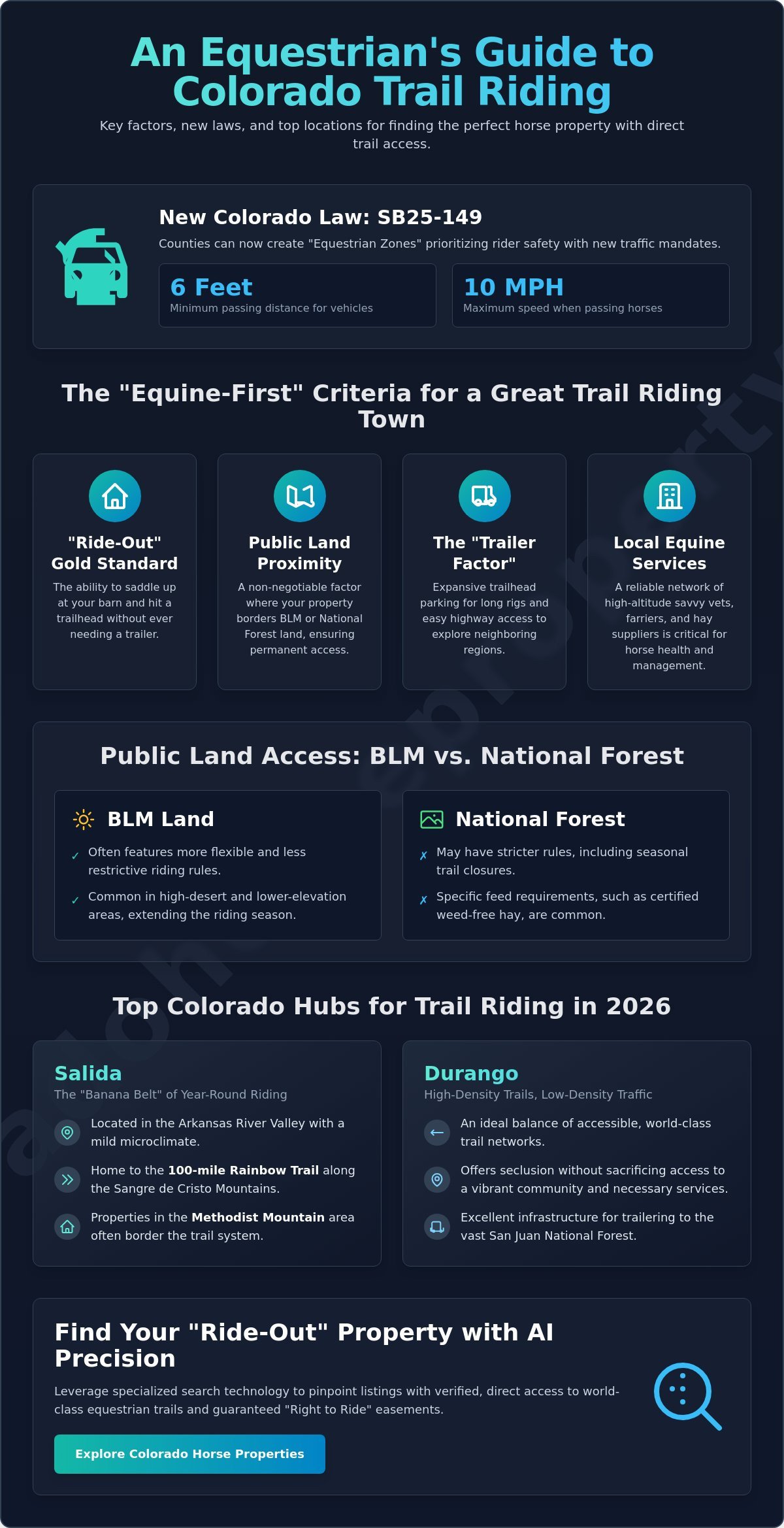
Identifying horse-friendly municipal codes is the first step in any search for the best Colorado towns for trail riding. Under SB25-149, signed in May 2025, many counties are now authorized to create specific “equestrian zones.” These zones prioritize infrastructure like road crossings and “wide and slow” signage. Drivers must maintain a six-foot distance and not exceed 10 miles per hour when passing horses. Local riding clubs act as the boots-on-the-ground advocates for maintaining these protections. High community density ensures that equestrian needs remain a priority during city planning meetings.
Public Land Access: BLM vs. National Forest
Understanding the regulatory differences between agencies is essential for long-term satisfaction. BLM land often offers more flexible riding rules, while National Forest trails may have stricter seasonal closures or specific feed requirements. For instance, the Gunnison National Forest requires certified weed-free hay to protect the ecosystem. Many riders target regions where The Colorado Trail passes through, as it connects six different national forests. Successful buyers use AI-powered search tools to identify properties that border these systems and look for “Right to Ride” easements that guarantee permanent access even as towns grow.
Top 5 Colorado Towns for Unrivaled Trail Riding in 2026
Selecting a home base involves balancing trail density with property utility. While luxury destinations often highlight horseback riding in Snowmass as a premier summer activity, the towns listed below offer a more robust foundation for full-time equestrian living. These locations represent the best Colorado towns for trail riding because they combine protected public land access with specialized local infrastructure.
Salida: Year-Round Riding in the Banana Belt
Salida is situated in the Arkansas River Valley, a region known as the “Banana Belt” due to its surprisingly mild microclimate. Riders here enjoy significantly more trail days than their neighbors in higher-elevation resorts. The crown jewel of this area is the Rainbow Trail. It stretches for 100 miles along the Sangre de Cristo Mountains, offering challenging singletrack for seasoned horses. Property buyers often target the Methodist Mountain area, where small acreages frequently border the trail system, providing that coveted ride-out capability.
Durango: The Multi-Terrain Equestrian Hub
Durango serves as the southern terminus for the Colorado Trail, making it a bucket-list destination for long-distance riders. The terrain here is exceptionally diverse. You can spend the morning on high-desert mesas like the Dry Fork Loop and the afternoon climbing into the rugged San Juan National Forest. This variety allows you to choose your elevation based on the season, avoiding deep snow in the winter and intense heat in the summer. Reviewing a guide to equestrian real estate Colorado is essential for this region, as zoning for “Animal Units” varies strictly between La Plata County and city limits.
The remaining top contenders for 2026 include:
- Estes Park: This gateway to the Rockies features dedicated equestrian corridors designed to keep riders separate from heavy tourist traffic.
- Pagosa Springs: Known for deep forest trails and natural water crossings, this town is ideal for those who prefer lush, shaded riding environments.
- Elizabeth & Kiowa: These Front Range communities are the best-kept secret for riders who want a mix of rolling prairies and ponderosa pine forests without leaving proximity to Denver.
Finding the right balance of acreage and trail access is easier when you use a specialized tool. You can narrow down your search for these premier locations by using our AI-powered horse property search to find listings with verified trail borders.
Each of these towns offers a unique topographical signature. Whether you prefer the rocky technicality of the San Juans or the soft footing of the Elizabeth pines, these hubs ensure your horse has the space to perform. The key is identifying which environment matches your horse’s fitness and your own riding goals.
This focus on quality and specific characteristics is what defines a premium lifestyle. For those who value exclusivity in every aspect of their lives, from their property to their table, the boutique offerings of Cave Winex provide a high-quality experience that complements the equestrian spirit.
High Alpine vs. High Desert: Choosing Your Riding Terrain
Selecting from the best Colorado towns for trail riding requires understanding how specific environments impact your horse’s health and performance. The state’s topography isn’t uniform. A town at 10,000 feet presents vastly different physiological challenges than a high-desert community at 5,000 feet. You must match your horse’s conditioning and your own riding goals to the local landscape to ensure a successful transition to the Rockies.
Altitude is the most significant factor for new arrivals. At elevations exceeding 10,000 feet, oxygen levels are significantly lower than at sea level. This puts an immediate strain on the equine respiratory system and aerobic capacity. It isn’t just a matter of fitness; it’s a biological requirement for the horse to produce more red blood cells to carry oxygen efficiently. Beyond breathing, the terrain itself dictates your maintenance routine. Colorado’s “mud season” in the spring can soften hooves, making them susceptible to thrush and bruising, while the abrasive granite of the high country acts like sandpaper on barefoot horses.
Hoof care for the Rockies often requires a shift in strategy. While some owners aim for “Colorado tough” barefoot hooves, the reality of technical mountain trails often necessitates front shoes or high-performance boots. Granite, scree, and volcanic rock will wear down a hoof wall faster than it can grow. Water management is another critical logistical hurdle. In the high alpine, natural streams are often plentiful, but in high-desert regions, natural sources are unreliable. You’ll need to pack in hydration or plan rides around verified stock tanks and river access points.
Navigating High Alpine Peaks
High alpine riding demands a horse with a “mountain motor” and a steady brain. Trails often feature narrow switchbacks with significant exposure and loose scree slopes. Safety here is dictated by the clock. Summer weather patterns in the high country almost always include violent lightning storms that roll in by 2:00 PM. You must plan to be off the ridges and below the tree line before the clouds turn dark. If you’re moving a horse from a lower elevation, follow a strict 10-day acclimation protocol: Days 1 to 3 should be rest and hydration only; Days 4 to 7 involve light walking; and Days 8 to 10 allow for short periods of trotting before attempting steep climbs.
The Perks of High Desert Canyons
High desert regions, such as those near Grand Junction or the Canyons of the Ancients, offer a longer riding season and different footing advantages. Sand and soft dirt can be easier on a horse’s joints than hard-packed mountain soil, though deep sand requires careful monitoring to prevent tendon strain. Trail awareness is paramount here due to environmental hazards like prickly pear cacti and rattlesnakes. Protective leg gear is recommended to prevent puncture wounds. These hidden trail systems provide a stark, expansive beauty that feels worlds away from the crowded mountain passes, offering a sense of solitude that’s becoming rare in more developed regions.
The Logistics of Living Near the Trails: Zoning and Access
A common concern for riders moving to the Rockies is whether the best Colorado towns for trail riding have become too congested. While it’s true that popular trailheads near major metro areas see heavy weekend traffic, the reality for locals is different. The secret to a peaceful riding life lies in identifying “hidden gem” access points. These are often secondary trailheads located at the end of county-maintained dirt roads that lack the signage found in tourist brochures but offer ample trailer parking and immediate solitude.
Agricultural zoning (Ag-Zoning) is the most critical factor for any prospective property owner. It doesn’t just define how much space you have; it dictates your legal right to keep livestock. For the weekend trail warrior, the “Ranchette” model is the most efficient choice. These properties, typically ranging from 5 to 35 acres, provide enough space for a small barn and turnout without the intensive land management required by a full-scale ranch. They offer the perfect home base for those who want to spend their time on the trail rather than on a tractor.
Acreage Requirements for Colorado Horse Properties
When you begin evaluating acres in colorado for sale, you must look beyond the total square footage. Most counties use an “Animal Unit” (AU) system to determine how many horses a parcel can support. While a common guideline is two acres of pasture per horse for sustainable grazing, many owners successfully manage smaller acreages through supplemental feeding and dry-lot strategies. Properties that offer true “Ride-In/Ride-Out” access command a significant premium in the 2026 market. This feature eliminates the need for a trailer for daily exercise, adding both convenience and long-term resale value to the investment.
Water Rights and Trail Riding
Water is the most complex legal issue in the West. You can’t always assume your horse can drink from a mountain stream crossing your property; water rights are often owned by entities miles away. Understanding your well permit is essential. In many rural Colorado counties, a “Household Use Only” permit prohibits watering livestock, while a “Domestic and Livestock” permit is required for your herd. These permits are tied to the land and are non-negotiable. The long-term viability of any trail riding town depends entirely on its water security and the legal protections afforded to its agricultural residents.
Securing a property that meets all these logistical requirements is the only way to ensure your equestrian dream doesn’t turn into a legal headache. To find a home base that already has these boxes checked, search our verified equestrian listings to see properties with established water rights and trail access.
Finding Your Equestrian Home Base with AI Precision
Traditional real estate platforms often fail to account for the specific logistical needs of a rider. Finding the best Colorado towns for trail riding requires data that standard filters simply don’t provide, such as the exact distance to a public land gate or the specific zoning for livestock. Our approach replaces guesswork with a data-driven strategy. We understand that a trail-ready property is more than just a house on a few acres; it is a functional asset that must support the health of your herd and your desire for freedom.
The year 2026 represents a pivotal moment for ranches for sale colorado. With the implementation of new equestrian zones and infrastructure mandates, the market is rewarding properties that offer verified access to riding corridors. Closing a deal in this specialized market requires a team that manages every detail, from the initial title search to the final escrow, ensuring your new acreage is legally and physically ready for your arrival.
Leveraging AI for Your Property Search
Our proprietary technology changes how you evaluate potential homes. Instead of scrolling through thousands of irrelevant listings, you can filter by barn type, the presence of an arena, and precise trail proximity. We use satellite overlays to verify public land borders before you ever step foot on the property. This ensures that the “ride-out” potential listed in a brochure actually exists on the ground. You can customize alerts for new horse property for sale in colorado, giving you an immediate advantage when a high-value parcel hits the market in one of the state’s premier riding hubs.
The Colorado Horse Property Advantage
We bring a 40-year history of specialized expertise in the Front Range and across the Rockies. Our team doesn’t just manage transactions; we provide personalized buyer representation based on a deep, personal knowledge of the landscape. We know the trails because we ride them. This peer-to-peer connection means we can identify which mountain passes are too steep for a green horse and which desert mesas offer the best winter footing. We bridge the gap between a standard real estate transaction and a lifestyle investment. Our expertise ensures that your search for the best Colorado towns for trail riding ends with a property that truly serves your needs.
Your journey toward a premier equestrian lifestyle starts with the right tools and the right partnership. Start your AI-powered horse property search today and discover where world-class trail access meets your perfect home base.
Secure Your Future on the Colorado Trail
Securing a home base in the Rockies requires more than a scenic view. It demands a strategic intersection of equestrian-friendly zoning, reliable water rights, and direct access to public land. By prioritizing ride-out potential and understanding the physiological demands of high-alpine or high-desert terrains, you ensure a sustainable lifestyle for both you and your herd. The best Colorado towns for trail riding are those where infrastructure meets opportunity, supported by local advocacy and specialized land management.
With 40 years of Colorado real estate expertise, we bridge the gap between general property searches and specialized equestrian requirements. Our team provides veteran buyer and seller representation, ensuring every transaction is managed with professional precision. You don’t have to guess about trail proximity or satellite-verified borders. We provide the data you need to make an informed investment in your legacy.
Find your dream trail-access property with our AI search tool and leverage a platform built specifically for the needs of land and livestock owners. Your vision of expansive space and mountain freedom is within reach.
Frequently Asked Questions
Can I ride horses on the Colorado Trail?
Yes, horses are permitted on nearly all segments of the 486-mile Colorado Trail. While the system is multi-use and shared with hikers and cyclists, it was designed with pack and saddle animals in mind. You should check specific wilderness area regulations for segments near Collegiate Peaks, as some high-traffic zones may have seasonal restrictions or specific group size limits for livestock.
What is the best time of year for trail riding in Colorado?
The peak window for high-country riding is between late June and September when the snow has cleared from the passes. For those exploring the best Colorado towns for trail riding in the high-desert regions, spring and fall offer ideal temperatures. You should generally avoid the “mud season” in April and May, as heavy hooves can damage fragile trails and lead to thrush issues.
Do I need a permit to ride my horse on BLM or National Forest land?
No daily permit is required for individual recreational riding on most BLM or National Forest lands. However, you must comply with specific forest orders, such as the Gunnison National Forest requirement to use only certified weed-free hay. If you are entering a Colorado State Park on horseback, you will need an individual daily pass, which costs $4.00 per person as of 2026.
Which Colorado towns have the most trailer-friendly trailheads?
Salida and Elizabeth stand out as the best Colorado towns for trail riding due to their expansive, flat trailhead parking lots. The Rainbow Trail access points near Salida are specifically maintained to accommodate large gooseneck trailers. In the Front Range, the trailhead systems in Kiowa and Elizabeth provide wide turnarounds that make navigating rural roads much safer for those hauling multiple horses.
How do I acclimate my horse to the high altitude in Colorado?
You must follow a gradual 10-day acclimation protocol to allow for increased red blood cell production. For the first three days, provide total rest and ensure your horse stays highly hydrated with added electrolytes. Between days four and seven, limit activity to light walking on flat ground. Don’t attempt steep mountain climbs or strenuous trotting until at least the tenth day of residency at high elevation.
Are there specific ‘horse-only’ trails in Colorado to avoid mountain bikes?
While multi-use trails are the norm, Mueller State Park and certain sections of Rocky Mountain National Park offer dedicated equestrian paths where mountain bikes are prohibited. Under the new SB25-149 legislation, more municipalities are beginning to designate specific “equestrian zones.” These areas prioritize horse safety by implementing “wide and slow” signage and requiring drivers to maintain a six-foot distance when passing riders on shared roads.
How many acres do I need to keep horses in a Colorado mountain town?
Most counties recommend at least two acres of pasture per horse for sustainable grazing, though local zoning laws vary significantly. In many rural areas, a 35-acre parcel is the threshold for obtaining an automatic “Domestic and Livestock” well permit. If you have a smaller “Ranchette,” you can still keep horses legally by using dry-lot strategies and supplemental feeding, provided your municipal code allows for the specific number of Animal Units.
What are the best horse-friendly campgrounds in Colorado?
Mueller State Park and Golden Gate Canyon State Park provide premier equestrian camping facilities, including sturdy corrals and level trailer pads. These sites often fill up months in advance, so early reservations are essential. For a more rugged experience, the Buffalo Creek area in the Pike National Forest offers expansive dispersed camping options with direct access to hundreds of miles of interconnected multi-use trails.