
What if the picturesque Colorado ranch you’re eyeing is actually a hidden liability for your herd? You’ve likely spent years envisioning a life of expansive space and morning rides, but the reality of finding a safe property for my horses involves much more than a beautiful view. Many buyers realize too late that poor drainage or toxic vegetation can lead to heartbreak, while outdated fencing often requires a small fortune to replace. It’s natural to feel overwhelmed by the technicalities of Colorado water rights or the “Animal Units” system used in Front Range counties.
This guide provides the clarity you need to evaluate land with the eyes of a seasoned expert. You’ll learn how to identify critical safety features and navigate the 2026 well construction rules that impact your ability to water livestock legally. We’re covering everything from identifying move-in ready estates to using a definitive safety checklist. By the end of this article, you’ll have the confidence to secure a property that protects both your investment and your horses’ well-being.
Key Takeaways
- Learn to look beyond aesthetics to evaluate structural integrity, from fire-safe electrical systems in barns to the safest fencing materials like PVC or pipe.
- Understand how to verify Colorado water rights and well permits, ensuring your land has the legal capacity to support livestock during drought conditions.
- Master a 5-point inspection process for finding a safe property for my horses, including identifying hidden drainage issues and toxic plants like Locoweed.
- Discover how AI-powered search tools and four decades of local expertise can streamline your search for a move-in ready equestrian estate.
The Equestrian Safety Framework: More Than Just Acreage
A safe property is a cohesive system where infrastructure, environmental health, and legal protections work together. Many buyers get distracted by a freshly painted barn or a sweeping mountain view, but “pretty” properties often mask significant risks. Poor soil drainage can lead to chronic thrush or mud fever, while hidden legal issues, such as restricted well permits, can leave you without water for your animals. Finding a safe property for my horses means looking for a site where the land’s utility matches its aesthetic appeal. Working with specialists in equestrian real estate Colorado is essential to identifying these subtle red flags before you sign a contract.
To better understand the core principles of horse safety on a new property, watch this helpful video:
The Hazards of “Hobby” vs. Professional Layouts
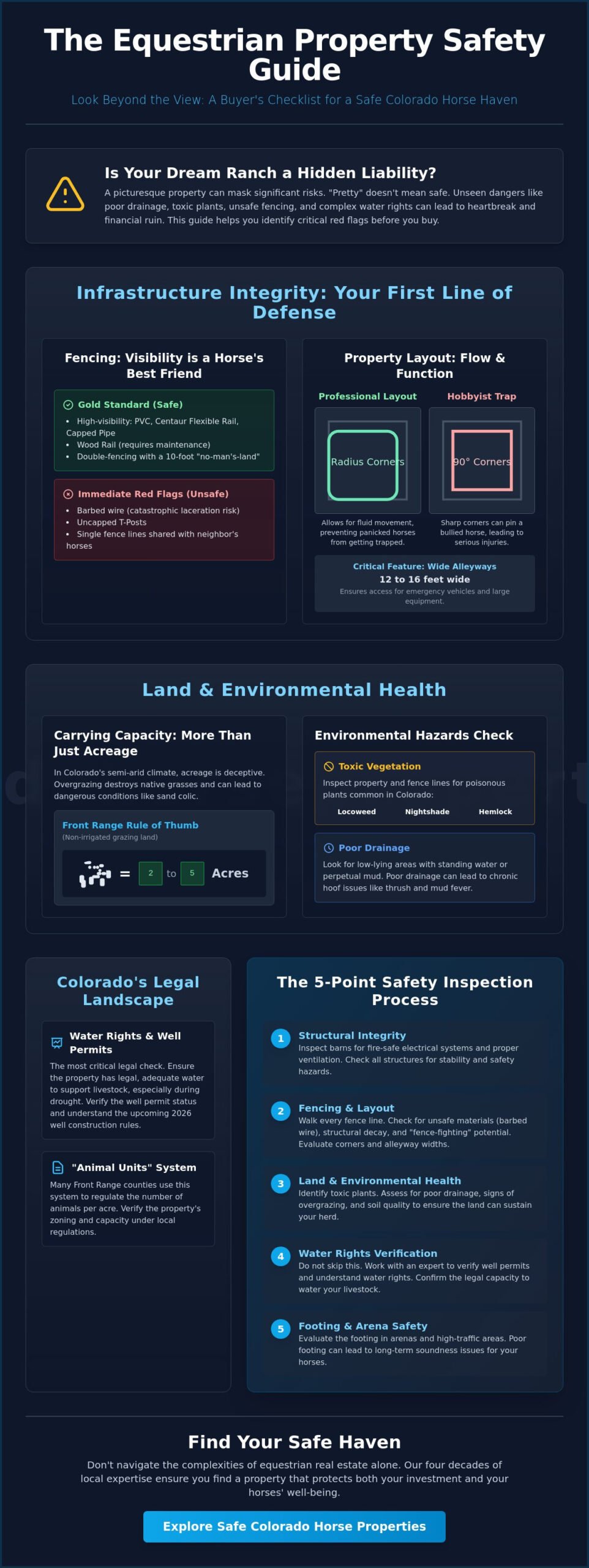
Layout mistakes are common in properties designed by casual owners rather than professional horsemen. These “traps” often occur in tight paddocks with 90-degree corners. A panicked or bullied horse can easily get pinned in a sharp corner, leading to collision injuries or fence breakthroughs. Professional layouts prioritize radius corners and wide alleyways that allow for fluid movement. These alleyways should be at least 12 to 16 feet wide. This width ensures that emergency medical vehicles or large tractors can reach every part of the property without getting stuck. Efficient property flow isn’t just about convenience; it’s a critical safety feature that saves time during a medical crisis.
Carrying Capacity and Land Health
Acreage size is often a deceptive metric for buyers. In Colorado’s semi-arid High Plains, the “carrying capacity” is much lower than in the lush Midwest. Overgrazing on small parcels destroys native grasses and exposes loose, sandy soil. This often leads to sand colic, as horses ingest dirt while trying to reach the roots of short grass. Adhering to horse management best practices involves understanding your specific soil type and vegetation limits. While a general rule of thumb for the Front Range is one horse per 2 to 5 acres of non-irrigated grazing land, this ratio changes based on water rights and soil quality. Without proper land management, a 10-acre parcel can quickly become a toxic dust bowl. Finding a safe property for my horses requires verifying that the land can actually sustain the number of animals you plan to keep without compromising their health.
Infrastructure Safety: Barns, Fencing, and Footing
The physical structures on an equestrian estate are either your greatest asset or your most significant liability. When finding a safe property for my horses, it’s easy to assume that existing facilities are ready for use. However, legacy infrastructure often hides dangers that lead to expensive vet bills or total retrofitting costs. Fencing is your first line of defense. High-visibility materials like Centaur flexible rail, PVC, or capped steel pipe are the gold standard for safety. Wood rail is a solid secondary choice but requires constant maintenance to prevent splintering. You should view barbed wire and uncapped T-posts as immediate red flags. These materials are responsible for the majority of catastrophic lacerations in panicked horses.
Evaluating Fencing Integrity and Visibility
Visibility is the most critical safety factor for any perimeter fence. Horses are flight animals; if they can’t see the boundary during a spook, they’ll attempt to run through it. While walking the property lines, check for “fence-fighting” potential. If the layout shares a single line with a neighbor’s horses, the risk of kicking injuries increases significantly. Double-fencing with a 10-foot “no-man’s-land” is the safest solution. While inspecting these boundaries, consult a guide to poisonous plants to ensure the fence rows aren’t harboring toxic weeds like nightshade or hemlock. Look for structural decay in wooden posts and sagging in tensioned wire, as these indicate a lack of long-term maintenance.
Barn Design for Respiratory and Physical Health
A safe barn must prioritize air quality and fire prevention. Colorado’s dry climate creates significant dust, making “natural draw” ventilation essential. Look for high ceilings and ridge vents that pull stale air out of the building. Stalls should be at least 12×12 feet to allow a horse to turn and lie down safely. Evaluate the flooring carefully. Rubber mats over a level, crushed-rock base provide the necessary cushion for joint health, whereas hard concrete or uneven dirt floors can cause long-term lameness. Fire safety is non-negotiable. Ensure all wiring is encased in metal conduit to prevent rodents from chewing through lines, and verify that hay storage is kept in a separate building or a fire-walled loft.
Don’t overlook the arena footing. Deep, shifty sand or hard-packed clay can lead to bowed tendons and ligament strains. High-quality properties feature a multi-layered footing system with a solid base and a consistent top layer. If you’re concerned about the cost of replacing unsafe legacy infrastructure, our team can help you evaluate these features through our real estate listing services. Finding a safe property for my horses is simpler when you prioritize structural integrity over cosmetic upgrades.
Colorado-Specific Hazards: Environmental and Legal Safety
Colorado’s rugged landscape presents environmental and legal challenges that differ significantly from other regions. Finding a safe property for my horses involves navigating complex water rights and identifying high-altitude forage risks. As of June 2026, 35.95% of the state is experiencing extreme-exceptional drought conditions. This makes water security your most critical legal and physical safety priority. You can’t assume that a property with a beautiful view also has the legal right to sustain your animals through a dry season.
Water Security and Quality Testing
Effective January 1, 2026, amended rules for water well construction require a “Well Construction and Yield Estimate Report” for any well built after this date. This report provides essential data on well cleaning and development. However, a “working well” doesn’t guarantee legal safety. You must verify the permit type. “Household Use Only” permits do not legally allow for watering livestock; you generally need a “Domestic” permit. These are typically granted for parcels of 35 acres or more. Furthermore, all valid non-exempt well permits now have an automatic expiration date of two years from issuance. A crucial step in finding a safe property for my horses is a professional water test to check for high mineral content or contaminants common in rural Colorado aquifers. Ensure the infrastructure includes heat tape or frost-free hydrants to prevent frozen lines during sub-zero winters.
Zoning, Easements, and Future Safety
When searching for horse property for sale in Colorado, zoning is your baseline for legal safety. Most Front Range counties use an “Animal Units” system. This dictates exactly how many horses you can keep based on your specific acreage and soil health. Don’t rely on the seller’s current horse count as proof of legality. You should also identify utility easements that might allow a power company to remove your safety fencing for maintenance. Check “Right to Farm” laws in your specific county to protect against future neighbor complaints regarding dust or noise. Finally, verify that local HOAs or covenants don’t restrict essential safety structures like hay sheds or specific fencing materials.
Environmental safety also includes managing local flora and wildlife. Locoweed and Houndstongue are common in the Rockies and can cause irreversible neurological damage or liver failure if ingested. While elk and deer are majestic, they can destroy fencing and compete for limited forage. Mountain lions and coyotes pose risks to foals and smaller livestock, requiring secure, well-lit barn areas at night. Identifying these hazards during the buying process ensures your equestrian dream doesn’t become a management nightmare.
The 5-Point Safety Inspection Process for Buyers
Walking the land is the only way to uncover risks that listing photos hide. Finding a safe property for my horses involves a systematic 5-point inspection during your final walkthrough. You should start by walking every inch of the perimeter. Look for “leg-breaker” holes from badgers or prairie dogs and hidden debris like rusted farm equipment or old wire buried in the grass. Push on every corner post to ensure the fence isn’t just standing by habit. A stable fence must withstand the weight of a leaning horse without yielding.
Next, perform a utility audit. Verify that the barn has dedicated electrical circuits for water heaters and that water pressure remains consistent at the furthest hydrants. You also need a “no-go” plant survey. While you previously learned about toxic species like Locoweed, use this walk to see what’s actually growing in the specific paddocks you’ll use for turnout. Finally, never conduct this walk alone. An equestrian-specialist Realtor understands how to spot subtle red flags, like the smell of mold in a hay loft or a lack of proper turnout rotation space, that a generalist agent will miss.
Identifying Drainage and Mud Management Issues
The Seasonal Safety Audit
A seasonal safety audit helps you visualize the property during Colorado’s extreme weather shifts. Evaluate winter access carefully. Can a heavy hay truck or an emergency vet vehicle reach the barn during a blizzard? Check for natural windbreaks, like dense tree lines or topographical shifts, that protect livestock from the biting north winds. Finding a safe property for my horses also means assessing summer shade. Without enough natural canopy or run-in sheds, horses face increased risk of heat stress during July and August. Ensure the property layout allows for safe animal movement even when the ground is covered in ice or baked hard by the sun.
If you’re ready to find a site that passes every test, start your journey with our AI-Powered Horse Property Search to filter for estates with professional-grade infrastructure.
Finding Your Safe Haven with Colorado Horse Property
The process of finding a safe property for my horses shouldn’t be left to chance or generalist real estate platforms. While a standard search might show you acreage and bedroom counts, it fails to highlight the nuances of equestrian safety. You need a system that prioritizes structural integrity and legal security from the first click. Our team bridges the gap between digital efficiency and decades of boots-on-the-ground experience. Mark and Alison Eibner bring over 40 years of Front Range expertise to every transaction. This longevity means we’ve seen how specific soils shift over decades and how various fencing materials hold up against Colorado’s intense UV rays and winter cycles.
Leveraging AI for Safety-First Property Searches
Technology now allows you to filter listings with a level of granularity previously unavailable. Our platform uses data-driven insights to help you identify properties with professional-grade infrastructure before you spend time on a physical visit. You can specifically search for horse barns for sale that meet the ventilation and fire-safety standards discussed in earlier sections. These listings provide immediate clarity on critical factors like well permit types and “Animal Unit” zoning limits. By excluding properties with hazardous legacy infrastructure or insufficient water rights, you save weeks of effort. This specialized approach ensures that every estate you tour has the potential to be a move-in ready haven for your animals.
Expert Closing and Transaction Management
The safety of your investment is just as important as the physical safety of your horses. Complex ranches for sale Colorado often involve intricate easements, shared well agreements, and agricultural tax status verifications. Specialized buyer representation is your best defense against “buyer’s remorse” on land that looks perfect but carries hidden legal liabilities. Our transaction management services oversee every detail of the contract to ensure no safety-related contingency is overlooked. We work closely with Meridian Title & Escrow to guarantee a clear title, protecting you from future disputes over property boundaries or access rights.
Choosing the right partner means finding a safe property for my horses with total confidence. We act as your advocate, evaluating every fence line and well report with a seasoned, no-nonsense perspective. Your horses deserve a home that protects them, and your legacy deserves a foundation that lasts. Start your safe property search with our AI tool today.
Secure Your Equestrian Legacy in Colorado
Securing a safe haven for your herd requires a blend of structural vigilance and legal expertise. You now have the tools to look beyond the surface of a listing and evaluate the integrity of fencing, the health of the soil, and the security of Colorado water rights. Finding a safe property for my horses is a process that demands precision, but you don’t have to navigate these complexities alone. The right land should offer more than just a view; it must provide a sustainable environment where your animals can thrive for years to come.
Our specialized AI search tool is designed to filter for the exact equestrian features you need, saving you time and protecting your investment. With over 40 years of local real estate experience, industry experts Mark and Alison Eibner provide the seasoned guidance necessary to avoid hazardous land and legal pitfalls. We’re committed to helping you find a property where your horses are protected and your lifestyle goals can finally take root. Your dream ranch is within reach when you have the right data and expertise on your side.
Find your safe Colorado horse property with our AI-powered search tool and take the first step toward your move-in ready estate today. Your dream ranch is waiting.
Frequently Asked Questions
How many acres do I really need for two horses in Colorado?
You generally need between 4 and 10 acres for two horses on non-irrigated Front Range land. Colorado’s semi-arid climate means the land’s carrying capacity is significantly lower than in wetter regions. Most counties use a specific “Animal Units” system to regulate these numbers. You should always check specific county zoning before buying to ensure your intended herd size is legally permitted on that specific parcel.
What is the safest type of fencing for a Colorado ranch?
High-visibility flexible rail, PVC, or capped steel pipe are the safest fencing options available today. These materials are designed to yield or remain visible during a spook, reducing the risk of catastrophic lacerations. You should avoid barbed wire and uncapped T-posts at all costs. These are major safety liabilities that often require immediate and expensive replacement after purchase to ensure the well-being of your animals.
Do I need a special well permit to water my horses in Colorado?
Yes, you typically need a “Domestic” well permit to legally water livestock in this state. A “Household Use Only” permit is strictly limited to indoor use and is insufficient for equestrian needs. Parcels of 35 acres or more generally qualify for a “Domestic and Livestock” permit. New well construction rules effective in 2026 also require detailed yield estimate reports to verify long-term water availability.
What toxic plants should I look for on a Colorado horse property?
You must watch for Locoweed, Houndstongue, and Russian Knapweed, which are common throughout the Rocky Mountain region. These plants can cause irreversible neurological damage or liver failure if ingested. Finding a safe property for my horses requires conducting a thorough pasture survey during different growing seasons. This ensures the forage is safe for grazing and hasn’t been overtaken by invasive, toxic species.
Is it safe to keep horses on a property with a high water table?
High water tables can be dangerous if they create “boggy” areas or standing water in high-traffic zones like gates or barn entrances. Constant moisture leads to chronic hoof rot, thrush, and mud fever. If a property has a high water table, you’ll likely need professional grading and advanced drainage systems to keep stalls and paddocks dry. This is often one of the most expensive infrastructure fixes for owners.
What are the red flags in an existing horse barn?
Primary red flags include poor ventilation, exposed wiring without metal conduit, and stalls smaller than 12×12 feet. Look for signs of mold in hay lofts and sharp 90-degree corners in tight alleyways that can trap panicked animals. Fire safety is also paramount. Ensure the electrical system is updated and that hay storage is properly separated from the main stabling area to minimize risks.
Can I change the zoning of a property to allow more horses?
Changing zoning is a complex, time-consuming legal process and is rarely guaranteed by local planning boards. Most counties base their “Animal Units” on specific acreage and environmental impact to prevent overgrazing and soil erosion. It’s much safer to buy a property already zoned for your intended use. Relying on a future zoning change often leads to legal disputes with neighbors or local authorities.
How do I verify if a property has adjudicated water rights?
You should verify water rights through the Colorado Division of Water Resources and a professional title search. Water rights are separate legal assets from land ownership in Colorado and don’t automatically transfer. Finding a safe property for my horses requires confirming that these rights are adjudicated and clearly listed in the deed. Our team works with title specialists to ensure your water security is legally protected.