
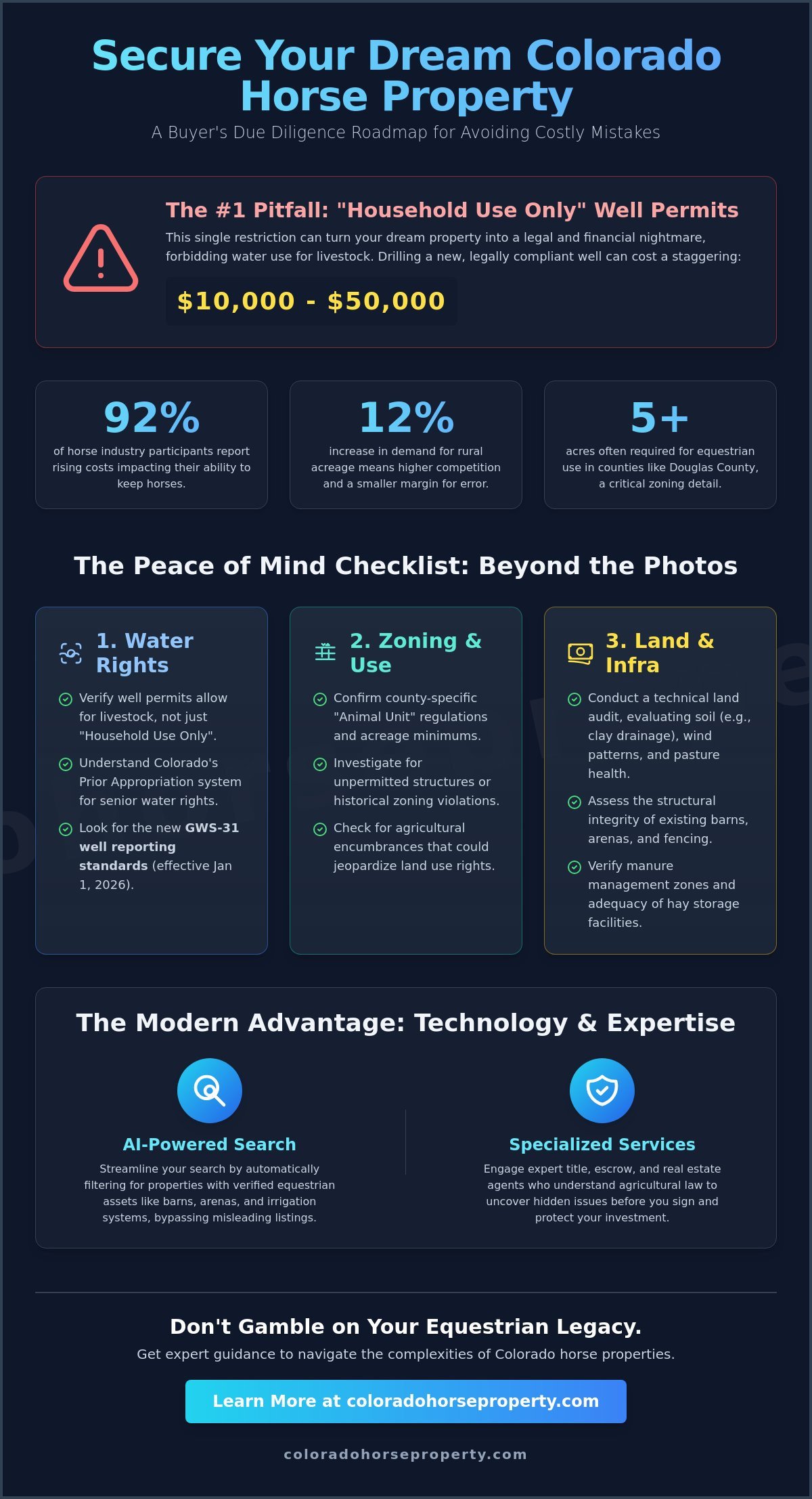
A “Household Use Only” well permit is the fastest way to turn a dream Colorado horse property into a legal and financial nightmare. While many buyers focus on the layout of the barn or the quality of the pasture, the real risks often hide in the fine print of water court decrees and county zoning codes. Achieving true peace of mind buying equestrian property requires looking past the aesthetic appeal to verify that the land can legally and physically support your animals. With 92% of industry participants reporting that rising costs are impacting their ability to keep horses, you can’t afford to overlook infrastructure details like the $10,000 to $50,000 cost of drilling a new well in today’s market.
It’s natural to feel anxious about shifting zoning regulations or the complexities of Colorado’s 35-acre rule. You want to ensure your investment is protected and your lifestyle is secure. This roadmap promises to eliminate the guesswork by showing you how to leverage AI-powered search technology and specialized due diligence to bypass hidden pitfalls. We will preview the critical legal requirements for 2026, from the new GWS-31 well reporting standards to specific acreage mandates in counties like Douglas, giving you the confidence to navigate the market with absolute certainty.
Key Takeaways
- Learn why standard real estate filters often overlook the “invisible” variables critical for livestock and how to identify functional infrastructure beyond the photos.
- Gain peace of mind buying equestrian property by mastering the verification process for Colorado water rights and county-specific “Animal Unit” zoning regulations.
- Discover how AI-powered search technology streamlines the search process by automatically filtering for specific equestrian assets like barns, arenas, and irrigation systems.
- Understand the role of specialized title and escrow services in uncovering agricultural encumbrances that can jeopardize your land use rights.
- Follow a structured 90-day stewardship plan to manage your new facility effectively and secure your equestrian legacy for years to come.
Why Standard Real Estate Approaches Fail Equestrian Buyers
Standard real estate platforms are built for residential density. They prioritize square footage and bedroom counts, leaving the technical requirements of livestock as an afterthought. For a serious buyer, a beautiful four-stall barn is irrelevant if the soil is heavy clay that won’t drain or if the local zoning forbids more than one animal unit per five acres. True peace of mind buying equestrian property starts by recognizing that a house with land is not the same as a functional agricultural facility. You can’t rely on generic search filters to tell you if the ground is safe for a 1,200-pound animal.
Many buyers rely on generic acreage filters, but these fail to account for the specific Equestrian facility components needed for daily operations. You need to evaluate wind patterns, manure management zones, and the structural integrity of existing arenas. In the 2026 Colorado market, a simple walkthrough is insufficient. You need a technical land audit to identify unpermitted structures or historical zoning violations that could lead to forced removals or heavy fines after closing. Generalist mistakes in this sector are expensive and often permanent.
To better understand this concept, watch this helpful video:
The Generalist Realtor Gap
A residential agent might see “horse-friendly” in a listing and assume it’s accurate. However, marketing descriptions aren’t legal guarantees. Specialists understand that grazing requirements vary by soil type and that Douglas County, for example, requires a minimum of five acres for equestrian use. A generalist often misses the subtle signs of poor pasture health or inadequate hay storage, which can lead to massive infrastructure costs later. A specialized agent protects your investment by verifying the legal zoning reality before you ever sign a contract. They look at the land’s utility, not just the kitchen’s backsplash.
Complexity of Colorado Land Transactions
Colorado land is uniquely challenging. You have to contend with steep mountain topography in the high country and intense development pressure along the Front Range. Equestrian properties are essentially hybrid assets. They combine residential living with commercial-grade agricultural infrastructure. In 2026, buyers must set realistic expectations. The 12% increase in demand for rural acreage means competition is high, and the margin for error is slim. You aren’t just buying a home; you’re becoming a steward of a complex land system that requires technical expertise to evaluate. Achieving peace of mind buying equestrian property means knowing exactly what the soil, the water, and the law will allow before the deal is done.
The Peace of Mind Checklist: Water, Zoning, and Soil
While a freshly painted barn or a white rail fence catches the eye, the true value of a horse property lies in its legal and physical foundation. You cannot achieve peace of mind buying equestrian property without first verifying three non-negotiable factors: water rights, zoning restrictions, and soil quality. These elements are the pillars that determine if you can actually keep horses on the land or if you are simply buying an expensive piece of residential real estate. In Colorado, assuming the land is “horse-ready” because the neighbor has a pony is a mistake that leads to litigation and lost equity.
Decoding Colorado Water Rights
Water is the most litigated asset in the state. Colorado operates under Colorado’s Prior Appropriation water system, which dictates that the first person to use the water has the senior right. Senior Water Rights are the ultimate security for Colorado land. As of January 1, 2026, any new well must have a GWS-31 report submitted to the state. You must verify if a well permit is “Household Use Only,” which forbids outdoor watering and livestock use, or “Domestic,” which allows for animal husbandry. If you’re looking at a parcel under 35 acres, the process for obtaining a domestic permit is significantly more restrictive and requires expert verification.
Zoning and Land Use Regulations
Don’t assume “Agricultural” zoning is a blank check for your equestrian dreams. Many counties use an “Animal Unit” (AU) calculation to limit how many horses you can keep. Douglas County, for example, requires a minimum of five acres for equestrian use. You must also verify setback requirements. Most Colorado counties mandate that barns and arenas stay 50 to 100 feet away from property lines and existing wells. Failing to check these maps can result in buying land where your planned indoor arena is legally impossible to build. It’s also vital to check surrounding parcels for future high-density development that could bring noise or traffic to your fence line.
Biological Due Diligence: Soil and Pasture
Soil testing is just as critical as a home inspection. Heavy clay creates a “mud pit” disaster during the spring thaw, while overly sandy soil may fail to support the forage needed for grazing. You also need to identify noxious weeds that are toxic to horses. Under House Bill 1340, landowners now face stricter responsibilities regarding revegetation and water management. Evaluating the natural drainage patterns ensures your arena won’t become a pond during a heavy rainstorm. Finally, check the legal access; ensure that easements are clearly defined so that hay deliveries and 40-foot trailers can reach the barn without crossing a neighbor’s disputed boundary. You can start filtering for these specific land requirements today by using an AI-powered horse property search to find parcels that meet your exact infrastructure needs.
Leveraging AI and Expertise to Filter Out ‘Money Pit’ Properties
Manual searches are exhausting. Most buyers spend months scrolling through listings, only to find that the “dream barn” in the photo is actually a structural liability or lacks legal water access. Achieving peace of mind buying equestrian property requires a shift from manual browsing to a data-driven strategy. By combining high-tech filtering with decades of boots-on-the-ground experience, you can eliminate “money pit” properties before they ever make it onto your tour list. Efficiency in the 2026 market isn’t just about speed; it’s about the quality of the data you use to make decisions.
The Power of AI in Equestrian Real Estate
Standard real estate sites treat a horse property like any other house on a lot. Our AI-Powered Horse Property Search changes the game by identifying high-value equestrian features instantly. Instead of clicking through 50 photos to find a tack room or an arena, the algorithm scans data points to verify outbuilding types, pasture size, and existing water infrastructure. This technology allows you to filter for specific needs, such as a domestic well versus a household-use-only permit. You save months of wasted tours by vetting the technical data before you ever leave your driveway. Data doesn’t lie, and our system ensures you only see properties that are truly horse-ready.
The Value of a Seasoned Expert
Technology provides the data, but human expertise provides the context. Mark and Alison Eibner bring 40 years of specialized experience to every transaction. An algorithm can identify a barn, but a seasoned expert can spot a failing well pump or a poorly graded arena in minutes. This professional longevity is essential in complex Colorado negotiations where water rights and zoning nuances make or break a deal. The Realty Oasis advantage lies in this blend of modern tools and historical knowledge of the Front Range. We understand the “invisible” variables of the 2026 market, ensuring your investment is protected by more than just a search filter. This dual-layered approach is the only way to navigate the current rural acreage demand with absolute certainty. You get the speed of AI with the protective layer of a seasoned specialist who has seen every type of land challenge Colorado has to offer.
Navigating the Transaction: Specialized Title and Escrow
Specialized partners like Meridian Title & Escrow play a vital role in ensuring your closing is legally sound. They understand that an equestrian transaction is a hybrid of residential and commercial law. This expertise is essential when verifying that water rights are properly adjudicated and that the 35-acre rule protections are intact for your well permit. Without this specialized oversight, you could end up with a property that has a beautiful barn but no legal way to fill the water troughs. Our transaction management services ensure that every agricultural exception is reviewed and resolved before you sign the final papers.
Specialized Title Coordination
A boundary survey is non-negotiable for large-acreage tracts. Fences in rural Colorado are often markers of convenience rather than legal property lines. A specialized title search will also uncover grazing leases that might allow a neighbor’s cattle to roam your land legally. We verify that all water rights are properly deeded, ensuring they transfer with the land rather than being “severed” by a previous owner. This level of scrutiny protects your investment from future litigation and ensures your land use remains exactly as you intended.
The Closing Process for Ranches
Managing the contingency period requires a strict timeline for technical inspections. You cannot rely on a standard home inspector to evaluate a 100-foot deep well or the compaction of arena footing. Follow these steps for a secure transaction:
- Step 1: Execute a contract with specific equestrian contingencies that allow for land-use verification.
- Step 2: Conduct specialized inspections, including a well yield test and a GWS-31 report review for any wells constructed after January 1, 2026.
- Step 3: Review the Title Commitment for agricultural exceptions, specifically looking for mineral severances or utility easements that cut through your planned pasture.
- Step 4: Coordinate with specialized lenders who understand the 25% agricultural tax assessment rate and the intrinsic value of outbuildings.
This structured approach ensures a seamless handoff from the contract phase to legacy ranch ownership. By managing the details now, you secure the long-term utility of your property and avoid the “buyer’s remorse” that comes from undiscovered land restrictions.
Securing Your Colorado Equestrian Legacy
Transitioning from a buyer to a land steward is a significant shift that happens in the first 90 days of ownership. It’s during this time that you establish the rhythms of facility management, from pasture rotation to well maintenance. You’ll need to monitor the health of your forage and ensure your water systems are operating at peak efficiency before the winter freeze or the summer heat. Protecting your investment requires more than just basic upkeep; it requires a clear vision for the land’s future. Equestrian real estate Colorado is more than a home; it’s a top-tier legacy asset that demands specialized care to maintain its value in 2026. True peace of mind buying equestrian property comes from knowing you’ve built a foundation that will last for decades.
Planning for the Future of Your Ranch
When you’re evaluating horse property for sale in colorado, look closely at the expansion potential of the site. You might start with a small shed-row, but your future needs could include larger horse barns for sale or a professional-grade indoor arena. Colorado land serves as a premier wealth-preservation tool that offers enduring value through market cycles and shifting economic climates. By mapping out your infrastructure early, you ensure the property remains functional as your equestrian goals grow. This long-term planning prevents the costly mistakes of building in areas with poor drainage or restricted setbacks that can devalue your ranch over time.
Partner with the Experts
Mark and Alison Eibner provide a concierge experience that extends far beyond the closing table. They understand that horse owners need more than just a realtor; they need a direct connection to a vetted network of industry professionals. This network includes fencing contractors, well service technicians, and arena builders who understand the unique Colorado terrain. Accessing these specialists ensures that your repairs and upgrades are done correctly the first time. Partnering with Colorado Horse Property means you have a seasoned ally to help you manage the complexities of rural land ownership long after the move-in date. Our goal is to simplify the search and the stewardship process alike, giving you the freedom to focus on your horses rather than your paperwork.
Start your stress-free journey today. Explore our AI-powered listings and secure your legacy with the confidence that only expert representation can provide.
Start Your Colorado Equestrian Journey with Confidence
Securing a horse property in Colorado requires more than a standard residential approach. You’ve seen how success depends on verifying technical land data, from water permits to soil drainage, before you commit to a purchase. By integrating specialized due diligence with modern technology, you can avoid the “money pit” properties that drain your resources and your time. Achieving true peace of mind buying equestrian property is possible when you have the right tools and a seasoned team by your side.
Led by industry veterans Mark and Alison Eibner, our team brings 40 years of Colorado real estate experience to your search. We combine this professional longevity with proprietary AI-powered search technology to identify functional infrastructure instantly. This ensures you only see properties that meet your specific requirements. Don’t leave your equestrian dream to chance in the 2026 market. Search Colorado Horse Properties with our AI Tool to find the land that supports your lifestyle. Your ideal ranch is within reach, and we have the expertise to help you secure it.
Frequently Asked Questions
Is buying a horse property a good investment in 2026?
Yes, equestrian property remains a resilient asset due to a 12% increase in demand for rural acreage in 2026. The Colorado horse industry now contributes $1.6 billion to the state economy, supported by the permanence of remote work. These properties serve as excellent wealth-preservation tools because specialized agricultural land often maintains its value even when suburban residential markets fluctuate.
How many horses can I legally have on 5 acres in Colorado?
Legal horse counts depend on specific county “Animal Unit” (AU) regulations rather than a state-wide standard. In Douglas County, 5 acres is the absolute minimum required for equestrian use. Other counties may require anywhere from 2.5 to 9 acres for the first horse, so you must verify the zoning map and land use code for your specific parcel before purchasing.
What is the difference between a domestic well and a household-only well?
A domestic well permit allows for the watering of livestock and domestic animals, making it essential for any horse property. Conversely, a “household use only” permit restricts water use to the interior of the primary dwelling and explicitly forbids outdoor use or animal watering. Verifying this permit type is a critical step for achieving peace of mind buying equestrian property.
Do I need a special home inspector for a ranch property?
A standard home inspector is rarely qualified to evaluate specialized agricultural infrastructure. You should hire separate professionals to conduct well yield tests, septic system inspections, and arena footing evaluations. These technical land audits identify hidden issues like failing pumps or poor drainage that a residential inspector would likely overlook during a basic walkthrough.
Can I build an indoor arena on any property zoned as agricultural?
Agricultural zoning does not grant an automatic right to build large structures without oversight. You must comply with county setback requirements, which typically mandate that barns and arenas stay 50 to 100 feet from property lines and existing wells. Some counties also have strict height restrictions or lot coverage limits that could prevent the construction of a professional-grade indoor arena.
How do I verify water rights before making an offer?
You must review the well permit and any adjudicated water court decrees via the Colorado Division of Water Resources. Confirm that the water right is for “beneficial use” and hasn’t been severed from the land by a previous owner. As of January 1, 2026, you should also ensure a GWS-31 report exists for any newly constructed wells to verify yield estimates.
What are the common hidden costs when buying an equestrian estate?
Common hidden costs include well restoration or new drilling, which averages between $10,000 and $50,000 in 2026. You may also face unexpected expenses for noxious weed mitigation and the maintenance of specialized arena footing. Buyers often overlook the cost of fence repair or the legal fees required to resolve boundary disputes discovered during a land survey.
Why should I use an AI-powered search tool for horse properties?
Standard real estate filters are designed for houses, not farms, and often miss critical details like hay storage or irrigation rights. An AI-powered search tool scans listing data to identify specific equestrian assets automatically, saving you months of manual research. This technology provides peace of mind buying equestrian property by ensuring you only tour parcels that legally and physically support your horses.