
In Colorado, a well permit isn’t a guaranteed right to use water; it’s a regulated allowance that determines your property’s literal carrying capacity. Many buyers assume a hole in the ground means unlimited water for their herd, but the reality is dictated by the doctrine of prior appropriation. Understanding well permits for equestrian properties CO is the difference between a thriving ranch and a dry investment that limits your lifestyle. It’s the most critical piece of due diligence you’ll perform before closing on your new acreage.
You’ve likely felt the anxiety of looking at a beautiful property while wondering if the 1972 permit cutoff or junior water rights will eventually leave your troughs empty. It’s a complex system, but you don’t need to be a water attorney to protect your interests. This guide will help you master these complexities to ensure your property has the legal and physical water capacity your horses require. We’ll look at permit upgrades, the impact of recent fee increases, and how to verify your water security so you can move forward with total confidence.
Key Takeaways
- Distinguish between Domestic and Household Use permits to confirm if your livestock can legally be watered on-site.
- Learn how the Doctrine of Prior Appropriation impacts your water security and why senior rights are vital during Colorado drought cycles.
- Master the due diligence process for well permits for equestrian properties CO, including DWR database searches and mandatory professional flow tests.
- Understand the acreage rule and how properties over 35 acres often benefit from more flexible water use regulations.
- Discover how AI-powered search tools can streamline your journey by filtering specifically for properties with verified water capacity.
Why Well Permits Are the Lifeblood of Colorado Equestrian Estates
A Colorado well permit is a specialized authorization issued by the Office of the State Engineer. It isn’t a simple “right to use” that comes with a land deed. In Colorado, owning the surface acreage does not automatically grant you ownership of the water flowing beneath it. This legal separation is a shock to many out-of-state buyers, but it’s the foundation of how we manage our most precious resource. When evaluating well permits for equestrian properties CO, you must understand that the permit defines exactly how, where, and how much water you can pump.
There is a massive difference between “physical” and “legal” water availability. You might find a property with a high-producing well that yields 20 gallons per minute. That is physical availability. However, if the permit attached to that well is restricted to “household use only,” you are legally barred from using that water for livestock or irrigation. For a horse owner, a well that is physically wet but legally restricted is essentially a dry well. Without the correct permit classification, your equestrian lifestyle cannot legally exist on that land.
The Role of the Colorado Division of Water Resources (DWR)
The DWR serves as the regulatory gatekeeper for all groundwater in the state. Their primary mission is to monitor stream flows and aquifer levels to prevent “injury” to other water users. Colorado operates under The Doctrine of Prior Appropriation, a system where the first person to put water to beneficial use holds the senior right. The DWR ensures that new wells don’t siphon water away from these senior holders.
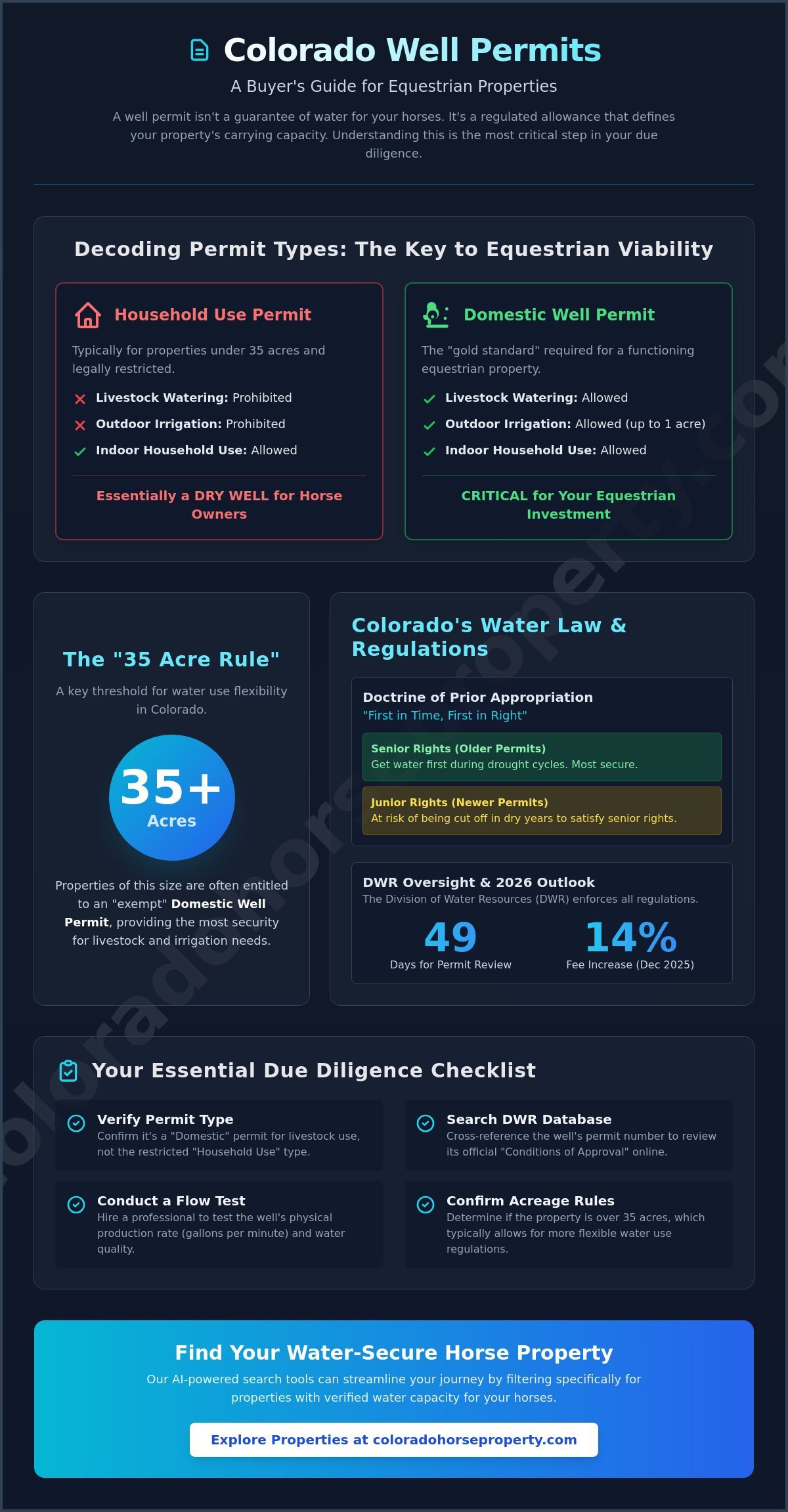
For 2026, buyers should prepare for a more rigorous administrative process. The DWR currently takes up to 49 days to review a complete residential well permit application. Additionally, permit fees have seen a significant upward trend. A 14% increase in various water-related fees took effect on December 31, 2025, with further adjustments possible by July 2026. The State Engineer’s office works closely with local water courts to adjudicate these rights, making the permit a strictly enforced legal document rather than a mere suggestion.
Why “Residential” Does Not Always Mean “Equestrian Ready”
Standard residential lots and equestrian estates have vastly different “water stress” profiles. A 3-bedroom home requires water for basic indoor needs. An equestrian property needs to support a herd that can consume hundreds of gallons of water daily, alongside the needs of wash racks and arena maintenance. If a buyer uses a domestic well beyond its permitted limits, they risk “overpumping.” This can lead to cease-and-desist orders, heavy legal penalties, or the complete revocation of the permit.
Securing the right well permits for equestrian properties CO requires looking beyond the house and into the fine print of the permit’s “Conditions of Approval.” To understand how water rights fit into the larger picture of land acquisition, consult our Equestrian Real Estate Colorado: A Complete Buyer’s Guide. Ensuring your permit matches your intended use is the only way to protect your investment and your animals.
Decoding Colorado Well Permit Types: Domestic vs. Household Use
Identifying the specific permit type attached to a parcel is the most important step in your property search. Many buyers assume any well provides enough water for a ranch, but Colorado law categorizes usage strictly. A Domestic Well is the gold standard for equestrian properties because it allows for livestock watering. If a permit doesn’t explicitly state “domestic” or “livestock,” you are likely looking at a restricted use case that could jeopardize your ability to keep animals on the land.
The “acreage rule” is a primary factor in permit classification across the state. Generally, properties that are 35 acres or larger are entitled to an “exempt” domestic well permit. This classification offers the most flexibility for horse owners. For smaller parcels, the Colorado Division of Water Resources often restricts water use to indoor purposes only, unless the property is part of a court-approved augmentation plan. Understanding these thresholds is essential when browsing our AI-powered horse property search, which helps you filter for land that meets your specific utility needs.
Household Use Only Permits: The Equestrian Deal-Breaker
The “Household Use Only” trap is a common pitfall for first-time ranch buyers. These permits are strictly limited to water use inside the primary dwelling. They forbid any outdoor use, including filling water troughs, washing down horses, or irrigating small pastures. These permits are frequently found in smaller subdivisions or “ranchettes” where water rights are more heavily allocated. Augmenting these permits to allow for outdoor livestock use is often a difficult and expensive legal process that requires purchasing additional water rights from an existing pool.
Domestic and Livestock Permits: The Equestrian Standard
A true domestic permit provides the legal security an equestrian estate requires. These permits typically allow for the watering of non-commercial domestic animals and the irrigation of up to one acre of home gardens and lawns. Most domestic wells are “Small Capacity,” which usually limits pumping to 15 gallons per minute. While this is sufficient for a private barn, you must verify the specific “Conditions of Approval” on the permit document to ensure there are no localized restrictions.
Land size dictates more than just your permit type; it impacts your entire management strategy. For a deeper look at how parcel size influences your water rights and infrastructure, see our Ultimate Guide to Buying Colorado Land in 2026. Whether you are looking for a high-capacity well for a commercial facility or a standard domestic well for a private hobby farm, verifying the permit type before the due diligence period ends is non-negotiable. Securing the right well permits for equestrian properties CO ensures your herd’s water supply remains legally protected for decades.
The Doctrine of Prior Appropriation and Your Horse Property’s Water Security
Colorado operates under a “First in Time, First in Right” system known as the Doctrine of Prior Appropriation. This means the person who first put water to a beneficial use has a senior right to that water. During a drought, senior holders get their full allocation before junior holders receive a single drop. For horse owners, this legal hierarchy is the difference between a reliable trough and a dry barn. When evaluating well permits for equestrian properties CO, you aren’t just buying land; you’re buying a spot in the state’s water queue.
The most critical date in Colorado water law is May 8, 1972. This date represents a massive shift in how wells are regulated. Wells permitted after this cutoff are generally subject to stricter priority rules unless they qualify as “Exempt Wells.” These exempt permits are a vital tool for rural land owners. They allow for specific uses, like watering livestock, while effectively bypassing the priority system. This means your ability to water your horses isn’t usually threatened by a senior user’s “call on the river,” provided you stay within the permit’s narrow scope. Understanding these nuances is key to long-term water security.
Understanding “Senior” Rights for Ranch Owners
Senior water rights act as an insurance policy against the unpredictable Colorado climate. If a property holds an adjudicated senior right, it has been legally recognized by a water court as having a specific priority date. This status protects your ability to maintain pastures and water your herd even when the local river basin is under stress. Because of this security, Colorado Ranches for Sale with established seniority often command a significant market premium. Buyers should always ask to see the decree from the water court to verify the priority date and the allowed volume of water during the due diligence period.
Augmentation Plans: The Solution for Junior Wells
Not every property has the luxury of senior rights. If a well is considered “Junior” and isn’t exempt, it may require an augmentation plan to operate legally. An augmentation plan is a court-approved system where the owner replaces the water they consume to ensure senior holders aren’t “injured” by the pumping. This often involves paying annual fees to a community association or a water conservancy district that manages a pool of replacement water. You can find more technical details on these requirements in the Colorado Division of Water Resources guide. Always verify if a property is already part of an existing plan before closing, as the cost of joining or creating one after the sale can be substantial.
Due Diligence: Verifying Water Capacity and Permit Validity Before Closing
The closing process for a ranch is far more technical than a suburban home sale. While a standard home inspection focuses on the roof and furnace, your equestrian due diligence must center on the well. Verifying well permits for equestrian properties CO requires a multi-step verification process to ensure the water is legally accessible and physically present. Relying on the seller’s word or a simple “the water is fine” statement is a high-risk strategy in 2026, especially with fluctuating water tables and stricter state oversight.
Follow these five steps to secure your investment during the inspection period:
- Step 1: Locate the Permit Number. Use the Colorado Division of Water Resources (DWR) search tool to find the official permit. This document outlines the depth, pump rate, and allowed uses.
- Step 2: Order a Professional Flow Test. This determines the current Gallons Per Minute (GPM) the well can sustain.
- Step 3: Conduct a Water Quality Test. Standard tests often miss equine-specific concerns. Test for nitrates, high mineral content, and bacteria that could impact long-term herd health.
- Step 4: Verify the Statement of Beneficial Use. Ensure the previous owner filed this document. Without it, the permit may not be “perfected,” leaving the water right vulnerable to cancellation.
- Step 5: Confirm the Transfer Process. Well permits are not automatically linked to the deed. You must ensure the correct paperwork is ready for the title and escrow phase.
Given that drilling a new well in Colorado now costs between $28 and $65 per foot, with average total costs reaching $10,500, verifying an existing well’s health is a financial necessity. If you need assistance navigating these technical records, our buyer representation services provide the expert oversight required to protect your ranch’s future.
The Flow Test: Gallons Per Minute (GPM) vs. Recovery Rate
A “4-hour flow test” is the minimum standard for equestrian due diligence. A quick 30-minute test only shows what is in the well casing; a longer test reveals the actual recovery rate of the aquifer. For a 10-horse barn, a flow rate of 5 to 10 GPM is generally considered the standard for supporting both household needs and livestock. Be wary of “drawdown” during the test. If the water level drops significantly and fails to recover quickly, it’s a warning sign of a dropping water table or a failing well casing, which are increasingly common issues in 2026.
Title and Escrow: Ensuring the Permit Moves with the Deed
Well permits do not always automatically transfer like a house key. In Colorado, the buyer must file a “Change of Ownership” form (GWS-11) with the DWR after closing. This form officially moves the permit into your name in the state database. If this step is missed, you may face administrative hurdles when trying to repair the well or renew the permit later. For more details on the logistics of these transactions, read our guide on Understanding Title and Escrow in a Ranch Sale. Ensuring the permit is correctly recorded is the final step in securing your equestrian legacy.
Expert Representation: Securing Your Equestrian Legacy with Colorado Horse Property
General real estate agents often prioritize the aesthetic appeal of a barn or the quality of the fencing, but they frequently overlook the technicalities of water law. This oversight can lead to catastrophic financial consequences if a buyer discovers after closing that their “Household Use” permit strictly forbids them from watering a single horse. At Colorado Horse Property, we treat well permits for equestrian properties CO as the primary variable in every transaction. Our approach combines decades of boots on the ground experience with advanced technology to ensure your investment is legally and physically sound.
We maintain a dedicated network of water attorneys and licensed well inspectors who specialize in ranch properties. These professionals help our clients interpret complex decrees and navigate the administrative requirements of the State Engineer’s office. By working with experts who understand the unique needs of livestock owners, you gain a layer of protection that a generalist agent simply cannot provide. We don’t just find you a property; we verify that the property can actually support your lifestyle.
AI-Powered Search for Water-Rich Properties
Our proprietary AI-powered search technology changes how buyers find land. Instead of sifting through thousands of irrelevant listings, our system analyzes data for specific water markers and DWR records. This allows us to identify “water-verified” properties that meet the specific needs of horse owners. Our technology filters for specific permit types and water rights seniority, giving you the benefit of seeing high-utility listings before they are picked over by the general market. This data driven approach removes the guesswork from the search process. Find your water-secure CO horse property today using our AI search tool.
The Realty Oasis Advantage: 40 Years of Colorado Expertise
Mark and Alison Eibner have spent 40 years navigating the intersection of Colorado land and water law. This longevity provides our clients with a distinct advantage, particularly in the Front Range and rural mountain communities where water scarcity is a constant reality. We understand that a “dry” property isn’t just a bad investment; it’s a dream that cannot be realized. Our commitment is to protect your equestrian legacy by ensuring every property we represent has the legal and physical water capacity to support your herd for generations to come. Contact Colorado Horse Property for expert buyer representation.
Secure Your Ranch’s Future with Expert Water Guidance
Success in the Colorado rural market depends on understanding that water is a legal asset as much as a physical one. You now know that distinguishing between Domestic and Household Use permits is the only way to ensure your horses are legally protected. By verifying priority dates and performing rigorous four-hour flow tests, you avoid the trap of buying a property that cannot support your herd’s daily requirements. Well permits for equestrian properties CO are the foundation of your investment, and getting the details right during due diligence is non-negotiable.
As a specialized division of Realty Oasis, we offer over 40 years of local expertise to guide you through these complexities. Our AI-powered search technology filters listings for verified water rights and niche equestrian features, giving you a competitive edge. Search Colorado Horse Properties with Verified Water Rights to partner with a team that understands the nuances of land and law. Your dream of a sustainable, water-secure ranch is waiting, and we’re here to help you secure it.
Frequently Asked Questions
Can I water my horses if my well permit says “Household Use Only”?
No, you cannot legally water horses with a “Household Use Only” permit. These permits are strictly for indoor use within a single-family dwelling. Using this water for troughs, pastures, or barn wash racks constitutes a violation of state law. If you need water for livestock, you must seek an augmentation plan or apply for a change in use through the State Engineer’s office, which can be a costly and uncertain process.
How many horses can I legally keep on a 35-acre property with a domestic well?
A domestic well permit on 35 acres or more typically allows for the watering of non-commercial domestic animals without a specific numerical limit on the horses themselves. However, the permit is intended for personal use rather than a large-scale commercial boarding operation. While the well permits for equestrian properties CO provide flexibility on large parcels, you must still adhere to local county zoning laws regarding livestock density per acre.
What is the difference between a “permitted” well and an “adjudicated” water right?
A well permit is a physical authorization to drill and pump water, while an adjudicated water right is a court-decreed priority date. A permit tells you how you can use the well today, but adjudication determines your place in the priority line during a drought. Most residential wells are “exempt” and don’t require adjudication, but larger ranching operations often seek court decrees to protect their long-term water security.
Does a well permit expire in Colorado if it is not used?
Yes, a well permit will expire if the well isn’t constructed within the timeframe specified on the permit, which is usually one or two years. For existing wells, the permit doesn’t expire simply from lack of use, but the water right itself could be subject to “abandonment” if it isn’t used for a long period. Always verify that a permit is “perfected” by checking for a filed Statement of Beneficial Use.
How do I find my well permit number on the Colorado DWR website?
You can locate your permit number by using the Colorado Division of Water Resources (DWR) online Well Permit Search Tool. You can search using the property’s physical address, the subdivision name and lot number, or the name of the original applicant. If the digital records are incomplete, you may need to contact the relevant DWR basin office to access historical paper files or microfiche records for older properties.
What happens if a neighbor’s new well causes mine to go dry?
If a neighbor’s pumping causes your well to fail, you may have legal recourse under the “injury” provisions of Colorado water law. Since the state follows the prior appropriation system, a new user cannot legally interfere with a senior user’s ability to access their water. Resolving these disputes usually requires a professional hydrogeologist to prove the connection and a water attorney to represent your interests in water court.
How much does it cost to drill a new well for a horse barn in 2026?
Drilling a new well in 2026 typically costs between $28 and $65 per foot. With the average Colorado well reaching a depth of 250 feet, the total cost often lands around $10,500. Keep in mind that these figures only cover the drilling and casing. You’ll also need to budget for the pump installation, pressure tank, and any necessary water lines to your barn or troughs, which can add several thousand dollars.
Is a cistern a viable alternative to a low-producing well for an equestrian property?
A cistern is an excellent supplemental tool for low-producing wells on horse properties. It acts as a storage buffer, collecting water slowly over 24 hours so you have a large volume ready for high-demand periods like morning feedings or arena grooming. While it doesn’t create new water, it makes a well that produces only 1 or 2 gallons per minute much more functional for a multi-horse facility.