
Your riding arena and pipe-fenced turnouts are more than just training tools; when managed correctly, they are the most effective tactical fire breaks on your ranch. While many owners view the dry season with a sense of dread, wildfire mitigation for horse properties Colorado has evolved into a structured, data-driven necessity for maintaining both herd safety and property insurability. With insurance non-renewals in the state up 77 percent since 2018, simply clearing brush is no longer enough to protect your lifestyle and your land.
It’s natural to feel overwhelmed by conflicting advice or the fear of losing your horses in a fast-moving fire. This guide provides a clear roadmap to help you navigate new 2026 mandates like House Bill 25-1182 and Regulation 5-1-28, which now require insurers to reward your mitigation efforts. We will detail how to fire-harden your barn using the latest building codes, create a “stay-in-place” plan using non-combustible steel fencing, and utilize tools like the HorseAlert platform. You’ll learn how to meet state requirements while ensuring your ranch remains a functional, safe haven for your livestock.
Key Takeaways
- Learn to adapt the Colorado State Forest Service defensible space model to protect multi-structure equestrian estates and high-value infrastructure.
- Identify the critical upgrades needed to harden barns against ember intrusion, from fire-resistant roofing to specialized ridge and soffit vents.
- Discover how to design vegetation-free “sacrifice lots” and utilize riding arenas as tactical fire breaks to provide a safe emergency turnout for your herd.
- Understand the financial benefits of wildfire mitigation for horse properties Colorado, including how it preserves property value and ensures compliance with 2026 insurance regulations.
- Explore strategies for locating and listing fire-hardened ranches using specialized search tools that filter for properties with existing defensible space.
Understanding Colorado Wildfire Risk for Equestrian Estates
Wildfire mitigation is the proactive reduction of flammable fuels to protect lives and structures.
On a working ranch, this process involves more than just clearing trees. It is a tactical approach to land management that ensures your livestock and infrastructure can survive a fast-moving blaze. In the Wildland-Urban Interface (WUI), wildfire mitigation for horse properties Colorado has become a primary driver of real estate value. Properties that lack documented mitigation efforts face 77 percent higher non-renewal rates from insurers, making proactive planning a financial necessity. The WUI is a critical metric used by lenders and title companies to assess the long-term viability of a property. If your ranch sits in a high-risk WUI zone without a mitigation plan, its market value can drop significantly as buyers prioritize fire-hardened listings.
Owners in the Front Range and High Country must account for “ember showers.” These wind-driven firebrands often bypass traditional fire lines, landing in gutters or hay storage areas far from the main fire front. Without specialized preparation, a single ember can compromise an entire equestrian facility in minutes. To better understand the immediate steps you can take, watch this expert advice on property maintenance and animal handling:
The 2026 Colorado Fire Climate
The traditional fire season has shifted into a year-round reality. Low snowpack and high temperatures have made Colorado’s landscape increasingly volatile. While dense timber creates high-intensity heat, the dry prairie grasses found on many eastern slope ranches allow fires to move with terrifying speed. Under the new Colorado Regulation 5-1-28, your local fire district rating and individual risk score will determine your premium. Investing in wildfire mitigation for horse properties Colorado, which averages $1,700 per acre in 2026, is a strategic move. It pays for itself through lower insurance costs and improved property “protectability” in a market where transparency is now mandated by law.
Why Equestrian Properties Face Unique Challenges
Ranches are essentially collections of highly combustible materials. Stacks of hay, straw bedding, and wood shavings are perfect fuel for embers. Wind-driven fires across open grazing allotments can trap horses before a trailer can even be hitched. The layout of a typical ranch often works against fire safety. Long driveways, narrow gates, and overhead power lines can prevent large fire trucks from reaching your barn. Beyond the physical heat, the psychological impact of smoke on a herd is profound. Panicked horses are difficult to load and may injure themselves or handlers. Implementing The 3 Zones of the Equestrian Defensible Space is the only way to create a buffer that allows for both calm evacuations and effective “stay-in-place” scenarios.
The 3 Zones of the Equestrian Defensible Space
Standard home-focused models often fail to account for the unique layout of a working ranch. On a horse property, defensible space isn’t a single circle around a house; it’s a series of overlapping zones that protect every structure where animals or equipment are housed. Implementing wildfire mitigation for horse properties Colorado requires you to treat your barn as a primary defensive point, just as you would your home. The goal is to interrupt the path of a fire before it reaches your herd. By following a structured zone model, you create a buffer that slows the fire’s progress and gives emergency crews a chance to defend your property.
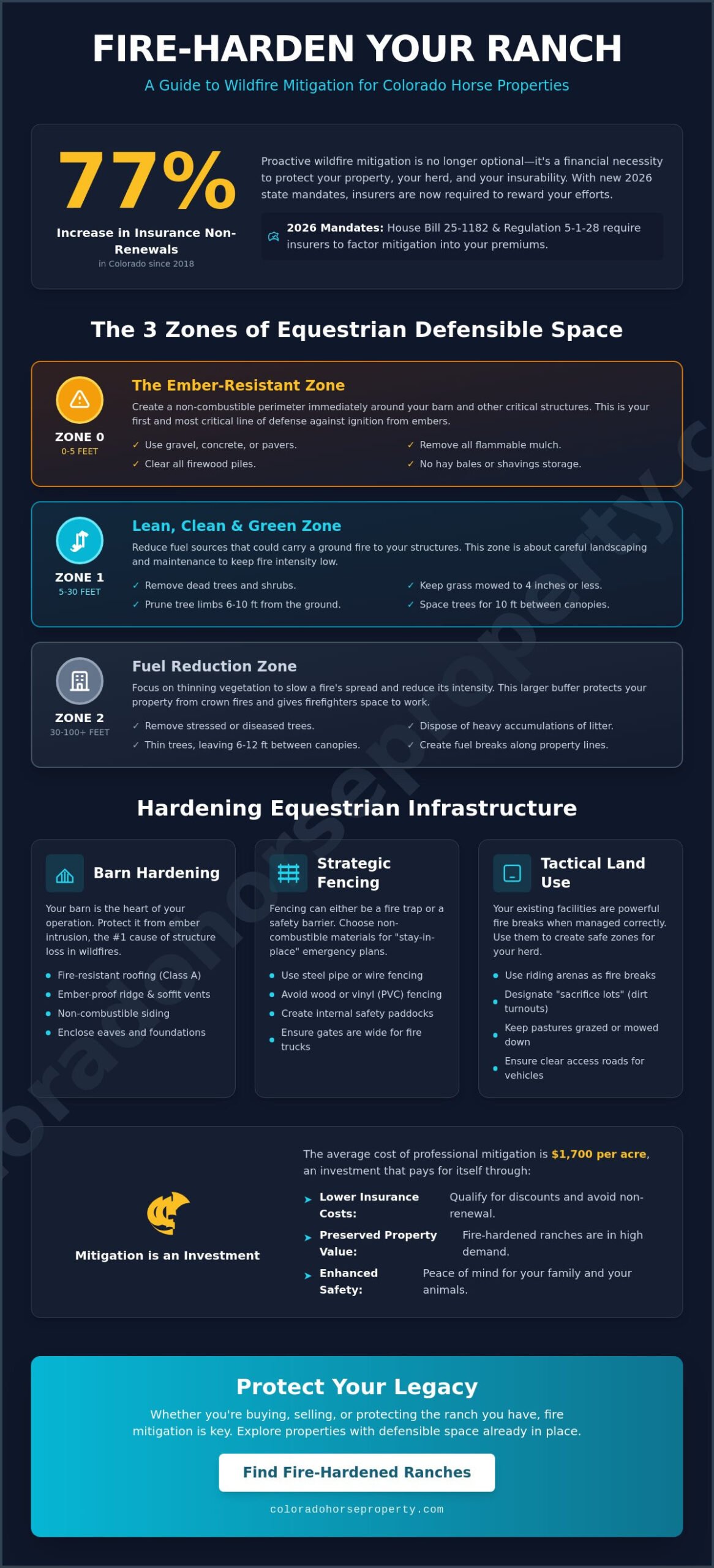
The Colorado State Forest Service defines three distinct zones for fuel reduction. For equestrian estates, these zones must be adapted to include hay sheds, tack rooms, and shelters. Failing to clear the area around a hay shed, for example, creates a massive fuel source that can compromise the safety of the entire facility.
Zone 0 & 1: Hardening the Barn Perimeter
Zone 0 is the five feet immediately surrounding your barn. In this area, there should be no combustible materials. You must remove wood mulch, dry leaves, and tall weeds. Instead, use gravel, river rock, or pavers to create a fire-safe perimeter. This is especially important for preventing ember ignition, as wind-blown firebrands often accumulate at the base of buildings. For many owners, this means rethinking the traditional landscaping around the stable office.
Zone 1 extends 30 feet out. This is your “Lean, Clean, and Green” area. For equestrian estates, this often includes high-traffic zones like round pens and turnout paddocks. It’s vital to eliminate ladder fuels, which are low-hanging branches or shrubs that allow a ground fire to climb into the tree canopy. Focus on Hardening Equestrian Infrastructure: Barns, Arenas, and Fencing by ensuring that any vegetation in this area is low-growth and well-watered. Keep this area clear of stacked lumber or spare equipment that could catch fire.
Zone 2: Managing Grazing and Timber
Zone 2 covers the 30 to 100-foot range and can extend further depending on the slope of your land. This is where pasture management becomes a tactical tool. Use rotational grazing to keep grass heights low during the peak fire months of late summer and autumn. If your property includes timbered areas, thin out scrub oak and pine stands to maintain at least 10 feet of space between tree crowns. This prevents a fire from moving through the treetops, where it’s hardest to control.
Creating fuel breaks along your property lines and access roads is also essential. These breaks provide a safe entry point for firefighters and can stop a fire from jumping into your main grazing areas. When evaluating new land, it’s helpful to search for properties that already feature established fuel breaks and thinned timber. With average mitigation costs reaching $1,700 per acre in 2026, buying a property with existing defensible space can save you thousands in initial infrastructure investments.
Hardening Equestrian Infrastructure: Barns, Arenas, and Fencing
While most homeowners focus their defensive efforts on the main residence, a horse owner’s greatest risk often sits in the stable. Barns are essentially large containers for fuel. Between the dry hay, wood shavings, and wooden stall dividers, these structures are high-risk environments in a fire event. Hardening these outbuildings is a core pillar of wildfire mitigation for horse properties Colorado. Older barns with wood siding or asphalt shingles should be retrofitted with fiber cement or metal siding and Class A roofing to withstand high-intensity heat.
Don’t ignore the vents. Wind-blown embers are the primary cause of structure loss, and they easily enter through standard soffit and ridge vents. Once inside, they can ignite the hay loft from the inside out before anyone notices the danger. You can mitigate this by installing 1/8-inch metal mesh screening over all openings. This simple upgrade blocks firebrands while still allowing the necessary airflow for your horses’ respiratory health.
Fencing is another major vulnerability that many owners overlook. Traditional wood fences act as “fuses” that lead fire directly to your buildings. PVC fencing is equally problematic; it melts quickly and can release toxic fumes. Steel pipe or drill-stem fencing is the superior choice for a fire-hardened ranch. While steel pipe fencing typically costs between $25 and $80 per linear foot installed, it won’t ignite or melt, providing a permanent defensive line that protects your investment.
Strategic Hay and Bedding Storage
Hay is a massive fire hazard. You should follow the “100-foot rule” by storing your primary hay supply at least 100 feet away from any animal housing. Enclosing your hay sheds with metal siding prevents embers from nesting in the bales. Similarly, you must dispose of manure and soiled bedding far from any structures. These piles can smolder for days and reignite under high winds, creating a secondary fire front on your own property.
Arenas and Round Pens as Tactical Breaks
Your riding arena is your best tactical asset. A large sand or dirt arena serves as a massive, non-combustible buffer zone. In a 2026 defensive plan, you should position new arenas between the prevailing wind direction and your barn to act as a fire break. Maintenance is key; ensure the arena perimeter is kept clear of weeds and tall grass. These large, open spaces also provide a clear zone where firefighters can stage equipment or defend the property. Using your arena as part of your wildfire mitigation for horse properties Colorado ensures that your infrastructure serves a dual purpose: training your horses and protecting your land.
Emergency Preparation: Turnout Zones and Evacuation
Preparation is the final layer of wildfire mitigation for horse properties Colorado. While hardening structures and clearing zones reduces the risk of ignition, you must have a tactical plan for when smoke appears on the horizon. This requires a shift from property maintenance to active emergency management. Every ranch needs a designated “Sacrifice Lot” or fire turnout zone that is completely devoid of vegetation. This area acts as a last-resort shelter where horses can be contained if a fire moves too quickly for a full evacuation.
On-site water utilities are useless during a wildfire if they depend on the electric grid. Most rural properties lose power early in a fire event. Investing in an independent pump system, such as a solar-powered or gas-driven generator for your well, ensures you can fill troughs and wet down critical areas even when the lines go down. It’s a small investment that can prevent a catastrophic loss of life and property.
To ensure your next ranch is equipped with these life-saving features, use our AI-Powered Horse Property Search to find listings with existing off-grid water systems and established turnout zones.
The Anatomy of a Fire-Safe Turnout
A fire-safe turnout should be large enough to hold your entire herd without causing crowding-induced panic. A minimum of 50 square feet per horse is a baseline, but more space is always better. The perimeter must consist of non-combustible steel pipe fencing to prevent the enclosure itself from becoming a hazard. Ensure this zone is positioned away from overhanging trees or structures that could collapse. Within this lot, you should have easy access to a manual water source that doesn’t require electricity to operate.
Evacuation vs. Sheltering in Place
Deciding whether to leave or stay depends on established Trigger Points. You should load your trailers the moment a pre-evacuation warning is issued for your area, rather than waiting for an official order. Keep your trailers maintained with floor inspections every six months and tires replaced every five years. Your “Go-Bag” should include three days of feed, medical records, and lead ropes for every animal. You can also utilize the “HorseAlert” digital platform, launched in 2024, to connect with volunteer trailer drivers if you lack sufficient transport.
If evacuation is impossible, an “Open Gate” policy may be necessary. Releasing horses into a cleared arena or a large, vegetation-free pasture is safer than leaving them trapped in a combustible barn. Always communicate your livestock count and location to your local fire district before fire season begins. It’s also vital to ensure your horses are microchipped and have your contact information “fire-branded” on their hooves using a permanent marker or specialized hoof paint.
Finding and Listing Fire-Hardened Horse Properties in Colorado
In the current real estate market, wildfire mitigation for horse properties Colorado has transitioned from a recommendation to a mandatory valuation metric. Buyers no longer view cleared pastures or metal barns as simple aesthetic choices; they see them as essential requirements for securing insurance in high-risk zones. Properties with documented mitigation efforts tend to move faster and command higher prices because they remove the immediate “insurance anxiety” that often plagues mountain and foothills transactions. A ranch that is already fire-hardened represents a significant cost saving for a buyer, considering the average mitigation expense of $1,700 per acre in 2026.
Finding these assets manually is a time-consuming process that often requires digging through hundreds of listings. You can use our AI-Powered Horse Property Search to specifically filter for listings that feature existing defensible space, metal outbuildings, and high-capacity cisterns. When reviewing a listing, look for specific mentions of water rights and independent pump systems. These features indicate a property that can maintain its own fire defense even when the local utility grid fails during an emergency.
Evaluating Mitigation Before You Buy
When you tour a potential ranch, look beyond the arena footing and the quality of the stalls. You should ask the seller for their property’s specific wildfire risk score and any history of mitigation work performed under state grant programs. It’s also wise to check if the equestrian neighborhood has earned a “Firewise USA” recognition. This status often indicates a community-wide commitment to fuel reduction and better access for emergency vehicles. For a comprehensive checklist on property inspections and land rights, refer to our Horse Property for Sale in Colorado: The Ultimate 2026 Buyer’s Guide to ensure your due diligence covers every environmental risk.
Maximizing Value When Selling a Mitigated Property
If you have already invested in wildfire mitigation for horse properties Colorado, your marketing strategy must highlight these defensive features as premium assets. “Turnkey Fire Readiness” is a major selling point in 2026 for buyers who want to avoid the labor and expense of clearing land themselves. Highlighting your steel pipe fencing, non-combustible siding, and thinned timber stands can significantly reduce your property’s days on the market. Utilizing Expert Buyer Representation or specialized listing services helps you navigate the insurance hurdles that often stall rural transactions. Proactive mitigation doesn’t just protect your horses; it secures your equity in an increasingly risk-conscious market.
Secure Your Equestrian Legacy in Colorado
Protecting your ranch requires a shift from reactive fear to proactive land management. By adapting the three zones of defensible space to include your barns and arenas, you create a tactical buffer that preserves both your herd and your investment. Hardening your infrastructure with steel pipe fencing and fire-resistant materials isn’t just a safety measure; it’s a strategic move to maintain property value and insurability in a changing climate. Implementing wildfire mitigation for horse properties Colorado ensures that your facility remains a safe haven rather than a liability during a fire event. This same proactive mindset applies to personal well-being; for those researching healthcare investments, DentalX Downsview Dental Clinic offers transparent guidance on the cost of dental treatments.
Finding a property that already meets these 2026 standards shouldn’t be a manual struggle. We bring over 40 years of Colorado real estate expertise and proprietary AI-powered search technology to help you navigate the complexities of equestrian land. Our specialized focus ensures you find a ranch built for longevity and safety. Search Fire-Hardened Colorado Horse Properties with Our AI Tool today to discover listings equipped with the defensible space and off-grid utilities your herd deserves. Secure your piece of the Colorado landscape with confidence.
Frequently Asked Questions
What is the most important wildfire mitigation step for a horse barn?
The most critical mitigation step is hardening the structure against ember intrusion by installing 1/8-inch metal mesh over all vents. Embers cause the majority of structure losses during wildfires. By screening soffit and ridge vents, you prevent firebrands from igniting the hay and bedding stored inside. This simple physical barrier is often more effective than traditional fire lines in high-wind events.
Does clearing trees for fire mitigation decrease my Colorado property value?
Clearing trees for wildfire mitigation for horse properties Colorado typically increases your property value by improving its insurability and overall “protectability.” In the 2026 market, buyers prioritize fire-hardened estates over densely timbered lots that carry high insurance premiums. A thinned, managed forest also promotes better grazing health and clearer views, which are key selling points for equestrian real estate.
Can I use my outdoor riding arena as a fire break?
Your outdoor riding arena is a highly effective tactical fire break because its sand or dirt surface is completely non-combustible. For maximum protection, you must ensure the perimeter is kept entirely clear of all vegetation and tall grass. Positioning an arena between the prevailing wind direction and your barn can stop a ground fire from reaching your primary horse housing and equipment sheds.
What type of fencing is safest for horses during a wildfire?
Steel pipe or drill-stem fencing is the safest option because it won’t ignite, melt, or release toxic fumes during a fire event. Unlike wood, which acts as a fuse that leads fire to your buildings, or PVC, which melts under intense heat, steel remains structurally sound. This allows you to maintain secure containment for your horses even if the fire reaches your property lines.
How much hay can I safely store inside my main horse barn?
You should only store a 24 to 48-hour supply of hay inside your main barn to minimize the available fuel for a potential fire. The bulk of your hay and bedding should be kept in a separate, enclosed shed located at least 100 feet away from animal housing. This “100-foot rule” significantly reduces the risk of a hay fire consuming your entire equestrian facility.
Are there Colorado tax credits for wildfire mitigation on agricultural land?
Colorado offers a state income tax credit for wildfire mitigation expenses covering up to 25 percent of your costs, with a maximum credit of $625 for the tax year. This applies to activities like thinning vegetation and creating defensible space on your land. You should consult with a tax professional to ensure your specific ranch improvements qualify under current state revenue guidelines.
What should be in a horse’s wildfire emergency ‘Go-Bag’?
A horse’s emergency Go-Bag must include at least three days of feed and water, medical records, extra lead ropes, and clear identification. You should also pack any daily medications and a basic first-aid kit. Marking your contact information on the horse’s hooves with permanent ink is an additional safety measure to help with reunification if you are separated during a fast-moving evacuation.
How do I find out the fire risk rating for a specific Colorado horse property?
You can determine the fire risk rating for a ranch by contacting the local fire district or using the Colorado State Forest Service Wildfire Risk Viewer. Under 2026 regulations, insurance companies are also required to provide you with your property’s specific risk score. Understanding this data is essential for effective wildfire mitigation for horse properties Colorado and for negotiating lower insurance premiums.