
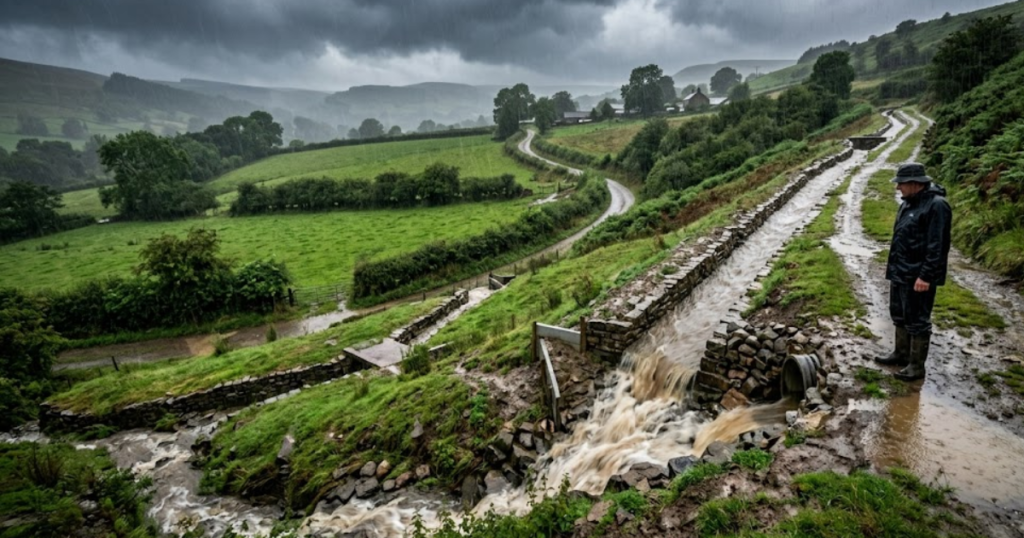
You enjoy a beautiful, warm July morning on your new farm. Around 2:00 PM, massive dark clouds roll over the Front Range, and the sky opens up into a classic, blinding summer monsoon downpour. Within ten minutes, the hillside behind your barn turns into a sheet of rushing water.
Because there is no drainage infrastructure to intercept the flow, the water shoots straight into your lower paddocks. It blasts through the pipe fencing, completely washes away $4,000 worth of premium crushed-stone footing, and leaves your horses standing hock-deep in a toxic mix of muddy runoff and flooded manure.
When searching for horse properties colorado buyers love, it is easy to evaluate a property on a dry, sunny day. But in the West, you have to buy a property based on how it handles its worst weather. Late-summer monsoons bring a staggering amount of water in an incredibly short window, and if the property isn’t engineered to handle flash runoff, your lower paddocks will pay the price.
Here is how to evaluate a property’s monsoon defenses and drainage systems before you make an offer.
How Does the Property Channel Sudden, Intense July/August Monsoon Downpours Without Flooding the Lower Paddocks?
Quick Summary: The Flash Flood Defense
- The Monsoon Surge: In late summer, Colorado frequently experiences intense afternoon monsoons that dump inches of rain in a matter of minutes. On a horse property, this sudden volume of water will relentlessly seek the lowest point on the land.
- The Lower Paddock Trap: If your barn or primary paddocks sit at the bottom of a slope without a drainage diversion system, they will instantly transform into a soup of mud, manure, and standing water, exposing your horses to thrush, scratches, and rain rot.
- The Swale and Berm Solution: Premium properties utilize engineered topography, like shallow, grass-lined ditches, swales, and raised dirt ridges, berms, to intercept sheet-flow runoff uphill and route it safely around the livestock infrastructure.
- The Culvert Calculus: Driveway crossings and pasture gates require heavy-duty steel or HDPE plastic culvert pipes. If these pipes are undersized or choked with spring debris, they will back up, causing a localized dam break that washes out your expensive arena or paddock footing.
A property that looks perfect in dry weather can fail badly under a short, violent storm if runoff routing, footing, and drainage infrastructure were not engineered correctly.
1. The Power of Swales, Berms, and French Drains
A property with good drainage does not try to stop the water. It politely escorts it somewhere else.
- The Interception Swale: Look at the high side of the barn and paddocks. Is there a wide, shallow, gently sloping ditch dug into the hillside? This is a swale. Its job is to catch heavy sheet-flow water rushing down the slope and channel it horizontally away from your livestock structures.
- The Protective Berm: Working in tandem with a swale is a berm, a compacted ridge of dirt placed on the downhill side of the ditch. Think of it as a small levee that ensures overflowing water cannot jump the ditch and head toward your stalls.
- The French Drain Grid: In tight spaces between barns or near arena gates, look for gravel-filled trenches with perforated pipes beneath the surface. These French drains capture subsurface saturation and quickly dump it into a safe drainage basin before it can bubble up and turn your high-traffic zones into a bog.
2. Sizing Up Culverts and Catch Basins
If the property uses pipes to route water beneath driveways or fences, size absolutely matters.
- The Diameter Dilemma: Many DIY property owners install cheap, 8-inch or 12-inch plastic culvert pipes under pasture gates to save money. During a severe August monsoon, these tiny pipes are instantly overwhelmed by water and debris. They clog, water backs up, and the resulting mini-flood will wash out your driveway or gate access.
- The 18-Inch Standard: A professionally engineered rural property will feature heavy-duty galvanized corrugated steel or dual-wall HDPE plastic culverts that are at least 18 to 24 inches in diameter. These massive pipes have the capacity to handle sudden surges without blowing out.
- Flared End Sections and Rip-Rap: Look at the mouth of the culvert pipes. Premium installations feature flared metal ends and a bed of heavy, jagged rocks, rip-rap. The rocks slow down the roaring water as it exits the pipe, preventing it from eroding the soil and carving deep, dangerous ruts into your pastures.
Culverts need enough diameter, proper outlet protection, and ongoing debris management. A small undersized pipe can become the weak point that causes the entire runoff system to fail.
3. Footing Architecture in the Lower Paddocks
Even with great swales, some water will always find its way into your lower turnouts. How those paddocks are built determines how fast they recover.
- The Native Clay Trap: If the lower paddocks are just native Colorado clay soil, they are a ticking time bomb. Clay acts like a sponge, holding onto moisture for weeks, creating deep, dangerous mud holes that pull shoes off horses and breed fungal hoof infections.
- The Layered Pad System: A flood-resilient paddock is built with layers. The topsoil is excavated, replaced with a highly compacted sub-base of coarse road-base gravel, topped with a layer of heavy geotextile fabric to prevent shifting, and finished with 4 inches of angular coarse sand or pea gravel. This allows water to drain straight down through the footing and exit laterally, leaving the surface firm and dry within an hour of the storm passing.
- The Slope Percentage: As covered in our previous guides, your lower paddocks should still maintain a subtle 1% to 2% grade. Completely flat ground holds water; a slight slope keeps it moving safely toward the property’s main drainage channels.
4. Evaluating the Regional Watershed and Creeks
When looking at Colorado horse ranches for sale, you must look beyond your own fences to see where your water eventually goes.
- The Seasonal Creek Danger: If your lower paddocks border a seasonal creek or dry arroyo, understand that these features can go from a dry bed of gravel to a raging, deep river in a matter of fifteen minutes during an August storm.
- The Historic High-Water Mark: Look closely at the trees and vegetation along any natural waterways on the property. Look for lines of dead sticks, debris caught high up in bush branches, or eroded banks. This shows you exactly how high the water rose during previous monsoon seasons, helping you determine if your lower fences and structures are safely out of the flash-flood zone.
We Analyze the Hydrology Before You Buy
We do not just look at the dry soil; we calculate how the water flows when the clouds break.
When our team represents you in your search for the perfect equestrian property, we bring specialized, practical knowledge of Western land management to the table. We evaluate pasture grades, inspect culvert networks, and map out the entire watershed flow of the estate. We want to ensure that when the summer monsoons hit, your barn stays dry, your footing stays put, and your horses stay safe.
Contact Us Today to find premium horse properties Colorado buyers trust for exceptional engineering, drainage, and structural integrity.
Browse Active Colorado Horse Properties: Browse active Colorado horse ranches for sale or ask our team about finding a premium horse property for rent Colorado featuring expertly designed flood-mitigation infrastructure
Frequently Asked Questions (FAQ) About Pasture Drainage
Can I use standard wood chips or cedar mulch to fix a muddy, flooded lower paddock?
No, this will actually make the problem worse over time. While wood chips offer a temporary dry cushion, they are organic materials that rapidly decompose when soaked. Within one season, the rotten wood will blend with the wet clay and manure, creating an even deeper, slicker, and more toxic mud paste that is incredibly difficult to clean out.
Does the county restrict where I can divert my property's stormwater runoff?
Yes, absolutely. Under Colorado drainage law, you cannot alter your land in a way that intentionally dumps a concentrated, unnatural volume of water onto your neighbor’s property or into a public county road ditch without permission. Your drainage swales must route water into natural, existing historic waterways or designated on-site retention ponds.
How do I prevent my outdoor riding arena from washing away during a monsoon?
An outdoor arena should always be built on a slight crown or a continuous 1% slope, and it should be surrounded by a dedicated exterior interceptor ditch. This ensures that water running off the surrounding hillsides is deflected around the arena fence line, rather than cutting across your expensive sand and fabric footing.