
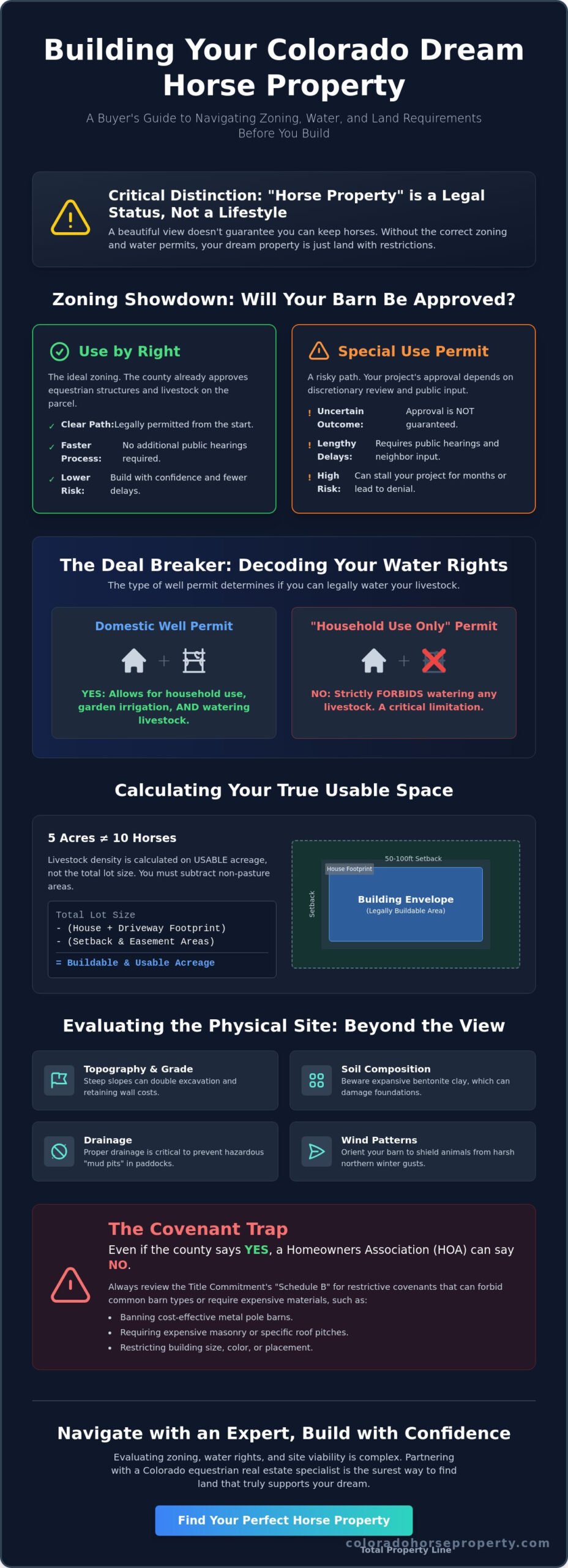
In Colorado, “horse property” is a legal status, not just a lifestyle. You might find a beautiful five-acre lot in the Front Range, but without the right zoning and specific water permits, you can’t legally keep a single horse or break ground on a stable. Finding horse property with room to build a barn Colorado requires a zoning-first strategy that looks far beyond the mountain views. It’s discouraging to find a perfect plot only to realize it’s restricted by an opaque HOA covenant or a “household-only” well permit that forbids livestock watering. You deserve a property that actually supports your goals.
This guide shows you exactly how to identify and secure land that meets every physical and regulatory requirement for your project. We’ll break down the 2026 water well rules and explain why the new 25% agricultural tax assessment rate matters for your long-term budget. You’ll learn how to evaluate building envelopes on difficult topography and confirm horse-count allowances before you ever sign a contract. From navigating House Bill 1340’s revegetation requirements to securing valid water rights, you’ll gain the expert knowledge needed to build your dream barn with total confidence.
Key Takeaways
- Identify the difference between “Use by Right” and “Special Use Permits” to confirm your barn and arena are legally permitted.
- Analyze site topography and soil health to ensure a stable building envelope and proper paddock drainage.
- Differentiate between “Household Use Only” and “Domestic” well permits to guarantee you have the legal right to water your livestock.
- Simplify the process of finding horse property with room to build a barn Colorado by using AI-powered search filters tailored to unimproved land.
- Understand the value of specialized buyer representation when evaluating complex zoning and water rights in the Front Range.
Navigating Zoning and Covenants for Colorado Horse Barns
Finding horse property with room to build a barn Colorado starts with a legal deep dive, not a walk through the pasture. You must first distinguish between “Use by Right” and “Special Use Permits.” Use by Right means the county already approves equestrian structures and livestock on that specific parcel. If a property requires a Special Use Permit, you’ll face public hearings and neighbor input before you can even pull a building permit. It’s a risky path that can stall your project for months. County boundaries also dictate your daily life. Weld County generally offers more lenient livestock density rules than Douglas County, where suburban sprawl has led to tighter regulations on animal units and manure management.
Always prioritize land in unincorporated areas. Properties within city limits are often subject to municipal codes that forbid large outbuildings or limit horse counts to a single animal regardless of acreage. To see how a well-positioned property looks in a prime equestrian area, watch this walkthrough of a Black Forest site:
To better understand this concept, watch this helpful video:
Understanding Animal Units and Setback Requirements
Most Front Range counties use a point system called “Animal Units” to regulate livestock. A standard horse usually counts as one unit. If a property is zoned for two units per acre, a five-acre lot doesn’t automatically mean you can keep ten horses. You must subtract the acreage used by the house and driveway first. Setback requirements also shrink your usable space. These rules mandate that barns must be a specific distance, often 50 to 100 feet, from property lines and existing wells. The building envelope is the legally buildable portion of a lot that remains after all setbacks, easements, and environmental restrictions are applied. If your envelope is too small or sits on a steep grade, your barn project might be dead on arrival.
Identifying Restrictive Covenants Before You Buy
The biggest threat to your equestrian dream is the “Covenant Trap.” Even if the county says yes, a Homeowners Association (HOA) can say no. When reviewing horse property for sale in colorado, your first step is requesting the Title Commitment. Scan the “Schedule B” exceptions for restrictive covenants. Some HOAs allow horses but forbid the “metal pole barns” that are most cost-effective to build. They might require expensive masonry or specific roof pitches to match the main residence. This legal landscape is as complex as Colorado’s prior-appropriation water rights, and overlooking a single line in the bylaws can result in a permanent ban on your planned stable.
Evaluating Topography and Soil for Your Building Site
Finding horse property with room to build a barn Colorado often reveals a harsh reality: truly flat land is a rare luxury in the Front Range. Most available acreage features rolling hills or significant slopes that complicate construction. If you choose a site with a steep grade, your excavation and retaining wall costs can easily double before the first post is set. Beyond the slope, you must account for Colorado’s expansive soils, specifically bentonite. This clay-heavy soil expands when wet and shrinks when dry, exerting massive pressure on foundations. Without a site-specific engineered slab or deep piers, a new barn will likely suffer from shifting floors and jammed stall doors within a few seasons.
Proper drainage is your best defense against the “mud pit” scenario that plagues poorly planned paddocks. Standing water is more than an eyesore; it’s a health hazard for horses, leading to hoof rot and skin infections. High-plains wind patterns also dictate your barn’s orientation. Positioning your structure to shield the interior from northern winter gusts and western Chinook winds ensures both animal comfort and structural longevity. To ensure your chosen lot can actually support these infrastructure needs, you can consult with an equestrian land specialist to evaluate the terrain before making an offer.
Slope Analysis and Excavation Logistics
Safe horse arenas and barn pads require a grade of less than 2% to prevent erosion while allowing for subtle water runoff. Evaluating a property requires checking more than just the building site; you must assess the access route for heavy machinery. If a concrete truck or semi-trailer carrying lumber cannot safely navigate the driveway, your build costs will skyrocket due to specialized transport fees. Southern exposure is critical for winter ice melt in CO, as it ensures paddocks and barn entrances clear quickly after a heavy snow.
Soil Quality for Pasture and Infrastructure
Distinguish between “rangeland” and “irrigated pasture” early in your search. Rangeland relies on natural precipitation and supports fewer animals per acre, while irrigated pasture requires documented water rights under Colorado’s Prior Appropriation System to maintain grass levels. If your barn plans include a wash rack or bathroom, you’ll need a percolation (perc) test to confirm the soil can handle a separate septic system. Deciding between horse barns for sale and building from scratch depends heavily on these site-specific soil conditions.
The Critical Role of Colorado Water Rights and Well Permits
Water is the single most common deal-breaker when finding horse property with room to build a barn Colorado. Approximately 18% of Colorado households rely on domestic wells, yet many buyers assume that any rural lot comes with the right to water livestock. This is a dangerous mistake. In Colorado, water is a private property right, and your ability to use it is strictly governed by the type of permit attached to the land. If you purchase a lot with a “Household Use Only” permit, you’re legally barred from watering horses, washing out stalls, or even irrigating a small paddock. These permits restrict water use to inside the primary residence only.
To legally support an equestrian lifestyle, you must secure a property with a “Domestic” well permit. This permit type explicitly allows for the watering of domestic animals and livestock. Recent updates to Colorado well water rules (2 CCR 402-2), effective January 1, 2026, have increased the scrutiny on these permits. You’re now required to post a copy of the permit at the well site during any maintenance or drilling work. In many newer subdivisions within water-scarce basins, you might also encounter “Augmentation Plans.” these are court-approved plans that allow well pumping only if the owner “replaces” the water consumed to protect senior water rights holders. When evaluating larger ranches for sale colorado, verifying these senior shares is a mandatory step in your due diligence process.
Decoding Your Well Permit for Livestock Use
You can look up any existing permit number on the Colorado Division of Water Resources (DWR) website to verify its allowed uses. Look specifically for “exempt” status, which is common on parcels 35 acres or larger and typically allows for livestock watering. Non-exempt wells are more restricted and often tied to specific court decrees or augmentation requirements. A Domestic Well is the gold standard for buildable horse property because it provides the legal certainty needed to sustain your animals through dry Colorado summers.
Water Storage and Hauling as a Backup Strategy
In arid regions of the Front Range, even a legal well might have a low flow rate. Many owners install large cisterns to store thousands of gallons of water, ensuring there’s enough pressure for barn wash racks and automatic waterers during peak use times. If a well’s production is insufficient, you must evaluate the proximity of local water fill stations for hauling. Understanding these logistical hurdles is a fundamental part of navigating equestrian real estate Colorado. You don’t want to discover your water limitations after the barn foundation is already poured.
Strategic Search: Using AI to Find Room to Build
Modern technology has transformed how you hunt for land. Finding horse property with room to build a barn Colorado no longer requires driving every dirt road in Weld or Douglas County. AI-powered search tools can now identify “unimproved” parcels that possess high equestrian potential but haven’t been marketed as such. By filtering for specific acreage ranges, you ensure there’s sufficient space for a primary residence, a septic system, and a 4-stall pole barn. Satellite overlays allow you to visualize existing clearings and access roads from your laptop, highlighting buildable spots that aren’t visible from the street.
You should also set highly specific alerts for “Back on Market” properties. In the complex Colorado market, these listings often reappear when a previous buyer’s building plans failed due to misunderstood zoning or water issues. While this sounds like a warning, it’s often an opportunity for a buyer with better representation. If the previous failure was due to a specific structural requirement you don’t need, you might find a discounted gem. To start your own targeted hunt, explore our AI-powered horse property search tool today.
Advanced Filtering for Equestrian Infrastructure
Effective searches use tags like “Level” or “Gently Sloping” to avoid the high excavation costs mentioned earlier. You should prioritize “No HOA” filters to maximize your building freedom and avoid the material restrictions common in planned developments. AI tools can now cross-reference land for sale in colorado with county-level zoning maps to instantly flag parcels that allow for the animal units you require.
The Value of Local Knowledge in the Digital Hunt
Automated Valuation Models (AVMs) are notoriously inaccurate for equestrian land because they can’t account for the value of a domestic well or the quality of rangeland soil. A general algorithm sees five acres; it doesn’t see the $22,000 average cost of a new well or the 17.5% increase in water permit fees scheduled for July 2026. This is where an equestrian agent becomes vital. They verify buildability and confirm that “Water Shares Included” actually means what it says before you spend time on a site visit. AI speeds up the search for properties with documented water rights, but the human expert confirms the legal reality.
Partnering with Colorado Equestrian Real Estate Experts
Finding horse property with room to build a barn Colorado involves more than just a real estate transaction; it’s a technical acquisition. A generalist agent might understand residential square footage, but they rarely grasp the nuances of animal units, setback requirements, or the legal priority of water decrees. Specialized buyer representation is non-negotiable when you’re evaluating unimproved land for its buildable potential. You need a partner who can look at a topography map and predict excavation hurdles or read a title commitment to spot hidden equine prohibitions before you ever reach the closing table.
The Colorado Horse Property team brings 40 years of Front Range experience to your search. We’ve navigated the complexities of Colorado land use through decades of regulatory shifts, providing a seasoned perspective that protects your long-term investment. Our expertise extends through the entire lifecycle of the deal, from initial site evaluation to professional transaction management. We handle the intricacies of title and escrow services to ensure that when you finally take ownership, your right to build a barn and keep livestock is legally secured and documented.
Beyond the paperwork, we bridge the gap between finding land and breaking ground. We maintain a network of local barn builders, excavators, and land use consultants who understand the specific challenges of Colorado’s expansive soils and climate. This collaborative approach ensures that your vision for a dream stable doesn’t stall due to a lack of reliable contractors or misunderstood county codes.
Full-Cycle Brokerage for the Equestrian Lifestyle
Mark and Alison Eibner specialize in identifying hidden gem properties that other buyers often overlook. By combining deep local roots with our proprietary AI search tool, we give you a distinct competitive edge in the 2026 market. This technology allows us to filter for specific land features and zoning potential across all types of colorado land. We don’t just find listings; we provide the data-driven insights you need to make a confident offer on land that actually supports your goals.
Next Steps: Starting Your Search for Room to Build
Your first step is requesting a buildable land consultation tailored to your target Colorado county. During this process, we’ll review your specific barn requirements and help you understand the current lending landscape. You should check with specialized lenders to see how to get pre-approved for land and construction loans, as these products differ significantly from standard residential mortgages. Securing the right financing is a critical hurdle that requires a clear plan for both the property and the planned improvements. Don’t leave your equestrian dream to chance in a competitive market. Start your AI-powered search for buildable horse property today and leverage four decades of specialized expertise.
Securing Your Colorado Equestrian Legacy
Navigating the Colorado land market requires a shift from browsing aesthetics to verifying technical data. You now understand that a successful build depends on securing a domestic well permit and confirming that county zoning aligns with your specific animal unit needs. Avoiding the “Covenant Trap” and choosing land with a manageable grade are the final steps in protecting your investment from unexpected costs. Every detail matters when you’re building from the ground up in the Front Range.
Finding horse property with room to build a barn Colorado is a complex process, but you don’t have to manage the due diligence alone. Our team provides over 40 years of Front Range experience and exclusive AI-powered search technology to help you identify truly buildable parcels. We specialize in the nuances of Colorado water rights and zoning to ensure your transaction is handled with expert precision. Don’t settle for a property that restricts your lifestyle or your animals’ comfort.
Find Your Perfect Buildable Horse Property in Colorado
Your dream of an expansive, functional stable is within reach when you start with the right data and seasoned representation. We’re ready to help you find the space you need to grow.
Frequently Asked Questions
How many acres do I need to build a horse barn in Colorado?
You generally need at least 2 to 5 acres to build a horse barn, though the exact requirement depends on county-specific “Animal Unit” rules. For example, Douglas County typically requires a minimum of 5 acres for equestrian use. Smaller parcels might allow horses through a Special Use Permit, but finding horse property with room to build a barn Colorado is much simpler on larger lots where “Use by Right” applies to livestock.
Can I build a barn on my Colorado property before I build a house?
Most Colorado counties don’t allow you to build a barn before a primary residence is established. Zoning codes typically classify barns as “accessory structures,” which means they must accompany a principal building like a house. Some agricultural-zoned parcels in unincorporated areas might offer more flexibility, but you’ll usually need to pull permits for both structures at the same time to ensure compliance with local land-use regulations.
What is the difference between a ‘Domestic’ well and a ‘Household Use’ well for horses?
A Domestic well permit is the only type that legally allows for watering livestock and horses. A “Household Use Only” permit restricts water consumption to inside the home and prohibits any outside irrigation or animal watering. This distinction is critical because approximately 18% of Colorado homes rely on wells, and using a household-only well for a barn can lead to heavy fines or legal action from the Division of Water Resources.
Are there specific Colorado counties that are more ‘horse-friendly’ for building?
Weld County and El Paso County are widely considered some of the most horse-friendly areas due to their expansive agricultural zoning and higher livestock density allowances. Black Forest in El Paso County is a prime example of a region designed for equestrian lifestyles. While Douglas County is very horse-centric, it often has stricter building codes and higher property values, making Weld a more flexible option for those prioritizing large-scale barn projects.
How do I find out if my HOA allows me to build a detached horse barn?
You must request the neighborhood’s Covenants, Conditions, and Restrictions (CC&Rs) and review the Title Commitment’s “Schedule B” exceptions. Even if county zoning allows a barn, an HOA can legally forbid detached structures or mandate specific building materials that match the main house. Look for “Equine Prohibitions” or “Outbuilding Restrictions” in the bylaws before you close on the land to avoid a “Covenant Trap” that prevents your build.
What are the average setback requirements for equestrian buildings in Colorado?
Standard setback requirements for equestrian buildings in Colorado usually range from 50 to 100 feet from property lines and existing water wells. These distances vary significantly by county and specific zoning district. It’s vital to identify your building envelope, which is the area remaining after all setbacks and easements are subtracted. If your lot is narrow, these setbacks might leave you with very little room to position a large arena or stable.
Does ‘Room to Build’ guarantee I will get a building permit for a barn?
No, “Room to Build” in a listing description doesn’t guarantee a building permit. Physical space is only one part of the equation. You must also clear legal hurdles like soil health tests, perc tests for septic systems, and water rights verification. Finding horse property with room to build a barn Colorado requires a professional due diligence period to confirm that the land’s topography and legal status actually support the structure you’ve planned.
How much does it cost to clear and level land for a barn in the Front Range?
Clearing and leveling land in the Front Range can cost anywhere from $5,000 to over $20,000 depending on the slope and soil composition. Colorado’s expansive bentonite soils often require specialized engineering and deeper piers, which adds to the total. If your site has a grade higher than 2%, expect significantly higher excavation fees to create a safe, flat pad for a barn or an outdoor riding arena.