
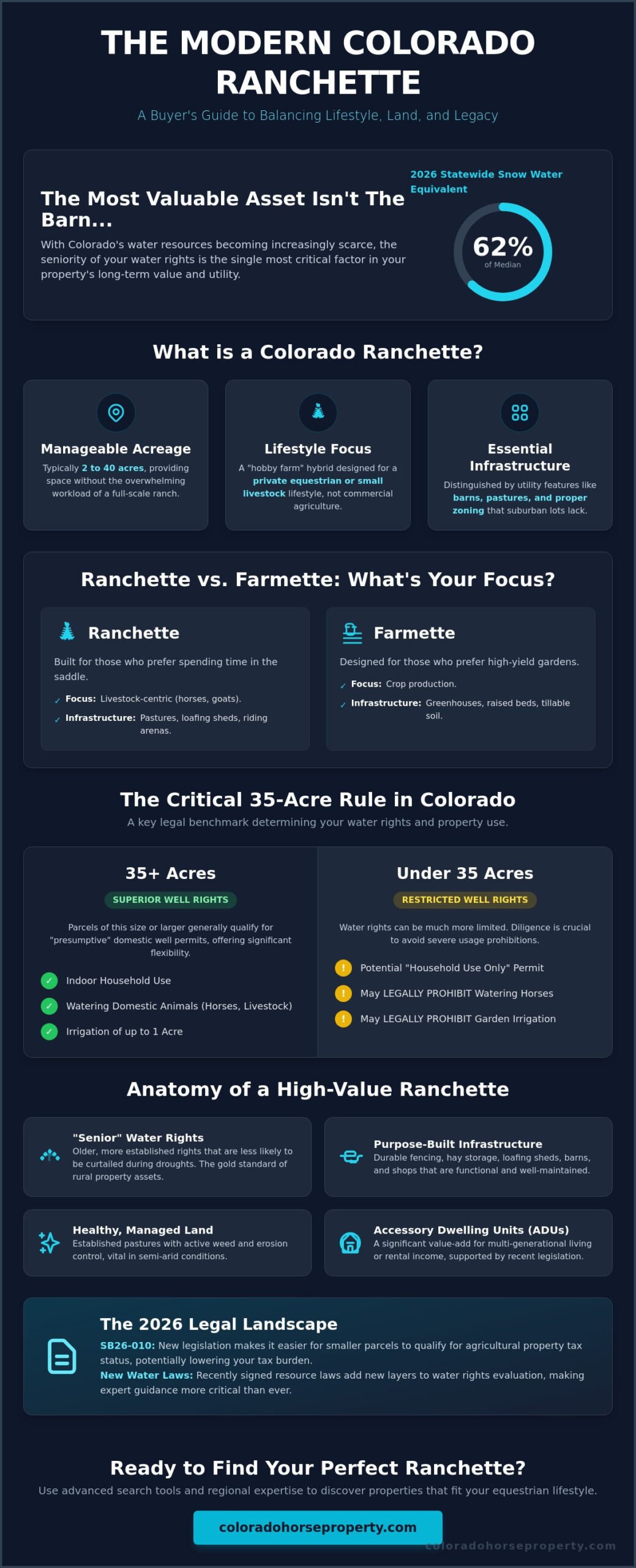
With Colorado’s statewide snow water equivalent sitting at just 62% of the median in 2026, the most valuable asset on a small property isn’t the barn; it’s the seniority of the water rights. Many buyers looking for a rural lifestyle ask, what is a ranchette in Colorado, and how does it differ from a full-scale agricultural operation? You want the freedom of open space and a place for your horses, but you likely feel overwhelmed by the complexities of ag status taxes and the maintenance requirements of a massive parcel. It’s a common concern for those who want the ranch lifestyle without the burden of a hundred-acre workload.
This guide will clarify exactly what defines a modern Colorado ranchette and how you can secure a manageable, small-scale equestrian property that fits your lifestyle. You’ll discover how the new SB26-010 legislation makes it easier to qualify for agricultural property tax classifications on smaller parcels. We’ll also examine the critical water resource laws signed in May 2026 and identify which regions currently offer the best balance of value and infrastructure for your equine goals.
Key Takeaways
- Define what is a ranchette in Colorado by exploring the 2-40 acre “hobby farm” hybrid that balances residential luxury with agricultural potential.
- Identify essential equestrian infrastructure, such as barns and loafing sheds, that ensures your small-scale property remains functional and high-value.
- Learn how to evaluate “Senior” water rights and leverage new SB26-010 tax laws to protect your investment in a drought-prone market.
- Compare the maintenance requirements and operational costs of small parcels versus full-scale ranches to choose the right management level for your lifestyle.
- Discover how to use AI-powered search filters and regional expertise to find properties that legally permit horses, goats, or specific livestock.
Defining the Colorado Ranchette: Size, Scope, and Purpose
A ranchette is a small-scale rural property, typically ranging from 2 to 40 acres, that functions primarily as a private residence rather than a commercial agricultural enterprise. It bridges the gap between a suburban lifestyle and the expansive operations of traditional production agriculture. To understand the historical context of these properties, it helps to look at the broad definition of What is a Ranch, which traditionally involves large tracts of land dedicated to raising livestock. In the modern Colorado market, the ranchette has evolved into a “hobby farm” hybrid. It provides enough space for a few horses or a small herd of goats while maintaining the residential comforts of a high-end home.
Distinguishing a ranchette from a standard suburban acreage is essential for any serious buyer. While a suburban lot might offer five acres of land, it often lacks the zoning or infrastructure required for livestock. When people ask what is a ranchette in Colorado, they are looking for a property that specifically supports an equestrian or agricultural lifestyle. These parcels are designed for utility, featuring outbuildings and grazing areas that you won’t find in a standard residential development. In the 2026 market, these properties are increasingly sought after by those who want a connection to the land without the overwhelming management requirements of a multi-hundred-acre operation.
To better understand this concept, watch this helpful video:
The 35-Acre Rule in Colorado
The 35-acre threshold is a critical legal benchmark in Colorado land ownership. Under state law, parcels of 35 acres or larger generally qualify for “presumptive” domestic well permits. These permits are superior because they typically allow for indoor water use, the watering of domestic animals, and the irrigation of up to one acre of land. For properties smaller than 35 acres, water rights are often much more restrictive. Buyers in 2026 frequently target the 35 to 40-acre range specifically to secure these automatic well rights. If you choose a smaller ranchette, you must verify if the well permit is “household use only,” which would legally prohibit you from watering your horses or a garden.
Ranchette vs. Farmette: What’s the Difference?
The primary difference between these two property types lies in their intended use and infrastructure. Ranchettes are livestock-centric. You will see pastures, loafing sheds, and perhaps a riding arena. The focus is on animal husbandry and the equestrian lifestyle. Conversely, a farmette, or micro-farm, prioritizes crop production. These properties usually feature greenhouses, raised beds, or tillable soil for specialty produce. While both offer a rural escape, a ranchette is built for those who want to spend their time in the saddle. In 2026, the choice usually comes down to whether you prefer managing four-legged residents or high-yield gardens.
Essential Features of a High-Value Colorado Ranchette
A high-value property is more than just acreage; it’s the sum of its infrastructure and resource management. When evaluating what is a ranchette in Colorado, you must look beyond the aesthetic appeal of a mountain backdrop. True value in 2026 is found in the property’s ability to sustain livestock during drought cycles and its integration of modern residential technology. High-quality parcels feature established pasture health, often requiring specific soil amendments to combat Colorado’s naturally semi-arid conditions. Buyers prioritize land that has been managed for weed control and erosion, especially following the 2026 drought declarations.
Infrastructure must be purpose-built. This includes durable perimeter fencing, dedicated hay storage to protect your winter supply, and outbuildings like shops or accessory dwelling units (ADUs). With recent legislative pushes for housing density, ADUs have become a significant asset for property value and multi-generational living. Crucially, any improvements must be backed by a clear understanding of Colorado’s Prior Appropriation System. This legal framework dictates who gets water first during a “call” on the river; senior water rights are a primary feature of any premium ranchette in this climate.
Equestrian Amenities for Small Acreage
Space efficiency is the hallmark of a well-designed 2026 ranchette. On a five-acre lot, a full-sized riding arena might consume too much grazing land. Many owners now prioritize 60-foot round pens and multi-purpose loafing sheds that provide shelter without the footprint of a traditional stable. For those managing two to five horses, a “center-aisle” barn with integrated tack rooms and wash racks offers maximum utility in a compact space. In 2026, a horse-ready ranchette is defined as a property featuring secure fencing, a reliable non-potable water source for livestock, and at least one permanent shelter per paddock. If you are starting your search, you can use an AI-powered horse property search to filter for these specific amenities.
Residential Luxury in Rural Colorado
The modern ranchette owner rarely wants to sacrifice comfort for a rural lifestyle. There is a clear trend toward high-tech homes that feature AI-integrated systems to monitor well levels, irrigation schedules, and security from a smartphone. These homes balance rustic design elements with professional-grade kitchens and dedicated home office spaces for remote work. Expansive outdoor living areas, such as wrap-around decks and outdoor kitchens, are essential for capitalizing on Colorado’s 300 days of sunshine and mountain views. This intersection of utility and luxury is what separates a premier ranchette from a basic rural house.
Ranchette vs. Full Ranch: Navigating the Colorado Land Market
The primary difference between a full-scale working ranch and a ranchette is the intent of the operation. While a production ranch operates as a commercial business requiring full-time staff and heavy machinery, a ranchette is designed for personal enjoyment and manageable hobby farming. Understanding what is a ranchette in Colorado requires looking at the labor involved. On a 10-acre parcel, you’re likely the primary laborer. You’ll handle the daily feeding, fence mending, and irrigation management yourself. This DIY approach appeals to those seeking a direct connection to their land without the overhead of a full ranch crew.
Financial commitments also differ significantly. A full ranch carries high operational costs for livestock inventory, large-scale equipment, and insurance. A ranchette, while still an investment, offers a more predictable cost structure. When evaluating what is a ranchette in Colorado, the tax benefits are a major draw. A benefit for 2026 buyers is the passage of SB26-010 on March 9, 2026. This law expanded the definition of “farm” and “ranch” for property tax purposes. It now includes “pasture-based operations,” making it easier for small-acreage owners to qualify for agricultural tax status. This classification can lead to substantial savings on property taxes, provided you meet the specific use requirements for your livestock or hay production.
Operational Differences and Labor
The daily rhythm on a ranchette is focused on chores rather than industry. You might spend an hour each morning and evening tending to your horses or cleaning stalls. Because the scale is smaller, your equipment needs are often simpler. Many owners find that a heavy-duty ATV with attachments for harrowing or snow removal is sufficient, whereas a full ranch requires multiple high-horsepower tractors. This smaller footprint allows for lock-and-leave potential. If your infrastructure is well-designed with automatic waterers and secure fencing, you can travel without the constant oversight required by a larger, more complex agricultural operation.
Investment Value in 2026
Small-acreage properties near the Front Range continue to see strong demand due to their proximity to urban centers like Denver and Colorado Springs. While standard residential homes are subject to the fluctuations of the broader housing market, equestrian real estate Colorado remains a stable asset class. These properties are finite. As zoning laws like HB26-1114 push for higher density in municipal areas, the value of existing 5-to-20-acre parcels often appreciates faster than standard suburban lots. Buyers in 2026 view these properties as both a lifestyle upgrade and a strategic hedge against urban sprawl.
Critical Considerations: Water Rights, Zoning, and Access
Understanding what is a ranchette in Colorado requires more than a look at the landscape; you must analyze the deed and the water court decrees. In this state, land and water are frequently separate legal entities. As of March 16, 2026, Governor Polis activated Phase 2 of the Colorado Drought Response Plan, a move triggered by a statewide snowpack sitting at just 62% of the median. This environmental reality makes the seniority of your water rights the single most important factor in your property’s long-term viability. Senior water rights have priority during a “call” on the river, while junior rights may be shut off entirely during dry spells.
Beyond water, you must evaluate legal access and community governance. Many ranchettes are located on private roads or within managed communities. If the property is part of an HOA, you might face restrictions on the number of horses permitted or even the specific materials allowed for outbuildings. Conversely, a no-HOA property offers more freedom but places the full burden of road maintenance and snow removal on the owner. Ensuring you have a recorded easement for legal entry is non-negotiable, especially in rural areas where “handshake deals” with neighbors often fail during a property transfer.
Decoding Colorado Water Law for Buyers
Well permits are not all created equal. A “domestic well” typically allows for in-home use, fire protection, and the watering of livestock and gardens. However, many ranchettes under 35 acres are restricted to “household-use-only” wells, which legally prohibit you from watering a single horse or a small lawn. If your target property lacks sufficient natural water, you may need an augmentation plan, which involves purchasing water from a provider to replace what you pump. When planning your infrastructure, consider how these water hookups will impact the placement of horse barns for sale on your land.
Zoning and Animal Units
Counties like Weld, El Paso, and Douglas use “Animal Units” to determine how many animals you can legally keep. Usually, one horse equals one animal unit, but the allowed density varies wildly. For example, a property in Douglas County might have stricter manure management setbacks than a similar parcel in a more agricultural-heavy county. You must verify local setbacks for stables and paddocks to ensure they don’t encroach on neighboring wellheads or property lines. If you need help navigating these local regulations, our team provides expert buyer representation for Colorado land to ensure your dream property is legally compliant.
How to Find the Perfect Ranchette in 2026
Finding the right property requires more than browsing generic listings. If you’ve been asking what is a ranchette in Colorado, you likely realize the market is fast-moving and technically complex. In 2024, there was a 12% increase in demand for parcels between 5 and 20 acres along the Front Range, and that competition has only intensified in 2026. Success depends on identifying properties that meet specific equestrian criteria before they reach the general public. You need a strategy that combines modern data analysis with deep-rooted local connections to secure a parcel that actually meets your livestock and residential needs.
Off-market opportunities are a major component of the 2026 market. Many of the best equestrian estates are sold within the community before they ever reach a public MLS. Accessing these listings requires a broker who is deeply embedded in the regional ranching culture. By focusing on properties that already possess the infrastructure discussed in previous sections, such as senior water rights and animal-ready barns, you avoid the high costs and regulatory hurdles of building from scratch. This proactive approach is the only way to navigate a market where land prices have historically increased six times faster than inflation.
Using AI to Narrow Your Search
Traditional search platforms often fail to filter for the nuances of rural land. Our proprietary AI-powered tools allow you to filter for barns, water seniority, and acreage simultaneously. This technology identifies the best colorado land for your specific needs, whether that’s a 5-acre lot in Elbert County or a larger parcel on the Western Slope. By focusing on “must-have” features like loafing sheds and irrigation rights during the digital search phase, you save time and act faster. In a market where the statewide average snow water equivalent is low, the speed advantage of AI helps you secure water-secure properties before the competition.
Expert Buyer Representation
Technology is a powerful tool, but it doesn’t replace the value of seasoned human expertise. Mark and Alison Eibner’s 40 years of experience in the Colorado market protect your investment from common pitfalls like junior water right “calls” or restrictive zoning changes. We provide specialized transaction management and buyer representation to navigate the legal complexities of land sales. This includes verifying well permits and ensuring your intended use aligns with local county “Animal Unit” regulations. Securing your dream horse property for sale in colorado starts with a clear strategy. Start your AI-powered ranchette search today to find a property that matches your vision of the Colorado lifestyle.
Secure Your Colorado Legacy
Identifying what is a ranchette in Colorado is the first step toward a specialized lifestyle that balances residential luxury with agricultural utility. Success in the 2026 market requires more than just finding a beautiful view. You must prioritize properties with senior water rights and understand how the recent SB26-010 legislation affects your agricultural tax status. Whether you’re looking for a five-acre equestrian setup or a 35-acre parcel with automatic well rights, your investment depends on technical accuracy and deep regional knowledge.
We combine over 40 years of Colorado real estate expertise with proprietary AI search technology to simplify this complex process. Our team specializes in the intricate details of water rights and zoning navigation that generalist brokers often overlook. You can take the next step today by using our specialized tools to filter for the exact infrastructure your horses require. Find Your Perfect Colorado Ranchette with Our AI Search Tool and start building your future on the range. The right acreage is waiting for you.
Frequently Asked Questions
How many horses can I keep on a 5-acre Colorado ranchette?
Most Colorado counties allow between two and four horses on a five-acre parcel, but the exact number depends on local “Animal Unit” regulations. For example, Douglas and Elbert counties have specific density limits based on pasture health and manure management plans. You must verify the zoning code for your specific parcel to ensure you don’t exceed the legal limit for livestock. Using a property with established grazing rotations can help you maximize your land’s capacity while staying compliant with local setbacks.
Does a ranchette qualify for agricultural tax exemptions in Colorado?
Yes, many small-scale properties now qualify thanks to SB26-010, which was signed into law on March 9, 2026. This legislation broadened the definition of a “ranch” to include pasture-based operations, allowing more small and family-owned parcels to access agricultural property tax classifications. To qualify, you must demonstrate that the land is predominantly used for agricultural purposes, such as raising livestock or producing hay. This status can significantly lower your annual tax burden compared to standard residential rates.
What is the difference between a ranchette and a hobby farm?
The primary difference lies in the property’s infrastructure and intended use. A ranchette is designed for an equestrian or livestock-focused lifestyle, featuring pastures, barns, and riding areas. A hobby farm, often called a farmette, typically prioritizes crop production, greenhouses, or specialty gardens. When people ask what is a ranchette in Colorado, they’re usually looking for a residence that supports horses or a small herd of cattle rather than intensive vegetable cultivation.
Do I need specific water rights to have horses on a ranchette?
You must have a well permit that specifically allows for “domestic” use, which includes watering livestock and domestic animals. Many ranchettes under 35 acres are restricted to “household-use-only” permits that legally prohibit watering a single horse. With the 2026 drought declaration in effect, the Colorado Division of Water Resources is strictly enforcing these permit types. You should always verify the permit number and its specific allowed uses before finalizing a purchase to avoid legal water shortages.
Are ranchettes usually located in HOAs?
Ranchettes are found in both managed communities and independent rural areas. Many newer developments along the Front Range include HOAs or protective covenants that regulate the size of outbuildings and the number of animals permitted. These can offer benefits like shared road maintenance but might restrict your freedom to build a large arena. If you prefer total autonomy, you should focus your search on unincorporated areas that lack formal homeowner associations.
Can I build a second home or guest house on a ranchette?
Building a second structure depends on your county’s zoning laws and your property’s water capacity. While recent state trends encourage the development of Accessory Dwelling Units (ADUs), your well permit must be legally capable of supporting the additional water demand. Some counties require a minimum acreage, often 35 acres or more, to permit a second full residence on a single parcel. Always check the local building department’s density requirements before planning an expansion.
What are the most popular areas in Colorado for ranchettes in 2026?
Douglas, Elbert, and Weld counties remain the most sought-after regions due to their established equine infrastructure and proximity to Denver. Buyers in 2026 are also looking toward the Western Slope, where prices can be 20% lower than Front Range averages. However, the Front Range corridor stays popular because it offers the best balance of rural space and access to professional services. Finding what is a ranchette in Colorado that fits your budget often means looking just outside these high-demand hubs.
How much maintenance does a 10-acre ranchette require weekly?
A 10-acre property typically requires 10 to 15 hours of active maintenance per week. This includes daily chores like feeding, stall cleaning, and checking fence lines for damage. Seasonal tasks like weed control and snow removal will add to this total during certain months. You can reduce this workload by investing in efficient infrastructure, such as automatic waterers and durable perimeter fencing, which allows for a more manageable “lock-and-leave” lifestyle.