
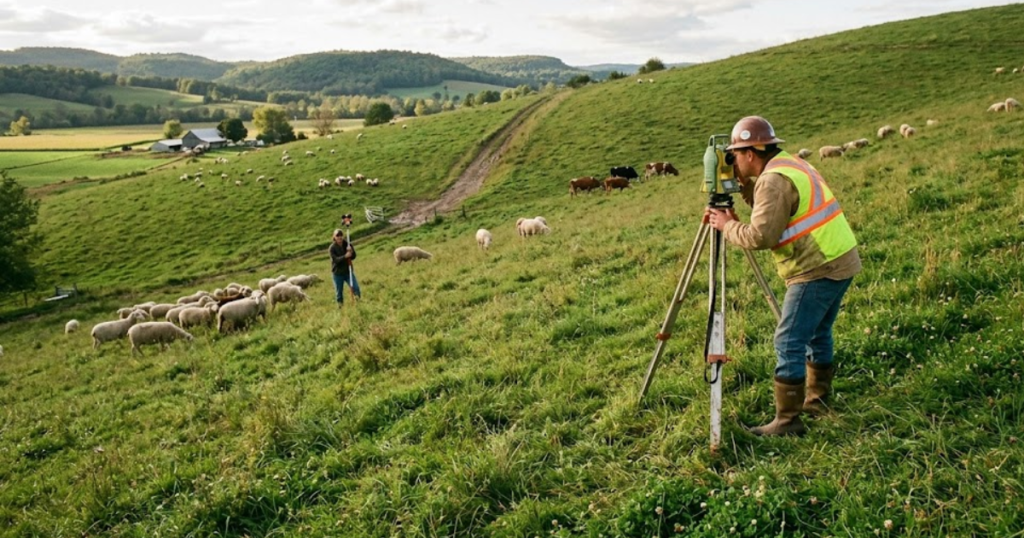
You find a spectacular mountain property nestled in the foothills. The views are panoramic, and the acreage looks immense on paper. The listing agent shows you a massive 20-acre pasture that sweeps up a beautiful mountainside. It looks picture-perfect in the summer sun, so you purchase the estate and turn your horses out.
Within a year, the reality of high-altitude grazing sets in. Because the slope percentage averages a steep 18%, your horses spend all their time huddling on the tiny, flat ribbon of land right next to the barn. They quickly eat that section down to bare dirt, while the rich grass up on the hillside goes completely ignored because it is too exhausting for them to climb daily. When the spring rains arrive, torrents of water rush down the bare mountainside, carving deep, dangerous erosion ruts across your property.
When evaluating horse properties colorado buyers often focus entirely on the total acreage number while completely ignoring the topography. The “slope percentage”—the rise in terrain elevation over a specific distance—dictates how much of your land is actually usable for foraging.
Here is how to evaluate pasture slopes to ensure a safe, sustainable environment for your herd.
What Is the "Slope Percentage" of the Primary Grazing Area?
Quick Summary: The Incline Balance
- The Erosion Trigger: A grazing area with a slope percentage greater than 10% to 15% is highly vulnerable to erosion. When horses run and graze on steep inclines, their hooves break up the native turf, causing topsoil to wash away during heavy rainstorms.
- The Flatland Trap: Conversely, a slope of 0%, completely flat land, is a drainage nightmare. Without a gentle 1% to 2% grade to move water, snowmelt and rain will pool in your pastures, turning your primary grazing areas into stagnant, muddy bogs that breed thrush and mosquitoes.
- The Overgrazing Pattern: Horses are fundamentally lazy grazers. If a pasture features a mix of steep hills and flat benches, the herd will congregate almost exclusively on the flat ground, completely decimating the grass there while leaving the hillside forage untouched.
- The Injury Risk: Forcing senior horses or mares with foals to navigate steep, slick slopes during an icy winter increases the risk of catastrophic slips, tendon strains, and joint injuries.
Total acreage can be misleading. The actual usefulness of pasture depends heavily on grade, drainage, and whether horses will safely and consistently use the terrain you are paying for.
1. The Ideal Grazing Sweet Spot (2% to 6%)
Like most things in equestrian infrastructure, moderation is key when it comes to terrain grade.
- The Perfect Drainage: A slope between 2% and 6% is the absolute gold standard for livestock management. It is steep enough to ensure that heavy rains and melting winter snow banks naturally drain away from the pasture, keeping the soil firm and dry.
- The Low-Impact Workout: A gentle incline provides fantastic, low-impact conditioning for your horses' hindquarters and toplines as they wander and graze, keeping them naturally fit without putting excessive stress on their hocks and stifles.
- The Easy Maintenance: A 2% to 6% grade is safe enough for you to comfortably drive a tractor, manure spreader, or pasture mower across without any fear of the equipment tipping over.
2. The High-Slope Hazard (10% and Greater)
Once a grazing area's slope percentage crosses into the double digits, management becomes increasingly difficult.
- The Turf Destruction: Horses exert massive physical force through their hooves when they run, play, or brake on a hillside. On a steep slope, this movement shears the root systems of native grasses, quickly turning a green hill into a scarred, rocky slope.
- The Water Runoff Avalanche: Steep slopes prevent water from soaking into the ground. Rain sheets off the incline rapidly, carrying vital soil nutrients down into the valley and leaving your hillside pastures dry, barren, and unable to regenerate forage.
- The Terracing Effect: Over time, cattle and horses grazing on steep hillsides will walk horizontally along the incline to make grazing easier. This creates deep, permanent dirt shelves across the hill, known as livestock terracing, which permanently ruins the aesthetic and smoothness of the terrain.
A beautiful hillside can look like extra pasture on paper but function more like a management burden if the slope pushes the land beyond practical daily use.
3. The Lazy Grazer Phenomenon
Understanding equine psychology is crucial when mapping out how your acreage will be utilized.
- The Path of Least Resistance: Horses are hardwired to conserve energy. If a pasture requires climbing a 15% slope to get to the upper grass, they will simply choose to starve or overgraze the lowlands until there is absolutely nothing left but weeds and dust.
- The Rotational Solution: If you buy a property with varied topography, you cannot manage it as one large pasture. You must budget to install cross-fencing that separates the hillsides from the flat valleys. This forces the horses to utilize the hillside forage during specific times of the year before moving them back down to the flats.
4. Reading the Topographical Map Before Escrow
You cannot accurately judge a slope percentage just by standing at the bottom of a valley and looking up.
- The USGS Overlay: During your due diligence period, your real estate team should pull an official United States Geological Survey, USGS, topographical map or use modern GIS satellite mapping software to analyze the pasture layout.
- The Contour Line Calculation: Closely packed contour lines on a map indicate tight elevation changes and a high slope percentage. We look for widely spaced contour lines in the primary grazing zones, ensuring your horses have plenty of accessible, safe, and productive ground to roam.
We Analyze the Terrain Layout Before You Buy
We do not just look at the horizontal boundaries of the land; we measure the vertical rises.
When Mark Eibner and Belinda Seville represent you in your rural property search, we look at the land through the eyes of a land manager. We calculate pasture slope percentages, analyze soil erosion risks, and ensure that your investment goes toward highly productive, usable acreage that will sustain your horses for a lifetime.
Contact Us Today to find premium horse properties Colorado buyers rely on for balanced, highly functional topography.
Browse Active Colorado Horse Properties: Browse active Colorado horse ranches for sale or ask our team about finding a horse property for rent Colorado that offers safe, sustainable grazing terrain for your herd
Frequently Asked Questions (FAQ) About Pasture Slope
Can I re-seed a steep hillside pasture if the grass dies off?
It is incredibly difficult. Because of the high slope percentage, standard tractor seed drills cannot safely operate on the incline. If you attempt to broadcast seed by hand, the first heavy Colorado rainstorm will simply wash the loose seed down to the bottom of the hill before it has a chance to take root.
Is a completely flat pasture (0% slope) bad for a horse's hooves?
Yes, if the region receives regular moisture. Completely flat land lacks a natural watershed path. Standing in stagnant, muddy pools for extended periods softens a horse's hooves, making them highly susceptible to thrush, white line disease, and abscesses.
What is the maximum safe tractor slope for mowing a horse pasture?
As a general safety rule, standard agricultural tractors should never be operated across a slope that exceeds 15% to 20%. Attempting to mow or turn on an incline steeper than this drastically increases the risk of a catastrophic rollover accident.