
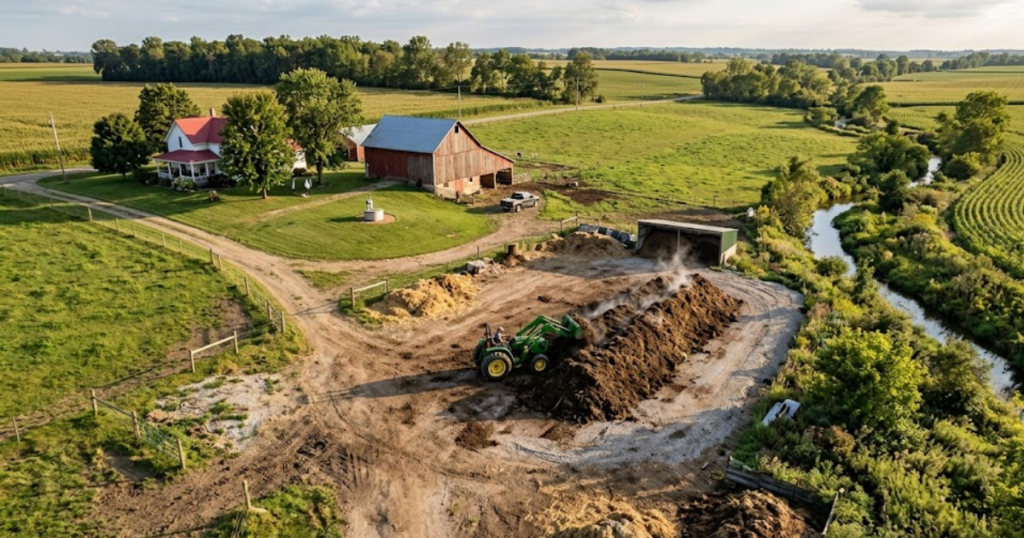
You buy a pristine 5-acre horse property. To keep the barn area tidy, you decide to wheelbarrow all your daily stall muck to the far back corner of the lot, dumping it into a massive pile tucked neatly against the boundary fence, right next to a small seasonal creek.
Three months later, a county code enforcement officer knocks on your door. Your neighbor complained about the smell and the flies, and the local water district noticed the pile was leaching brown runoff directly into the creek during a rainstorm. You are issued a heavy environmental fine and forced to hire a commercial front-loader to immediately relocate tons of wet, heavy manure to the center of your property.
When buying a horse property, buyers obsess over where the horses will sleep, but completely forget to plan where their waste will go. A single horse produces roughly 50 pounds of manure a day—that is over 9 tons a year. Where you are legally allowed to stack and compost that waste dictates the daily flow of your barn chores.
Here is how to evaluate the strict setback requirements for manure management before you buy.
What Are the Setback Requirements for a Manure Composting Pile?
Quick Summary: The Spatial Logistics of Waste
- The Property Line Buffer: Most rural Colorado counties strictly prohibit stacking or composting manure directly on a boundary fence. You generally must maintain a 50-foot to 100-foot setback from all property lines.
- The Waterway Protection: Environmental regulations are ruthless regarding runoff. Manure piles typically must be kept a minimum of 150 to 200 feet away from any creeks, ponds, or floodplains.
- The Well Water Threat: To prevent nitrates and dangerous bacteria from leaching into the local drinking supply, composting operations must be located at least 100 to 150 feet down-gradient from any domestic well.
- The Neighbor Nuisance: You cannot force your neighbors to smell your farm. Code enforcement frequently mandates that manure storage be placed 100 to 150 feet away from neighboring residential dwellings.
Manure handling is not just a cleanup issue. It is a zoning, drainage, neighbor-relations, and environmental compliance issue that shapes the daily layout of the whole property.
1. The Property Line and Neighbor Mandate
You cannot use your property line as a dumping ground.
- The Boundary Buffer: While zoning laws vary slightly by county, almost all rural agricultural codes require manure storage to be set back at least 50 to 100 feet from side and rear lot lines, and often 100 feet from the front lot line facing the road.
- The Dwelling Distance: Counties prioritize human health and comfort over agricultural convenience. You generally must keep manure piles at least 100 to 150 feet away from any neighboring residence.
- The Wind Factor: Even if you meet the legal footage setbacks, if your pile is located directly upwind of your neighbor’s patio, you will likely face constant nuisance complaints regarding odor and flies. A well-planned property places the compost site downwind of both your own house and the neighbors.
2. The Hydrological Threat (Wells and Waterways)
Colorado protects its water fiercely. Manure runoff is considered a severe biological pollutant.
- The Domestic Well Radius: Nitrates from decaying manure can easily leach through the soil and poison the groundwater. Health departments typically mandate a strict 100-foot to 150-foot protective radius around all domestic wellheads. Furthermore, the pile must be placed down-gradient, downhill, from the well so rain cannot wash the contaminants toward the casing.
- The Surface Water Ban: You cannot store manure anywhere near surface water. Setbacks of 150 to 200 feet from seasonal creeks, irrigation ditches, ponds, and wetlands are standard. If the property has a designated FEMA floodplain, manure storage is strictly prohibited inside those boundaries.
The legal compost location is often controlled by slope and water flow, not just by convenience. Downhill position and drainage path matter as much as straight-line distance.
3. Active Composting vs. Passive Stacking
How you manage the pile can affect how the county regulates it.
- The Passive Nuisance: Simply dumping wheelbarrows of raw manure into a growing mountain is considered passive stacking. This attracts massive amounts of flies, breeds parasites, and takes years to break down. Code enforcement is far more likely to target a passive, unmanaged pile.
- The Active Compost Shield: True composting requires managing the carbon-to-nitrogen ratio, aerating, turning, the pile, and keeping it moist. An actively managed compost system breaks down waste rapidly, generates heat that kills fly larvae and weed seeds, and rarely smells.
- The Infrastructure Requirement: Many counties will relax their scrutiny if you utilize a proper, engineered, three-bin concrete composting facility with a roof and a solid floor, as it completely eliminates the risk of groundwater leaching and windblown runoff.
4. Evaluating the Daily Chores
Setbacks look fine on a map, but you must evaluate how they affect your physical labor.
- The Wheelbarrow Commute: If you buy a tight 2-acre parcel, the required 100-foot setbacks from the property lines, the well, and the house might force the only legal compost location to be at the extreme opposite end of the property.
- The Winter Trek: Pushing a 200-pound wheelbarrow through 8 inches of snow for 300 feet every single morning is backbreaking work. You must calculate this physical commute before you decide a property's layout is workable for your daily lifestyle.
We Evaluate the Layout Before You Buy
We do not just look at the barn; we map the entire operational footprint.
When Alisa Lewis, Pamela Williams, and Eric Johnson represent you in a rural equestrian purchase, we analyze the property through the lens of daily management and county code. We map out the legal setbacks for wells, property lines, and waterways to ensure you have a highly functional, legal, and accessible location to manage your manure without triggering a war with your neighbors or the county.
Contact Us Today to find a properly zoned, highly functional equestrian estate.
Browse Active Colorado Horse Properties: Browse Active Colorado Horse Properties featuring professional-grade waste management infrastructure
Frequently Asked Questions (FAQ) About Manure Management
Can I just spread raw manure over my pastures instead of piling it?
Spreading raw manure is only recommended if you have large acreage and can drag the pastures during hot, dry summer months to bake and kill the parasite eggs. If you spread raw manure on small, heavily grazed paddocks, you will rapidly re-infect your horses with internal worms and ruin the palatability of the grass.
If I use a dumpster service to haul the manure away, do setbacks still apply?
Yes, but they are often slightly more flexible. A commercial roll-off dumpster prevents ground leaching and runoff, which satisfies many environmental water concerns. However, you still cannot park a rotting, fly-covered dumpster 10 feet from your neighbor's property line.
Will the county provide funding to build a concrete composting bin?
Yes. As covered in our previous guides, the federal Environmental Quality Incentives Program, EQIP, administered by the NRCS frequently offers cost-share funding to help equestrian property owners build engineered, concrete waste-storage facilities to protect local watersheds.