
What if the most valuable asset on your new Colorado ranch isn’t actually covered by your title insurance policy? Many buyers assume a standard title commitment protects their entire investment, but in the world of agricultural real estate, the “standard” approach often excludes the very water and mineral rights that give the land its value. With Colorado currently under a Phase 2 drought response as of March 2026, these legal oversights can be financially devastating. You’ve worked hard to build a legacy, and you deserve to know that your fences, forage, and flow rates are legally secure.
We understand that navigating title and escrow for ranch sales Colorado feels high-stakes, especially when dealing with complex agricultural easements and large earnest money deposits. This 2026 expert guide will show you how to master these complexities to ensure a secure transaction. We’ll examine the mandatory January 1, 2026, real estate contract updates, explain how to coordinate livestock and equipment transfers at closing, and detail the specific title endorsements needed to protect your senior water rights before the 2007 Colorado River guidelines expire later this year.
Key Takeaways
- Understand how title and escrow for ranch sales Colorado manages a complex “bundle of rights” that goes far beyond surface acreage and structures.
- Identify the critical risks of severed mineral estates and why surface ownership doesn’t always include the rights to what’s underground.
- Learn why a standard ALTA survey is an essential tool for resolving fence-line encroachments and verifying legal access points before you close.
- Navigate the extended due diligence timeline required for reviewing specialized water court records and environmental assessments.
- Discover how expert transaction management ensures a seamless closing that accounts for livestock, equipment, and agricultural easements.
Title and Escrow for Ranch Sales: Why Standard Services Fall Short
Most title companies in Denver or Colorado Springs handle thousands of suburban home closings every year. These transactions are routine and predictable. However, title and escrow for ranch sales Colorado require a completely different set of professional skills. A standard title policy often ignores the complex layers of usage rights that define a working ranch. If your title officer isn’t looking for historical grazing permits or unrecorded agricultural easements, you’re walking into a legal minefield. Choosing a firm without rural experience is the fastest way to “cloud” your title before the ink is even dry.
To better understand how specialized title services operate in the state, watch this brief overview:
As of the January 1, 2026, mandatory real estate contract update, the scrutiny on earnest money and land-use documentation has intensified. Non-specialized firms might miss the nuances of the updated CBS1 form, particularly regarding the handling of high-value deposits and the specific deadlines for HOA status letters in subdivided ranch communities. Missing a single deadline in a multi-million dollar land deal isn’t just an inconvenience; it can lead to the forfeiture of a massive deposit. You need a seasoned expert who knows that a ranch isn’t just a house on a lot. It’s a business asset with specific zoning requirements, agricultural tax assessment rates, and long-term land-use protections that must be verified.
The Complexity of the Colorado Ranch Title Search
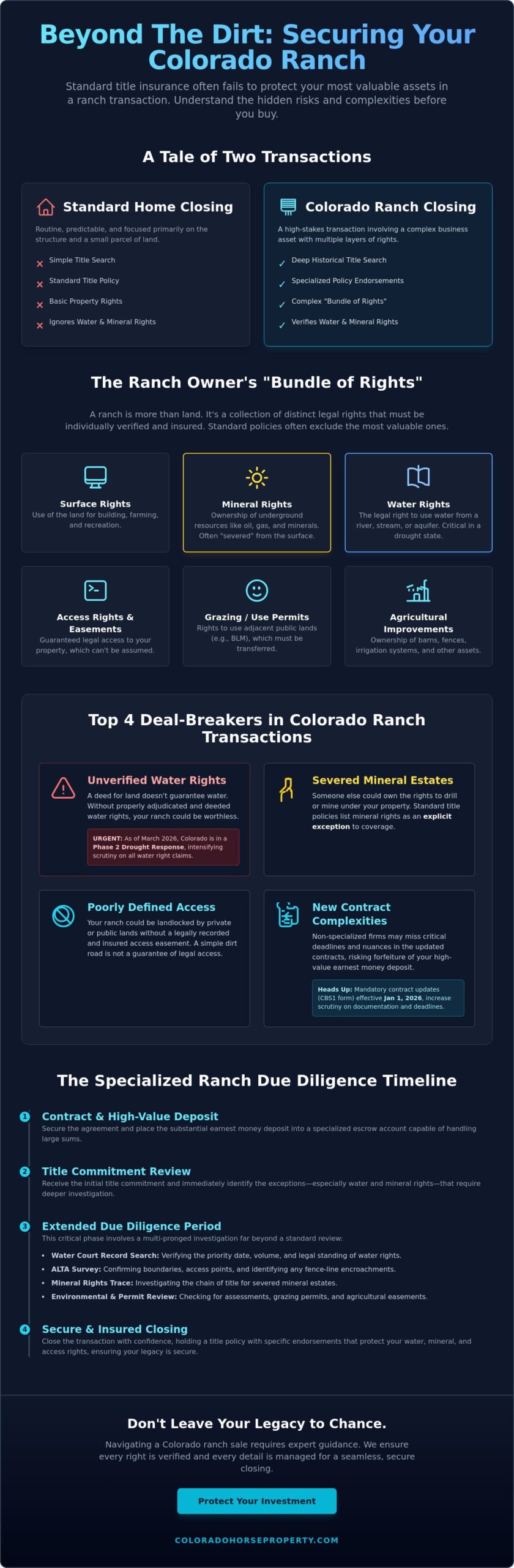
Verifying the chain of title for a property spanning thousands of acres is a massive undertaking. We often have to look back through decades of records to identify historical land grants or homesteading claims that could still impact your ownership today. In this context, the “bundle of rights” for a Colorado equestrian estate includes the legal authority to use, exclude others from, and transfer various interests in the land, including surface access, water usage, and specific agricultural improvements. If these rights aren’t clearly documented and insured, your land legacy remains at risk.
Escrow Management for High-Stakes Land Deals
Managing the financial side of a ranch sale involves more than just holding a check. You need to understand what the escrow process entails when million-dollar earnest money deposits are on the line. Escrow officers must accurately calculate pro-rated grazing fees and agricultural property taxes that differ significantly from residential rates. This is especially true for multi-parcel ranch sales where each section of land may have different tax statuses or lease agreements. A neutral third party with specialized knowledge ensures that every dollar is accounted for and that all agricultural assets transfer smoothly at closing.
Critical Title Issues in Colorado Ranch Transactions
Owning a ranch in the West means owning more than just the dirt. It’s about the legal right to use the resources on and under that dirt. In Colorado, the most frequent deal-breakers in title and escrow for ranch sales Colorado involve “severed” rights. This occurs when the surface land is owned by one person, but the water or minerals are owned by another. As the Colorado Division of Insurance explains, title insurance is designed to protect against hidden liens or ownership claims, but standard policies often list water and mineral rights as explicit exceptions. You must go beyond the basic commitment to ensure your investment is actually what you think it is.
As of March 2026, Colorado remains under a Phase 2 drought response. This status makes the verification of adjudicated water rights the single most important step in your due diligence. If the water rights aren’t properly deeded, you might find yourself owning a dry piece of land with no legal way to irrigate your pastures or water your livestock. We also see significant risks with access easements. If your property is landlocked by private holdings or Bureau of Land Management (BLM) acreage, you need a recorded easement that guarantees legal ingress and egress. Without it, your ranch’s value could plummet overnight.
Navigating Colorado Water Rights and Title
Water law in Colorado is based on the “prior appropriation” doctrine. This means the first person to use the water has the senior right to it. During your title search, we distinguish between tributary water, non-tributary groundwater, and simple well permits. It’s a common mistake to assume water rights “run with the land” automatically. They don’t. They must be specifically described in the deed and transferred correctly. Always verify ditch company shares and historical usage records to ensure the rights haven’t been abandoned due to non-use.
Mineral Rights and Surface Use Agreements
In Colorado, the mineral estate is often the “dominant” estate. If a third party owns the minerals under your horse property, they may have a legal right to enter your land to extract them. This can lead to drilling rigs or pipelines appearing in the middle of your grazing land. To mitigate this, we look for a “Mineral Endorsement” in your title policy. This provides a layer of protection against damage to surface improvements. You should also evaluate any existing oil and gas leases to understand the long-term impact on your equestrian lifestyle. If you’re concerned about how these issues affect your search, our specialized buyer representation can help you identify properties with cleaner title histories.
Finally, be aware of agricultural and conservation easements. While these can provide tax benefits, they often strictly limit your ability to build new arenas, barns, or additional residences. A thorough review of the title commitment will reveal these restrictions before you’re locked into a purchase agreement.
Title Commitment vs. Agricultural Reality
When you first receive your title commitment, the sheer volume of the document can be overwhelming. Buyers often ask why their title commitment is 100 pages long when a suburban home report is barely a dozen. The answer lies in the history of the land. In title and escrow for ranch sales Colorado, that length represents layers of historic use. You’re looking at records of 19th-century railroad rights-of-way, old telegraph lines, and modern utility easements that cross thousands of acres. This document isn’t just paperwork; it’s a map of every legal “handshake” made on that property over the last century.
The most important part of this document is Schedule B-2. This is where the title company lists the “exceptions” to your coverage. For an equestrian property, you must look for unrecorded encumbrances. These might include historic cattle trails that neighbors still use or utility lines that aren’t properly mapped. If these aren’t addressed during the due diligence period, they become your permanent problem the moment you close. Identifying these issues early prevents “clouded” titles that can disrupt your land legacy and future resale value.
Boundary Disputes and Fence-Line Issues
The biggest myth in Colorado ranching is that “the fence is the line.” It’s a dangerous assumption. Fences are often built for convenience or topography rather than legal accuracy. If a fence has been in the wrong place for decades, you may face an adverse possession claim from a neighbor. You must resolve these disputes before the closing date to ensure your acreage is exactly what you’re paying for. For more site selection tips, check our guide on horse property for sale in colorado to avoid common boundary pitfalls.
The Role of the ALTA/NSPS Land Title Survey
A standard survey isn’t enough for a working ranch. An ALTA/NSPS survey is non-negotiable. It maps every improvement, including barns, arenas, and loafing sheds, relative to the property lines. This survey identifies “blanket easements” that cover the entire property. Such easements could legally prevent you from building a new indoor arena in the future. Additionally, confirming your exact acreage is vital for tax compliance. Qualifying agricultural properties in Colorado can benefit from a 25% agricultural tax assessment rate, but only if your acreage is accurately documented and verified by the county.
The Ranch Escrow Process: A Step-by-Step Timeline
The process begins the moment the ink dries on your purchase agreement. Opening escrow involves depositing earnest money, which in large agricultural deals often represents a significant percentage of the purchase price. In title and escrow for ranch sales Colorado, the timeline is significantly longer than a standard residential closing. You aren’t just buying a house; you’re acquiring complex infrastructure and legal rights that require extensive verification. This extended period allows for specialized reviews of water court records and Phase I environmental assessments to ensure there are no historical contamination issues from old fuel tanks or pesticide storage.
Reviewing the title commitment leads to the “Objection Letter” phase. This is your opportunity to demand the seller clear specific agricultural encumbrances or resolve boundary issues found in the ALTA survey. Under the mandatory January 1, 2026, contract updates, the handling of earnest money and deadlines for these objections is more rigid. If a seller can’t provide a clean title for the water rights or clear a prescriptive easement, the objection letter protects your deposit and gives you the legal leverage to walk away or renegotiate before the hard deadlines pass.
Managing the Due Diligence Period
Coordination is the key to a successful escrow. You’ll need to work with specialized inspectors to evaluate high-capacity wells, complex septic systems, and irrigation infrastructure. The title officer plays a critical role here, working behind the scenes to clear “Requirements” like old liens or unreleased deeds of trust before the closing deadline. For a broader look at what to expect during your search, see our guide on colorado ranches for sale to understand current market conditions and due diligence standards.
Closing Day: Beyond the Warranty Deed
Closing day on a ranch involves much more than signing a warranty deed. You must handle the transfer of grazing permits for BLM or Forest Service land through the escrow process, which often requires separate agency approval. A livestock bill of sale and a separate Bill of Sale for equipment like tractors or hay inventory are also necessary. The escrow officer ensures final funding is distributed correctly, accounting for prorated land taxes and commissions. You’ll also see the Colorado documentary fee, calculated at $0.01 per $100 of the sale price, on your settlement statement. Once finished, ensure your water certificates are recorded with the county to finalize your legal standing. If you need professional assistance managing these moving parts, our transaction management services provide the expert oversight you need.
Streamlining Your Colorado Ranch Closing with Colorado Horse Property
The transition from a signed contract to a successful recording requires more than just standard paperwork. It demands a partner who understands that a ranch is a complex ecosystem of legal rights and physical assets. We specialize in title and escrow for ranch sales Colorado, ensuring that the high-stakes details discussed in this guide are handled with precision. Our approach reduces transaction friction by bridging the gap between the technical requirements of a title officer and the practical needs of a working ranch owner. With 40 years of local expertise, we know how to anticipate “clouded” title issues before they threaten your closing date.
Our team works closely with specialized partners like Meridian Title & Escrow to provide a level of scrutiny that generalist firms simply cannot match. We speak the language of ditch companies, BLM field offices, and county assessors. This seasoned, no-nonsense expertise allows us to manage your transaction with a focus on long-term security. Whether we are coordinating the transfer of senior water rights or ensuring a bill of sale accurately reflects your equipment inventory, our goal is a seamless experience that protects your Colorado land legacy.
AI-Driven Due Diligence
Finding the right property is the first step in avoiding title nightmares. Our proprietary platform allows you to filter listings by specific water rights, adjudicated usage, and total acreage before you ever step foot on the dirt. This data-driven approach helps us spot potential title red flags, such as missing mineral endorsements or irregular boundary lines, early in the process. Our AI search streamlines the equestrian real estate Colorado experience by pre-vetting listings for the specific resource and acreage requirements essential for a functional horse property.
The Realty Oasis Advantage
When you work with us, you’re leveraging the Eibner’s decades of specialized experience in the Colorado ranch market. We don’t just find you a property; we provide end-to-end transaction management that carries you from the initial offer through the final recordation of your deed. This personal, trustworthy partnership ensures that no detail, from grazing permit transfers to the final funding of land taxes, is overlooked. We invite you to contact our team today for a specialized ranch valuation or to begin a search backed by four decades of authoritative industry knowledge. Let us help you master the complexities of title and escrow for ranch sales Colorado so you can focus on the lifestyle you’ve worked hard to build.
Protect Your Land Legacy with Expert Oversight
Navigating the intricate world of Colorado ranch real estate requires more than just a general interest in land; it requires a specialized understanding of how usage rights and legal protections intersect. You now understand that a standard title commitment often leaves critical assets like water and minerals exposed. By prioritizing a comprehensive ALTA survey and a professional review of Schedule B-2 exceptions, you ensure your property remains a functional asset rather than a legal liability. These steps are essential for anyone looking to build a secure future in the high country.
Mastering title and escrow for ranch sales Colorado is the final step in protecting both your financial investment and your lifestyle. At Colorado Horse Property, we combine 40 years of local expertise with AI-powered search tools to help you identify equestrian-specific properties with verified title histories. Through our specialized partnerships with industry leaders like Meridian Title & Escrow, we provide the seasoned oversight needed to handle high-value deposits and complex agricultural closings with confidence. Start your journey with a team that understands the unique requirements of Colorado land owners.
Secure Your Colorado Legacy—Search Title-Verified Ranches Today
Your dream of owning a legacy ranch is within reach when you have the right experts in your corner to protect every acre.
Frequently Asked Questions
What is the difference between title insurance and an abstract of title for a ranch?
Title insurance provides a financial indemnity policy against future claims, whereas an abstract of title is merely a historical summary of the property’s legal history. In modern ranch transactions, title insurance has almost entirely replaced abstracts because it offers actual financial protection. If a hidden lien or ownership claim surfaces after the sale, the insurer covers the legal costs and financial loss up to the policy limit.
Do water rights automatically transfer with the land in a Colorado ranch sale?
Water rights do not automatically transfer with the land in Colorado. They are considered a separate real estate interest and must be specifically identified and transferred by a separate deed. If the purchase agreement fails to describe the water rights or the specific ditch company shares, the buyer may find themselves owning the land without any legal right to irrigate their pastures.
Why is an ALTA survey required for ranch title insurance in 2026?
An ALTA survey is required to remove the standard “survey exception” from your title insurance policy. This detailed map identifies fence-line encroachments, unrecorded easements, and legal access points that a standard survey might miss. For ranch buyers, this is the only way to guarantee that the physical boundaries of the land match the legal description provided in the title commitment.
How long does a typical ranch escrow period last in Colorado?
A typical ranch escrow period in Colorado lasts between 60 and 90 days. This extended timeline is necessary to complete specialized due diligence, such as verifying water usage history and conducting Phase I environmental assessments. Residential closings are much faster, but they don’t involve the complex agricultural components or the extensive record searches required for a working ranch or horse property.
What happens to my earnest money if the title search reveals severed mineral rights?
You can typically recover your earnest money if you submit a formal objection before the title deadline specified in your contract. Severed mineral rights are often listed as an exception in the title commitment. If your contract requires the transfer of the full mineral estate and the search reveals those rights are owned by a third party, you have the legal right to terminate the deal.
Can I use a standard residential title company for my horse property purchase?
You should avoid using a standard residential title company for these transactions. These firms are often unfamiliar with the nuances of title and escrow for ranch sales Colorado, particularly regarding agricultural tax assessments and water law. A specialized firm understands how to verify grazing permits and unrecorded easements that are rarely encountered in a suburban neighborhood closing.
Who pays for the title insurance policy in a Colorado ranch transaction?
The seller customarily pays for the owner’s title insurance policy in Colorado, while the buyer pays for the lender’s policy. However, these costs are entirely negotiable in the purchase contract. It’s common for both parties to split the administrative settlement fees, which typically range between $300 and $500 for each party in 2026 transactions according to verified state averages.
What are ‘exceptions’ in a ranch title commitment and should I be worried?
Exceptions are specific legal interests or encumbrances that the title company will not cover under your policy. While items like standard utility easements are common, you should be concerned about exceptions involving senior water rights or severed mineral estates. Reviewing Schedule B-2 is the only way to confirm that these exceptions won’t prevent you from building arenas or grazing livestock on your new land.