
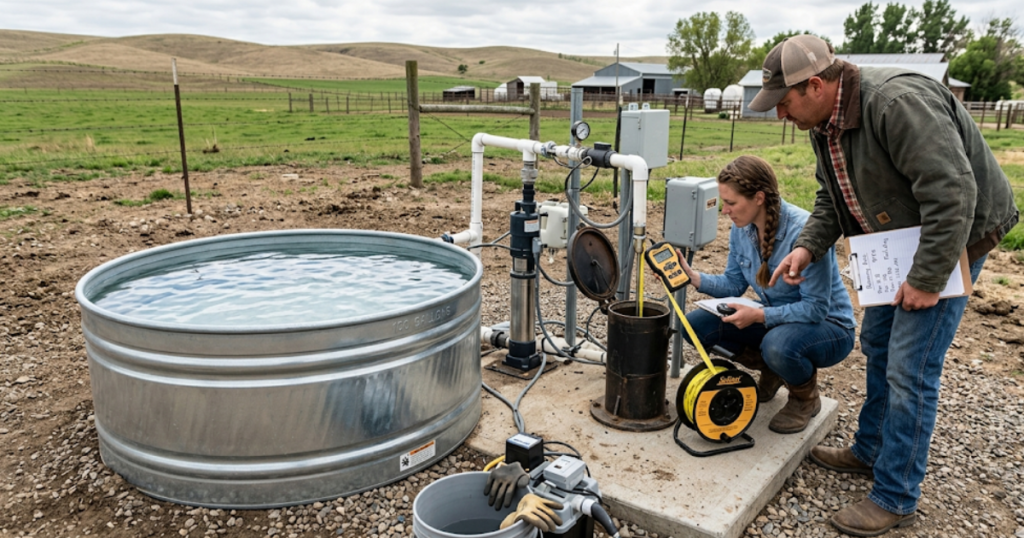
You move into your new Colorado equestrian property and start your morning chores. You turn on the barn hydrant to fill the 100-gallon stock tank in the back pasture. Halfway through, the water pressure drops to a sputtering trickle, and then stops completely. You rush inside to wash your hands, and the house faucets are bone dry.
You just drained your well, and it might take hours for your water to come back.
In rural real estate, buyers obsess over how deep the well is and how many Gallons Per Minute (GPM) the pump can push. However, they completely ignore the most critical metric: the recovery rate.
Here is how to evaluate the true stamina of a property’s water supply before you close the deal.
What Is the "Recovery Rate" of the Well After Filling a 100-Gallon Stock Tank?
Quick Summary: The Underground Bank Account
- The GPM Illusion: A well that pumps 15 Gallons Per Minute means nothing if it runs dry after five minutes. You need to know how fast the aquifer actually refills the well casing once the water is drawn out.
- The Stock Tank Stress Test: Filling a standard 100-gallon water trough is the ultimate real-world test. If the well cannot recover quickly after a single heavy draw, it will struggle to support a working equestrian property.
- The Cistern Solution: If the well has a painfully slow recovery rate, such as 1 or 2 GPM, the property is not necessarily useless, but you must invest in massive, expensive underground storage cisterns to act as a daily water buffer.
- The Rigorous Inspection: Never buy a horse property based on a 20-year-old drilling log. You must demand a specialized 2-to-4-hour well drawdown and recovery test during your due diligence period.
A well can look strong during a short showing and still fail under real farm demand. Recovery rate is what determines whether the water supply has true stamina for daily equestrian use.
1. The Difference Between Yield and Recovery
Think of a well like a bank account. The yield is how fast you can withdraw money, but the recovery rate is your paycheck depositing money back in.
- The Yield (Pumping Rate): This is the size of the pump. A powerful pump can easily blast 20 gallons of water per minute out of the well casing and into your barn.
- The Recovery Rate: This is the speed at which the surrounding underground aquifer naturally seeps back into the well casing through the bedrock fractures.
- The Static Level Drop: When the well is resting, water sits at a natural static level. When you blast 100 gallons out to fill a stock tank, that water level plummets. If your pump draws water out faster than the aquifer pushes it back in, you will pump the well dry, sucking in air and sediment.
2. The Equestrian "Peak Demand" Problem
Horses change the entire mathematical equation for household water usage.
- The Morning Bottleneck: The highest water demand on any farm happens simultaneously. Between 6:00 AM and 8:00 AM, the family is taking showers and running the dishwasher, while someone else is down at the barn scrubbing buckets and filling the 100-gallon troughs.
- The Volume Spike: A standard household might trickle through 300 gallons spread over an entire day. An equestrian estate might demand 200 gallons in a single, intense 30-minute window. A well with a slow recovery rate physically cannot survive this morning peak demand spike.
Well problems often appear during concentrated high-demand periods, not during casual kitchen-sink use. Horse properties create those demand spikes every day.
3. Surviving a Slow-Recovery Well (The Cistern)
If you fall in love with a property that has a 1 GPM recovery rate, it is not an automatic dealbreaker, but it requires significant infrastructure.
- The 24-Hour Trickle: Even a terribly slow 1 GPM well produces 1,440 gallons of water over a 24-hour period, more than enough to sustain a family and a herd. The problem is you cannot access it all at once.
- The Storage Buffer: The only way to make a slow well viable is to install a 1,500 to 3,000-gallon underground holding tank, a cistern. The weak well slowly trickles into the cistern all day and night. When you turn on the barn hose, a massive secondary booster pump blasts the water out of the cistern, giving you flawless pressure and volume, entirely masking the slow recovery of the actual well.
4. The 4-Hour Inspection Imperative
You cannot verify the recovery rate just by turning on the kitchen sink during a showing.
- The Useless Home Inspection: A standard residential home inspector will usually turn the water on for 15 minutes to make sure the pressure holds. On a deep well with a lot of stored water in the pipe, it will easily pass this test, hiding a catastrophic recovery issue.
- The Drawdown Test: You must hire a specialized well contractor to perform a true drawdown and recovery test. They will continuously pump water out of the well for 2 to 4 hours, physically measuring how far the water level drops and timing exactly how many minutes it takes for the aquifer to refill the pipe once the pump is turned off.
We Test the Lifeline Before You Buy
We do not just look at the barn hydrants; we stress-test the system feeding them.
When Mark and Alison Eibner at Realty Oasis help you purchase a horse property, we ensure rigorous well flow and recovery tests are front and center during your inspection period. We analyze the well logs, look for hidden cisterns, and make sure the property can actually sustain your herd's daily demand without leaving your house high and dry.
Contact Us Today to find an equestrian property with a strong, proven water supply.
Browse Active Colorado Horse Properties: Browse Active Colorado Horse Properties featuring reliable and sustainable infrastructure
Frequently Asked Questions (FAQ) About Well Recovery
Can hydro-fracturing, fracking, a water well improve its recovery rate?
Yes, sometimes. If a well is drilled into solid rock with poor fractures, a specialized well driller can inject highly pressurized water down the casing to blast open new veins in the bedrock, allowing more water to flow in. However, it is an expensive gamble, often $3,000 to $6,000, and is never guaranteed to work.
Is it bad for the well pump if the water runs dry?
It is catastrophic. Submersible well pumps rely on the surrounding water to keep their internal motors cool. If the well runs dry and the pump is left sucking air, it will quickly overheat, melt its internal components, and permanently burn out, leading to a massive replacement bill. Modern systems should always have a low yield shutoff sensor installed to prevent this.
How deep does a well need to be to have a good recovery rate?
Depth does not guarantee recovery. You could drill an 800-foot well through solid, unfractured granite and end up with a terrible 1 GPM recovery rate. Conversely, a shallow 100-foot well drilled directly into a massive, porous gravel aquifer could recover at an incredible 30 GPM. It is entirely dependent on the specific local geology.