
Buying ten acres in Douglas County doesn’t make you a rancher if the local zoning prevents you from building a single stall. You’ve likely spent hours scrolling through generic real estate apps only to find “equestrian” listings that are actually steep, rocky hillsides or dry lots without a drop of legal water. It’s exhausting to filter through the noise while worrying about the Colorado horse property market trends 2026 and potential land valuation bubbles. We understand that your goal isn’t just a house; it’s a functional environment where your horses can thrive and your investment remains secure.
This forecast provides the clarity you need to secure a legacy property that supports your herd. You’ll discover which high-growth regions are currently undervalued and how to identify technical red flags, like restrictive easements or insufficient well permits, before they become expensive mistakes. We will examine the economic drivers and regional shifts shaping the next year of real estate. From understanding complex water rights to finding the perfect acreage for your lifestyle and dreams, this guide uses our team’s nearly 40 years of specialized experience to help you make an informed move.
Key Takeaways
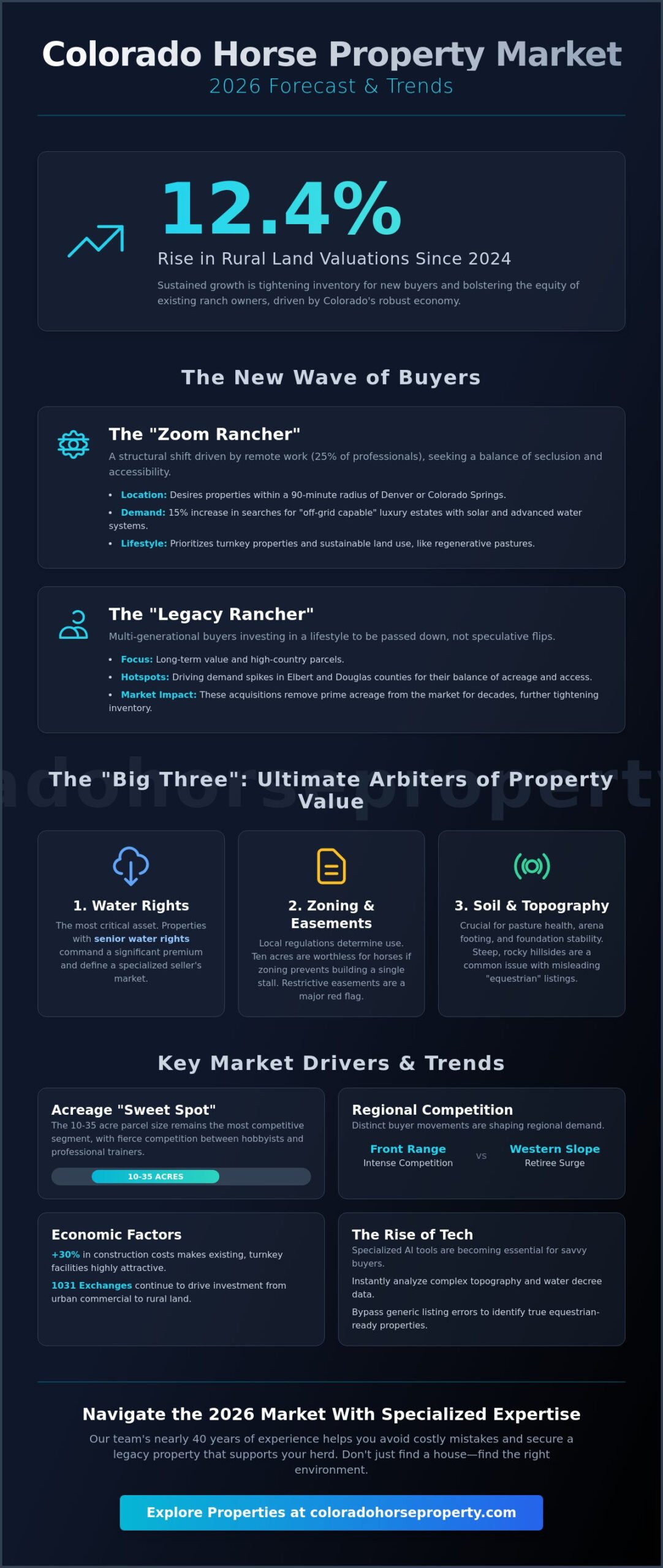
- Analyze the 12.4% rise in rural land valuations and how current economic drivers are tightening inventory for high-value ranch transactions.
- Discover why the “Zoom Rancher” effect is pushing demand for off-grid capable luxury properties within reach of Denver and Colorado Springs.
- Identify how the “Big Three”—water, zoning, and soil—act as the ultimate arbiters of property value in the current equestrian landscape.
- Stay ahead of the Colorado horse property market trends 2026 by comparing the competitive Front Range against the Western Slope’s retiree surge.
- Learn to use specialized AI tools to bypass generic listing errors and instantly analyze complex topography and water decree data.
The 2026 Colorado Horse Property Market Landscape
Entering 2026, the equestrian real estate landscape has reached a new level of maturity. Rural land valuations have climbed 12.4% since 2024, creating a tighter entry point for new buyers while bolstering the equity of existing ranch owners. Much of this sustained growth is anchored by Colorado’s diversified economy, which continues to attract high-net-worth individuals who view land as a hedge against volatility. While interest rates have stabilized compared to the fluctuations of previous years, they remain a primary consideration in high-value ranch transactions, often dictating the pace of closing for properties priced over $2.5 million.
To better understand how these shifts are manifesting on the ground, watch this helpful video:
Colorado horse property market trends 2026 show a distinct migration to quality. Buyers are no longer interested in the “fixer-upper” ranch; they’re prioritizing turnkey equestrian estates that offer immediate utility. This preference has created a record premium for properties with professional-grade infrastructure. Inventory shortages are particularly severe in the 10-35 acre “sweet spot” across the Front Range, where competition between hobbyists and professional trainers remains fierce.
Macroeconomic Drivers Shaping Equestrian Real Estate
Inflation and rising construction costs have fundamentally changed the buy vs. build debate. Building a custom four-stall barn or an indoor arena now costs 30% more than it did three years ago, making existing facilities much more attractive. 1031 exchanges continue to drive the market as investors move capital from urban commercial assets into Colorado acreage. The 2026 market is a specialized seller’s market for properties with senior water rights.
The Rise of the Legacy Rancher
We’re seeing a surge in multi-generational buyers targeting Colorado’s high-country parcels. These families aren’t looking for speculative flips; they’re investing in lifestyle and dreams that can be passed down. This long-term mindset has led to regional demand spikes in Elbert and Douglas counties, where buyers can find the perfect balance of acreage and accessibility. Current Colorado horse property market trends 2026 suggest that these “legacy” acquisitions are removing prime acreage from the market for decades at a time, further tightening available inventory.
- Valuation Rise: 12.4% increase since 2024.
- Key Counties: Elbert and Douglas leading in demand.
- Target Acreage: 10-35 acres remains the most competitive segment.
- Premium Factors: Senior water rights and turnkey barns.
Emerging Buyer Demographics and Lifestyle Shifts
The “Zoom Rancher” isn’t a temporary fad; it’s a structural shift in how people live and work. By 2026, remote work has solidified as a permanent fixture for roughly 25% of the professional workforce. This shift drives a specific demand for properties within a 90-minute radius of Denver or Colorado Springs. Buyers want the rural lifestyle without losing access to urban hubs for occasional meetings or cultural events. This demographic prioritizes properties that offer a balance of seclusion and accessibility.
The 2026 market shows a 15% increase in searches for “off-grid capable” estates. These aren’t primitive cabins. They’re luxury homes equipped with sophisticated solar arrays, Tesla Powerwalls, and advanced water catchment systems. Eco-conscious equestrianism is also on the rise. Owners now look for properties designed for regenerative pasture management and solar-powered indoor arenas to reduce their environmental footprint. This focus on sustainable land use is a core component of CSU’s Equine Science program, which influences how the next generation of horse owners manages their acreage.
Small-scale “ranchettes” have become the preferred entry point for first-time owners. These parcels, typically between 5 and 15 acres, allow new enthusiasts to fulfill their dreams without the massive overhead of a 100-acre operation. If you’re looking to start your journey, you can search by acres to find a manageable property that fits your lifestyle.
Connectivity: The New Frontier of Land Value
High-speed data is now as critical as water rights. The expansion of Starlink and 5G satellite technology has transformed “dark” rural parcels into viable homes. Colorado horse property market trends 2026 show that properties with verified high-speed connectivity sell for 12% more than those without. Buyers prioritize data for everything from remote work to real-time barn monitoring and automated irrigation systems. A stable connection is no longer a luxury; it’s a baseline requirement for land value.
Health and Wellness as a Market Driver
The equestrian lifestyle serves as a direct response to urban burnout. Buyers are trading crowded city streets for “quiet enjoyment” and low-density zoning. Proximity to public trail systems is a major value-add in this environment. For example, homes with direct access to Fox Run Park command a premium. These properties offer miles of maintained equestrian paths without the need for trailering. The 2026 buyer views their horse property as a sanctuary for mental and physical wellness. Understanding these Colorado horse property market trends 2026 is essential for sellers looking to position their land effectively in a competitive landscape.
Regional Performance: Front Range vs. Western Slope Trends
Colorado horse property market trends 2026 show a widening gap between the bustling Front Range and the expanding Western Slope. Buyers aren’t just looking for any plot of land anymore; they’re seeking specific regional advantages that cater to their discipline and long-term goals. While the Front Range remains the hub for performance horse events, the Western Slope is capturing a different demographic focused on sustainability and climate resilience. These shifts are redefining how we value acreage across the state’s five distinct equestrian zones.
The Front Range Squeeze
In communities like Littleton, Parker, and Elizabeth, the battle for limited acreage has reached a fever pitch. Urban sprawl continues to push horse owners further east and south, making it harder to find land that isn’t slated for future residential development. This scarcity makes finding quality equestrian real estate Colorado a challenge for those who need to stay within commuting distance of Denver or Colorado Springs. Conservation easements are now the primary tool for preserving horse-friendly land in Douglas County. Prospective buyers should watch for 2026 land-use density changes in Douglas County. New zoning rules may restrict the number of horses allowed on smaller parcels, which makes existing properties with established water rights and animal units significantly more valuable.
The Western Slope’s Growing Appeal
Grand Junction and Fruita are seeing a 2026 surge in equestrian retirees. This move is driven by the region’s longer growing season, which directly impacts hay production and pasture costs. Owners here often see two to three more weeks of pasture viability compared to the Front Range, reducing the need for supplemental winter feeding. The 2023 Equine Economic Impact Survey highlights how land use and economic contribution are tied to the health of the horse industry, and the Western Slope is capitalizing on this growth. Luxury buyers are also flocking to the Roaring Fork and Eagle River valleys. In these areas, professional-grade indoor arenas and heated barns are becoming standard requirements for high-end listings rather than optional upgrades.
The High Country remains a specialized niche. Demand centers on summer grazing properties and high-altitude training facilities used by competitive endurance riders. Price-per-acre metrics vary wildly across the state. While the Front Range can average $60,000 to $110,000 per acre for developed horse property, the Western Slope offers value at $28,000 to $48,000 per acre. The Eastern Plains and Southern Colorado provide the most affordable entry points, though water rights remain the deciding factor in those valuations. Understanding these Colorado horse property market trends 2026 is essential for anyone looking to secure their dream ranch before inventory tightens further.
Technical Value Factors: Water, Zoning, and Connectivity
In the current landscape, the “Big Three” factors of water, zoning, and soil quality serve as the ultimate arbiters of value. As we analyze Colorado horse property market trends 2026, it’s clear that aesthetic appeal takes a backseat to technical viability. A beautiful farmhouse on thirty acres is a liability if the well permit doesn’t allow for livestock. Buyers must distinguish between “dirt” and “irrigated pasture.” True pasture requires specific soil compositions and consistent moisture to support grazing. Without these, you’re looking at the high cost of supplemental hay, which can exceed $300 per ton in peak seasons.
Well permits are the most misunderstood aspect of rural real estate. A household-only permit restricts water use to inside the home. It forbids watering a garden or a single horse. Conversely, a domestic well permit typically allows for the watering of domestic animals and small-scale irrigation. For serious operations, a livestock well permit is the gold standard. The 2026 Colorado Water Plan updates have placed stricter scrutiny on new permit applications, making existing, high-capacity wells significantly more valuable than they were five years ago.
Senior vs. Junior Water Rights in 2026
Senior water rights are the legal priority to divert water from a specific source based on the earliest established date of use. This “first in time, first in right” system is the backbone of Colorado law. During the due diligence period, you must verify the water decree status through the Colorado Division of Water Resources. Do not rely on a seller’s word. The hidden costs of “dry” land are substantial. If you lack sustainable irrigation, you’ll spend thousands annually on hauled water or increased feed costs because your ground can’t produce forage.
Zoning Red Flags for Horse Owners
Zoning varies wildly between counties like Weld, Douglas, and El Paso. An “A-1” (Agricultural) designation is generally the most flexible, but “Rural Residential” zones often hide restrictive animal unit caps. You might find a property that seems perfect, only to discover the county limits you to two horses regardless of acreage. These restrictions directly impact your ability to build horse barns for sale or add arenas.
Always check the hierarchy of authority. If a property is governed by an HOA, their rules can be more restrictive than county zoning. An HOA can legally ban livestock even if the county allows it. Understanding these technical factors is essential for anyone tracking Colorado horse property market trends 2026. Before you sign a contract, ensure the land can actually support your lifestyle and dreams.
Navigating the 2026 Market with AI-Powered Expertise
Success in the current landscape requires more than just browsing listings on generic platforms. Zillow and Redfin often fail to capture the nuances of rural acreage; they frequently misidentify zoning or overlook critical water rights. To truly understand Colorado horse property market trends 2026, you need tools built for the rancher. Our proprietary AI technology analyzes topography, soil types, and water decree data in seconds. This level of precision ensures you aren’t just buying a house, you’re investing in land that can support your herd’s health and your long-term goals.
Technology alone isn’t the answer. We pair these modern search capabilities with nearly four decades of local expertise. While an algorithm can flag a 35-acre parcel, it won’t understand the local wind patterns or the specific reputation of a county’s road maintenance. We bridge that gap. This combination allows us to provide a high-definition view of the market that generalist realtors simply can’t match. If you’re looking for horse property for sale in Colorado, you need data that respects the complexity of the land.
The Power of Specialized Search
Our platform goes beyond basic filters like bedrooms and bathrooms. You can search specifically for “indoor arenas,” “cross-fencing,” or “loafing sheds.” This saves hours of manual sorting. Our AI also identifies off-market opportunities by tracking land use changes and historical ranch data. When you find the right spot, we provide equestrian-first representation. We ensure your contract includes specific contingencies for hay production capacity and barn inspections, protecting your interests in a way standard residential contracts won’t.
Preparing for a 2026 Transaction
Sellers must position their ranches for high-value buyers who expect turn-key facilities. Equestrian-staging is vital for 2026. This includes clearing fence lines, organizing tack rooms, and providing certified weed-free hay records. We also recommend using specialized title and escrow services familiar with complex water rights and agricultural easements to prevent closing delays. These details often make the difference between a standard sale and a record-breaking valuation. High-quality Colorado horse property market trends 2026 data shows that properties with documented maintenance and water security sell 22% faster than those without.
Ready to find your ideal ranch? Start your AI-powered search today and leverage 40 years of Colorado expertise.
Secure Your Legacy in the 2026 Equestrian Landscape
The road to 2026 shows a clear divide between the high-demand Front Range and the expanding opportunities on the Western Slope. Buyers are now prioritizing technical factors like senior water rights and specific agricultural zoning over simple aesthetics. Success in this evolving environment requires more than just a standard search. Navigating the Colorado horse property market trends 2026 effectively means leveraging data to find land that supports your specific equine goals.
We’ve spent nearly 40 years mastering the nuances of Colorado land and water. Our full-service brokerage, backed by Realty Oasis, combines this deep history with proprietary AI technology. This tool identifies niche features like soil quality and connectivity that traditional platforms miss. You don’t have to guess about the future of your ranch or training facility. We provide the expert guidance and technical tools needed to turn your lifestyle dreams into a secure investment.
Find your next Colorado Horse Property with our AI-powered search
Your ideal Colorado lifestyle is waiting for you to claim it.
Frequently Asked Questions
What is the average price per acre for horse property in Colorado in 2026?
Average prices vary by region, but 2024 USDA Land Values reports showed Colorado pasture land at roughly $1,150 per acre, while improved equestrian properties near the Front Range often exceed $20,000 per acre. By 2026, these figures will likely reflect a 3 to 5 percent annual appreciation based on current Colorado horse property market trends 2026. Buyers should focus on specific sub-markets like Weld or Elbert County for better value.
Do I need senior water rights for a small 5-acre horse property?
You don’t necessarily need senior water rights for a 5-acre property, as most small parcels rely on domestic well permits. In Colorado, a “household use only” well won’t allow for livestock watering. You’ll need a “domestic and livestock” well permit, which is standard for parcels over 35 acres but can be obtained for smaller lots in specific augmented water districts. Always verify the permit type with the Colorado Division of Water Resources.
Which Colorado county has the most horse-friendly zoning laws?
Weld County is widely recognized for having the most horse-friendly zoning laws in the state. Their “A” Agricultural zoning typically allows for one horse per half-acre of available pasture. This is more lenient than the stricter animal unit calculations found in Boulder or Jefferson Counties. Weld County also offers streamlined permitting for outbuildings like hay sheds and indoor arenas, making it a top choice for serious riders.
Can I use a standard residential Realtor to buy an equestrian estate?
You shouldn’t use a general residential Realtor to purchase an equestrian estate because they often lack expertise in water rights, soil composition, and specialized zoning. A niche expert understands how to evaluate barn structural integrity and pasture drainage. We’ve spent nearly four decades helping clients navigate these complexities. A mistake in checking a well permit or an easement can cost you thousands of dollars after closing.
How does the 2026 interest rate environment affect ranch land loans?
The 2026 interest rate environment for ranch land loans is expected to stabilize around 5.5 to 6.5 percent according to Federal Reserve long-term projections. Land loans typically carry higher rates than standard residential mortgages, often requiring 20 to 30 percent down. Lenders like Farm Credit or specialized agricultural banks remain the best sources for these products. These rates directly influence the Colorado horse property market trends 2026 by dictating buyer purchasing power.
What are the minimum acreage requirements for horses in Douglas County?
Douglas County requires a minimum of 2.3 acres to keep horses in Rural Residential zoned areas. This allows for one “animal unit,” which equals one horse. If you want more horses, you’ll need larger parcels, as the county generally allows one horse per additional acre beyond the initial requirement. Always check the specific Plat and Covenants for your subdivision, as private rules can be more restrictive than county code.
Is high-speed internet available on most Colorado horse properties now?
High-speed internet is now available on roughly 85 percent of Colorado rural properties thanks to the 2023 expansion of low-earth orbit satellite services like Starlink. Many counties have also utilized the Colorado Broadband Office grants to install fiber-optic lines along main county roads. You can verify speeds at a specific address using the FCC National Broadband Map. Don’t assume a property has service just because it’s near a town.
What should I look for in a 2026 property valuation report for a ranch?
Your 2026 valuation report should prioritize “contributory value” for equestrian improvements like indoor arenas and fencing. Standard appraisals often undervalue these features, so look for a report that uses at least three comparable sales of similar horse properties within a 10-mile radius. Ensure the appraiser accounts for water well production rates and soil quality. These details are vital for securing accurate financing in a competitive market.