
What if the most stunning 40-acre pasture you visit this summer becomes a frozen, inaccessible island for your herd by mid-January? Searching for a mountain horse property for sale Colorado requires looking far beyond the peak views. You already know that high-country ranching demands more than just a sturdy barn; it requires a deep understanding of how topography and climate impact your daily operations. We’ve spent nearly four decades helping buyers identify the difference between a seasonal retreat and a true year-round legacy home.
This 2026 High-Country Buyer’s Guide provides the technical roadmap you need to secure an equestrian estate that functions as beautifully as it looks. You’ll learn how to verify mountain-specific water rights, evaluate winter trail access, and navigate the complex zoning laws that govern Colorado’s peaks. We will cover the essential factors of high-altitude property management, from pasture rotation to snow removal logistics, so you can invest with total confidence in your family’s lifestyle and dreams. It’s time to find a property that supports your passion through every season.
Key Takeaways
- Understand why land above 6,000 feet demands a shift in perspective, trading flat pastures for vertical terrain and specialized equestrian infrastructure.
- Navigate the complexities of mountain water rights and slope analysis to determine the true grazing capacity and livestock health potential of high-altitude acreage.
- Evaluate the significant differences in maintenance requirements and cost per acre between rugged high-country estates and traditional plains properties.
- Follow a professional 2026 checklist to audit well permits and ensure year-round road access for your trailer when searching for a mountain horse property for sale Colorado.
- Learn how to leverage specialized expertise and AI search filters to identify critical land flaws and infrastructure needs that generalist realtors often overlook.
Defining the Mountain Horse Property: More Than Just a View
A true mountain horse property for sale Colorado is defined by more than its scenic backdrop. For buyers in 2026, this category refers to acreage situated at elevations above 6,000 feet that includes purpose-built equestrian infrastructure. It represents a fundamental lifestyle shift. You aren’t just buying land. You’re trading manicured, flat pastures for the vertical terrain and rugged trails found in the high country. Market data from late 2025 shows a 12 percent increase in searches for these high-altitude estates as more riders prioritize direct trail access over proximity to urban centers.
To better understand the scale and beauty of these estates, watch this video of a working luxury ranch in Western Colorado:
While many buyers start with a general search for horse property for sale in colorado, the mountain niche requires specialized knowledge. The Rocky Mountains geography dictates everything from your barn’s snow load capacity to the oxygen levels your performance horses must adapt to. It’s a world where weather patterns change in minutes and terrain management is a daily priority. Investing in this landscape means securing a legacy property that often appreciates due to finite land availability in protected alpine corridors.
The High-Country Advantage
Living at altitude offers perks that lower elevations cannot match. Most mountain horse property for sale Colorado provides direct access to National Forest or BLM trails right from your back gate. This eliminates the need for trailering to find world-class riding. Additionally, summer temperatures in regions like Gunnison or Routt County rarely exceed 80 degrees. This cooler climate significantly reduces heat stress for performance horses during heavy training. These properties offer unmatched privacy and a connection to the environment that defines the Colorado dream.
The Reality Check: Altitude and Climate
Managing a high-altitude ranch requires a different strategy than a Front Range farm. The growing season is short, often lasting only 60 to 90 days between June and August. This means you can’t rely on year-round grazing and must secure high-quality mountain hay well in advance. Infrastructure is also critical. In regions that receive over 200 inches of annual snowfall, your barn must be built for heavy loads. You’ll need heated automatic waterers and, ideally, an indoor arena to keep your horses conditioned when the snow sits deep on the ground.
Critical Technical Factors: Water, Slopes, and High-Altitude Health
Buying a mountain horse property for sale Colorado requires looking past the views to the technical data beneath the surface. Colorado water law is strict and often surprises out-of-state buyers. Many assume a well permit grants unlimited use, but that isn’t the case. If a property is part of a subdivided parcel under 35 acres, the well might be restricted to “household use only.” This specific designation prevents you from watering horses or irrigating a small paddock. You need a “domestic” permit to legally provide water for your livestock.
Navigating Mountain Water Rights
Verify the permit number with the Colorado Division of Water Resources before signing a contract. Household-only permits are common in high-density mountain developments and strictly limit water to inside the home. Larger equestrian operations require adjudicated water rights to ensure long-term viability during drought cycles. An augmentation plan is a court-approved program that replaces water consumed by a well to prevent injury to senior water rights holders.
Terrain and Infrastructure Placement
Usable acreage differs significantly from deeded acreage in the high country. A 40-acre lot with a 30 percent grade offers very little space for a standard 100×200 riding arena. Finding a flat bench for a barn often involves hitting granite or shale. This requires heavy machinery and potentially blasting, which increases site preparation timelines. If you’re evaluating a specific site, look at our current listings for mountain horse property for sale Colorado to compare how different topographies accommodate barns and arenas.
- Slopes over 15 percent lead to rapid runoff and significant topsoil loss.
- Arenas require a 1 percent to 2 percent grade for proper drainage without causing erosion.
- Rock excavation often requires specialized hydraulic hammers, adding to foundation costs.
High-altitude health is a biological reality above 7,000 feet. Brisket disease, or pulmonary hypertension, can lead to heart failure in livestock not acclimated to thin air. Horses also lose moisture through respiration faster in Colorado’s low humidity, which averages 15 percent to 30 percent in summer months. Soil in the mountains is often “lean,” meaning it lacks the organic matter found on the plains. You’ll likely need to import topsoil or use soil stabilizers for high-traffic areas around gates and water tanks to prevent mud and rock slides.
Pasture management on a slope requires a different strategy than on flat ground. Overgrazing on a mountain incline destroys the root systems that hold the mountain together. Once the native grasses are gone, cheatgrass and noxious weeds move in, increasing fire risks. Effective mountain horse keeping means utilizing sacrifice lots and rotational grazing to protect the fragile high-altitude ecosystem.
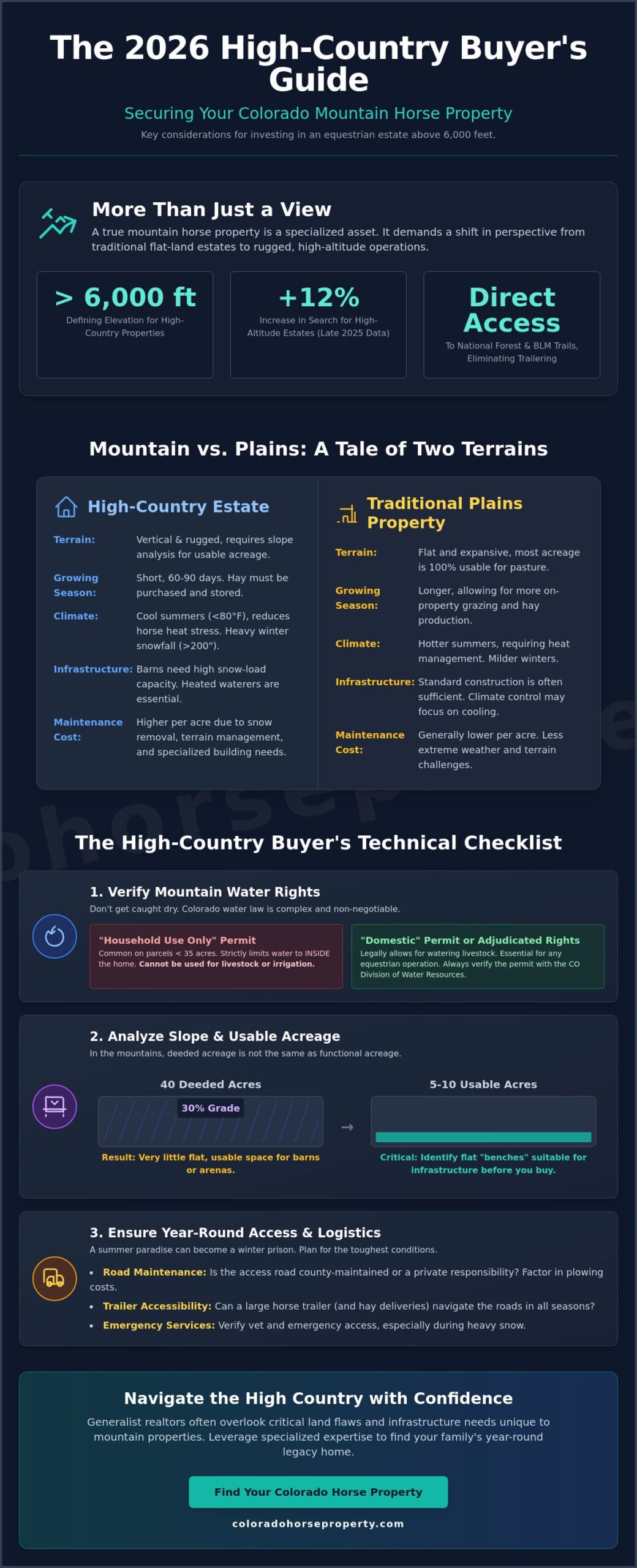
Mountain vs. Plains: Choosing Your Colorado Equestrian Terrain
Deciding between a mountain ranch and a plains estate isn’t just about the view; it’s about your daily workload. In the High Country, you’ll spend significant time clearing snow and managing forest health to mitigate wildfire risks. On the plains, your focus shifts to water rights and maintaining complex irrigation schedules for hay production. If you’re researching colorado ranches for sale on the Front Range, you’ll find that prices per acre are generally lower than in prime mountain corridors like Aspen or Steamboat Springs. High Country land carries a premium because private ownership is limited. In some mountain counties, less than 25% of the land is privately held.
Accessibility changes everything for the horse owner. A mountain horse property for sale Colorado might sit on a seasonal dirt road that requires a private plow or a tracked vehicle from December through March. If you plan to haul horses year-round, these logistics are non-negotiable. Paved access is a luxury in the mountains that adds 15% to 20% to the property value, whereas it’s standard for most plains estates.
For the Trail Rider: High Country Ranches
For riders who value solitude, proximity to trailheads is the primary value driver. We prioritize properties that offer direct borders with National Forest or BLM land. Some of the most coveted 2026 listings are “land-locked” parcels. These are private properties that border public land which is otherwise inaccessible to the general public. This effectively expands your riding territory by thousands of acres without the tax burden. The 2026 market shows a 12% increase in demand for off-grid mountain setups where solar arrays and high-output wells support a self-sufficient lifestyle.
For the Competitor: Foothills and Front Range
If your weekends involve hauling to shows, the foothills offer a strategic advantage. Properties near Parker or Castle Rock provide quick access to the Colorado Horse Park and major regional circuits. Transporting a heavy horse trailer is much safer on the paved, level roads of the Front Range than on steep, winding mountain passes. You’ll also find a higher density of specialized equine surgeons and certified farriers within a 30-mile radius of these urban hubs. This proximity reduces emergency call-out fees and ensures your performance horse has consistent, professional care. Finding a mountain horse property for sale Colorado that offers this level of veterinary access usually means looking specifically at the I-70 or Highway 82 corridors.
The 2026 High-Country Buyer’s Checklist
Buying a mountain horse property for sale Colorado requires a different strategy than purchasing a flatland ranch. You aren’t just buying a home; you’re acquiring a complex infrastructure that must remain functional at 8,000 feet. Use this five-step checklist to ensure your investment stands up to the high-country climate.
- Step 1: Road Maintenance Audit. Don’t assume the county plows every road. Verify if your access is a “school bus route” or privately maintained. If you’re hauling a 3-horse slant-load trailer, you need to know if the 10% grade is manageable after a 12-inch October snowfall.
- Step 2: Well and Water Permit Audit. A standard residential well test isn’t sufficient. You need a professional flow test aiming for at least 5 gallons per minute and a permit audit. Ensure the permit explicitly allows for “livestock watering” rather than just “household use only.”
- Step 3: Equine Zoning Verification. Colorado counties vary wildly in their “animal unit” allowances. While one county might allow four horses on 35 acres, another might permit only two. Verify the specific density limits for your exact parcel before signing.
- Step 4: Barn Winter-Readiness. Inspect the barn for R-19 insulation and frost-free hydrants. If the facility lacks heated automatic waterers, factor in the cost of a 2026 upgrade to avoid hauling buckets in sub-zero temperatures.
- Step 5: Specialized Title Review. Use equestrian real estate Colorado expertise to review the title commitment. You need to identify agricultural liens or grazing leases that could impact your ownership.
Zoning and Covenants
County zoning provides the legal framework, but HOA or LOA (Landowner Association) covenants often impose tighter restrictions. Colorado’s “Right to Farm” laws, specifically Colorado Revised Statutes § 35-3.5-101, offer some protection against nuisance suits, but they won’t override a signed HOA agreement that bans metal barns. Always check for prescriptive easements. These can allow neighbors or the public to ride horses or hike through your private pastures, which creates significant liability and privacy concerns.
Winter Infrastructure Essentials
High-altitude riding seasons are short without an indoor arena. For year-round training in the Rockies, a 60 by 120-foot indoor space is the gold standard. You also need a plan for the “spring thaw.” Mud management, using geotextile fabrics and crushed rock in high-traffic gates, prevents thrush and lost shoes. Fire mitigation is equally vital. Clear a 30-foot defensible space around all outbuildings. Removing gamble oak and low-hanging pine limbs can be the difference between a total loss and a saved barn during a wildfire event.
Ready to evaluate a potential ranch with a seasoned expert? Contact our team today to schedule a specialized property walkthrough.
Finding Your Legacy: Why Specialized Representation Matters
Buying a mountain horse property for sale Colorado involves technical complexities that a typical residential agent rarely encounters. A generalist might admire a property’s view, but they often miss the critical flaws that impact livestock safety and property value. Specialized representation means having an expert who examines the slope grade for potential arena sites, evaluates the snow-load capacity of existing outbuildings, and verifies that well permits specifically allow for equine use. Since 1985, Realty Oasis has focused on these high-altitude details to protect buyers from costly post-closing surprises.
The stakes are higher in the mountains. Soil composition, wind patterns, and wildfire mitigation zones dictate where you can build a barn or turn out your herd. Without an advocate who understands the Colorado Front Range and high-country terrain, you risk purchasing land that can’t support your equestrian goals. We provide the technical scrutiny needed to ensure your mountain legacy is built on a functional foundation.
AI-Powered Search for Niche Properties
Finding the right mountain horse property for sale Colorado shouldn’t feel like a full-time job. Our proprietary AI-driven search tool streamlines the process by analyzing aerial data and listing metadata to identify specific equestrian features. Instead of manually filtering through thousands of irrelevant homes, you can instantly isolate properties with existing barns, fenced pastures, or indoor arenas.
The tool allows you to filter by “Acres” and “Mountain Views” simultaneously, ensuring you don’t have to sacrifice your aesthetic dreams for functional land. You can save your specific “lifestyle and dreams” search criteria to receive instant 2026 market alerts the moment a matching property hits the system. This technology gives you a competitive edge in a market where the best acreage often sells before the general public even knows it’s available.
The Eibner Advantage: Expert Guidance
Mark and Alison Eibner are the trusted names in Colorado horse real estate because they live the lifestyle they sell. With nearly four decades of experience, they provide a comprehensive ecosystem of support that goes far beyond showing houses. Their team handles everything from complex water rights transfers to title coordination and escrow management. They understand that a ranch purchase is a major life transition, not just a transaction.
Their deep roots in the community mean they have access to off-market listings and historical data that general search engines miss. To see how current market trends are impacting property costs, you can review our horse real estate for sale valuation guide. When you’re ready to move from browsing to buying, we’re here to guide every step.
Secure Your High-Country Legacy in 2026
Finding the right mountain horse property for sale Colorado requires a strategy that goes beyond a simple scenic view. You must account for 2026 technical factors like high-altitude equine health and complex mountain water rights. These properties demand a specialized lens that recognizes the difference between a functional high-country ranch and a standard rural home. Mark and Alison Eibner provide this expertise, backed by nearly 40 years of specialized Colorado real estate experience. They focus on the critical details of barns, arenas, and zoning that generalist agents often overlook.
Our platform streamlines this process with exclusive AI search technology designed specifically for equestrian features. You can filter listings by precise needs like pasture quality or terrain slope. Don’t leave your rural lifestyle goals to chance; partner with experts who have spent four decades navigating the unique challenges of the Rocky Mountain landscape. It’s time to turn your vision of a high-altitude sanctuary into a reality.
Start your AI-powered mountain horse property search now
Frequently Asked Questions
How many acres do I need for a horse in the Colorado mountains?
You typically need at least 2 to 5 acres for your first horse, though 35 acres is the standard threshold for domestic well permits in many counties. Mountain forage is less dense than the plains, so relying on grazing alone often requires 15 acres per animal according to Colorado State University Extension. Always check specific zoning in counties like Gilpin or Teller, as they have strict animal unit densities.
Can I use a domestic well for my horses in Colorado?
You can use a domestic well to water horses if your property is 35 acres or larger or has a specific court-decreed water right. The Colorado Division of Water Resources issues domestic well permits that allow for the watering of non-commercial livestock. If you’re looking at a mountain horse property for sale Colorado on a smaller lot, you’ll likely be restricted to an “in-house use only” permit, which prohibits outdoor animal watering.
What is the best mountain town in Colorado for horse owners?
Steamboat Springs and Pagosa Springs are the premier choices for mountain horse owners due to their extensive trail systems and proximity to national forests. Steamboat Springs offers access to over 1,500 miles of public trails within Routt County. Pagosa Springs provides direct entry into the 499,771-acre Weminuche Wilderness, making it ideal for riders seeking high-altitude backcountry experiences and reliable summer grazing.
Are there specific horse breeds better suited for high-altitude Colorado living?
Quarter Horses and Mustangs are the most resilient breeds for Colorado’s thin air and rugged terrain. These breeds typically have the lung capacity and sturdy hooves required for elevations exceeding 8,000 feet. It’s vital to monitor any horse for High Mountain Disease, a condition affecting the heart and lungs, which occurs in roughly 2 percent of cattle but can impact horses relocated from sea level too quickly.
How do I manage horse pasture on a mountain slope?
You must implement rotational grazing and maintain at least 4 inches of grass height to prevent soil erosion on slopes. Mountain soils are thin; a slope exceeding 15 percent can quickly lose its topsoil if overgrazed. Installing cross-fencing allows you to move horses between paddocks every 14 days, which protects the root systems and ensures the long-term health of your high-country forage.
What should I look for in a mountain horse barn for winter?
A mountain barn must have a roof rated for at least 40 pounds per square foot of snow load and insulated water lines buried 4 feet deep. While it’s tempting to seal a barn against the cold, you need constant airflow to prevent ammonia buildup. Proper ventilation is essential when temperatures drop to -20 degrees Fahrenheit, as trapped moisture leads to respiratory infections like heaves in stabled horses.
Is it harder to get homeowners insurance for a mountain horse property?
Securing insurance is more complex due to high wildfire risk and the added liability of equine activities. Many traditional insurers have pulled out of Colorado’s high-risk zones, forcing some owners to use the Colorado FAIR Plan as a last resort. When evaluating a mountain horse property for sale Colorado, ensure the home has a defensible space of 100 feet and a Class A fire-rated roof to improve your coverage options.
How does the “Right to Farm” act affect mountain properties?
The Colorado Right to Farm Act (CRS 35-3.5-101) protects established agricultural operations from nuisance lawsuits filed by new neighbors regarding odors or noise. This law is vital in mountain communities where residential growth encroaches on traditional ranching land. It ensures that if your horse property was there first, or has been operating for over one year, you’re legally shielded from complaints about typical ranching activities.