
Last July, a dedicated equestrian searching for ranches for sale near Boulder Colorado discovered that a stunning 40-acre listing lacked the senior water rights necessary to sustain a small herd through a dry summer. It’s a common hurdle in a market where a beautiful mountain view often masks complex legal realities. You likely already understand that securing a piece of the Front Range is about more than just finding a barn. It requires managing some of the strictest land-use regulations in the United States, especially since Boulder County now protects over 100,000 acres of open space, making large contiguous parcels increasingly rare.
We’ve spent nearly four decades helping buyers turn their rural lifestyle dreams into reality by focusing on the technical details that others overlook. This 2026 buyer’s guide provides the expert insights you need to secure a legacy property while ensuring your water rights and luxury equine facilities are fully protected under local law. We’ll examine the current zoning restrictions, essential water law requirements, and the top equestrian features that define the modern Colorado ranch.
Key Takeaways
- Learn how to distinguish between hobby farms and working estates when searching for ranches for sale near Boulder Colorado to ensure your investment matches your lifestyle goals.
- Master the complexities of the Boulder County Land Use Code and understand why senior water rights remain the non-negotiable gold standard for Colorado land.
- Compare price per acre and regulatory climates across Boulder, Weld, and Larimer counties to determine which location offers the best balance of value and agricultural freedom.
- Identify the essential infrastructure for luxury equestrian properties, including the critical differences in professional arena footing and modern barn architecture.
- Discover how to leverage proprietary AI-powered search tools and decades of specialized expertise to find specific ranch features that general real estate platforms often overlook.
Understanding the Boulder Ranch Real Estate Market in 2026
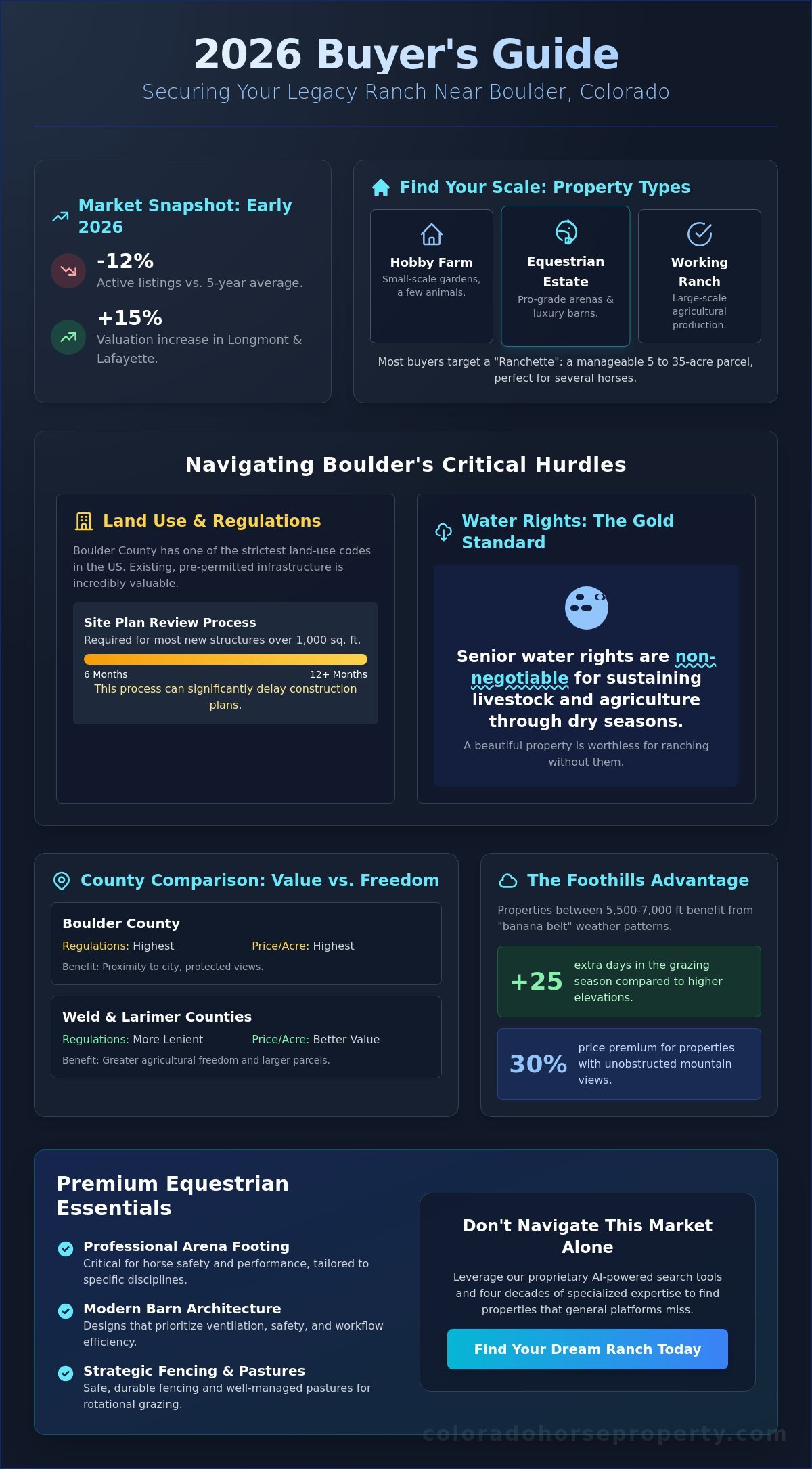
The search for ranches for sale near Boulder Colorado has reached a fever pitch entering 2026. Buyers aren’t just looking for land; they’re looking for a specific standard of living that combines rugged independence with high-end convenience. In Boulder County, Colorado, the market distinguishes itself through three primary property types. Hobby farms cater to those wanting small-scale gardens or a few goats. Equestrian estates focus on professional-grade arenas and barns. Working ranches, though rarer, maintain the county’s agricultural heritage through large-scale production.
Inventory levels in early 2026 remain at historic lows, with active listings down 12% compared to the previous five-year average. This scarcity drives demand for lifestyle properties where the home is as sophisticated as the outbuildings. As prime Boulder acreage becomes harder to secure, buyers are looking east. Ranches near Longmont and Lafayette have seen a 15% valuation increase over the last 18 months because they offer more level ground and better water rights while staying within a 20-minute drive of downtown Boulder.
To better understand the layout and potential of these properties, watch this video of a premiere local listing:
The Appeal of the Boulder County Foothills
The foothills offer unique micro-climates that directly affect land utility. Properties situated between 5,500 and 7,000 feet often benefit from “banana belt” weather patterns; these can extend the grazing season by up to 25 days compared to higher elevations. These locations provide the unobstructed mountain views that command a 20% to 30% premium over properties with obscured sightlines. You get the privacy of the wilderness without sacrificing proximity to world-class dining and tech hubs.
Ranches vs. Ranchettes: Finding Your Scale
Most buyers in this region target the “ranchette,” typically defined as a 5 to 35-acre parcel. These smaller plots are manageable for individual owners but large enough for several horses. If you need more space, 100+ acre parcels still exist in the northern and western reaches of the county, though they rarely hit the open market. Balancing agricultural tax status is vital here. Properties over 35 acres often qualify for significant tax breaks if they’re used for hay production or grazing. This makes the search for ranches for sale near Boulder Colorado a matter of both lifestyle and financial strategy. We’ve helped clients navigate these zoning complexities for nearly four decades.
Navigating Boulder County Land Use and Water Rights
Buying ranches for sale near Boulder Colorado requires more than just a down payment. You’re buying into one of the most regulated land-use environments in the United States. The Boulder County Land Use Code acts as the primary hurdle for any buyer looking to expand or modify a property. It dictates everything from the exterior color of your barn to the maximum height of a hay shed. If you want to build a secondary structure over 1,000 square feet, you’ll likely face a Site Plan Review process. This administrative hurdle can last six to twelve months and requires architectural and environmental impact studies.
The Comprehensive Housing Market Analysis shows how these strict supply constraints and land use regulations continue to drive property values in the region. This scarcity makes existing infrastructure, such as pre-permitted barns or legacy outbuildings, incredibly valuable. Many premier properties also border Boulder County Open Space and Mountain Parks (OSMP). While this guarantees your view won’t be blocked by a future subdivision, it means you have a government neighbor with specific boundary expectations. Conservation easements are common here too. They offer significant tax benefits but often “extinguish” development rights, meaning you can’t subdivide the parcel in the future.
Zoning for Horses and Livestock
Boulder County uses an “animal unit” system to prevent overgrazing and land degradation. Typically, you’re allowed two animal units for the first half-acre of available pasture, with additional acreage required for more livestock. Building an indoor arena is the hardest feature to achieve. Most zoning districts in unincorporated Boulder County require a Special Use permit for large equine facilities. This process involves public hearings and neighborhood input, making it much more difficult than building in city limits where rules are often even more restrictive regarding livestock counts.
Securing Water for Your Ranch
Water is a legal property right in Colorado, separate from the land itself. For irrigation, you need senior ditch rights. These are priorities established as far back as the 1860s. A Water Court decree is the only way to guarantee your right to divert water during a drought. If you’re looking at foothills properties, well production is critical. A domestic well permit might only allow for in-house use, while a “household use only” permit won’t let you water a single horse. Always verify the gallons per minute (GPM) during your due diligence. High-value transactions often require a formal water engineer’s report to confirm that the historical use matches the deeded rights. If you’re feeling overwhelmed by these regulations, our team can help you find ranches for sale near Boulder Colorado that already meet your specific zoning needs.
Boulder vs. Neighboring Counties: Where Should You Buy?
Boulder County offers unparalleled access to high-end dining and the local tech corridor, but land prices reflect that convenience. When looking for ranches for sale near Boulder Colorado, buyers often compare local inventory against Weld, Larimer, and Jefferson counties to maximize their investment. Boulder land prices frequently sit at a 40% to 60% premium compared to Weld County. This price gap stems from Boulder’s aggressive open space acquisition programs and proximity to global employers like Google and Apple. Property taxes also fluctuate significantly between these borders. Boulder’s mill levies support extensive public services; however, Weld County benefits from significant oil and gas tax revenue, which often keeps property tax burdens lower for agricultural landowners.
Commute times play a major role in the decision process. A ranch in southern Weld County allows for a 25-minute drive to Boulder’s downtown core, while properties in western Larimer County might require a 50-minute trek. Accessibility to specialized equine vets and high-quality hay suppliers is consistent across the region, but the regulatory climate varies. Boulder has some of the most stringent land-use codes in the state. If you plan to build a massive indoor arena or multiple outbuildings, you’ll face a more complex permitting process than you would just a few miles east or north.
Weld County: The Agricultural Alternative
Many horse owners focus their search on the Weld side of Erie and Longmont to find better value. Weld County is one of the top agricultural producers in the United States, and its “Right to Farm” policies protect traditional ranching activities from suburban encroachment. You’ll find larger parcels here, often 35 to 160 acres, with established cattle infrastructure and senior water rights. The trade-off is the scenery. While Boulder offers immediate foothills access, Weld County is characterized by flatter plains. It’s a functional choice for those who prioritize expansive pastures and lenient zoning over mountain views.
Larimer and Jefferson: The Mountain Ranch Experience
Larimer County ranches provide a different lifestyle, especially those near Fort Collins or bordering the Roosevelt National Forest. These properties offer high-country grazing and immediate access to thousands of acres of public trails. In contrast, Jefferson County caters to the luxury equestrian market near Golden and Arvada. You’ll find high-end estates with professional-grade barns and manicured paddocks. Jefferson County terrain is often rugged, providing a true mountain feel while remaining within 30 minutes of the Denver metro area. Buyers here trade flat, tillable acreage for privacy and dramatic topography.
Essential Features of a Premium Boulder Equestrian Property
Finding the right ranches for sale near Boulder Colorado requires a keen eye for infrastructure. A premium property isn’t just about the mountain views; it’s about how the land and structures support the horse’s health and the owner’s convenience. High-end buyers in 2026 look for a blend of historic Colorado aesthetics and advanced equine technology. This means timber-frame aesthetics paired with automated climate control and rubberized flooring systems that protect a horse’s joints.
The Modern Horse Barn
Boulder winters are harsh. Stalls need proper thermoregulation to handle 40-degree temperature swings in a single day. Modern barns now use passive solar design and insulated ventilation to keep air fresh without creating drafts. High-end properties include heated wash stalls and humidity-controlled tack rooms to preserve expensive leather gear. If you plan to house a trainer or caretaker, check the specific zoning. Boulder County currently allows Accessory Dwelling Units (ADUs) for agricultural workers, but these are often capped at 1,000 square feet or 40% of the primary dwelling’s size.
Fencing and Perimeter Security
Safety is the priority. Pipe fencing remains the gold standard for durability in the Front Range. Non-climb mesh is essential if you’re dealing with smaller livestock or want to keep out predators like mountain lions or coyotes. Boulder’s elk population, which often numbers over 3,000 in the North Foothills, can destroy light-duty fencing during migration. Use heavy-gauge materials to protect your investment and keep your horses contained.
A professional arena needs more than just dirt. Premium properties use silica sand or GGT footing to reduce impact on equine joints. Since Boulder receives only about 18 inches of annual precipitation, dust management is a major factor. Indoor arenas are highly coveted for year-round training, while outdoor arenas must have professional-grade drainage to handle the spring snowmelt.
- Pasture Management: The semi-arid climate makes rotational grazing a requirement. You’ll need at least two to four acres per horse to prevent overgrazing.
- Weed Control: Successful owners implement aggressive plans to manage invasive species like diffuse knapweed and Canada thistle.
- Trailer Logistics: A 40-foot gooseneck trailer needs a wide berth. Ensure the property has a turnaround radius of at least 50 feet and driveway widths of 12 feet.
- Winter Maintenance: Driveways with grades over 10% require specialized gravel or heating systems for winter traction.
If you’re ready to view these features in person, browse our current listings of ranches for sale near Boulder Colorado to find your ideal fit.
Finding Your Dream Ranch with AI-Powered Search
Locating the perfect ranches for sale near Boulder Colorado demands more than a standard real estate filter. Our proprietary AI search technology scans thousands of data points to identify properties with specific equestrian infrastructure. Whether you need a 12-stall barn with automated waterers or a 150-foot outdoor arena with specialized footing, our system isolates these features instantly. This technology reduces your search time significantly, letting you focus only on properties that meet your livestock and lifestyle requirements.
Buying a ranch involves layers of complexity that residential transactions don’t face. You need to verify senior water rights, evaluate soil drainage for pastures, and confirm that zoning allows for your intended number of head. We bring nearly four decades of experience to every negotiation. This deep history in the Colorado market ensures you don’t miss critical details during due diligence. Our team identifies potential red flags like restrictive conservation easements or outdated grazing leases before you ever sign a contract. Professional buyer representation isn’t just helpful; it’s a safeguard for your investment.
The Colorado Horse Property Advantage
We hyper-specialize in rural and equine real estate. We speak the language of barns, hay production, and irrigation pivots fluently. This expertise grants our clients access to off-market ranch listings through a professional network built over 38 years. We don’t just find the land; we manage the entire process. By integrating title, escrow, and transaction management, we ensure a seamless close on even the most complex agricultural holdings. You get a seasoned partner who understands that a ranch is both a home and a significant capital asset.
Start Your Search Today
Your journey toward owning a piece of the Front Range starts with the right data. Use our equestrian real estate Colorado search tools to filter by acreage, water features, and outbuildings. Once you’ve identified potential sites, consult with Mark and Alison Eibner. They provide a tailored acquisition strategy designed to secure your property in a competitive 2026 market. We’ll help you evaluate the long-term viability of the land and schedule private tours of the most promising ranches for sale near Boulder Colorado.
Ready to see these properties in person? Find your next Colorado Horse Property with AI and let us put our decades of experience to work for your lifestyle and dreams.
Secure Your Legacy in the Front Range
Finding the right acreage in 2026 requires more than a casual search. You must navigate the strict Boulder County Land Use Code and secure seniority in water rights to protect your long term investment. Whether you’re comparing Boulder County to the more flexible zoning in neighboring areas or seeking a turnkey equestrian estate, success depends on technical expertise. We’ve spent nearly 40 years mastering the nuances of the Front Range market to help buyers find premium properties. Our specialized AI technology now simplifies the process by filtering listings specifically for barns, indoor arenas, and deeded water rights. This data driven approach ensures you don’t waste time on properties that can’t support your specific goals. There are still incredible ranches for sale near Boulder Colorado that offer the space and freedom you’ve been searching for. Your dream of owning a piece of the Colorado landscape is within reach when you have the right tools and experience on your side.
Search Ranches for Sale Near Boulder with our AI Tool
Frequently Asked Questions
How many acres do I need for 2 horses in Boulder County?
You need a minimum of 2 acres to keep two horses according to the Boulder County Land Use Code. The county requires 2 acres for the first two horses, and every additional horse requires 1 more acre of land. When searching for ranches for sale near Boulder Colorado, it’s vital to check specific zoning. Some sub-areas have stricter density limits based on soil health and local grazing capacity.
Are water rights always included when buying a ranch near Boulder?
Water rights don’t always transfer automatically with a land sale in Colorado. You must verify if the rights are appurtenant to the property or if they’ve been severed and sold separately. Buyers should review the deed and well permit numbers with the Colorado Division of Water Resources. A residential well permit often limits use to indoor household chores, while an irrigation well is necessary for pastures.
What is the average price for a ranch with 10+ acres in Boulder?
Average prices for a 10-acre ranch in Boulder County typically exceed $2 million based on 2024 market trends. High demand and limited inventory keep these values elevated compared to neighboring counties. Properties with senior water rights or existing equine infrastructure command a premium. We use our decades of experience to help you find a property that fits your lifestyle and dreams within this competitive market.
Can I build a new indoor riding arena on my property in Boulder County?
You can build an indoor riding arena, but it requires a Site Plan Review if the structure exceeds 1,000 square feet. Boulder County regulations limit building heights to 30 feet in most agricultural zones. You’ll also need to account for setbacks from property lines and any existing wetlands. It’s a complex process that requires careful planning and coordination with the county’s building department.
Is Boulder County horse-friendly compared to Weld County?
Weld County is often considered more horse-friendly because it has fewer land-use restrictions and lower entry prices. While Boulder offers better trail access and proximity to urban centers, Weld County’s 2022 agricultural census shows it leads the state in livestock production. Boulder County requires more permits for infrastructure like barns or large-scale boarding operations. Your choice depends on whether you value trail access or operational flexibility.
What is a conservation easement and how does it affect ranch value?
A conservation easement is a permanent legal agreement that restricts development to protect agricultural or scenic value. This agreement often reduces the property’s market value by 30% to 50% because it limits future subdivision or building. While it lowers the resale price, it offers substantial federal tax credits and helps preserve the rural Colorado landscape. It’s a strategic tool for those prioritizing land preservation over development potential.
Do I need a specific type of insurance for a Colorado horse ranch?
A standard homeowners policy won’t cover a working ranch, so you’ll need a specialized farmowners policy. This coverage includes your home, barns, fencing, and specialized equipment like tractors. It also provides liability protection for equine-related injuries on your property. If you plan to board horses or host clinics, you’ll need additional commercial liability endorsements to protect your assets and your business.
How do property taxes work for agricultural-zoned land in Colorado?
Colorado taxes agricultural land based on its earning potential from grazing or crops rather than its market value. This classification often results in property taxes that are significantly lower than residential rates. To qualify for this status in Boulder County, you must prove the land has been used for primary agricultural purposes for at least two consecutive years. This tax benefit makes maintaining large ranches for sale near Boulder Colorado more affordable.