
Buying 40 acres might feel like the ultimate dream, but for most modern equestrians, the 20-acre parcel is the true “Goldilocks” zone where luxury meets manageable maintenance. Since 1983, we’ve helped clients realize that a 20 acre horse property for sale Colorado offers the perfect balance of space for a professional arena and enough pasture for sustainable grazing. You aren’t just buying dirt. You’re building a lifestyle that requires a specific set of geographical and legal boxes to be checked to ensure your investment remains secure for the next several decades.
You likely already know that a beautiful view doesn’t guarantee a functional ranch. It’s frustrating to find a perfect lot only to realize the topography won’t support a 100 by 200 foot outdoor arena or that the local zoning limits you to just two horses. We promise to help you avoid these costly mistakes by explaining exactly how to evaluate your potential land. This guide covers the 2026 essentials for buyers, including the nuances of Colorado water rights, county livestock counts, and the infrastructure required to turn raw land into a dream equestrian estate.
Key Takeaways
- Understand why 20 acres is the “sweet spot” for balancing sustainable rotational grazing with manageable property maintenance in Colorado’s semi-arid climate.
- Learn how to navigate complex water laws and well permit types when searching for a 20 acre horse property for sale Colorado to ensure your land legally supports your livestock.
- Discover the essential “Master Plan” for infrastructure, including how to site your home, barn, and a full-sized arena for optimal drainage and daily workflow.
- Identify the top-performing equestrian regions across the Front Range and Northern Colorado that offer the best long-term value for 20-acre parcels.
- See how specialized AI-powered search tools can help you instantly distinguish between “horse-allowed” and truly “horse-ready” properties to streamline your journey.
Why 20 Acres is the ‘Sweet Spot’ for Colorado Equestrian Real Estate
Finding a 20 acre horse property for sale Colorado offers a unique balance that smaller parcels simply can’t match. It represents the perfect middle ground between a high-maintenance commercial ranch and a restricted hobby farm. Owners get enough space for professional-grade infrastructure without the overwhelming management demands of triple-digit acreage. This size is large enough to feel like a private sanctuary but small enough that you won’t need a full-time ranch hand to keep up with the daily chores.
To visualize how this acreage looks in practice, watch this tour of a premier local listing:
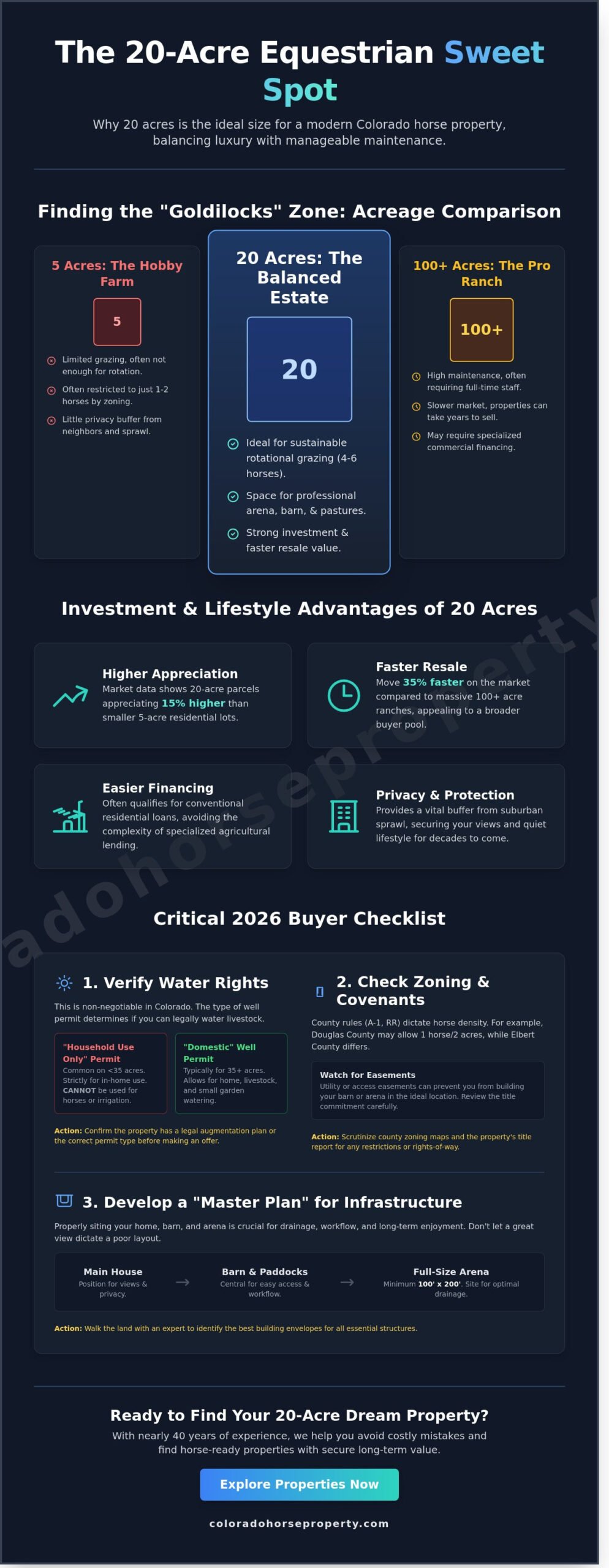
In the semi-arid climate of the Front Range, space equals sustainability. This acreage provides a vital buffer from suburban sprawl, ensuring your mountain views and quiet mornings remain protected as development expands into rural areas. Market data for 2026 indicates that 20-acre parcels are appreciating at a rate 15% higher than smaller five-acre residential lots. This trend is driven by buyers who prioritize long-term privacy and the ability to maintain a self-contained equestrian lifestyle.
The 20-Acre Grazing Advantage
Colorado’s native Blue Grama and Buffalo Grass are hardy, but they require careful management to prevent overgrazing. Most counties define an “animal unit” based on forage needs; 20 acres typically satisfies density requirements for 4 to 6 horses while allowing for effective rotational grazing. Integrating smart equestrian facility planning ensures you have enough room for cross-fencing, which prevents soil compaction and protects the land’s health. Carrying capacity on a 20-acre Colorado parcel is the specific number of horses the native forage can sustain throughout the year without requiring excessive supplemental hay or damaging the root systems.
Investment Value and Resale Potential
Selling a massive 100-acre ranch often takes years, but 20-acre estates usually move 35% faster on the open market. Lenders often view these properties as residential assets, making them easier to finance with conventional loans compared to large-scale agricultural tracts that require specialized commercial lending. It’s about finding a home that supports your lifestyle and dreams without becoming a financial burden. Our team brings nearly 40 years of experience to every transaction, helping you identify high-value land that offers both immediate utility and strong resale potential in a competitive market.
Zoning, Water Rights, and Legal Essentials for 20-Acre Parcels
Buying a 20 acre horse property for sale Colorado requires a sharp eye for legal details that larger ranches often bypass. In Colorado, the 35-acre mark is a significant legal threshold. When you purchase 35 acres or more, you’re generally entitled to a “Domestic” well permit. This permit covers household needs, fire protection, and the watering of domestic animals and livestock. However, on a 20-acre parcel, you often fall under “Household Use Only” restrictions unless the land is part of a specific augmentation plan.
Zoning classifications like A-1 (Agricultural), A-2, or Rural Residential (RR) dictate your daily operations. Each county applies these labels differently. For instance, Douglas County might allow one horse per two acres of usable pasture, while Elbert County may permit higher densities depending on the specific sub-zone. You’ll also need to verify easements. A utility company’s right-of-way or a neighbor’s access easement can split your 20 acres, making it difficult to build the barn or arena exactly where you want it. Always check the title commitment for any “ingress or egress” clauses that could impact your privacy.
Securing Your Water Future
The difference between a “Domestic” and “Household Use Only” well permit is critical for equine owners. If your well is restricted to household use, you cannot legally use that water for your horses or irrigation. You must confirm that the property has an augmentation plan in place. This legal agreement allows you to pump water for livestock by replacing that water elsewhere in the system. Always verify water rights through the Colorado Division of Water Resources before closing. You can find more details in our guide on Water Rights in Colorado: What Every Buyer Must Know.
Livestock and Land Use Restrictions
Don’t let a “horse friendly” description fool you. County rules on livestock density vary across the Front Range. El Paso County often uses a points-based system or specific acreage-to-animal ratios. Beyond county zoning, check for Covenants and HOAs. Even without a formal HOA, some 20-acre tracts have “Protective Covenants” filed with the deed that restrict the number of outbuildings or the types of animals allowed. Use this checklist when evaluating a 20 acre horse property for sale Colorado:
- Verify Animal Units: Confirm the specific number of horses allowed per acre by the county planning department.
- Check Setback Requirements: Ensure your planned barn or arena meets the minimum distance from property lines, which can be 50 feet or more in rural areas.
- Review Title Commitment: Look for hidden utility easements that could restrict your building footprint.
- Building Permits: Check if existing structures like loafing sheds or hay barns were permitted correctly to avoid future fines.
Understanding these legal layers ensures your dream property doesn’t become a regulatory headache. If you’re ready to start your search, you can view current horse property listings to see what’s available in your preferred county.
Maximizing Your 20 Acres: Infrastructure and Layout Planning
Designing a 20 acre horse property for sale Colorado requires a strategic approach to the “work-flow triangle.” You need to position the house, barn, and arena to minimize transit time while maximizing visibility. Proper siting isn’t just about aesthetics; it’s about survival in Colorado’s variable climate. Place your primary structures on the “high and dry” portions of the land. This natural elevation ensures that snowmelt and heavy spring rains drain away from your stalls and riding surfaces rather than pooling in high-traffic gates.
A 20-acre parcel offers the luxury of space that smaller lots lack. You have 871,200 square feet to work with, which easily accommodates a professional-grade 100×200 foot arena. Whether you choose an outdoor sand floor or a fully enclosed indoor structure, this footprint allows for full jumping courses or reining patterns. If you’re building an indoor arena, orient the building to shield your outdoor workspace from prevailing westerly winds. This layout choice can extend your riding season by 45 to 60 days each year.
Fencing choices on mid-sized acreage must balance security with budget. Pipe fencing is the gold standard for high-pressure areas like round pens and catch paddocks because it’s nearly indestructible. For the larger perimeters of your 20 acres, Centaur flexible rail or high-tensile coated wire provides a safer, more forgiving barrier than traditional wood or barbed wire. You’ll also need a dedicated manure management plan. A single horse produces roughly 50 pounds of waste daily. On a property of this size, you should designate a composting site at least 100 feet away from any domestic wells or natural water runoff points to maintain soil health and neighbor relations.
Barn and Stable Design for 20 Acres
When you evaluate a 20 acre horse property for sale Colorado, look closely at the existing barn’s orientation. Shed-row barns work well for Colorado’s milder days, offering excellent ventilation, but center-aisle barns provide essential protection for both horse and rider during blizzard conditions. If the property doesn’t have a barn yet, you’ll need to decide between Horse Barns for Sale: Buying vs. Building. Regardless of the structure, ensure you have power and frost-free hydrants installed. Running water lines at least 4 feet deep is a requirement to prevent freezing when temperatures drop below zero.
Pasture Management and Fencing
Maintaining 20 acres of healthy Colorado grass requires discipline. You must design a sacrifice lot, also known as a dry lot, where horses stay during the winter or mud season. This protects the root systems of your primary pastures from being trampled when the ground is soft. Cross-fencing is essential for 20-acre land health because it allows you to rotate grazing areas, preventing overgrazing and the encroachment of noxious weeds like cheatgrass or bindweed. Aim for sandy loam soils in your riding areas, as these provide the best natural drainage and stability for equine athletes.
Top Colorado Regions for 20-Acre Horse Properties
Finding the right 20 acre horse property for sale Colorado requires a deep understanding of the state’s diverse micro-climates and terrain. Your choice of location dictates everything from the type of hay you can grow to how many months a year you can use your outdoor arena. Colorado’s equestrian landscape is divided into distinct hubs, each offering a unique lifestyle for horse and rider.
Douglas and Elbert Counties: The Equestrian Heart
These two counties remain the premier choice for equestrian real estate Colorado. Parker, Franktown, and Elizabeth are popular because they sit at the center of the state’s horse culture. Owners here benefit from being within a 20 minute drive of the Colorado Horse Park, a venue that hosts over 40 weeks of world-class competitions every year.
Soil quality is a major factor in this region. In the High Plains of Elbert County, you’ll often find sandy loam. This is the ideal soil for horses because it drains quickly and provides a soft, forgiving surface for hooves. However, as you move toward the northern edges of Douglas County, the soil shifts toward heavy clay. Clay requires more careful management to prevent “greasy” footing during the spring thaw, making proper paddock grading a necessity for any 20 acre horse property for sale Colorado.
- Northern Colorado: Loveland and Berthoud have seen a 12% increase in equestrian development since 2020. These areas offer stunning views of the Longs Peak and easy access to the Larimer County Fairgrounds.
- Colorado Springs and Black Forest: This area is famous for 20-acre parcels covered in mature Ponderosa pines. These trees provide natural windbreaks and shade, which are vital for horses during the intense summer sun.
- The Western Slope: Near Grand Junction, the focus is on irrigation. Properties here often come with senior water rights, allowing for high-yield hay production even in arid conditions.
Emerging Markets and Value Finds
As prices rise along the Front Range, savvy buyers are looking further south. Pueblo and Canon City offer 20-acre tracts that are significantly more affordable than those in the Denver metro area. These regions are gaining traction for 2026 buyers who prioritize “off-grid” potential. With over 300 days of sunshine annually, these southern parcels are perfect for solar-powered barns and independent well systems.
Locating these opportunities isn’t always easy through traditional methods. We use AI-enhanced search tools to scan topography, zoning records, and water rights data. This technology helps us identify hidden gems that haven’t hit the mainstream market yet. Whether you want a property with specific grazing rotation potential or one with pre-existing cross-fencing, our data-driven approach saves you months of manual searching.
Ready to see what’s available in these prime locations? Search current 20-acre listings across Colorado today.
Finding Your 20-Acre Dream with AI-Powered Search
Generic search engines usually fail equestrian buyers because they can’t tell the difference between “horse-allowed” and “horse-ready.” A property might have the right zoning, but it lacks the actual infrastructure needed to house animals safely. Our AI technology solves this by automatically filtering listings for barns, arenas, and verified water rights. It looks for the specific data points that matter to you, so you don’t waste time visiting properties that are just empty dirt lots with no utility.
Finding a quality 20 acre horse property for sale Colorado involves navigating complex land use regulations. Our team brings nearly four decades of local expertise to every transaction. We handle the heavy lifting of transaction management, ensuring that escrow services and title searches account for the unique aspects of rural land sales. This includes verifying well permits and ensuring that the property’s water rights are fully transferable at closing. We focus on the technical details so you can focus on the land.
Leveraging Proprietary Search Tools
Efficiency is key when searching for larger parcels. Our Search by Acres tool is the fastest way to isolate 20-acre parcels from the noise of smaller residential listings. You won’t have to manually sort through 5-acre lots to find the space you need. You can also set up automated alerts for specific zip codes. This ensures that you’re the first to know when a new 20 acre horse property for sale Colorado becomes available in your target area. Use our AI search tool today to streamline your hunt for the perfect ranch.
The Expert Representation Advantage
Mark and Alison Eibner provide a no-nonsense, expert approach that generalist realtors simply can’t match. As fellow horse people, they understand the practical needs of an equestrian lifestyle. They know how to evaluate a property’s drainage, the safety of its fencing, and the functionality of its outbuildings. This specialized knowledge protects your investment and ensures the property fits your specific lifestyle and dreams. Don’t settle for an agent who doesn’t know a tack room from a tool shed. Schedule a consultation to find your 20-acre Colorado horse property and work with a team that speaks your language.
Secure Your Colorado Equestrian Legacy
Finding the right 20 acre horse property for sale Colorado is about more than just acreage; it’s about securing your lifestyle and dreams. We’ve explored why 20 acres remains the strategic choice for 2026, providing the necessary space for professional-grade arenas and rotational grazing without the overwhelming maintenance of larger tracts. Success in today’s market requires a deep dive into water rights and regional zoning laws, which can change drastically between different counties. Our team brings nearly 40 years of specialized Colorado real estate expertise to your search, ensuring you don’t overlook critical legal essentials or infrastructure needs.
We’ve streamlined the process by integrating proprietary AI search technology that identifies specific equine features like hay lofts or specialized fencing in seconds. This precision allows you to focus on properties that actually meet your operational requirements. Whether you’re looking for a private retreat or a functional boarding facility, our data-driven approach removes the guesswork from land acquisition. It’s time to stop searching and start planning your move to the Front Range or the Western Slope.
Find your 20-acre Colorado horse property with our AI-powered search. Your future under the wide Colorado sky is closer than you think.
Frequently Asked Questions
Can I have a domestic well on a 20-acre property in Colorado?
Yes, you can typically obtain a domestic well permit for a 20-acre parcel through the Colorado Division of Water Resources. These permits generally allow for in-house use, fire protection, and the watering of non-commercial domestic animals and livestock. It’s important to verify the specific permit type, as some older parcels might have restrictive “household use only” permits that forbid outdoor watering.
How many horses can I keep on 20 acres in Douglas County?
Douglas County zoning regulations generally allow for one horse per 35,000 square feet of dedicated pasture area. On a 20-acre property, this calculation permits roughly 24 horses, provided the land isn’t covered by structures or driveways. You’ll need to check your specific zoning district and any private HOA covenants, as these often set stricter limits than the county’s baseline requirements.
Is 20 acres enough land to be considered a ‘farm’ for tax purposes in Colorado?
Yes, 20 acres is sufficient for agricultural classification if you use the land for the primary purpose of obtaining a monetary profit. The Colorado Department of Property Taxation requires proof of agricultural activity, such as breeding horses or producing hay, for the previous two years. Meeting these requirements can lower your property taxes by 50% or more compared to residential rates.
What is the average price for a 20-acre horse property in the Front Range in 2026?
Market forecasts from the Colorado Association of Realtors suggest a 20 acre horse property for sale Colorado will average between $1.2 million and $2.5 million in 2026. Prices vary based on proximity to major hubs like Denver or Fort Collins and the quality of existing equestrian infrastructure. Properties with senior water rights or luxury indoor arenas consistently command prices at the higher end of this projected range.
Do I need water rights to water my horses on a 20-acre parcel?
You don’t usually need separate adjudicated water rights to water your own horses if your well permit includes livestock watering. The Colorado Division of Water Resources issues these domestic permits for parcels between 10 and 35 acres that aren’t served by city water. However, if you plan to irrigate more than one acre of pasture, you’ll likely need to purchase additional water shares or rights.
What should I look for in a 20-acre property’s topography for an arena?
Look for a building site with a natural slope between 1% and 2% to facilitate proper water runoff without causing significant erosion. A site that’s too flat will lead to standing water and mud, while a grade over 4% requires expensive excavation and retaining walls. Avoid areas with heavy clay soils, as they expand when wet and can shift your arena’s base over time.
How does the ’35-acre rule’ affect my ability to subdivide a 20-acre property?
Senate Bill 35, passed in 1972, prohibits subdividing land into parcels smaller than 35 acres without a rigorous county review process. Since your property is already under this threshold, you can’t split it further without full platting approval from county commissioners. This process often takes 12 to 18 months and requires you to prove you have a 100-year supply of water for any new lots.
Are there specific insurance requirements for a 20-acre equestrian estate?
You’ll need a specialized farm and ranch policy because standard homeowners insurance doesn’t cover agricultural outbuildings or commercial equine activities. If you board horses for others, most carriers require a “Care, Custody, or Control” endorsement to protect you against liability for animal injuries. This coverage is essential for any 20 acre horse property for sale Colorado where you plan to run a business or host events.