
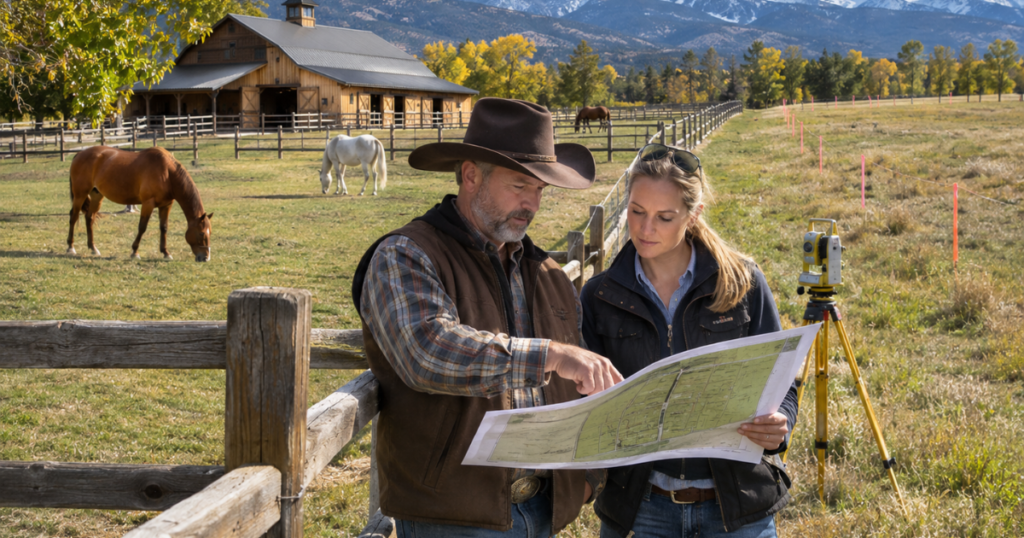
Plenty of horse owners buy more land than they need, figuring they can sell off a piece later to pay down the mortgage, fund a new barn, or give a lot to one of their kids. Sometimes that goes smoothly. Sometimes the county, the well permit, or the covenants say no.
The short answer: In Colorado, you can often split a horse property and sell part of it, but how easily depends on parcel size. Under state law, dividing land so that every parcel is 35 acres or more generally falls outside county subdivision rules. Creating any parcel smaller than 35 acres usually needs county approval, plus a legal water supply, access, and a septic site for the new lot.
Below, we walk through the 35-acre rule, the county approval paths, the water and septic questions that make or break a split, the tax side of selling land, and how splitting changes the horse property you keep.
Can You Subdivide a Horse Property and Sell Part of It Later?
Quick Summary: Splitting a Horse Property at a Glance
- 35 acres is the key number: Colorado's county subdivision statute excludes divisions where every parcel is 35 acres or more, though counties can still set minimum lot sizes for building a home.
- Water often decides the outcome: CSU Extension notes that a domestic and livestock well is usually allowed on parcels of 35 acres or more, one per parcel, while most post-1972 wells on smaller parcels are household-use only. A new lot under 35 acres may not be able to water horses.
- Some counties require more proof of water: El Paso County requires new development relying on Denver Basin groundwater to show a 300-year supply, three times the state's 100-year standard.
- Selling land but keeping the house is usually taxable: IRS rules let you exclude gain on adjacent vacant land only if you also sell the home within two years before or after the land sale.
Ways to Divide Land in Colorado
The path depends mostly on the size of the parcels you want to create and on your county's rules. Names and thresholds vary from county to county.
| Path | When It Applies | What's Involved |
|---|---|---|
| 35-acre division | Every resulting parcel is 35 acres or more | No county subdivision review in most cases; survey, deeds, and legal access still needed, and zoning still applies |
| Subdivision exemption or minor land division | A small split creating one or a few parcels under 35 acres, where the county allows it | County application, referrals to state and local agencies, water and septic review, recorded plat |
| Cluster or rural land use process | Larger tracts where homes are grouped on smaller lots and the rest stays open | County plan and hearings; remaining land is restricted from further development |
| Full subdivision | Several lots under 35 acres | Sketch plan, preliminary plat, and final plat; water supply plan; engineering; public hearings |
| Boundary line adjustment | Moving a line between existing parcels without creating a new one | Often a simpler county process; check effects on well permits and zoning |
1. Can You Legally Split a Horse Property in Colorado?
Usually, yes, but the rules depend on the size of the parcels you create. If every resulting parcel is 35 acres or more, Colorado law generally treats the split as outside county subdivision review. If any parcel is smaller than 35 acres, you'll need county approval.
The 35-Acre Rule
Under C.R.S. 30-28-101(10)(b), the terms "subdivision" and "subdivided land" don't apply to a division that creates parcels of 35 acres or more each. Moffat County gives a simple example: a 350-acre tract can be split into ten 35-acre parcels without going through its subdivision regulations, but splitting it into seventy 5-acre lots would.
What the Rule Doesn't Cover
The 35-acre rule only exempts land from subdivision review. A Colorado land use treatise notes that counties can still regulate those parcels in other ways, and some require a minimum lot size larger than 35 acres before a home can be built. Zoning, building permits, driveway access, and septic rules still apply.
The Rule Could Change
Some counties want the exemption tightened. For the 2026 legislative session, Huerfano County proposed eliminating it or raising the threshold to a size usable for grazing. If a future split is part of your plan, check the current law before you buy.
2. What County Approval Do You Need?
To create a parcel smaller than 35 acres, you'll go through one of your county's land division processes. Most counties offer a simpler exemption or minor division for one or two new lots, a cluster option for larger tracts, and a full subdivision process for several lots. Each one takes time, fees, and outside reviews.
Subdivision Exemptions and Minor Divisions
Colorado lets counties exempt certain small divisions from full subdivision review. In Moffat County, for example, an owner can apply for an exemption to split off a parcel smaller than 35 acres, with a 5-acre minimum for a home. Some counties limit repeat use: Saguache County generally won't allow a parcel created by an exemption to be divided again by exemption.
Cluster and Rural Land Use Options
Some counties reward owners who keep most of the land open. In its land division options guide, Larimer County describes its Rural Land Use Process as a voluntary alternative to 35-acre development that requires at least 70 acres, allows no more than one home per 17.5 acres, and protects the remaining land for agriculture or open space. Douglas County's subdivision regulations include a clustered 35-acre option, where lots are smaller than 35 acres but overall density stays at one home per 35 acres.
Full Subdivision
Creating several smaller lots usually means a full subdivision. Larimer County's process moves through a sketch plan, a preliminary plat, and a final plat, with referrals to agencies and neighbors along the way.
Plan for Time and Fees
Expect application fees, survey and engineering costs, and outside reviews. Moffat County, for instance, notes that a Colorado Geological Survey review is required for divisions there, with a fee of $485 for parcels under 20 acres and $585 for larger ones. Start with a pre-application meeting with your county planning department.
3. What Happens to Your Water When You Split?
Water is often the deciding factor. Every new lot needs a legal water supply, and the type of well a parcel can get depends heavily on its size. Splitting below 35 acres can leave the new lot, and sometimes the one you keep, unable to water horses.
Well Permits and Parcel Size
CSU Extension's guide to Colorado well permits explains that owners of 35 acres or more can usually get a domestic and livestock well, limited to one per parcel. That well can serve up to three homes, water up to an acre of lawn and garden, and water livestock. Most wells drilled on or after May 8, 1972 on parcels under 35 acres are permitted for household use only, with no outside use at all.
So if you split a 40-acre horse property into 30 and 10 acres, neither parcel meets the 35-acre threshold. Before you plan the lines, ask the Colorado Division of Water Resources how the split would affect your existing well permit and what kind of well, if any, each new parcel could get.
The State Reviews Water for Land Divisions
The Colorado Division of Water Resources reviews water supply proposals that county staff send it for subdivisions and other land use permits. It also notes that it can't confirm a well permit will be issued for a parcel without a full evaluation under state law.
Denver Basin Counties Ask for More
Where new lots rely on Denver Basin groundwater, counties may set a higher bar than the state. El Paso County requires new development in unincorporated areas to show a reliable water supply for 300 years, three times the state's 100-year requirement.
Ditch Shares and Water Rights
If the property has ditch shares or decreed water rights, decide in writing how they'll be divided, if at all. The ditch company may need to approve the transfer, and the deeds must convey the shares clearly. Keeping the irrigation water with the parcel that has the pasture usually protects the most value.
4. Does the New Lot Have Access, Septic, and Utilities?
A buyer won't pay much for a lot they can't reach, build a septic system on, or bring power to. Before you split, confirm the new parcel has legal access, a workable septic site, and a realistic way to connect utilities.
Legal Access
The new lot needs legal access to a public road, either by frontage or a recorded easement. If the only way in crosses the land you keep, you'll grant an easement through your property, which affects your privacy and your horses' turnout. Driveways onto county roads usually need a county access permit, and fire departments may set width and turnaround standards.
Septic
Colorado sets statewide septic standards under Regulation 43, and counties issue the permits. The new lot needs soil that can handle a septic system, plus room for the required setbacks from wells, property lines, and water. A soils test before you finalize the lot lines can save you from drawing a lot that can't pass.
Utilities
Find out where the nearest power line is and what the utility will charge to extend service. On rural land, a long extension can cost more than buyers expect and make the lot harder to sell.
Survey and Plat
A licensed surveyor will map the new lot lines, easements, and any improvements near them. Keep barns, arenas, wells, and septic fields well inside the lines you keep, so you don't create setback problems on either parcel.
5. Can Covenants, Easements, or Your Lender Stop a Split?
Yes. Even when the county would approve a split, private restrictions on the land can block it. Review the title documents before you count on selling part of the property.
Covenants and HOAs
Many rural subdivisions have recorded covenants that prohibit further division of lots or set a minimum lot size. Some also require HOA approval for new homes or outbuildings. Your title commitment lists the recorded documents; read them, not just the summary.
Conservation Easements
A conservation easement is a permanent agreement that limits development on the land, often in exchange for tax benefits to a past owner. Most easements sharply restrict or prohibit subdivision. If the property has one, read it closely before you buy with a split in mind.
Earlier Land Divisions
If the parcel was itself created through a county exemption or a cluster plan, the county may not allow it to be divided again, or the remaining land may be restricted as open space. Ask the planning department for the history of the parcel.
Your Lender
If you have a mortgage, the loan is secured by the whole property. To sell part of it, you'll need the lender to agree to release that part from the loan, and the lender may require a payment toward the balance or a new appraisal of what remains. Ask early, because the process can take weeks.
6. How Is the Sale of Part of Your Land Taxed?
If you sell part of your land and keep your home, the gain on that land is generally taxable. The home-sale exclusion usually covers adjacent land only when you sell the house too, within a two-year window. Talk to a CPA before you split, because the timing and the way you allocate your purchase price both matter.
The Home-Sale Exclusion and Vacant Land
Under IRS regulations, the sale of vacant land counts as part of selling your principal residence only if the land is adjacent to the home, you owned and used it as part of the residence, and you sell the home within two years before or after the land sale. The land and the home then share one exclusion limit.
In practice, that means selling off a back pasture while you stay in the house is usually a taxable sale. If you plan to sell the house within two years anyway, the timing may let you include the land.
Your Cost Basis
To figure the gain, you'll need to allocate part of what you originally paid for the property, plus qualifying improvements, to the land you sell. Keep your closing statements and records of improvements such as fencing, wells, and roads.
Property Taxes Going Forward
Once the split is recorded, the county assessor values each parcel separately. If the land was classified as agricultural because someone grazed cattle on it, a new residential lot may lose that status. Keeping pleasure horses doesn't qualify land for agricultural classification in Colorado, as we explain in What Hidden Costs Come With Owning a Horse Property?
7. How Does Splitting Affect the Property You Keep?
Selling part of your land brings in cash, but it also leaves you with a smaller horse property, a new neighbor, and possibly a different water situation. Draw the lines so the parcel you keep still works well for horses and holds its value.
Fewer Acres, Fewer Horses
Less land means less pasture and less room for turnout, and county zoning often ties the number of animals allowed to lot size. Check how many horses the remaining parcel can legally keep before you commit to a split.
Water and Pasture
If the parcel you keep drops below 35 acres, confirm with the Division of Water Resources what your existing well permit allows afterward. Keep the irrigated pasture, ditch access, and the best-drained ground on your side of the line.
Privacy and Use
A new home next door changes the feel of a horse property. Think about sightlines, noise, shared driveways, and where the new owner's dogs and kids will be relative to your paddocks. A buffer of pasture between the barn and the new lot line helps.
Value on Resale
Horse property buyers pay for usable acreage, water, and privacy, so a smaller parcel may sell to a narrower pool of buyers. On the other hand, money from a lot sale can pay for barn upgrades, fencing, or an arena that raise the value of what you keep. We cover what drives horse property value in Do Horse Properties Appreciate Like Regular Homes?
8. How Do You Plan a Split, Step by Step?
Start with the questions that can stop a split outright, such as covenants, water, and county rules, before you spend money on surveys and engineering. If you're still shopping, ask those same questions before you buy.
If You Already Own the Property
- Read your title commitment, covenants, and any easements for restrictions on dividing the land.
- Ask the county planning department for the parcel's history and request a pre-application meeting.
- Contact the Colorado Division of Water Resources about your existing well permit and what each new parcel could get.
- Have a surveyor sketch possible lot lines that keep your barn, arena, well, septic, and best pasture together.
- Order a soils test for a septic site on the new lot, and price power and driveway access.
- Talk to your lender about a partial release and to a CPA about the tax on the sale.
- Submit the county application and complete the referrals, hearings, and plat recording.
- List the new lot with disclosures about water, access, and any shared easements.
If You're Buying With a Future Split in Mind
Ask these questions before you make an offer:
- Is the parcel large enough to split into 35-acre pieces, or will any future lot need county approval?
- What does county zoning allow for minimum lot size and the number of horses per parcel?
- What water rights and well permits come with the land, and how would a split affect them?
- Are there covenants, a conservation easement, or a prior land division that limits further splits?
- Is there a realistic location for a second driveway, septic system, and home site?
We Help You Plan the Split Before You Buy
Whether a horse property can be split later is a question worth answering before you sign a contract, not years afterward. The parcel size, the water, and the title documents decide most of it.
When Mark Eibner's team works with you, we look at each property's acreage against the 35-acre rule and county zoning, pull the well permits and water rights, and flag covenants or easements that could block a future split. If you already own land you want to divide, we can help you think through where the lines should go and what the new lot is likely to be worth.
Contact us today at coloradohorseproperty.com to find premium horse properties Colorado buyers trust.
Browse active Colorado horse ranches for sale or search by location with our Search by County and Search by City tools.
About the Author
Mark Eibner is broker/owner of Realty Oasis and leads Team Eibner with MB Metro Brokers. His team represents buyers and sellers of horse and acreage property across the Denver metro and Colorado Front Range.
Frequently Asked Questions (FAQ) About Subdividing Horse Property
Can I split my horse property and sell part of it in Colorado?
Often, yes. If every resulting parcel is 35 acres or more, Colorado law generally keeps the split outside county subdivision review. If any parcel is smaller than 35 acres, you'll need county approval through an exemption, a cluster process, or a subdivision, and each new lot needs legal water, access, and a septic site.
What is the 35-acre rule in Colorado?
It's the part of Colorado's county planning statute, C.R.S. 30-28-101(10)(b), that excludes divisions creating parcels of 35 acres or more each from the definition of a subdivision. It doesn't exempt those parcels from zoning, building permits, or other county rules, and some counties require more than 35 acres to build a home.
Can a new lot under 35 acres have a well for horses?
Usually not with a standard exempt well. CSU Extension explains that most wells drilled on or after May 8, 1972 on parcels under 35 acres are permitted for household use only, which rules out watering livestock. A domestic and livestock well generally requires 35 acres or more. Ask the Division of Water Resources before you draw the lot lines.
How long does it take to subdivide land in Colorado?
It depends on the county and the process. A 35-acre division can move as fast as a survey and deeds. A county exemption or minor division often takes several months, and a full subdivision, with sketch plan, preliminary plat, and final plat, can take a year or more. A pre-application meeting with county planning gives the best estimate.
Do I pay taxes when I sell part of my land?
Usually, yes, if you keep your home. IRS rules let you treat adjacent vacant land as part of your principal residence only if you also sell the home within two years before or after the land sale. Otherwise, the gain on the land is generally taxable. Talk to a CPA about timing and how to allocate your cost basis.
Can covenants or a conservation easement prevent a split?
Yes. Recorded covenants can prohibit dividing lots or set a minimum lot size, and most conservation easements restrict or prohibit subdivision. Parcels created through an earlier county exemption may also be barred from being divided again. Review the title documents and the parcel's history before you plan on a split.
Sources
- Colorado Revised Statutes: Section 30-28-101
- Moffat County: Subdivision regulations
- Colorado land use treatise: County regulation of land divisions
- Huerfano County: 35-acre subdivision proposal
- Saguache County: Subdivision exemption application
- Larimer County: Land division options
- Douglas County: Clustered 35-acre subdivision regulations
- Larimer County: Land division process
- Moffat County: Property division information
- CSU Extension: Colorado well permits
- Colorado Division of Water Resources: Land divisions and water supply
- El Paso County: Water supply requirements
- Federal income tax regulations: Section 1.121-1